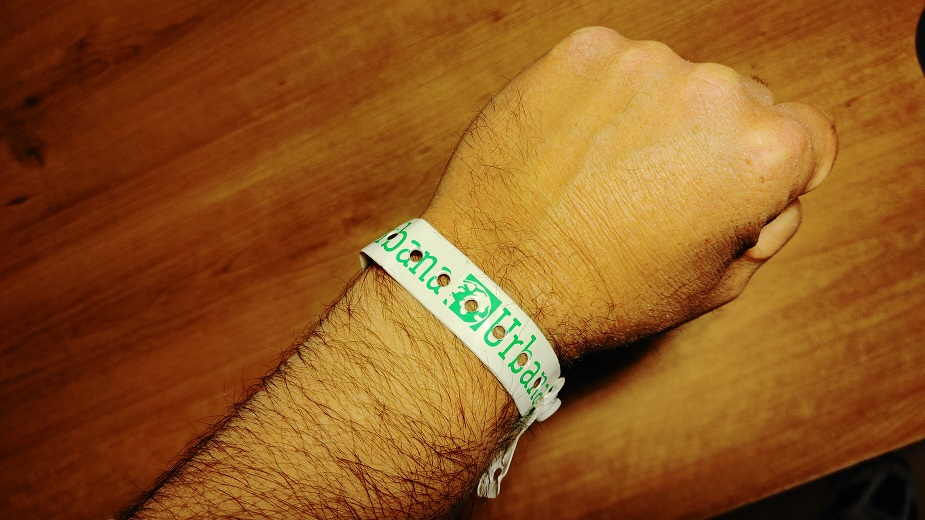
January 23-28, 1997. Time to start thinking about the future. (#116)

I walked into Kerry Hall and pressed the Up button for the elevator.  As I waited for the door to open, I noticed a flyer for the event I was going to on a bulletin board.  I walked over and read the flyer, even though I already knew the time and place of the event; we had discussed this upcoming event in detail at this month’s Math Club meeting.

MATHEMATICS CAREER FAIR
Presented by the University of Jeromeville Math Club
January 23 – 3-5pm – 450 Kerry

Kerry Hall, home to the offices of the mathematics and statistics departments, was easy to navigate; each of its six floors consisted of one straight hallway about two hundred feet long. Room 450 would be at the low-numbered end of the fourth floor.  The first digit of the room number was the floor, but for some reason the numbering on each floor started in the 50s at the end close to the elevators and ended in the 90s at the other end.  I wondered if this was because each floor of adjacent Wellington Hall only had room numbers ending between 01 and 30, so that way the two buildings would not repeat room numbers.  I also wondered if I was the only person on the Jeromeville campus who actually thought about such things.

I got off on the fourth floor and turned left, where I expected room 450 to be.  A sign next to an open door said 450 – GRADUATE STUDENT STUDY ROOM.  I did not know that this room existed, probably because I was not a graduate student.  On the other side of the door, a sign that said MATHEMATICS CAREER FAIR had been taped to the wall.  I cautiously walked inside.

I recognized several students I knew from Math Club.  Sarah Winters was picking up brochures from a table; she looked up and saw me in the doorway.  “Greg!” she said, waving.  Although Sarah was also a mathematics major, and one of my best friends, we had never had a math class together.  I knew her because she had lived downstairs from me in the dorm freshman year, and I also knew her from Jeromeville Christian Fellowship and from my church.

“Hey,” I said to Sarah.  “How are you?  What table is this?”

“School of Education,” she replied.  “I don’t know yet if I’m going to stay in Jeromeville for my teacher certification program.  I’m thinking I’ll probably move back home, but I may as well look into all the options.”

“Good idea.”

“Are you still not interested in being a teacher?”

“Probably not,” I replied.

“You’re still working as a tutor, right?  Why aren’t you interested in teaching if you like tutoring?”

“I like helping people learn math, but I don’t want to get involved in all the politics involved in public education.”

“Yeah, that’s one thing I’m not looking forward to.  What about private school?”

“Don’t private school teachers make less money?”

“Yeah, but if you really love what you do, money shouldn’t be an object.  Would you want to teach at a community college, or a university, or something like that?”

“If I stay in college forever, I’ll probably end up being a professor and having to teach.”

“That’s true.  Is that what you want to do?”

“I always kind of thought so, but I’m starting to realize I need to explore my options.”

“Well, you came to the right place.”  Sarah gestured across the room.  The UJ School of Education table where we were now was the first in a row of four manned exhibits.  At the far end of the room, the rest of the furniture that was usually in this room appeared to have been pushed to the side, to give fair attendees room to mingle.  I was not sure exactly how many exhibitors I expected at a career fair, but the answer was definitely more than four.  This was disappointing.

“I need to go,” Sarah said.  “Enjoy the rest of the fair!”

“Thanks,” I replied.  “I’ll see you around.”

After Sarah left, I walked to the next table.  “Are you interested in being an actuary?” a man in a business suit asked me from behind the table.

“I don’t know,” I replied.  “I’m kind of just gathering information right now.  I hear a lot about actuaries when people talk about math careers, but I’m not sure exactly what you do.”

“Basically, we predict the future,” he explained.  “We use mathematical modeling to make predictions, which are used by insurance companies to determine rates and risk assessment figures.”

“I see.”

“I represent the Casualty Actuarial Society.  We give the exams that actuaries have to pass.”

“Do you go to grad school to get a degree to be an actuary?”

“Usually not.  You get hired first for an entry-level position, and your job training includes prep for the exams.  Then you get promoted after you pass the exams.”

“I see,” I said.  “I’ll think about that.”  I took his brochure and put it in my backpack, although from his description, being an actuary sounded incredibly boring and unfulfilling.

I next went to the table for Sun Microsystems, a computer company big enough for me to have heard of it.  “Hi,” the woman at the table said.  “We’re looking for applied math majors with computer programming or computer engineering experience.  Is that you?”

“Not really,” I said.  “But can I have a brochure, in case I change my emphasis?”

“Sure!”

I took the Sun brochure and put it with the others.  I had chosen not to major in computer science, because I did not want a hobby to turn into work.  I also knew that most of my technology skills were vastly out of date.  I had grown up with only my childhood Commodore 64 until I got my current computer as a high school graduation present, years after the Commodore had been discontinued.  I had taken two computer science classes sophomore year and learned to code in Pascal and C.  Computer Science 110, Data Structures, counted in place of an upper-division mathematics class toward my major; I had registered for the class this quarter and got put on the wait list, but I did not get in.

The fourth and final table was for Graduate Studies in the UJ Department of Mathematics.  I took their brochure as well to learn about the different programs offered, although much of that information I already knew from the course catalog.  This career fair felt like a giant disappointment.

An older student named Brandon, whom I knew from Math Club, asked me as I was leaving, “So what did you think?”

“It was a little disappointing.  Nothing really stood out to me.  I still don’t know what I want to do.”

“Don’t forget, the Engineering Career Fair is coming up on Tuesday.  You should look at that one too, if you’re looking for what you can do with a math degree.”

At that moment, a familiar woman’s voice said from behind me, “Greg? I just overheard what you were saying; can I talk to you for a minute in my office?  I have something you might be interested in.”

“Dr. Thomas,” I said, turning around.  “I didn’t see you here.”  I had taken Combinatorics from Dr. Thomas sophomore year, and she was my favorite mathematics professor so far.  She explained things clearly, in non-broken English, and she made an effort to get to know students more than most of my professors had.  She also attended Math Club meetings sometimes.

“Sure,” I said.  I followed Dr. Thomas upstairs to her office on the far end of the fifth floor.

“Are you familiar with REU programs?  Research Experiences for Undergraduates?”

“No,” I said.

“The National Science Foundation has programs that you can apply to and do research in your field.   Some of them, you can get credits for, or you get paid a stipend.  I’m trying to start an REU here at Jeromeville, but there are programs like this at schools all around the country.”

“I see.”

“A colleague whom I’ve worked with runs the program at Williams College in Massachusetts.  And three are others much closer if you don’t want to travel that far.  It’s a good way to get a sense of what graduate school is like.  Being that you’re an excellent math student, wondering about your future, I think it would be good for you to apply to REUs.”

“Sure,” I said.  “What do I have to do?”

“Here’s the brochure from the NSF,” Dr. Thomas said, handing me a paper.  “They have a website with links to different schools’ programs, and you can find all the instructions on how to apply there.”

“I will look into that,” I said.  “Thank you.”

“You’re welcome.  And whatever happens, with how well you do in math, I know you’ll figure out what you want to do.”


The Engineering Career Fair was much larger than the Mathematics Career Fair; I expected it to be, since it was being held on the floor of the Pavilion, where the UJ Colts basketball teams played.  Engineering was also a much more popular major, and one more directly connected to industry.  A sea of tables, probably close to a hundred of them, covered the floor.  The region around San Tomas, Sunnyglen, and Willow Grove, a little over a hundred miles to the south, was a hub of technology companies; I expected that many of them had representatives here looking for people with computer experience.  Surely someone here would have a career option for pure mathematics majors.

I had not brought résumés to the career fair.  Next year, when I would be close to graduation, it would be more important to do so, but today was still mostly about gathering information.  Of course, if I found an internship for this summer that I wanted to apply to, I would still need to make a résumé and send it in.  We had discussed making résumés at this month’s Math Club meeting, and I mostly just felt frustrated and unaccomplished.  “I don’t know what to put on my résumé,” I said to Brandon at one point.  “I don’t have any work experience, or skills.”

“Sure you do,” Brandon replied.  “Just put what you can do.  On my résumé, I put ‘problem solver.’  Because when you give me a problem, I’ll solve it.”

“Hmm,” I said.  I was not a problem solver like Brandon.  I had tons of unsolved problems in my life, and padding my résumé with vague embellishments that I could not back up with action or experience would not help solve any of them.

I walked to the first table in the row closest to me.  A pile of mechanical pencils lay on one end of the table.  “May I have one?” I asked.

“Sure,” the woman behind the table said.  I read the pencil: NNC DATA SOLUTIONS, INC., SAN TOMAS.  “What’s your major?” she asked.

“Math.”

“Pure math?”

“Yeah.”

“We’re looking for computer science majors with experience in coding.  I don’t think we have any positions or internships for pure math.  Sorry!”

I continued up and down each row of tables, picking up lots of free pens, pencils, notepads, and foam balls to squeeze for stress relief purposes, each with companies’ names and contact information printed on them.  And I got the same story from each one of them: they were looking for computer science or engineering majors, not me.

At one point, I walked to a table I had not visited yet, for a company in Sunnyglen called West Coast Technologies.  I grabbed their free pencil and notepad.  “Do you have a résumé?” the woman behind the table asked.

“No,” I said.

“You need a résumé to apply for a job,” the woman replied, in a condescending tone.

“I’m just gathering information this year,” I explained, trying to hide my shame and frustration.

“What’s your major?”

“Math.”

“We’re looking for computer science majors.  But, hey, maybe ten years from now, when you’re wondering why you chose math for your major, you’ll go back to school for computer science, and we might have something for you!”  She made an amused chuckle.

I walked away without saying another word to the West Coast Technologies lady.  Who does she think she is?  How exactly does mocking an applicant to his face help your company recruit employees?  If I did go back to school in ten years, I thought, I certainly would not apply to work for West Coast Technologies.  Hopefully they would be out of business by then.

I continued past the next table.  I had only three tables left to visit, and I could tell from the names of the companies represented that they were looking specifically for engineers.  I turned toward the exit, not watching where I was going, and almost bumped into someone who was facing away from me.  As I looked up at this guy, who was about an inch taller than me, I realized that I recognized this tall guy with curly dark blond hair, and I became even more embarrassed.

“Sorry, Todd,” I said as he turned around.  “I wasn’t watching where I was going.”

“Hey, Greg,” Todd Chevallier replied.  “No problem.  What are you up to?”

“Looking to see if there are any options for math majors here.  There aren’t.”  I told him about the condescending lady from West Coast Technologies, as well as the unsuccessful Mathematics Career Fair from the previous week.

“Well, what do you want to do with your math degree?”

“I’m not sure.  I always assumed I would just stay in school forever and become a professor, but now I don’t know anymore.  And I’m starting to stress about it.”

“Have you thought about going into teaching? It seems like a lot of people with math degrees do that.”

“I don’t want to be a teacher,” I explained.  “I don’t want to deal with the politics involved in education.”

“Yeah, I get that.  Don’t stress, though.  You have time to figure things out.  You’re only a sophomore.”

“I’m a junior.”

“What?” Todd exclaimed, with a puzzled look on his face.

“I’m a junior.”

“But I thought you and I were both new at JCF last year.  Freshman year.”

We were.  But it was my sophomore year.  I didn’t go to JCF freshman year.”

“Really.  Wow.  It’s weird that I never knew that.  I guess you do need to start thinking about your future.”

“I know.”

“Good luck.  Pray about it.  I’ll see you Friday?”

“Yeah.”


I rode my bike home more slowly than usual, feeling disappointed and discouraged.  I pulled a random CD from the shelf; it was New Adventures In Hi-Fi, the recently released album from R.E.M.  More disappointment; I did not like this album as well as their previous ones, although it did have a few good songs. I played it anyway.

I looked through the brochure that Dr. Thomas gave me.  I connected the computer to the dial-up Internet and went to the main website for the Research Experiences for Undergraduates program.  I found the list of schools offering REUs for mathematics; there were quite a few, but none were nearby.  If I ended up doing this for the summer, I would have to travel, but that was not necessarily a bad thing.

School was what I was good at, so I always assumed I would stay in academia forever.  However, even that felt uncertain now.  And unless I changed my mind about being a teacher or an actuary, I had no other career options.  The good news was that, with my future so wide open, I could try different things and see what I did and did not like.  But this would require some work, and I always felt anxious about possibly making the wrong decision.  I got out my homework for tomorrow’s Advanced Calculus class and worked on that, putting aside my career uncertainty for now.  I knew that God had a plan, and I felt encouraged that Dr. Thomas believed in me, but all of this still felt overwhelming.  It was time to start thinking about the future, but none of this was imminently urgent, so planning my future career could wait.


Readers: Have you ever been told anything unusually cruel when being turned down for a position, or for something else?

Disclaimer: None of the corporations or organizations mentioned in this story were involved in its writing or production, and this is not a sponsored post.  Some of the corporations and organizations are fictional.

January 19, 1997.  Hey, you!  Wanna go to McDonald’s? (#115)

Some of the major events of my life were the result of careful planning, such as getting good grades in challenging high school classes to prepare for university studies.  But other major events in my life came out of nowhere and took my life in directions I had never considered before.

As church ended, I stood up and turned to Taylor Santiago, standing next to me.  “What are you up to today?” I asked.

“Studying,” Taylor replied.  “Two weeks in, and I’ve hardly done any reading for any of my classes.  I’m so behind.”

“I have some of that to do too.  But with the holiday tomorrow, and no football to watch today, I should have enough time to catch up.”

“Yeah.  Who are you going for in the football championship next week?”

“I don’t really care,” I said.  “The Captains aren’t in it, and I can’t root for whoever is playing against the Toros because they aren’t in it either.”

“Good point.  I’m for Wisconsin.  Coach Mike Holmgren is a Christian, you know.  Noah and I met his kids at a church camp once.”

“Wow,” I said.  “I didn’t know that.”

“Well, I should get going.  Enjoy your day off tomorrow.”

“I will.  Thanks.”  I walked around after Taylor left, looking for someone else to talk to.  I wandered outside and saw a guy named Jim talking to three teenage boys.

“Come on!” one boy with light brown wavy hair said to Jim.  “Take us to McDonald’s!”

“I can’t,” Jim replied.  “I have work to do.”

“Maybe someone else will take us to McDonald’s,” another boy said.  This one was thin, with dark hair.

“Hey, you!” the third boy said, turning in my direction.  “Wanna go to McDonald’s?”

I looked behind me, trying to see who this boy was talking to; no one was there.  The boy was still looking at me.  He had shaggy dark blonde hair and a wide grin.  “Me?” I asked.

“Yeah.  Let’s go to McDonald’s.”

“I’m sorry,” I replied, “but have we met?”

“My name’s Ted.”

“I’m Greg,” I replied.  “So why do you want to go to McDonald’s with me?”

“You seem like a cool guy.”

“Thanks,” I said, still a little confused.

“Let’s go!” the boy with wavy hair said.

“Okay.”

McDonald’s was in the shopping center on the corner of Andrews Road and Coventry Boulevard, just a few hundred feet from the church.  I learned on the walk over that the dark-haired boy was named Zac and the wavy-haired boy was named Danny.  “What grade are you boys in?” I asked.

“Eighth,” Danny said.

“Nice.”

“What about you?  Are you in school?”

“Yeah.  I’m a junior at UJ, majoring in mathematics.”

“Math!” Ted repeated.  “Eww!  Why?”

“I’ve always been good at math.”

“I hate math!”

“I always liked math,” Zac said.

“That’s because you’re weird,” Ted said.

“You’re not weird,” I told Zac.

We ordered and sat down.  Danny started talking about something called Winter Camp.  “Are you going to Winter Camp, Greg?”

“I don’t think so,” I said.  “I don’t think I know what that is.”

“We all go up to the mountains for a few days.  And we go sledding and snowboarding and have snowball fights.  And we learn about the Bible.”

“That sounds fun.  Who is ‘we?’  What group is this?”

“The Edge.  The junior high youth group.”

“I see.  That’s the group that Taylor Santiago is one of the leaders for, right?”

“Yeah!” Ted replied excitedly.  “You know Taylor?”

Taylor and I lived in the same dorm when we were freshmen,” I explained.  “Who are the other leaders for that group?”

“Adam is the youth pastor,” Zac said.  I did not know Adam.

“And there’s Noah, and Martin,” Ted added.  “And Courtney.  And a bunch of other people.”

“I know Noah and Martin and Courtney,” I told them.  “So are you guys out of school tomorrow too?”

“Yeah,” Zac said.

“What are you guys doing?”

“Sitting around all day playing video games!”

“Same,” Danny added.

“That sounds fun,” I said.  “I have homework to do.”

“Eww,” Zac replied.

As we finished eating, I realized that I had no idea where, or who, these kids’ parents were, or how they were getting home.  “How are you guys getting home?” I asked.  “Is someone going to come pick you up?”

“Danny and I were going to go to Ted’s house.  You wanna take us to Ted’s house?  You can see the raft.”

“I guess.  Do your parents know you’re going there?”

“We’ll call them when we get there.”

“Okay,” I said.  When I was growing up, it was normal to turn kids loose to go play at each others’ houses, especially by the time they reached eighth grade, so I did not question this.  The three of us walked back to my car, and I drove out of the parking lot toward Andrews Road.  Zac handed me what he said was a mix tape of Christian music and asked if I would play it. A song I did not know, something about a big house, came on. “Which way?” I asked.

“Left,” Ted said.  I turned onto the street, then he continued, “Turn left up here at the light?”

“At Coventry?”

“This street here at the light,” Ted repeated, pointing to the traffic light at Coventry Boulevard.  “I don’t know what it’s called.”  I thought it was odd that Ted would not know the name of one of Jeromeville’s major streets, particularly one on the route from his home to church, but I had realized over the previous few years that many people do not pay attention to details like street signs and maps the way I do.

“Who is this singing?” I asked.

“Audio Adrenaline,” Zac said. I did not know that band, but they had a cool name.

I turned left on Coventry, crossed Highway 117, and continued driving.  As we approached the four-way stop at Lakeside Avenue, the last intersection in the city limits of Jeromeville before the subdivisions gave way to fields and orchards, Ted had not given me any further instructions.  “Do I turn here?” I asked.

“No.  Keep going straight.”

“Are you sure?”

“Yeah.  I live kind of far out.”

I hoped that Ted was right, and I did not entirely trust his sense of direction since he could not identify Coventry Boulevard by name earlier, but I kept driving west.  If Ted was correct, then he lived pretty far out in the country.

Almost four miles past Lakeside Avenue, Ted finally said, “Turn here, where you see that white mailbox.”  I saw the mailbox on the other side of an approaching bridge over a small stream; I slowed down and turned.  A dirt road followed the stream, curving around to the southeast.  Ahead of me, I saw a very old looking farmhouse, painted a distinct pale green color.  Three tall palm trees stood at the end of the dirt road in front of the house.  I walked past the trees and followed the boys to the front porch, which was up a set of stairs about five or six feet off the ground.  The boys walked in the door, and I followed them, looking for an adult.

“Hey, Ted,” I heard a man’s voice say from somewhere in the house.  “Danny.  Zac.  How’d you guys get here?”

“Our new friend Greg brought us,” Ted replied.

As I stood in the doorway, I heard footsteps approaching.  A middle-aged man with unkempt brown-gray hair and glasses walked up to me.  “Hi,” he said.  “I’m Carl Hunter.  I’m Ted’s father.”

“Greg,” I said.  “Nice to meet you.”

“Are you a leader with the junior high group?”

“No,” I said, “but some of my friends are.  I just saw these guys after church, and they asked if I wanted to go to McDonald’s with them.  And they said something about showing me the raft.”

“Really,” Dr. Hunter chuckled.  I did not know yet on that day to call him “Dr.,” but I would learn later that Carl Hunter was a professor at the university, with a Ph.D. in electrical engineering.  “Do you go to the college group?  20/20?”

“Yeah.”

“Well, welcome to our home.  The raft is out back, by the slough.”

I walked across the house in the direction Dr. Hunter pointed, noticing several other children of various ages.  I found Ted, Zac, and Danny to my left as I stepped into the backyard, in the direction of the stream I had noticed earlier.  “Are all those kids your brothers and sisters?” I asked Ted.

“Yeah.  I have an older brother and four younger sisters.”

“Wow.  So what’s this raft you were talking about?”

“Here.”  Ted gestured toward a large piece of plywood with large chunks of plastic foam from the insides of packages attached to the bottom.

“Can that thing hold all four of us?” I asked.

“Probably not, but it can hold two of us.  My brother and I were in it together before.”

“Who’s going first?”

“You and me.  Come on, Greg.”

Ted and I dragged the raft down the bank of the slough, about a five foot drop in elevation.  Ted stepped on the raft, holding a long pole, and placing one end of the pole in the water all the way to the bottom.  The water was muddy, but it appeared to be only about a foot deep.  I stepped onto the raft with Ted.  I felt the raft sink a little, but it remained afloat.

“It works,” I said.  “You built this?”

“Yeah.  My brother and my dad helped.”

“Where are we going?”

“That way!”  Ted began using the pole to push and steer the raft upstream.  The water was relatively still, without much of a current.  The banks of the slough were lined with bushes and trees, many of which had lost their leaves for the winter.  We rowed upstream as far as the bridge where Coventry Boulevard crossed the slough, then Ted turned the raft around back toward where Zac and Danny were waiting for a turn.  “Hi!” Ted called out, waving to Zac and Danny watching us from downstream.  Zac and Danny waved back.  “So, Greg, how old are you?”

“Twenty.”

“When’s your birthday?”

August 15.”

“No way.  You’re lying.”

“No, I’m not.  Why?”

“Because August 15 is my birthday.”

“Really?”

“Yeah.”

“That’s so cool.”

“And my brother is August 14, and Zac is August 12.”

“That’s crazy.  So many of us with August birthdays.”

“I know!  Like, what are the chances?”

I thought about this, trying to answer Ted’s question seriously.  “I can’t do that calculation in my head,” I said.

“You’re such a math guy,” Ted said.

After we returned to where we started, Zac and Danny got on the raft, pushing it to the bridge and back just as we did.  I asked Ted, “So what do you guys do at youth group?”

“Well, we have fun, mostly.”

“I figured that.  I mean, like, what goes on in a typical youth group meeting?  I didn’t grow up with a youth group, so I don’t really know.”

“We play a game.  Then we sing.  Then we break into groups and learn about the Bible.”

“That sounds nice,” I said.  “I’m part of Jeromeville Christian Fellowship on campus.  It sounds kind of like your youth group, but without the game.”

“That’s too bad.  The games are the best part.”

“Yeah, but this is a group for UJ students, so they aren’t going to play kid-type games.  But a lot of times we hang out afterward.”

“That’s fun.”

I ended up staying at the Hunters’ house for about another hour after we got off the raft.  Ted showed me around the rest of the house, and I watched them play some racing video game.  I took a turn myself, but did not do well, since I was not used to the controls.  When it came time for me to leave, I asked Zac and Danny, “Do you guys have rides home?”

“If you can take us, that would be great.”

“You both live in Jeromeville?” I asked, slightly wary after discovering that Ted lived so far outside of town.

“Yeah.”

“Sounds good.”  I went to find Ted’s parents, to tell them that I was taking the other boys home.  “Thanks for letting me hang out here this afternoon,” I said.

“You’re welcome,” Dr. Hunter replied.  “You’re welcome here any time.”

“It was nice meeting you,” Mrs. Hunter added.

“You too,” I said.  “I’ll see you around.”

Danny lived in west Jeromeville off of Lakeside Avenue, and Zac lived off of Andrews Road about half a mile north of the church and fairly close to my apartment.  When I got home, Shawn was upstairs in our shared bedroom, sitting at his desk writing something.

“Hey, Greg,” Shawn said.  “How was your afternoon?”

“Weird,” I replied.  “But fun.  Three teenage boys from church, whom I’ve never met before, walked up to me and decided they wanted to hang out with me.  We went to McDonald’s, and then we went to one of their houses, which backs up a slough, and we got on the water in a raft.”

“Wow.  That is interesting.  Kind of random.”

“Yeah.”

I took my Bible, the daily devotional book I had bought at Urbana, and the notebook I was using as a prayer journal and sat on the couch on the landing on the top of the stairs.  I opened the devotional book and read the Scripture for the day.  I began writing in the notebook, thinking of things to pray for.  Seeking and knowing God’s will.  Wisdom to know where God wanted me to serve.  To come to terms with Haley’s rejection.

I started thinking about everything I had learned at the Urbana convention three weeks ago.  I had gone to that convention wanting to learn more about missions, but also seeking some specific role to play in the body of Christ.  What if this was an answer to prayer?  What if God was using Ted and Zac and Danny to show me my role?  Maybe God is calling me to youth ministry, I wrote in the journal.

Over the next few weeks, I kept praying about this.  I also hung out with those boys after church a few more times.  Sure, I was several years older than them, but they were fun, and they were interested in what I had to say.  They taught me some of their favorite video games.  I showed them my creative project, my comic-book-like stories called Dog Crap and Vince.

About a month later, in mid-February, Taylor approached me after church one day.  “Hey, Greg, I have a question for you.”

“Yeah?”

“I’ve noticed you’ve been hanging out with Ted and Zac and Danny after church lately.”

“Yeah.”

“I’m taking spring quarter off.  I’m going to be doing an urban missions project in Chicago for the spring and summer.  I told you that, right?”

“Yeah.”

“Well, I was wondering, since you get along with those boys so well, that maybe you might want to take my spot as a leader with The Edge.  Those boys are all in my small group.  You could try it for the next month while I’m still around and do the small group with me.”

Thank you, God, for bringing another answer to prayer directly to me, I said in my head.  It was at least worth a try.  “Sure,” I said.  A month after that day with the raft, I began volunteering with the junior high group at church, which I would go on to do for the next four years.


Readers: Have you ever had a memorable moment hanging out with random strangers?

Also, if you haven’t yet, be sure to check out these two guest posts I wrote for other blogs, about two childhood Christmases. Merry Christmas!
December 23-25, 1985. A new family tradition born of immaturity and impatience (for Tall Blonde Tales)
December 25, 1986. The decorative candles (for My Days In Montana)

January 9-10, 1997.  New year, new classes. (#114)

I walked down the center aisle of the bus, looking for a place to sit.  It was rainy outside, so the bus would fill up quickly, although one nice thing about living a mile and a half beyond the edge of campus was that my bus stop was one of the first ones on the route in the morning.

At the next stop after mine, I noticed out of the corner of my eye a girl wearing an Urbana ’96 T-shirt boarding the bus.  I wondered who this was, which campus Christian group she belonged to, which church she went to, and if we ever crossed paths at the convention in Urbana during the break.  I looked up, about to ask her about her shirt and point out that I was at Urbana too, when her eyes lit up and she smiled.  “Hey!” she said.  “How are you?”

Apparently we had crossed paths before.  Where?  What was her name?  “I’m good,” I replied.  “How are you?”

“Good!  I really like my schedule this quarter.  What about you?  What classes are you taking?”

“Advanced calculus, Euclidean geometry, Nutrition 10, and RST 141.”

“Two math classes?  That’s your major, right?”

“Yeah.  What are you taking?”

“English, history, psych, and bio.  It’s a lot of work already.  How is the Religious Studies class so far?  Which one is 141?”

I realized at this point that I was going to have to see this through and act like I knew who this girl was.  She was Asian, with dark wavy hair down to her shoulders and chubby cheeks.  I felt terrible for not remembering who she was.   “John,” I said.  “The Gospel and Epistles of John.”

“Nice!  Is that with Dr. Hurt?”

“Yeah,” I replied.  “I had him for RST 40 last quarter.”

“I took that last year,” the girl said.  “It was a really good class.  But I haven’t been able to take anything else he’s taught.  I always have other classes I need to take at the same time.”

“I know what that’s like,” I said.  “I had to choose between Hurt’s class and chorus this quarter.”

“I didn’t know you were in chorus!  How often do you guys sing?”

“We have a performance at the end of each quarter.  We spend the whole quarter rehearsing, pretty much.”

“That sounds fun!”

“Last quarter was the first time I did it.  I’m hoping I can still make it to the performance this quarter, to support the people I sang with last quarter.”

“That’ll be nice,” the girl said.

Since I was fully committed to pretending to know this girl at this point, I continued the conversation.  “How was the rest of your break?” I asked.

“Good,” she replied.  “Pretty boring.  I was just with my family, in Willow Grove.  What about you?”

Same.”

“Where are you from again?”

“Plumdale.”

“Where’s that?”

“Near Gabilan and Santa Lucia.”

“Oh, okay.  Not too far from Willow Grove.”

“Right. About an hour.”  At this point, the bus was pulling off to the side of the road at the bus terminal on campus across the street from the Memorial Union, so as I stood, I said, “Hey, it was good running into you.”

“You too!  I’ll see you tomorrow at JCF?”

“Yeah,” I replied.  That definitely helped; now I knew she was someone from Jeromeville Christian Fellowship.  But why did I not recognize her?  And now that I had spent an entire bus ride pretending to know her, it would be more awkward to admit that I did not recognize her.  Hopefully I would figure this out soon.

Today was Thursday, which was my lightest day of class, as was usually the case.  All I had on Thursdays this quarter was the discussion for Religious Studies.  I worked 10 hours per week for the Learning Skills Center on campus, so for the rest of the quarter I would probably have tutoring groups to run on Thursdays.  For this particular Thursday, though, I just stayed on campus for a few hours, buying a few things I needed at the campus store and doing math homework in a quiet corner of the library.

Early in the afternoon, when it came time to go home, I left the library and walked toward the bus stop.  The rain had stopped by then, but since the ground was still wet, I stayed on the sidewalks, instead of cutting diagonally across the grass of the Quad like I would have otherwise.  I looked up at one point and saw Haley Channing approaching.  The sidewalk was narrow enough, and the ground wet enough, that there was no way to avoid coming face to face with her.  This was the first time I had seen Haley since our serious conversation at the beginning of finals week.

I looked up again to see Haley now about ten feet away, making eye contact with me.  I halfheartedly smiled and waved.

“Hey, Greg,” Haley said.  “What’s up?  How was Urbana?”

“It was good,” I said.  “I learned a lot, although I’m still trying to process exactly what it means for my life.”

“Yeah.  Discerning God’s will can be like that.”

“How have you been?” I asked in the most neutral possible way, knowing that this must have been a hard Christmas for the Channings.

“Okay,” Haley replied.  “It was good to be together, but, well, you know.”

I had never experienced that kind of loss so close to the holidays, but I imagined it was not easy.  “Yeah,” I said, nodding.

“Are you heading to class?”

“I’m done for the day.  Heading to the bus.”

“Nice.  I still have a class and a discussion this afternoon.  I’ll be here until 5.”

“Wow,” I replied.  “Good luck.  I’ll see you tomorrow?”

“Yeah.  Have a good afternoon.”

“I will.”

That did not go too badly, I thought as I continued walking toward the bus stop.  Haley and I still seemed to be on good terms, and I managed not to say anything awkward about her mother’s passing.  Although Haley had done nothing wrong by not reciprocating my feelings for her, the situation still made me feel like a failure.  This couple sitting across from me on the bus held hands and kissed for the entire ride; seeing them certainly did not help my mood.  I would probably never get that opportunity.


None of my roommates appeared to be home when I got home.  I went to my room and turned on the computer, clicking the icon for the program that made the dial-up modem click and whir so that I could check my email.  I had three messages: one from Mom; one from the TA for Religious Studies, who was starting an email list for our class; and the one I was hoping for, from a new Internet friend named Amy. I skipped the other two messages and went straight to Amy’s.


From: “Amy D.” <ajd1973@aolnet.com>
To: gjdennison@jeromeville.edu
Date: Thu, 09 Jan 1997 15:48 -0500
Subject: Re: hi!

Hi!  I hope you’re having a wonderful day!  Yes I would love to read some of your poetry!  It’s so cool that you like to do that.  I’m not a very good writer.

To answer your question, yes I am married… my husband and I got married two years ago.  We don’t have kids yet.  We wanted to wait a few years.  What about you?  I’m sure a nice guy like you probably has a girlfriend, right?  She’s a lucky woman!

How have your classes been so far this semester?  You guys start early!  I could never handle taking two math classes… you must be a genius!  I hope you have a great day!

Amy (your big sis)


I first met Amy through an email I got while I was in Plumdale the week before Christmas.  I had made a personal Web page last year, and I updated it occasionally with the things that were going on in my life.  Apparently Amy randomly found my page and liked the Bible verses I had quoted.  After the first few emails we exchanged, she started jokingly calling me her little brother, because she was a few years older than me, she never had a brother, and I reminded her of what she had pictured a hypothetical brother to be like.  That was sweet.

Of course she would be married.  I could never realistically expect a nice girl to just fall in my lap out of nowhere and actually be interested in me back.  Girls just never liked me like that.  It probably would not have worked out anyway, because she was almost three thousand miles away, in Massachusetts.

I opened the folder on the computer where I had saved my creative writing.  Last summer, I was on a bike ride on the other side of Jeromeville, and I rode past the house at 2234 Baron Court, where Haley Channing and her roommates had lived last year.  On the ride home, I kept thinking about the first time I went to that house, when some friends from JCF found me having a bad day and decided to include me, and how one of these new friends, Haley, had such a sweet smile and pretty blue eyes.  I wrote a poem about that night and called it “2234.”  A few months later, when I was struggling with my feelings for Haley, I wrote another poem; I called it “2235,” intending for it to be a sequel to 2234.

while i was in that house that awesome night
a bomb was planted deep within my soul
when bad turned good and everything seemed right
the evil bomber came and took control

today when i am with my friends
i hear a scary ticking sound
it’s growing louder every day

do i run away and hide?
do i leave without a trace?
do i stand here at ground zero
while it blows up in my face?
do i carefully inspect the bomb
so i may then defuse?
do i set the darn thing off right now?
i’ve not a thing to lose

i know the answer will come
but how much pain must i endure
and how many friends must i lose
before it arrives?

During finals week in December, after I told Haley I liked her and she was not interested back, and after Eddie Baker found out I liked Haley, I spent several study breaks writing another poem called “2236,” since that was the next number after 2235.

On this day,
a great weight has been lifted
from my shoulders.

I wanted to run away and hide from you,
to keep from dealing with this.
But God had other plans for me.
So I turned and said hello.

When I found out
that my friend knew all along,
I knew that it was over.
So I let go.

Now there is no more bomb
waiting to go off.
The Lord is doing His will,
leaving me free
to strengthen those special friendships I made
during that cold winter night.

When I wrote 2236, I was feeling at peace regarding Haley.  I was no longer feeling so peaceful, and the poem now felt somewhat inauthentic.  However, the poem captured a specific feeling at a specific time, which was not necessarily what I would feel forever.  I copied and pasted those poems, along with the original 2234, into my reply to Amy.  I also answered no to her question about having a girlfriend and explained what had happened with Haley, to give her some context for the poems.


All four of my lectures this quarter met on Mondays, Wednesdays, and Fridays, as had usually been the case with my schedule.  It was sunny on Friday, so I rode my bike to campus.  I parked near Wellington Hall and walked inside to Advanced Calculus.  I had left the house a little later than usual, and when I arrived, almost but not quite late, the room was about three-quarters full.  I saw an empty seat behind Katy Hadley, a cute redhead math major who had been in several of my classes over the years.  I walked toward that seat, wondering if today would be the day I would finally get to talk to Katy.  I really only knew her name because I had seen her write it on papers before.

As I sat in the chair, the momentum of my heavy backpack carried me awkwardly out of control, and my left foot swung forward, hitting the leg of Katy’s chair and Katy’s ankle.  “Ow!” Katy said, turning around looking annoyed.

“Sorry,” I said sheepishly.

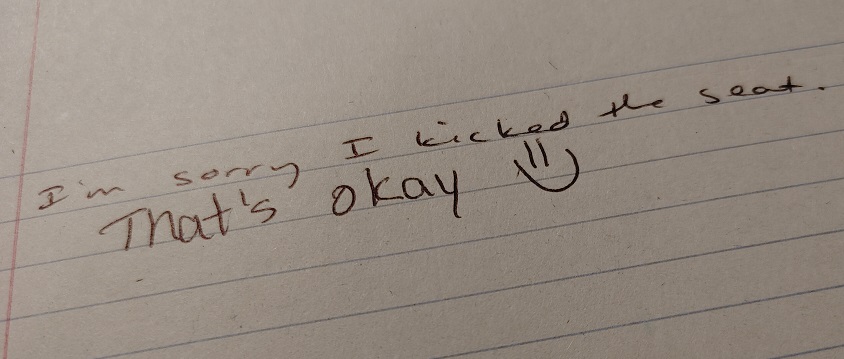
Anton, the professor whom I had had once before, began talking about bounded variation in his thick but comprehensible Belgian accent.  I hoped that a mathematics lecture would distract me from the embarrassment of having blown it with Katy, but it did not.  About ten minutes into class, I quietly tore a page out of the back of my notebook and wrote on it, I’m sorry I kicked the seat.  I discreetly passed the note to Katy.

About a minute later, as I was writing down theorems about functions of bounded variation, Katy turned halfway toward me and placed the paper I gave her back on my desk.  That’s okay, she had written, with a smiley face.  This was progress, I supposed.


Later that day, after I was done with classes, I ran into Taylor Santiago and Pete Green, friends from the freshman dorm two years ago who I now went to church with.  They were walking in the same direction I was, so I walked with them, and we shared stories about our first week of classes.

“I ran into Schuyler Jenkins this morning,” Pete said.

“Schuyler Jenkins!” Taylor replied.  “I haven’t seen her since freshman year!”  Schuyler was a girl who had lived across the hall a few doors down from Taylor freshman year, upstairs from me.  She was short, barely over five feet, and she could be both short-tempered and whiny at various times.  She did not speak to me for several weeks that year, after I played a prank which hurt her much more than I thought it would.

I unlocked my bike and began riding.  “Where are you guys headed?” I asked.

“Bus,” Pete replied, pointing to the northeast.

“I’ll follow you,” I said, riding my bike very slowly alongside Taylor and Pete toward the bus terminal.

“Greg?” Taylor asked.  “Has anyone else told you that your bike might be a little too small for you?”

“Actually, yes.  A few other people told me that.  I just got something cheap when I first came to Jeromeville; I didn’t get it properly sized or anything”

“It seems like you might be comfortable on a bigger bike.”

“This one is starting to fall apart,” I said.  “I’ll keep that in mind someday when I get a new bike.”  I know now that I did not keep that bicycle regularly maintained.  The chain needed to be cleaned and lubricated, and a few spokes in the back were broken, making the back wheel wobble.  “Not only is this bike too small, but it makes weird squeaking noises, and it wobbles in the back,” I explained.

“Sounds like Schuyler Jenkins!” Pete said.

“Haha!” I laughed, loudly.

“Wow!” Taylor said.  “Greg, you should name your bike Schuyler.”

“That’s hilarious!” I replied  I had never made the connection before between my bike and Schuyler.  But from that day on, I called my bike Schuyler, and I loved telling that funny story so much that I named my next bike Schuyler II.

I took Schuyler out for a ride in the Greenbelts after I got back from class.  The weather was colder than I would have wanted it, but after having rained for a couple days, it felt nice to see the sun again.  I showered when I got home, then went to Jeromeville Christian Fellowship that night.  I saw the girl I had spoken with on the bus the day before, wearing a name tag that said “Anna.”  When I got home, I found my phone and email list for JCF; there was one Anna on the list, a sophomore named Anna Lam.  That was most likely her, but her name did not register in my memory at all.

Haley was at JCF that night, but we did not get to talk beyond saying hello.  I was okay with that.  Haley and I were on good terms, but sometimes I was still going to feel weird about our past.  That was normal.  So what if Haley did not like me as more than a friend.  So what if I had an awkward conversation on the bus with Anna Lam, and my new Internet friend Amy D. was married and not interested in me, and I accidentally kicked Katy Hadley in class.  I still had friends who cared about me, and the right people would stay in my life.  Hopefully something would work out for me eventually.


Author’s note: Do any of you name your vehicles, and if so, what’s an interesting story behind the name of your vehicle?

Also, yes I did really just painstakingly edit every episode to include the episode number in the title. Maybe if someone who just happens upon this blog sees that it is episode number 114, this person will actually be motivated to go back and read episodes 1 through 113… yeah, that’s probably wishful thinking.


December 27-31, 1996. You are my witnesses. (#113)

Previously on Don’t Let The Days Go By, Greg was traveling to Urbana, Illinois for a Christian student convention to learn about missions and service opportunities. Read the previous episode here.


“Hi,” Matt, the small group leader, said to the remaining guys in the group who were just entering the room.  Matt had long wavy brown hair down to his shoulders and wore a long sleeved button shirt and jeans.  “Glad you found us.  Our room smelled of smoke really bad, so Obadiah here offered to let us meet in his room.  We’re all here, so we can get started now.  My name is Matt, and I’m a senior at Michigan State, majoring in religious studies.”

“I’m Greg,” I said.  “I’m a junior, a mathematics major at the University of Jeromeville.”  Most of the others did not know where Jeromeville was, so I told them.  This small group had eight other guys in it besides me, one from Canada and seven from various parts of the United States, none of which were out west near me.  Matt, the leader, also led a small group at Michigan State’s chapter of Intervarsity.  He pointed out that I had traveled the farthest to get to Urbana.  “Did a lot of people from Jeromeville come to Urbana?” he asked.

I thought for a minute.  “Probably around thirty,” I said.  “It’s a big school with a big Intervarsity chapter, and there are churches with college groups too.”

“Wow,” said the guy named Obadiah, who was from Oklahoma.  “I’m the only one here from my school.  But I go to a small Bible college with only three hundred students, and we don’t have an Intervarsity chapter.  I found out about Urbana from my church.”

After two and a half years at the University of Jeromeville, with twenty-five thousand students, I could not picture what life at a school that small would be like.  The others introduced themselves, with half of them having come from public schools like me and the other half from private schools.

“So what did we learn about being a witness from the session tonight?” Matt asked.  Some of the others shared their thoughts.  One guy whose name was also Matt mentioned giving our lives for Jesus, and another guy, Pablo, pointed out that we are all witnesses all the time, because the rest of the world sees how we act as Christians.  I had never really thought of it that way, but he was right.  The theme for this year’s Urbana conference was “You Are My Witnesses,” taken from God’s words to the people of Israel in Isaiah 43:10, and echoed by Jesus in Acts 1:8 when he tells the disciples that they will be his witnesses, just before he is taken up to heaven.  The first general session had been earlier this evening, just before this small group, and a number of speakers had discussed this concept of witness.

After this, we spent some time praying with each other.  Matt, the leader with the long hair, asked us each in turn how we could pray for each other.  When it was my turn, I said, “Pray that I will hear what God has for my life.  I’m a fairly new Christian, and I don’t really know a lot about missions, but a lot of my friends have done mission trips, and I want to know what’s out there, and what God has for me.”

“Well, I’m glad you’re here,” Matt said.  “I think God definitely has something to show you.”

 We each took turns praying for someone else, then we dispersed to our rooms.  Long-Haired Matt and Pablo were my roommates; I slept in the top bunk, Matt on the bottom, and Pablo on a cot that had been placed in the room specifically for this convention.  As Matt had said earlier, our room smelled horribly of smoke, and with my normal difficulty sleeping in unfamiliar places, I hoped that the smell would not keep me awake.

Intervarsity was a nondenominational Christian organization with chapters at colleges and universities throughout North America.  Jeromeville Christian Fellowship, which I had begun attending at the beginning of sophomore year, was a chapter of Intervarsity.  Every three years, during the week after Christmas, the organization held this convention, named after its location in Urbana, Illinois.  I had never traveled this far east before, nor had I ever seen this much snow.

The University of Illinois campus hosted the convention.  Attendees slept in dormitories that were normally occupied by students, who were home for winter break during the convention.  Normally these rooms held two students, but cots had been added for this convention so that three of us could share each room.  I was glad I had not been assigned to the cot.  Apparently the residents of this room were smokers.  The Illinois students did not have to move their things out during their break.  The other Matt in my small group had mentioned that his room’s walls were full of bikini model posters, so he asked for leftover Urbana posters to cover them up.  The organizers of the convention had extra posters available; apparently this was a common occurrence.

Each day of the convention began with a small group Bible study, with the same eight other guys that I had met with last night.  Following this was a two hour general session with worship music and speakers, ending at noon.  Dozens of smaller sessions filled each afternoon, with attendees free to choose which sessions to attend, and representatives from ministry and service organizations, as well as Bible colleges and seminaries, filled three exhibit halls.  Another general session met each night after dinner, with prayer time in our small groups before bed.

On the second morning, December 28, I saw Long-Haired Matt, the other Matt, and Obadiah talking in the dorm as they prepared to leave for the general session.  I asked if I could walk over with them.  The University of Illinois, Urbana-Champaign was a very large campus, spread out along the border of two adjacent cities.  Many of the buildings appeared older than those of UJ back home.  The buildings were arranged more densely than those of UJ, for the most part.  The general session was held in the basketball arena, and I had to walk past the football stadium to get there.  Both of them were much larger than the corresponding facilities at UJ, which did not surprise me since Illinois was a Division I school.

The general session began with a worship band playing on a stage where the basketball court normally was.  Some of the songs were familiar to me, the same songs that we sang at Jeromeville Christian Fellowship and at church.  After the music, speakers came up to talk about various aspects of missions and being a witness.  The keynote speaker that morning was an older woman named Elisabeth Elliot.  She told a story about she and her husband, Jim, serving as missionaries in a remote part of South America in the 1950s.  They tried to establish contact with an indigenous group so they could live with them and teach them the good news about Jesus dying for our sins.  Jim and four other members of their group were killed by the people they were trying to reach, but Elisabeth later returned to live with those people for several years.  As one new to evangelical Christian missionary culture, I had never heard anything like that; Ms. Elliot’s story was both inspiring and intense.  I overheard Long-Haired Matt and Obadiah talking after the session; apparently the Elliots’ story was well-known among those who grew up going to churches that emphasized world missions.

I spent the afternoon in a session about keeping a prayer journal.  The speaker, an Intervarsity staff leader from some other school, had a lot of good things to say, but I also came out of the session feeling a bit like a failure.  My prayer times tended to be unproductive, and I did not hear God’s voice audibly.  The speaker also cautioned against having an experience orientation, in which one’s faith and prayer life is focused on results instead of the mere presence of God.  I knew that this was something I struggled with.  That evening, I could not find either of the Matts or Obadiah or Pablo or any of the others in my group when the time for the general session came, so I sat alone.

By lunch time on December 29, I was feeling two things: discouraged and cold.  We had a good small group last night, though.  Multiple people prayed that I would get out of this rut of discouragement, but it had not happened yet.  Long-Haired Matt reminded me about the guest services booth where I could look up dorm room phone numbers for other attendees.  I made a note to look up Brian Burr, Eddie Baker, and Taylor Santiago later that day, so I could at least see them at some point during this convention.

As I left the cafeteria and headed across campus for a session about forgiveness, I realized that something looked different.  The snow was melting.  The blanket of white that had covered the campus when I arrived two days ago had receded to little patches of snow scattered across the greens and browns of nature and the grays of paved surfaces.  The air also felt noticeably warmer this afternoon.

“Greg!” I heard someone call out as I approached the building where my session was.  It was a female voice, not any of the guys in my small group.  I turned and saw a girl with light brown hair in a white sweatshirt, smiling and waving to me.

“Autumn!” I called out excitedly.  Autumn Davies was a sophomore at Jeromeville, who stayed in the same hotel as me on the night before Urbana began.  She gave me a hug.

“How are you?” Autumn asked.  “How have you been?”

“Okay, I guess.  Just trying to figure out what God is telling me through all this.”

“You’ll figure it out.  Just keep listening.”

“Yeah.  How has Urbana been for you?”

“It’s been great!  I’m learning so much!  I want to go on a mission trip this summer.”

“Awesome!  Keep me posted on that.”

“Hey, do you want to come sit with us at the session tonight?  Some of us from Jeromeville decided to sit together, and we’ve gradually been finding other people we know.”

“Yeah!  Definitely!  You’re actually the first person from Jeromeville I’ve seen since we got off the bus.”

“Wow!  We’ve been sitting in section 205.”

“I need to get to this session, but it was great to see you!  I’ll see you tonight!”

“Yeah!”


My Urbana experience seemed to change from the moment the snow melted.  A couple hours after I ran into Autumn, I saw Tabitha Sasaki and Melinda Schmidt walking toward a different session.  And when I arrived in section 205 that night, it felt like coming home, being surrounded by familiar faces.  Dave and Janet McAllen, Cheryl, and Brian, our campus staff.  Eddie, Autumn, Leah, Tabitha, Leslie, Alyssa, Scott and Amelia, Melinda, Ajeet, Mike Knepper, and many of the other friends I made at JCF last year.  Taylor, Pete, Sarah, Liz, and Ramon, friends from my freshman dorm who invited me to JCF in the first place.  I had told Long-Haired Matt at dinner earlier that I found some of my Jeromeville friends and would probably sit with them instead of my small group; he seemed to approve of this idea.

“Greg!” Taylor said when he saw me approach their section.  “Good to see you!”

“You too!” I said.  “I ran into Autumn earlier, and she told me where everyone would be.”

“So what have you thought of everything so far?  Are you ready to pack up and go on a mission trip this summer?” Taylor chuckled.

“It’s definitely been a learning experience.  I was thinking earlier today, I should probably start with something smaller.  Like maybe I could be a Bible study leader next year.”

“Oh yeah?  That’s a good thought.  If you’re interested in that, talk to Dave and Janet.  And talk to your Bible study leader this year, so you know what you’re getting yourself into.  Who is that?”

“Evan Lundgren.”

“He’s not at Urbana, is he?”

“No.  But I’ll talk to him when we get back.”

“Good idea.  I’m going to be taking a quarter off in the spring to do inner-city missions this spring and summer, so I’ve been looking for stuff that’ll help with that.”

“That’s cool.  Keep me posted about that.”

Although I possibly had the beginnings of a plan, I still felt a lot that was unresolved within me.  I did not have a specific plan like Taylor.  So much here seemed to be pushing the idea of going to serve God in other countries, and I just did not feel ready for that.  I knew that not everyone was called to missions overseas, but what if I was just being lazy and staying in my comfort zone instead of actually doing God’s will for my life?

For the remaining two days of Urbana, I followed the same pattern of sitting with Long-Haired Matt and my small group in the morning session and with my Jeromeville friends in the evening.  Although I enjoyed seeing my friends at the evening sessions, I was haunted by the words of the speaker from earlier in the week who reminded me not to have an experience-oriented faith.  It was difficult to find the balance of having friends to encourage me in my faith, and for me to encourage in theirs, yet also remembering that my faith is deeper than just experiences with friends.

 By the final evening, the smell of smoke from my dorm room had permeated all of my clothes and the towel I was using to dry myself after showering.  I hoped that the smell did not bother my friends, and I hoped that people I came across would not assume that I was a smoker.  That would not be a good witness to others.

According to the program, one of tonight’s topics was about “sending,” presented by one of the people in charge of Intervarsity.  I was not sure what this word meant exactly.  “You’ve probably learned a lot about Urbana about missions,” the speaker said.  “But it is just as important to know that someone back home is sending these people on missions.”  He went on to explain the importance of the teams who give financially to missionaries and pray for them, how they are a crucial part of the missions experience.  I liked that.

The final evening session was scheduled to end two and a half hours later than on the other nights.  It was December 31, and we would all take communion together at midnight to celebrate the New Year.  After the last speaker, the band came back and played an extended worship session.  They began with a song called “Good To Me,” a song that I had heard many times back home, but which was still just as true.  God really was good to me.

Around 11:45, hundreds of volunteers spread out throughout the arena to distribute crackers and grape juice for communion.  The people on stage told the story of the Last Supper and instructed us to eat the bread and drink the juice in memory of Jesus.  I sat reflecting on everything that had happened this week as the worship team played music with no vocals.  The burden I had been feeling, wanting to make sure I was doing enough to serve God, was lifting now that I had heard the talk about sending.  Suddenly it felt okay if I was not ready to cross any oceans this summer.  I could still make donations and pray for my friends who would be crossing oceans, and that was still an important part of the cause of world missions.  And I was planning to learn more about leading a small group next year.

I looked at my watch after a while; It was 12:02.  The date displayed on my watch said “1-1-97.”  January 1, 1997.  A new year, full of new opportunities and possibilities.

After the worship team dismissed us from the session, I stood up and looked around at my friends sitting nearby.  Eddie made eye contact with me; he walked over and patted me on the back.  “Happy New Year, Greg,” he said.

“You too,” I replied.  “By the way, you were wrong when you said a couple weeks ago that Urbana was so big that we probably wouldn’t see each other.”

“I know.  I guess I was.”

“No offense, but in this case I’m glad you were wrong.” I smiled.

“Me too,” Eddie replied.  “So what did you think of tonight?”  I told him of my realization about sending, that it did not make me any less of a Christian if I did not go on a mission trip right away.  “Good,” he said.  “We as Christians are saved by faith, not by our works.”

“I know.”


The next morning, as we packed and cleaned our rooms, the nine of us in my small group exchanged contact information and took a group photo.  Most of them did not stay in touch with me, though, and the ones who did I only heard from for a couple months.  Life just gets in the way, I suppose.

In one of the exhibit halls was an Urbana store, selling merchandise and books.  I bought a T-shirt, with a design identical to the poster I had received in the mail when I first signed up for Urbana.  I also bought three books, two written by speakers I had heard and one a devotional book to use in my personal prayer time.  I began reading Shadow of the Almighty by Elisabeth Elliot on the plane ride home.  Although I found her talk intriguing, the book came across as boring.  A couple weeks later, I gave up halfway through the book, and while I still have it all these years later, I never finished it.

Although Urbana was an amazing experience that answered some of my questions about missions, I also felt like I was leaving with new questions.  Was it God’s will for me to serve him overseas, and how do I separate the answer to this question from my flesh and its desire to stay comfortable?  How could I serve the body of Christ back home?  Would I lead a small group senior year, and how would that impact my schedule?  As I looked forward to new opportunities and experiences in 1997 while traveling thousands of feet above the ground, I prayed that God would reveal his will to me, that he would show me where.  And, unsurprisingly, God did reveal his will to me not too long after that, and it was not at all what I was expecting.

Proof that I really did see Eddie at Urbana.

Author’s note: What’s the most interesting way you’ve ever spent a New Year?

Disclaimer: Urbana is a real event (urbana.org), but it has since moved, and is not actually held in Urbana anymore. Intervarsity was not involved in the composition of this story, and this is not a sponsored post.

(December 9, 2021. Three years of DLTDGB!)

Wait, something is different here, I’m posting on a Thursday… that’s because today is my so-called blogiversary. The first episode of DLTDGB posted three years ago today. So if you’re new to the story, go read how it all started! If you really want to be filled in on the entire story, keep clicking “Next” until you’ve read all 112-ish episodes :-P

Also, I wrote two Christmas-related guest posts for two other blogs recently, about two different childhood Christmases. One of them has not posted yet; as soon as both are up, I’ll post links to those.

Greg Dennison's avatarDon't Let The Days Go By

We drove south on Highway 117 on a hot summer day, through cow pastures, olive and almond orchards, and fields of tomatoes and corn and numerous other agricultural products.  I was in the passenger seat in the front, Dad drove, and Mom and my 11-year-old brother Mark were in the back seat.  We went to visit my dad’s relatives in Bidwell for the holiday weekend; we had left my great-grandma’s house an hour and a half ago, and we were about a third of the way to our home in Plumdale.  But Highway 117 was not the most direct way home; we were going somewhere else first.

When we got to Woodville, the highway widened to two lanes in each direction.  After another seven miles of fields, we saw buildings again, a semi-rural neighborhood just off the frontage road to the left, and then a bunch of large apartment complexes…

View original post 1,432 more words

December 18-26, 1996.  A time of firsts. (#112)

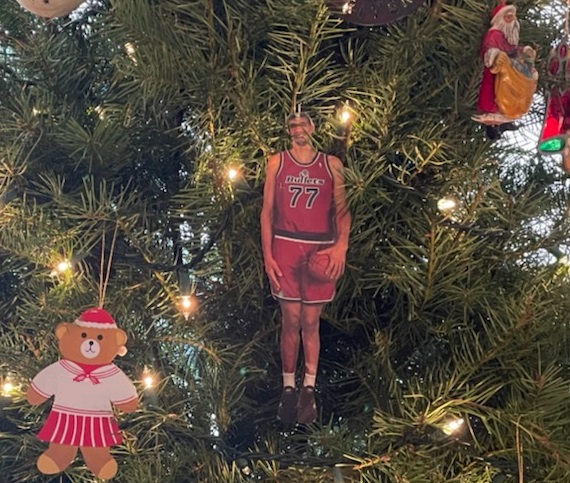
“What is that on the tree?” I asked, laughing, because I knew exactly what this new Christmas ornament was.

“Your brother made that,” Mom said, rolling her eyes.

Back in the 1990s, the tallest player in the National Basketball Association was seven-foot-seven-inch Gheorghe Muresan, of the team known then as the Washington Bullets.  My brother Mark loved basketball and played on the school team, and he thought Gheorghe Muresan was fascinatingly odd-looking.  Mark apparently cut a photo of Gheorghe Muresan out of a magazine, attached an ornament hook to it, and hung it on the Christmas tree.

“But why?” I asked.

“Why not?” Mark said, laughing.

“Good point.  Hey, is that a Nintendo 64?”

“Yes,” Mom answered.  “It was Mark’s early Christmas present.”

“Can I get a turn when you’re done?” I asked Mark.

“Yeah,” he said.  “Whatever.”

I took my bags to my bedroom.  I had finished final exams a few days earlier, and Christmas was about a week away.  I spent a lot of time that week playing the new Super Mario game on Mark’s Nintendo 64.  The previous Mario games had been two-dimensional platform games, in which Mario moved side to side and jumped on things.  This one was three-dimensional, with a thumbstick controlling Mario from the first person, and I had more difficulty with it.  It was still fun, though.

The week went by quickly.  I got my dad a Grateful Dead calendar for Christmas, as I always did, and I got Mom the new book in Sue Grafton’s Kinsey Millhone series, M is for Malice.  I got Mark a calendar of NBA players, which he put on his wall and then ignored.  The calendar still displayed January 1997 well into 1999, and when I asked him about it then, he complained that he never used calendars.  I never got Mark a calendar again.

We had fewer presents to open this year. Mark had already gotten his Nintendo 64, and a few days after I got home, Mom took me shopping for my early Christmas present. We bought a jacket, a beanie, and comfortable thick socks, since I was going to be spending the week after Christmas in a colder climate. On the ride home from the mall, Mom made small talk.

“How many people do you know who will be at Urbana?” she asked.

“I don’t know.  Quite a few.  But it’s such a huge convention, and I don’t know where everyone will be.  Eddie Baker told me we might not even see each other.”

Next, Mom started naming specific school friends whose names she remembered.  “What’s Brian doing for Christmas?” Mom asked.

“Going to his parents’ house in Valle Luna, then going to Urbana.  Since he’s a staff member, he has to work there, but I don’t know what he’s doing.”

“Okay.”

“He left the apartment on Sunday.  When he left, he said, ‘I’ll see you at Urbana!’”

“What’s Eddie doing for Christmas?  Seeing his family too?”

“Yeah.  In Sunnyglen.”

“Did he tell you, ‘I won’t see you at Urbana?’”

“No,” I laughed.


Usually, the evening of December 25 was a time to relax and unwind after a long day of being around relatives.  But this year was different; Mom and I spent the evening packing.  I would need a minimum of six changes of clothes besides the clothes I would put on in the morning, so I put seven changes of clothes in my suitcase just in case.  I also packed my new jacket, beanie, and socks.  In my backpack, I put a notebook, a few pens, and my Bible.  Mom suggested that I move one change of clothes to the backpack and use it as carry-on luggage, just in case I got stranded in an airport somewhere.  I was not familiar with this concept of carry-on luggage, but I figured out what she meant.

It was close to midnight by the time I finally got to bed and set my alarm for 4:30.  Tonight was not looking like a restful night.  I was too excited and overwhelmed to fall asleep quickly, and I got less than four hours of sleep that night.  Hopefully I would be able to sleep on the plane, but since I had no concept of what an airplane trip was like, how uncomfortable or noisy it would be, I was not sure.

We left the house a little after five o’clock, which got us to the Bay City airport around seven.  The flight left at 8:30, and although going through airport security did not take nearly as long in 1996 as it does now, I still wanted to be there in plenty of time.

I did not know how to plan an airplane trip.  Tabitha Sasaki had said a few months ago that she wanted to get a few people to go in together on a flight and hotel room, and she had done all the planning; I just gave her money.  The convention did not start until the morning of the 27th, so today, the 26th, would be a travel day, ending in a stay at a hotel.

The Urbana convention, hosted by Intervarsity, the parent organization of Jeromeville Christian Fellowship, was named after its location in Urbana, Illinois.  Thousands of Christian young adults would descend on Urbana this week to learn about opportunities to serve Jesus around the world.  Shuttle buses for Urbana attendees would pick up students from the airports in Chicago and Indianapolis, each about a two-hour drive from Urbana.  We were scheduled to arrive in Indianapolis in the early evening, after changing planes in St. Louis.  I had never been that far east before.  I also had no memory of ever having been in an airport, so basic airport concepts like checking bags, going through security, waiting at the gate, and showing a boarding pass were completely foreign to me.  Mom says that I was on an airplane once as a baby, but I was too young to remember that.

“Which airline are you taking?” Mom asked as she turned off the freeway to the airport entrance.  Bay City International Airport was very large, with different airlines served by different terminals.

“TWA,” I replied.  Mom followed the signs to the terminal for TWA and found a place to park in a short-term parking garage.  Mom followed me inside the terminal, then asked, “Who are you supposed to be meeting here?”

“Tabitha said to meet near check-in.  Is that there?” I asked, pointing toward the long desk and longer line of travelers waiting to check bags and get boarding passes.  As we approached, I noticed a round-faced Asian girl with chin-length black hair standing not too far off and said, “There’s Tabitha right there.”

Tabitha saw me as I walked toward her.  “Hey, Greg,” she said.  “We’re still waiting for Leslie and Lillian.”

“Mom, this is Tabitha,” I said.  “Tabitha, this is my mom, Peggy.”

“Nice to meet you,” Tabitha said, shaking Mom’s hand.

“You too,” Mom replied.

“Do I have to get in that line?” I asked.  “I’ve never done this before.”

“You’ve never been on an airplane?” Tabitha replied.

“Once when I was a baby.  But I don’t remember it.”

“Oh, wow!  Yeah, we’ll have to check our bags there.  I figured the line doesn’t look too long, so we can wait until everyone gets here and all stay together.  There’s Leslie.”

“Hey, guys,” Leslie said, walking toward us.  “Is everyone here?”

“We’re still waiting for Lillian,” I said.

After I introduced Mom and Leslie, Mom said, “I still have to drive all the way back to Plumdale and work today.”

“I think you can go now,” I said.  “I’ll be okay.”

“Are you sure?” Mom asked.

“Yes.”  I knew that Mom was going to worry the whole time I was traveling, but she also seemed to be subtly complaining about having gotten up early.  I had found my traveling companions, though; I was ready to continue on my own.

“Okay,” Mom said.  “Call me from the hotel room when you get there.”

“I will.”  I gave Mom a hug and watched as she walked away.


Lillian arrived a few minutes after Mom left, and we boarded the flight to St. Louis without incident.  We rode a very large aircraft, with ten seats in each row broken into three sections by aisles.  The four of us were all near each other, although not immediately adjacent.  We had one window seat among the four of us, on the left, and being a map and geography geek, I was quite interested in seeing the United States from thousands of feet in the air.  I reminded everyone that I had not been on an airplane in almost twenty years, and that I was too young to remember my other airplane trip, so they were willing to let me have the window seat.  I decided that I would be nice and not push for the window seat on the return trip.

We took off over the Bay, and I could see Oaksville and other sprawling suburbs spread out on the other side of the Bay against the hills.  It took only a few minutes for the airplane to fly over the hills, and by the time we reached the Valley on the other side, I could spot Jeromeville in the distance, although it was too far away to identify any landmarks.

Beyond the Valley, the land below the airplane became mountainous.  Vast stretches of this terrain was high enough in altitude to be covered with snow.  It was beautiful; I had only seen snow up close twice in my life at this point.  After we had been in the air for about forty-five minutes, a layer of clouds appeared between the airplane and the ground.  I had never seen this perspective, with clouds stretched out below like a puffy carpet, but I soon got bored at staring at the clouds, since there were no features to identify.  I began dozing; I was still tired from having awakened so early this morning.

When the clouds cleared, I could see a highway interchange on the brown land below me, but I had lost all my bearings by this point and had no idea where I was.  The land was mostly featureless, and the trip was not close to being over yet.  I still looked out the window for a long time, seeing an occasional road or building below, before nodding off again.

Our plane touched down in St. Louis in mid-afternoon, although it felt like lunch time since we lost two hours because of time zones.  “Which way are we going now?” I asked Tabitha as we emerged into the airport gate.

“Follow me,” she replied, looking at her boarding pass.  We walked down a row of gates and found the one for the next leg of our flight.  It was not far from where we were, and our next flight did not leave for an hour and a half, so we went to find overpriced fast food for lunch.

“Did you say someone else we know is going to be at our hotel?” Lillian asked.

“Yes!” Tabitha replied.  “So many people from Jeromeville will be at our hotel.  We’ll probably hang out with them later tonight.”

“That’ll be fun,” I said.  With so much around me at the moment that was unfamiliar, in light of Eddie’s comment about how we might not see anyone we know at Urbana, I definitely felt relieved that others I knew would be at the hotel.

Boarding the flight to Indianapolis was much like the experience of boarding the other flight from Bay City to St. Louis, but the inside of the airplane was much different.  This plane was smaller, with only six seats across and one aisle down the middle.  The flight itself was also much shorter, so I did not have time for a nap.  I sat in a middle seat, so my view out the window was not as clear as on the first leg of the flight, but as the plane headed east, I noticed more and more snow appearing on the ground.  By the time we landed in Indianapolis, the entire ground was covered in a few inches of snow for as far as I could see in any direction.  I wondered if the ground in Indiana and Illinois was continuously covered in snow all winter.  I mentioned to the others while we were waiting to get our luggage that I had never seen so much snow in my life.

“Really?” Leslie asked.

“We’re definitely not home anymore,” Tabitha said.

We caught a shuttle bus to the hotel.  The driver seemed completely unfazed by the snow.  I would have been panicking, driving in the snow like that, wondering if I needed to put chains on the tires, but people who lived in this climate apparently knew how to drive in snow.  There did not seem to be snow accumulating on the roads, probably because the snow was not currently falling and cars had been driving on the road all day.

I was the only guy in our travel group, so Tabitha had booked me in a separate room.  After we checked in, I went to my room and lay on the bed.  I spent the next hour or so attempting to nap again.  Although the clock said it was dinner time, I was not hungry, since I had just eaten a fairly large lunch, and my body was still on West Coast time and felt like it was earlier.

At around quarter to eight, Tabitha knocked on my door; Leslie was with her.  “We saw Scott and Amelia in the lobby earlier.  We’re all going to meet now to watch Friends.  You wanna come?”

I was not expecting to have a major quandary on this trip.  In an effort to keep from alienating myself from all of the people I had met at Jeromeville Christian Fellowship and Jeromeville Covenant Church, I had hidden from them the fact that I did not watch Friends.  Since I was on a school holiday, it had not even crossed my mind that today was Thursday, and that Friends would be on tonight.  I had never actually seen the show, so I could not really say that I hated it, but the show was extremely popular, and I got the impression from commercials and hearing people talk about the show that it was not my thing.  However, could I really have a well-formed opinion of the show without having watched it?  I also did not want to pass up an opportunity to see my actual friends here in this unfamiliar, snow-covered landscape, so I shrugged my shoulders and said, “Sure.”

I followed Tabitha and Leslie upstairs to a hallway that looked identical to the one on my floor.  They knocked on a door, and Amelia answered.  “Hey,” she said.  Then, noticing me, seeing me for the first time in two weeks, she said, “Hi, Greg!  How are you?  How was your Christmas?”

“Good,” I replied.  “Just the usual stuff with my family.  My brother got a Nintendo 64, so that was fun.  How was yours?”

“Nice.  But I spent most of yesterday packing, so I wasn’t around my family as much.”

I walked into the room, where about a dozen people had packed in on the beds and floor, including Amelia’s boyfriend Scott, Lillian from our flight, Melinda Schmidt, Joe Fox, Alyssa Kramer, Autumn Davies, Leah Eckert, and others.  I made small talk with some of the people in the room for a few minutes until the show started.

As I watched the six New Yorkers on the screen talk about their lives, careers, and sexual partners, I realized exactly why I disliked the show.  I found all of them completely unrelatable.  The show had some moments that made me chuckle, but so much of the plot revolved around relationships and sex, for which I had no frame of reference.  They reminded me of the stereotypical cool kids who excluded me and got what they wanted through morally questionable means.  I wondered why so many of my Christian friends were so attached to a show with characters behaving in a way that contradicted the Bible’s teachings about sexuality.  I hoped that the others in the room did not live like Rachel and Ross and Joey and all the annoying people on the screen.  But I kept quiet and watched the show; now was not the time to start an argument.  And now that I had watched the show, I knew for sure that I did not like it.


I looked out the hotel window before I went to bed that night and watched snow fall lightly on the parking lot for a few minutes.  When I woke up in the morning, the snow was clearly deeper than it had been yesterday.  I bundled up, wearing my new jacket and beanie, and met Tabitha and the others in the lobby at the time we had discussed, to wait for the shuttle bus.  After we boarded the bus, it took a little over two hours to travel west through the snow-covered rolling hills to the campus.

I was excited for what was coming.  This winter break had been a time of firsts.  Back home with my brother was my first time playing Nintendo 64.  Now, this trip was my first time being on an airplane, at least in my memory; my first time in a different time zone; and my first time in Missouri and Indiana.  This morning, as I saw a sign out the bus window that said “ILLINOIS STATE LINE,” I added a third new state to this trip.  It had also been my first time watching Friends, an experience I had no particular desire to replicate.  Once I arrived on the campus and stood in line for registration, receiving a bracelet as a convention attendee, I knew that this would be a unique experience opening my eyes to new firsts that God would show me in the upcoming years.

(To be continued…)

The actual wristband from 1996. Photo recreated using my 2021 wrist.

Author’s note:

Hi, friends! I’m back… my break from writing was a little longer than I thought it would be, mostly just because life got in the way. During the break, I started another blog (click here) to write about other things, or to write about writing, or to share other creative works besides my continuing story. I’m not planning to post there on any schedule, but you can subscribe if you want updates from me. Also, I wrote a couple of guest posts for other blogs; I will share the links here when they get published.

This Urbana trip was the farthest I had been from my home in the western US at the time, but as of 2021, the farthest I have been from home is Kittery, Maine, on the US East Coast about an hour drive north of Boston. The story of that trip will be told in Just Take The Leap, a sequel to Don’t Let The Days Go By that I plan on writing someday, years from now.

What is the farthest you have been from home?

Disclaimer: Urbana is a real event (urbana.org), but it has since moved, and is not actually held in Urbana anymore. Intervarsity was not involved in the composition of this story, and this is not a sponsored post.


Mom found the Christmas ornament and put it up this year.

(October 2021. Interlude, and a new blog.)

Welcome! If you are new here, this is not my usual kind of post. Don’t Let The Days Go By is a continuing story set in 1996, about a university student. In the fictional timeline, after final exams in June and December, I take a break from writing for a month or so, and the last episode included December finals, so I am on a break.

I started yet another blog, called “Greg Out Of Character.” In this blog, I will write about pretty much anything that isn’t an episode of DLTDGB. Maybe some of the events in my past that inspired DLTDGB, maybe thoughts about other writing projects, maybe I’ll share some other writing I did in the past unrelated to DLTDGB, I’m not really sure yet. We’ll see. I don’t plan on posting there on a schedule. But any of you who regularly interact with me, I would appreciate if you followed that blog too, especially if you actually find me interesting.

I’m not sure what I’ll be doing on this site during the hiatus. I’m thinking I should probably update the About This Site and Dramatis Personae pages, so watch for those soon. I might also make an organized and categorized list of episodes. I’ve also thought it would be fun to draw maps of the University of Jeromeville, and possibly of Jeromeville and the surrounding region. I started this a while ago, but whenever I try drawing maps, it just ends up looking too much like the actual place that inspired my fictional universe, and it feels like I should at least make it a little bit different. We’ll see what I come up with.

So, back to my original point, if you are new here and interested in this story, you can read all 111 episodes. Start with the first episode (July 5, 1993) by clicking here, and then just click Next at the bottom of each one. If that’s too much, you can read the summary of Year 1, then the summary of Year 2, then start with the first episode of Year 3 (June 18-21, 1996) and continue from there. You can also listen to the music for Year 1, Year 2, and Year 3 (in progress).

How is everyone’s October going?

Early December, 1996.  We were all just kids. (#111)

When I was growing up, no one ever taught me anything about girls or dating or relationships or anything like that.  My parents had been married since before I was born, but they were not visibly affectionate with each other, and my dad spent all his time working, so I never had a healthy relationship to watch and emulate.  And since I did not know how to tell a girl that I liked her, the way to act in a relationship or marriage was a moot point for me.

When I got to the age where I started paying attention to girls, my parents would sometimes notice and point out my behavior in a teasing and humiliating way.  At age thirteen, my friend Paul Dickinson noticed that I had been paying attention to a girl at school named Rachelle Benedetti, and he asked me if I liked her.  There was no teasing or judgment in Paul’s question, unlike what I had experienced from my parents, so I admitted that, yes, I did like Rachelle.  Shortly after that, it felt like the whole school knew, and that was inherently embarrassing to me even if I was not actively being teased for it.  Because of that, whenever I liked a girl, I kept my feelings a closely guarded secret.  I had learned by now that a girl was not going to walk up to me out of the blue and ask to be my girlfriend, so now I was twenty years old, I had never had a girlfriend, and I did not know how to change that.

I had known Haley Channing for almost a year now.  I met her one night after Jeromeville Christian Fellowship, when I was upset and had a lot on my mind. Two guys, Eddie Baker and Xander Mackey, asked me what was wrong, and they ended up inviting me to hang out with them and their friends.  Haley was there that night.  She had pretty blue eyes, a cute smile, and a kind heart.  We had gotten to be friends since then, but I just did not know how to tell her that I wanted to be more than friends.

A couple weeks ago, I thought I had a chance.  I was mingling with people after JCF, and for a brief moment, I saw Haley sitting not too far away and not talking to anyone.  I walked up to her and said hi.

“Hey, Greg,” Haley replied.  “How are you?”

“Pretty good.  How are you?”

“I’m doing okay,” she said in a tone that suggested that everything was not exactly okay.  Haley had lost her mother to cancer recently, and Thanksgiving was next week.  My go-to small talk that time of year was to ask people their plans for Thanksgiving, but I figured that it might be best to avoid that topic with Haley this year.  “What are you up to?” she continued.

“Just looking for something to do,” I said.  JCF met on Fridays, and people often hung out afterward, playing games, eating, or watching movies in room 199 of Stone Hall, a large lecture hall that was converted into a second-run theater on weekends.   I became unusually brave and floated an idea, saying, “Mission: Impossible is playing at 199 Stone tonight.  I was hoping people might be going.”

“I haven’t seen that!  I want to!”

“You want to go?”

“I would, but I have to get up early in the morning,” Haley said.  “Maybe another time?”

“I understand,” I said.  I did not end up seeing that movie until months later, on a rented VHS tape, and I ended up just going home that night.

A while later, a few days after I got back from having Thanksgiving with my family, I was walking through the Memorial Union looking for a place to sit and study in between classes.  It was cold outside, so the indoor tables were crowded.  I saw Haley sitting with Kristina Kasparian talking to Janet McAllen from JCF staff.  A fourth seat at their table was open. 

“Hey,” I said, walking toward the open seat.  “Mind if I sit here?”

“Actually, we’re working on Kairos group planning,” Janet explained.  “Sorry!”

“Oh.  That’s okay.  I guess I’ll see you guys later.”

“I’ll see you Friday?” Haley said.

“Yeah,” I replied.  “Actually, no.  Friday is our concert for chorus, so I won’t be at JCF.”

“Oh, that’s right!  Have fun!  I’ll be at church on Sunday, I’ll probably see you then.”

“Yeah.  Have a good one!”

I walked across the Memorial Union, unable to find a table, and ended up sitting cross-legged against a wall.  The Kairos group clique strikes again.  The Kairos ministry within JCF involved small groups designed to prepare students for leadership in ministry.  The students from each year’s Kairos group would lead a group the following year, handpicking the students in their group.  From my outsider perspective, the main purpose of these groups seemed to be the establishment and perpetuation of cliques.  I thought it sent the wrong message, especially since many of the friends who were part of my best University of Jeromeville memories so far were in the cliques and I was not.  And I could not help but wonder if these cliques were the reason things were not working out with Haley.

A few days later, back at the Memorial Union, I saw Eddie Baker eating lunch by himself outside on a picnic bench.  I did not particularly want to eat outside, it was sunny but not very warm, but I was also in the mood to socialize.   Also, Eddie was a Kairos group leader, and I had not talked to him as much this year.  “Mind if I sit here?” I asked Eddie.

“Go ahead,” he replied.  “How are you?  Getting ready for finals?”

“I’m getting there.  We also have the concert for chorus tomorrow night.  This is my first one, I don’t really know what to expect, but I think I know the music by now.”

“That’ll be fun!  Scott and Amelia are in that too, right?”

“Yeah.  And Jason Costello too.”

“Well, good luck with that!”

“How have you been?”

“Just busy with school and JCF.  You’re going to Urbana, right?  Are you excited?”

“Yes!  I can’t wait to see what it’s like.  I don’t know that I’m ready to pack up and go serve God in another country, but I know a lot of you guys do stuff like that, and I want to find out more about what’s out there, so I know how to support people who do mission trips.”

“That’s a good way to think about it,” Eddie said.  “There’s gonna be so many people there.  Twenty thousand students all worshiping God.  We might not even see each other.”

“I know,” I said.  The thought of being thousands of miles away and not seeing my friends who were also there was a little disappointing, but maybe it wouldn’t be like that after all.

“How’s life other than that?” Eddie asked.

“Well…” I said.  I debated how much to tell him, and eventually decided to say everything except her name.  “There’s this girl I would really like to get to know better.  But I just don’t know how.  I’ve never been good with girls and dating and stuff like that.  I’m starting to think that maybe I need to just tell her how I feel, and let her reject me, so I can just move on.”

“I think we all know how that feels,” Eddie replied.  “Is it someone from JCF?”

“Yeah, it is.”

“I have an idea who it is.  Do you mind if I ask?” Eddie asked.

I did not expect this question.  I trusted Eddie, and I did not think he was going to make fun of me, but I still was not used to sharing these secrets with others.  “I guess you can say it,” I said, “but I don’t know if I want to admit whether or not you’re right.”

“That’s fair,” Eddie replied.  “I think it’s Haley.”

Apparently subtlety was not one of my strong points, I thought.  I wondered how many other people knew.  But if Eddie had figured it out, there was no point in hiding this from him.  “Yes, it’s Haley,” I said.  “Please don’t tell anyone.  How did you know?”

“I’ve just noticed the way you act around her sometimes,” Eddie explained.  “And remember that night at JCF, right after her mother passed?”

“Yeah.”

“I noticed the way you kept trying to talk to her.  That was kind of unusual.”

“I just saw someone I cared about upset, and I wanted to make sure she knew that I was there for her if she needed to talk.”  I did not understand what was so weird about that, although I do remember some of the others who were there that night acting like I was intruding on something.  I had assumed it was because I was not in their clique.

“I’m gonna be honest with you,” Eddie said.  “I really liked Haley too, freshman year.  We hung out a few times.  I told her how I felt, and she didn’t feel the same way back.”

“Aww,” I said.  It felt weird knowing that Eddie used to like Haley too.  Maybe every guy at JCF liked Haley.  I would had no chance with all of that competition.

“But talking about it, being honest with her, that was good.  I feel like we grew closer as friends after that.”

“Interesting,” I said.

“If you do tell her how you feel, I know she’ll appreciate the honesty.”

“That’s good to know.”


The next night was the concert for chorus, and I spent most of Saturday studying for finals.  Sunday morning at church I went to 20/20, the college Sunday school class, before the service, and I had a hard time concentrating because Haley was there.  I could not stop thinking about her all weekend.  I had to know if I had a chance with her.  Ever since she turned down my offer to see the movie, with the ambiguous caveat of “maybe another time” which never happened, I felt like I could not continue not knowing.  With JCF done for the quarter, and finals and winter break coming up, this may be the last time I saw her for a month.  I knew that if she was here at church today, that would most likely be my last chance.  All morning, I had been playing in my mind how I would approach her and what I would say, which made the teaching of Dan Keenan, the college pastor, difficult to follow this morning.

After 20/20 ended, as people were standing around the room and gradually trickling out headed toward the main building for the regular service, the opportunity presented itself.  Haley stood by herself about ten feet away from me, and I knew that I had to go for it now, or else I would hate myself through my entire winter break for not having said anything.

“Haley?” I asked as I approached her.  “Can I talk to you?”

“Sure,” she replied.  “What’s going on?”

“Can we step outside, away from everyone?”

“Yeah.”  Haley walked outside a few feet away from the entrance, and I followed her.  “What’s going on?  Are you okay?” she asked.

“Yeah.  I…” I trailed off, trying to remember the conversation I had rehearsed many times.  “I’m really glad I met you last year.  I’ve enjoyed getting to know you, and I’d really like to get to know you… as more than just a friend.”

Haley thought for a few seconds, apparently processing what I said.  She probably was not expecting to hear this.  “Greg,” she said.  “You’re a really nice guy.  But I just don’t see you that way.  Please don’t be upset.”

“I’m not,” I said.  “I had a feeling you didn’t feel the same way.  I just felt like I needed to know for sure.  Like, if I never said anything, I’d never know.”

“It’s okay.  I’m glad you said something.  And I hope you meet the right person soon.”

You’re the right person, I thought.  And you’re standing right in front of me.  If you really meant that, you would give me a chance.  But then I realized that maybe Haley was not the right person after all.  If she was, then we would both feel the same way.  “Thank you,” I said.  “And I meant what I said before: I know you’re going through a rough time right now, and I’m always here if you need to talk.  Even if we are just friends.”

“Thanks.  I appreciate it.”


The next morning, Haley’s rejection felt like a dark cloud hanging over me as I got out of bed, showered, and dressed.  The t-shirt I ordered with the logo for the upcoming Urbana ’96 convention had arrived in the mail on Saturday, and I wore it for the first time that day.  I went to campus and took my final for Advanced Calculus, and even with the rejection still on my mind, I felt like I did well on the exam.

After the exam, I left Wellington Hall and crossed the street to the Memorial Union, looking for a table where I could study.  I saw Eddie sitting at a table talking to Raphael Stevens, his roommate.  Todd Chevallier and Ajeet Tripathi, two sophomores from JCF, were also there.  I walked over as I heard Ajeet say, “Man, I need more coffee.  I was up way too late last night.”

“Yeah,” Eddie replied.  “Maybe last night was a bad idea.”

“Hey, guys,” I said.

“Hey, Greg,” Eddie said.

“How are finals going?” Raphael asked.

“Good.  I just got out of Advanced Calculus; I think I did well.”

“Advanced Calculus,” Eddie repeated.  “Just saying those words stresses me out..”

“I think I’ll be ok.  I’ve been studying.”

“Studying!” Todd said.  “That’s what we were supposed to be doing last night.”

“What happened last night?” I asked.

“We invited Ajeet and Todd and their house to our house for a study break,” Eddie explained.  “We ended up watching movies until around two in the morning.”

“Wow,” I said.

“I’d invite you to sit down,” Eddie explained, “but there isn’t really room at our table.  You could pull up a chair, if you could find one.”

“That’s okay,” I replied.  “I should probably go study anyway.  I’ll see you guys around.”

“Yeah. Good luck with your final.”

“Bye, Greg,” Todd said.

Apparently I had been left out of something else now.  I would have come over to Eddie and Raphael’s study break if I had known about it.  I scanned the room, still looking for an empty seat; I found one at a table next to a tall guy with brown wavy hair who looked familiar.  I had seen this guy somewhere before, but I could not remember where.  A large girl with long, straight brown hair sat with him.  I walked to them and asked, “You guys mind if I sit here?”

“Go ahead,” the guy said.  “I don’t remember your name, but you go to Jeromeville Christian Fellowship, right?”

“Yes,” I said.  Apparently this guy had seen me around before too.  “I’m Greg.”

“I’m Ben,” he said.  “And this is my friend Alaina.  We go to U-Life, but I also go to JCF occasionally.”  University Life was another large Christian student group on campus.

“Okay.  I knew I had seen you somewhere before.”

“How’s your finals week going?” Alaina asked.

“Pretty good.  I just got out of Math 127A, and I have Math 128A tomorrow.”

“Those sound hard.  What’s your major?”

“Math.”

“That makes sense,” Ben said.

“Are you going to Urbana?” Alaina asked, noticing my shirt.

“Yes!” I said.  “It’s going to be overwhelming, but I’m excited.”

“A couple of our other friends are going.  I’ve heard good things about it.”

“Yeah.  I’ve never been to Illinois.  I’ve never even been that far away from home at all.  It’ll also be my first time on an airplane, at least as far as I remember.”

“Wow,” Ben said.

“My mom says I was on a plane once as a baby, but I don’t remember it,” I explained.

“Sounds like you’ll have a great trip,” Alaina said.

I did not do my best at concentrating on my studies that day.  I was still thinking a lot about Haley’s rejection, and about everything that my friends were leaving me out of.  I also talked to Ben and Alaina a bit, who I noticed were definitely not a couple.  They seemed like nice people; maybe they could be a new group of friends for me.  I wondered if University Life had the same problem with cliques that JCF did.


I stayed in Jeromeville for a few days after finals ended.  I had three weeks off, and taking a few days off in my apartment, reading, going for bike rides in the Greenbelts, and staying up late talking to girls on Internet Relay Chat was worth having a little less time with my family.  Although I did fine on finals, I felt like the quarter ended on a bad note, considering the conversation with Haley and all of the times I was left out.  I now knew that Haley definitely did not feel the same way about me that I felt about her.  In theory, now that I knew, I would be able to move on, but it did not always feel so easy in practice.  I still felt like I had failed.

As for the cliques, I was probably not being intentionally singled out every time.  Eddie and Raphael’s study break, for example, was a last-minute unplanned thing, and those two households just happened to be right around the corner from each other.  The most likely reason I was not invited was because I lived on the other side of town.  But I also felt left out in that they did not invite me to be roommates with them in the first place.  I thought that living with Brian and Shawn this year would help, since they were not only part of the in crowd but older.  It did help in some ways, like when they invited me to toilet-paper Lorraine.  But Brian spent a lot of his spare time applying for medical school, and Shawn was busy with student teaching, so they were less social than in previous years.

Looking back on these days as an adult has given me a bit of a different perspective on what was going on.  The Haley situation was not at all a failure on my part.  Sometimes one can do everything right and still lose.  Sometimes someone is just not interested in someone else like that.  Over the course of my life, I have been on both sides of those conversations many times.  Being rejected is just a part of life, not necessarily a sign of failure.

I was still bothered by the cliques within JCF.  But, ultimately, I was not involved in JCF to be one of the cool kids; I was there to learn about God and serve him.  I had the trip to the Christian student convention in Urbana to look forward to; hopefully I would learn more about how God wanted me to serve him, and stronger relationships with peers could come out of that. 

It took me years to realize this, but when I look back, I have to remember that we were all just kids back then.  Being rejected, being left out of groups, those are common to most young people, no matter where they are or which God they claim to worship.  As a newly practicing Christian, I saw many of my Christian friends as very mature spiritually, because they had grown up more involved in church than I had been, or because they spent their summers doing service projects in other countries.  But true maturity often comes with age and cannot be forced.  Eddie and many of the other key individuals in leading me to Christ were the same age as me in school, twenty or twenty-one years old.  Brian and Shawn had each just turned twenty-three.  On the JCF staff, Cheryl was twenty-five, and Janet and Dave, the oldest of my spiritual mentors, were twenty-eight and thirty respectively.  As an adult, I know plenty of people that age whom I would not consider mature.  Many of my JCF friends were more mature than average, of course, but being between twenty and thirty years old, they still had a lot to learn themselves, just as I did.  And over the next several months, as my third year at UJ continued, I would learn much about myself, and life, and God, and much of that learning would come from unexpected sources.


Author’s note: This is the mid-season finale for year 3, so I’ll be taking a break for a month or so. I will probably make an interlude post or two, maybe revise the Dramatis Personae page or organize the site, maybe do some supplemental projects, but there won’t be another episode of the main story for a while.

What do you think about the events of Year 3 so far? Does anyone have any predictions about what will happen to character-Greg, or any of the other characters, in the rest of Year 3? As always, if you’re new here, you can start with the first episode here and read all 111 episodes in order, or you can read the summary and abridgement for Year 1 and Year 2., then start from the beginning of Year 3.

December 6, 1996.  My first chorus performance. (#110)

I opened the closet door, sliding aside shirts and pants on hangers trying to get out the tuxedo from behind all of my other clothes.  When Dr. Jeffs had announced a few weeks into the quarter that we would need a tuxedo for our chorus performance at the end of the quarter, I panicked a little.  I had no idea how to get a tuxedo or how much it would cost.  A minute later, though, Dr. Jeffs mentioned that the music department had a place where they ordered tuxedos for people who needed them.  I met with a music major who handled the tuxedo orders; I recognized her from chorus, she was a soprano, but I did not know her name.  She measured my waist and inseam and arm length, just like senior year of high school when I took Renee Robertson to the prom and had to rent a tuxedo.

A week ago, I went home to my parents’ house for Thanksgiving.  Mom wanted to see the tuxedo, and since it did not come with shoes, Mom told me we could get shoes while I was home.  I put on the tuxedo in my room, a little confused at first but eventually figuring out where to put the cummerbund and cufflinks and all these other accessories and articles of clothing that I did not normally wear.

I emerged from my room wearing the tuxedo, awaiting Mom’s reaction, wondering what she would find to make a big deal of this time.  “Look at you, all dressed up,” Mom said as I rolled my eyes.  Her tone quickly changed when she said, “The pants aren’t hemmed.  And they look a little bit too short.”

I looked down at the bottom of my pants, only now noticing the slightly ragged edge where the pants stopped at approximately ankle level.  I had failed; the show was just a week away, and there was not enough time to get new tuxedo pants.  “I never actually got my pants measured properly,” I said.  “The girl who ordered our tuxedos, she just asked if I knew what size pants I wore, and I told her 36-32, because that’s the size of pants I always buy.”  I paused before deciding to reveal more details of my failure.  “But people have told me before that my pants look a little too short.  Maybe they really are.”

“Don’t worry about it,” Mom said.  “It probably won’t even show, if you’re going to be part of a whole choir.  And you’ll probably be in the back, since you’re tall.”

“That’s true,” I replied.

After I took off the tuxedo, Mom and I drove to Macy’s in Gabilan.  I hated shopping for shoes.  I had large, unusually shaped feet, and a few years ago I always seemed to have a hard time finding new shoes that fit me.  This traumatized me and made me afraid to buy shoes, because of all the hassle.  I wore a size 14 in athletic shoes and 13 in dress shoes, with shoes being more comfortable if they came in an extra wide option, although normal width shoes were usually not prohibitively uncomfortable.  The only black dress shoe they had that fit well had this weird scaly pattern along the surface of the shoe.  It looked like the shell of a shiny black turtle.

“Why is there that pattern on it?” I asked Mom.

“What pattern?” she said.

“This!” I replied, tracing my finger along the pattern on my shoes.

“Oh, that.  That’s what dress shoes look like.”

“What?  I’ve never seen dress shoes like that.”

“Dress shoes look like that.  It’ll be fine.  Besides, if we want anything else, we’ll have to special-order it, and it probably won’t be able to get to you in time.”

“I guess,” I sighed, resigning myself to the fact that these ugly shoes were probably the only option.  Maybe Mom was right, maybe dress shoes really do look like this, although I did not remember ever having seen shoes like these before.

I laid the tuxedo in the back of the Bronco; there would be time to change when we arrived. I had people to pick up; we had organized carpools a few days ago, and I got a car full of people I knew, which was fortunate since I did not know many people from chorus, at least not well.  Danielle Coronado and Jason Costello, were in my car, both of whom I had known since our first week at the University of Jeromeville.  We all lived on the same floor of the same dorm, Building C, when we were freshmen two years ago.  Phil Gallo, a sophomore, was also in my car; we sang together, along with Danielle, at my old church last year. After I picked everyone up, I headed east on Highway 100 toward the Drawbridge.

“How was everyone’s Thanksgiving?” Danielle asked.

“Nothing special,” Phil replied.  “Just went to my parents’ house.”

“I was at my grandma’s house in Arizona,” Jason said.  “There were a ton of people there, but it was really good.”

“Greg?” Danielle asked.  “Don’t you have a big Thanksgiving family gathering too, somewhere in the north state?”

“Bidwell.  But we didn’t do that this year,” I explained.  “My brother is in high school now, and he has basketball practice, so we couldn’t be away from home for that long.  So we just had a smaller Thanksgiving at home, just us, plus my grandparents on Mom’s side who live nearby.  Today is Grandma’s birthday, in fact.”

“How did that go?”

“It was okay.  I always used to like traveling to Bidwell, but it just hasn’t been the same since my great-grandma died.  She lived out on the edge of town on an old cattle ranch, and I used to love exploring in the hills near her house, but we don’t have that property anymore.”

“Did she pass recently?”

“It’s been a couple years.  Senior year of high school.  So how was your Thanksgiving?”

“I was just back home with my immediate family.  But it’s always kind of loud, since I come from a big family.”

“Yeah,” I said.  “Probably like when I was a kid and all the cousins would be there.”

About ten miles east of Jeromeville, I took the exit for the Drawbridge and downtown Capital City.  “So why are we having the performance here instead of somewhere on campus?” I asked.  “Is it always here?  This is my first time in chorus, remember.”

“Usually the fall performance is here,” Danielle explained.  “Winter and spring are at the Main Theatre on campus.  But I don’t know why this one is here.”

“I think there are just a lot of other performances at the Main Theatre this time of year,” Jason explained.  “And they just couldn’t reserve the building for this night.”

“That makes sense,” I said.

A few days ago, someone had handed out a flyer with directions and a map.  I knew my way around Capital City enough that it seemed easy to find, but in the maze of one-way streets that was downtown Capital City, I got lost far more often than I should.  Complicating things further was a historic shopping district along a street that was now only open to pedestrians and light-rail commuter trains, which traveled the street at slow speed.  

In the middle of the pedestrian-only section was the Cathedral of the Sacred Heart, the cathedral for the Catholic diocese for this part of the state and the location of this performance.   The large stone building, half the width of the entire block, was gray, with a large clock tower in front rising from the center and two smaller towers with crosses on top on either side.  A wide, low set of stone steps climbed about three feet to the entrances, three large sets of wooden double doors with statues of saints placed between them.  The middle set of doors was open.

The four of us arrived at 4:15 and walked in through the open door, through the lobby to the back of the church.  On the far side of the church, just in front of the altar, risers had been set up for the chorus to stand on.  The students who had arrived so far stood around and sat in pews, while the students from the orchestra set up their instruments.  At the side, a familiar face sat at a grand piano, organizing sheet music.  “Hey, Spencer,” I said, walking up to the piano.

“Greg!” Spencer said.  “I didn’t know you were in this.”

“Same,” I said.  “How long have you been doing piano for chorus?”  Spencer Grant lived downstairs from me freshman year, and he had gone to high school with Danielle.  I knew that he played piano, because I remembered him playing the piano in the common room of Building C many times, but I did not know that he was the accompanist for these performances.  Although I knew him to play piano, I would not have pictured him as the type to be in a performance like this.  Spencer always struck me as an odd combination of equal parts overconfident nerd and country hick, neither of which was a personality I associated with classical music.

“I started last year,” Spencer explained.  “They needed a pianist, I play piano.”

“That works.”

“Is this your first time in one of these?  I don’t remember seeing you here before.  Which group are you in?”

“Chorus.  I sing bass. And, yes, it’s my first time.”

“How do you like it?”

“It’s great.  For a long time, when I was younger, I never liked singing in front of people, but it’s not so bad when I’m part of a group.”

“That’s true.”

“Section leaders, I need to see you for a minute!” I heard a voice say.  It took a few seconds to register that I was a section leader and I should be listening.  I looked over my shoulder and saw the section leader for the sopranos, a blonde girl named Carolyn, waving and calling out, “Section leaders!”

“I need to go see what that’s about,” I told Spencer.  “It was good seeing you.”

“You’re a section leader?” Spencer asked.  “And this is your first time in chorus?”

“Yeah.  No one else really wanted to do it.”

“A lot of people get talked into things that way.”

“I know.  I’ll see you later.”

I walked over to the other section leaders.  “I’m here,” I said.  “What’s up?”

“If anyone in your section doesn’t show up, be sure to let Dr. Jeffs or Sharon know as soon as possible.  If you didn’t bring your roster, here’s a copy of the program with all the names on it,” Carolyn said, as she gave the three of us programs.

I went up to the risers to stand with the other basses as I read through the program.  As the section leader, I had been responsible for submitting everyone’s names exactly as they wanted.  I listed myself as “Gregory James Dennison.”  Over the last several months, I had started using all three of my names when I had to fill things out, and I had changed my email name and signature to show all three names.  I remember passing the list around asking the basses how they wanted their names in the program, and my friend Scott Madison, whom I knew from Jeromeville Christian Fellowship before I joined chorus, commented on my name.  “‘Gregory James Dennison?’  You’re using your full name now?”

“Yeah,” I said.  “I don’t know why, I just like the way it sounds.”

“Oooh.  Can I be ‘Scott R. Madison?’”

“Sure,” I said as Scott wrote “Scott R. Madison” on the form.

Phil Gallo took the form next.  “When I was in high school,” he said, “I was reading something about these gangsters from the 1920s, and they all had cool nicknames.  My friend started calling me Phil ‘The Fist’ Gallo.  He said it sounded like a Mafia name.”

“That’s awesome,” I said.

“I probably shouldn’t put that on the chorus program, though,” Phil said, writing “Philip T. Gallo” on the form.

“‘Philip T. Gallo?’” I said.  “The T stands for ‘The Fist?’”

“Haha!” Phil shouted.  “My middle name is Thomas, but I like that better.”

The dress rehearsal went well.  We had performed these pieces well enough that I knew my parts by then.  Since we had learned them out of order, though, we had only been performing them in their entirety from start to finish for a week.  We sang Haydn’s Missa in Angustiis, commonly called the Lord Nelson Mass, first.  I liked hearing it all together in order; it began quickly but in a minor key, specifically D minor; switched to D major for the Gloria, and changed to many other keys and tempos through the piece to fit the mood of the lyrics, ending with an upbeat Dona Nobis Pacem in D major.  I thought we sounded great.

After the Nelson Mass, the Chamber Singers did their part of the show.  Sharon, the teaching assistant for chorus, conducted this part of the show. We did not have to do anything during that time except stand quietly.  As one who had not studied classical music in detail, I was not sure exactly what the term chamber music even meant, what distinguished it from other music, but the Chamber Singers were a much smaller group than University Chorus.  When the Chamber Singers finished, the University Chorus performed Vaughan Williams’ Fantasia on Christmas Carols, a composition from the early twentieth century incorporating four existing British Christmas songs.  This one had been more difficult to learn at first, since I did not have a recording of it to sing along with, but we had rehearsed it enough that I knew it by now.


After the rehearsal, we had a break for dinner.  Despite being in the middle of a big city, with lots of interesting places around to eat, I walked down the street to McDonald’s.  I needed something simple and familiar.  Danielle walked there with me, and we saw about ten other people from chorus there too.  I ordered an Arch Deluxe and French fries, but no milkshake or Coca-Cola.  Someone had advised me not to have sweet drinks or dairy, since those might affect my voice.

We all had to be back by 7:45, and I made it in plenty of time.  Some of the audience had already arrived, and more trickled in as we waited to the side of the risers.  My mom and dad were making the drive up to see my performance, and eventually I saw them walk in.  It was close enough to the start of the performance that I could not go talk to them, but I made note of where they were sitting so I could find them quickly afterward.

At 7:55, the lights went dim, and the orchestra began playing the oddly familiar droning A note that the stringed instruments used to tune themselves.  After they finished, Dr. Jeffs stepped up to the podium and raised his baton.  The orchestra began playing as Dr. Jeffs conducted, and a few measures later, we began our choral part.  “Kyrie!  Kyrie eleison!” we sang.

I was surprisingly not nervous at all.  I had rehearsed this enough, and listened to the recording of the piece often enough, that I knew exactly what we were supposed to sound like.  The entire Mass was long, around forty minutes; I sang my part, just as we had been rehearsing, and I stood still and silent as the soloists did their parts.

As much as I enjoyed being in chorus, I never considered trying out for a solo.  I did not have the vocal talent to sing a solo.  The resounding deep voice of the bass soloist, the clear high tones of the tenor soloist, the warble of the alto and soprano soloists, all of those were sounds that my voice was not trained to make.  I was not a vocal soloist, but I was getting used to feeling like I at least belonged in the chorus.

The rest of the night went smoothly, just as we rehearsed.  I felt a little uncomfortable standing through the entire Chamber Singers performance, looking down on Sharon conducting the small group in front of us, but once we began Fantasia on Christmas Carols, I was sufficiently distracted that I no longer noticed my uncomfortably sore feet in the ugly shoes.  I wished I had a recording of this piece, because I really liked it; it was a different twist on classical Christmas music, beyond the same old songs I hear every year.

The performance ended, and we got a standing ovation from the audience.  The applause seemed to last a long time as each conductor and each group took bows and was recognized separately.  I was a part of that.  They were cheering for me.  I was not used to receiving applause, and it felt good.  I smiled.

Eventually, the lights came back up, and I saw people mingling with friends and family in the audience.  I turned to Phil, the nearest person from my carpool, and said, “I’m going to go say hi to my parents.  If Jason and Danielle are ready to drive back, tell them I’ll be back soon.”

“Okay,” Phil said.

I walked over to Mom and Dad; Mom saw me and gave me a hug.  “You look good in your tux,” she said.

“Thanks,” I replied.

“That was very nice,” Dad said.  “I’m glad you’re doing music again.”

“Me too,” I said.  “What are you guys doing tonight?”

“If it’s okay with you, we’re just going to go back to the motel without stopping at your house.  It’s getting late.  We’re staying at the Oak Tree Inn in Woodville, because everything in Jeromeville was either booked or really expensive.”

“Yeah, that sounds right for Jeromeville.”

“We can take you to breakfast in the morning.  Does that sound good?”

“Sure.  That works out perfectly, because there’s an after party, and I wanted to stop by.”

“Great!  We don’t want to get in the way when you’re hanging out with your friends.”

“Thanks.  So I’ll see you in the morning?”

“Sounds good!”


I got home after dropping off the others in my car.  The after party was at someone’s house, not too far from my house, just off of Maple Drive on the other side of Coventry Boulevard.  I walked in and looked around.  I saw a number of familiar faces, but most of my closest friends in chorus were not here.  Danielle, Scott and Amelia, Jason, Phil, all absent.  Claire and Margaret were here, but Claire was a music major, so she knew all these people, and Margaret was her sister.

“Hey, Greg!” Claire said as Margaret waved.  “What did you think of the show?”

“It was great!  I’m glad it’s over, though.  One less thing to concentrate on as finals start.”

“I know!  This is your first chorus after-party, right?”

“Yeah.”

“Have fun!”

I walked around trying to start conversations.  Most of the conversations were about music things that I did not understand, and a lot of people were drinking.  I sat to the side making small talk with anyone who seemed interested in doing so, and I learned names of more of the people I had been singing with for three months but did not know well.  I eventually went home after a little over an hour, because this party did not really feel like my scene.

Breakfast with Mom and Dad the next morning went well.  We went to Denny’s, where I ate way too much, and Mom spent much of the time asking gossipy questions about other people in the show last night and pointing out if their noses were too big, or their eyes were too close together, or any other interesting thing to notice about them.  Mom did this kind of thing for everyone.  She also said that the Oak Tree Inn was very nice for the amount they paid.  For the rest of the years I lived in Jeromeville, my parents stayed at the Oak Tree Inn when they came to visit.  It was only ten miles away, and much less expensive than the alternatives.

I may have not fit in with the crowd at the after party, but I was starting to feel like I was actually a musician.  I had no plans to try out for a solo, but I enjoyed being in the chorus.  I would not be able to take chorus winter quarter, though.  Dr. Hurt, the professor I currently had for Introduction to New Testament, taught another class I wanted to take that met at the same time as chorus.  I would do everything I could to make sure I took chorus again spring quarter, though.  In addition to Jeromeville Christian Fellowship and the Math Club, chorus was now one of my activities to be involved in, and I looked forward to when I could do it again in the future.  Even if it meant wearing those ugly uncomfortable shoes with the tuxedo.

The ugly shoes today, after spending a couple decades collecting dust in the bottom of my closet and not being worn. I still have them, for some reason.

Author’s note: Have any of you ever been part of a chorus or any sort of performing group? What was that like for you? Do any of you have any interesting stories about that?

Also, I thought about making the song for this episode be something from Fantasia on Christmas Carols, since I already shared a different part of the Nelson Mass in a different episode. But Fantasia on Christmas Carols is 11 minutes long and not broken into parts, and I am posting this episode in October and I have a strict personal policy not to share Christmas music when it’s not December. But if you really want to hear Fantasia on Christmas Carols, click here.

Mid-November, 1996.  A loss, a birthday, and a poem. (#109)

“Is that everything?” I asked as Lars Ashford and I finished loading a heavy guitar amplifier into my Ford Bronco. 

“I think so,” Lars answered.  “Let’s go!”

We left Lars’ house, in the old part of Jeromeville on the corner of Sixth and K Streets, and drove multiple cars across downtown to campus, to haul all of the equipment.  I turned on the radio; the song “Roll To Me” was on, by a one-hit wonder called Del Amitri.  We parked on the south side of campus in the lot next to Marks Hall, the administration building, and unloaded the equipment into room 170 of Evans Hall, a medium-sized lecture hall where Jeromeville Christian Fellowship met.  A few months ago, I had been praying that God would find a specific way for me to get more involved with JCF, and the prayer was answered almost immediately, when Tabitha Sasaki asked if I would be willing to volunteer my time and my large car to be the worship band’s roadie.

Most of my duties as the roadie involved carrying equipment from Lars’ house to Evans Hall before the JCF large group meetings, and back to Lars’ house afterward.  With five of us working, it really did not take long.  I usually arrived early enough to hang out and talk with Lars, Tabitha, Brent Wang, and Scott Madison for a bit before we started working, and, honestly, this was my favorite part of the experience.  I had made so many new friends last year when I started attending JCF, and through them, I had learned a lot about what it means to really follow Jesus.  However, I also felt like JCF was still cliquish, and I had not broken into the group’s inner circles, despite being part of the worship team.  I had found out recently that JCF was phasing in a new exclusive invitation-only small group ministry that, from my perspective, entrenched cliques into the fundamental structure of the group, and of course I had not been invited to participate in that ministry.

“‘Look around your world, pretty baby, is it everything you hoped it’d be?’” Tabitha sang as she assembled a microphone stand.  I attached the snare drum to its stand as Tabitha continued, “‘The wrong guy, the wrong situation, the right time to roll to me.’”

“We had the same station on the radio on the way over,” I said to Tabitha.  “I just heard that song too.”

“Haha!  That’s funny.”

As I worked on reassembling Scott’s drum set, Lars plugged cables into the guitars, keyboards, and microphones.  Tabitha and Brent spoke into the microphones to make sure everything worked.  When we had all finished, Tabitha said, “All right, guys, let’s pray.”  The five of us stood in a circle and bowed our heads.  “Father,” Tabitha said, “I pray, Lord, that we will glorify you through our music tonight.  I pray, God, that you will be with Dave as he gives the talk tonight.  Give him the words he needs to say, Father, and open people’s hearts who need to hear that talk.”  Tabitha paused, then added, “Amen,” which the rest of us repeated.

I looked up and turned around, still in the front of the room but now facing the seats.  The time for the meeting to start was approaching soon, and about twenty people had trickled in so far while we were setting up.  I noticed a group of about eight of my friends gathered in the back in an unusual way, with serious looks on their faces.  I walked toward the back of the room to see what was going on.

Haley Channing sat in the center of this group, looking like she had been crying.  Eddie Baker, Kristina Kasparian, Lorraine Mathews, Ramon Quintero, and a few others sat and stood around her, some with their hands on Haley’s back and shoulders.  They took turns speaking softly and just sitting in silence at times.

“Haley?” I asked, approaching the group.  “Are you okay?”

Lorraine looked up and glared angrily at me, making me wonder exactly what I was doing wrong.  Haley looked up next, not angrily but with the puffy-eyed look of one who had been crying.  “My mother died this morning,” Haley said.

My heart sank.  This was something far more tragic and heavy than I was prepared to deal with.  “How?” I asked.

“Cancer.”

“I’m sorry,” I told Haley as Lorraine and now Kristina glared at me.  “I’m here if you ever need to talk, okay?”

“Thanks,” Haley replied.  I walked away; I was clearly interrupting, and some of the others seemed to be unhappy with my presence, even though I was only trying to help, just like everyone else was.

I prayed for Haley and her family while the worship team was playing that night.  I remembered meeting her parents once last year; they had come to Jeromeville for a weekend, and they had come to JCF that Friday.  Haley had an older brother who had recently graduated from the University of Jeromeville and still lived here, and a younger brother in high school on the other side of the state.  They must all be going through a very difficult time right now.  I did not know how long Haley’s mother had been battling cancer, if it was something that the family had time to prepare for emotionally, but it was not easy to deal with either way.

I thought back to when I met Haley’s parents; I remember noticing that Haley’s mom was wearing a big straw sun hat indoors at night, but I thought nothing of it.  I thought maybe she just liked the hat.  Now, though, it made more sense: she had probably lost her hair from cancer treatments, and she wore the hat to hide her missing hair.

After the meeting ended, I walked around, mingling and saying hi to people.  I noticed that Haley left early, which was completely understandable.  After about fifteen minutes, I noticed the worship team working on putting the instruments away.  I grabbed two guitars in cases, brought them out to the Bronco, then stared at the sky for a few minutes, thinking about Haley.  I would not know what to do if I lost one of my parents; for as much as I felt like they got in the way sometimes, I really was not ready to live completely on my own.  I wanted to be there for Haley, to listen and to have something comforting to say for my friend.  I wanted to help her feel better, and I wanted her to see what a nice guy I was and maybe be more than just friends.  But apparently this was a bad time for that.

“Greg?” Tabitha said, bringing me back to reality.  “Are you ok?”

“Yeah,” I said.  “Just thinking about stuff.  Sorry.”

I followed Tabitha back to 170 Evans to finish loading the musical instruments and gear.  After we finished unloading everything at the house on K Street, I just went home and read a book for the rest of the night.  I was feeling sad enough that I did not even try to find people to hang out with afterward.


I spent all day Saturday careful not to divulge a secret.  A few days earlier, I was at home watching TV while Josh ate at the dinner table.  It was a rare occasion that Josh was actually home.  I felt like I still barely knew him, despite living in the same apartment for over two months, because he worked odd hours.

Shawn walked into the apartment after a run.  “Hey, guys,” he said.  “Brian’s birthday is coming up.  I’m going to surprise him with a trip to Redwood Valley Saturday night.  And he doesn’t know this, but one of our roommates from last year who lives out that way will be meeting us there for dinner.  Greg, you remember Mike Kozlovsky, right?”

“Yeah.”

“Are you guys free Saturday?  Can you come?”

“I have to work,” Josh said.

“Bummer,” Shawn replied.  “What about you, Greg?”

Saturday night… Let’s see… I have a date with a really hot girl, then I’m going out clubbing with my friends.  No, that is definitely not happening.  “Yeah, I can go,” I said.  “That sounds like fun.  What time are we leaving?”

“Five o’clock.  I’ll drive.”

“Sounds great,” I said.

Now, shortly after five o’clock on Saturday, Brian and I were in Shawn’s car, driving across downtown Jeromeville headed toward Highway 100.  Brian had been contemplating out loud where we might be going, and Shawn and I had not revealed anything.  Shawn drove under the railroad track on Cornell Boulevard, driving straight toward the freeway overpass, toward south Jeromeville and the ramp to eastbound 100 and Capital City, but then made a sudden swerve to the right, as if he had been feigning that we were going one way before actually going the other way.  Shawn turned onto 100 westbound.

“We’re going west!” Brian exclaimed as we entered the freeway.  We continued driving west for about half an hour, past Fairview.  Shawn’s car did not have a CD player, so Brian had brought a bunch of tapes he made from his CDs; he put on ABBA’s Gold greatest hits album first.  I did not know much of this group growing up, but apparently they were still popular among students here in Jeromeville, despite having broken up over a decade earlier.  Brian sang along enthusiastically to some songs, which I found quite amusing.

In Fairview, Highway 212 merged with Highway 100 for a few miles, and when the highways split again, Shawn took 212.  “We’re going to Silverado-Valle Luna!” Brian said, reading the two destination cities on the sign.  I had only been this way once before, when I had gone to visit a friend from high school a year ago, but I could not enjoy the scenery much because it was dark by the time we got there.  Brian had grown up in Valle Luna, so this was a familiar drive to him, and Mike Kozlovsky, the guy we were meeting, was also from this part of the state.

We drove through Silverado and into the hills to the west.  This was a world-class wine producing region, and even in the dark I could see grapevines covering the hills.  About halfway between Silverado and Valle Luna, we passed through a town called Redwood Valley.  I had never been here before; the center of the town featured a number of historic buildings, including what was once a mission from the Spanish colonial era.  We parked about a block from the mission and walked toward an Italian restaurant called Calabrese’s, where a tall, stocky blonde guy and his curly-haired girlfriend of average height and build stood outside waiting for us.

“Mike!” Brian said as the two embraced.  “Hey, Jeanette,” Brian said to the curly-haired girl, who said hi back.  Mike said hi to Shawn, then to me, and shook our hands.  I said hi back, then said hi to Jeanette.  Mike, like Shawn and Brian, had graduated from the University of Jeromeville the year before, when they had all shared a large house with a few other guys.  Jeanette was my age and still lived in Jeromeville; I figured that she had probably come to see Mike for the weekend.

I looked around inside the restaurant as the server led us to our table.  The room was dimly lit and full of candles, with red and white checkered tablecloths on all the tables.  I imagined this was the kind of place where people would go on romantic dates.  It was definitely not the kind of restaurant I was familiar with.

I ordered lasagna; it was fairly expensive, compared to most restaurants I had been to, but it was very good.  Much of the conversation at the table involved Shawn and Brian catching up with Mike.  I did not know Mike as well as the other guys knew each other, so I did not have much to say.  Mike did ask me how my classes were going at one point, though, so I did get to talk about those.  As the night went on, Mike and Jeanette seemed to tune out the rest of the conversation, getting sort of lost in their own little couple world.  I kept looking at them, wishing I had someone to get lost with.

I enjoyed the evening away from Jeromeville, but on the way home, I could not get the thought out of my head of Mike Kozlovsky and Jeanette being cute and coupley.  I wanted so badly to know what that felt like.  I wished I knew how to talk to girls, how to ask someone out.  Even the fun road trip music on the drive home was not enough to shake my discouragement.


We got home from Redwood Valley a little after midnight.  I woke up around seven-thirty on Sunday morning, a normal amount of sleep for me, and drove to church in time for 20/20, the college class on Sunday morning.  Haley was there, and I said hi, but I did not try to intrude any more, since I did not want to repeat the awkwardness of Friday.  After 20/20, I went to the regular service, and after the service, Pete Green mentioned that a few people from 20/20 were going to have lunch at Dos Amigos.  I had never been to this place, but it sounded like Mexican food, so I said sure.

Five of us ended up going: me, Pete, Noah Snyder, Mike Knepper (a different Mike from last night, I knew a lot of Mikes back then), and a friendly blonde freshman girl named Courtney.  As I waited in line, looking at the menu, I felt in over my head; this was different from the Mexican food at our go-to Mexican restaurant back home, Paco’s Tacos.  There I usually ordered a bean and beef burrito with sides of beans and chips.  I found the beans and chips on the menu, but most of the burritos did not appear to have beans, and some of them had ingredients unfamiliar to me.  I ordered something called a Southwest Burrito with steak, with sides of beans and chips. (I would learn years later that Dos Amigos was inspired by a trip to Santa Fe, and that Santa Fe-style Mexican food was different from most of the Mexican food in this area, but that distinction was lost on me at the time.)

“How was your weekend, Greg?” Pete asked when we got to the table.

“Pretty good,” I said.  “Last night Brian and Shawn and I went to Redwood Valley for Brian’s birthday.  Mike Kozlovsky and Jeanette met us there.”

“That sounds like fun.  How do you like having those guys as roommates?”

“It’s been good,” I said.  Good enough that I’m getting over missing out on my chance to live with you guys, I thought without saying it out loud.  I heard loud giggling from the other side of the table; apparently Mike Knepper had said something funny, and Courtney laughed.

My food arrived on three separate plates; I was not expecting this.  One plate had the burrito along with a small handful of chips; a second, smaller plate held my side of beans; and the third plate, the same size as the first, was full of chips.  “I think I got too much food,” I said.  “I didn’t know there’d be chips with the burrito.  The Mexican restaurant we always go to back home, you have to order chips separately.”

“On the bright side, now you have a lot of chips,” Noah said.  “And these chips are really good.  You should go try the pico de gallo.”  Noah gestured toward the small cup of chunky tomato salsa next to his plate, fortunately, since I had no idea what “pico de gallo” meant except that it was literally something about a rooster.

Noah was right; the pico de gallo was excellent.  So was the rest of the food.  I definitely wanted to come back to this place.  Noah and Pete and I talked about life and classes and things while Mike Knepper and Courtney made googly eyes at each other and giggled the whole time.  It sure looked like something was going on between them, or at least that one or both of them was interested in the other.  I looked down dejectedly at my plate for a while, but tried to keep up with the conversation and not give away what was on my mind.

After I got home from Dos Amigos, I spent most of the afternoon studying, although my mind was elsewhere and I could not focus.  I kept thinking about Haley, about the passing of her mother, and how I wanted to be there for her, but I did not get the chance.  I wished I knew some way to spend time with her.  And I really hoped that nothing was developing between her and Ramon, and or anyone else.  I did not know how to tell her that I liked her, and I also did not want to mess things up so badly that we could not salvage a friendship afterward.  Friendship was important to me too; she was there for one of my darkest nights last year.

I felt like the world was conspiring against me to shove it in my face that so many people around me were in relationships, and I was not.  Of course, I was overreacting, but I still felt frustrated and angry that everyone else who had normal childhoods seemed to know some secret about how to talk to girls and go on dates, and I did not.  Mike Kozlovsky and Jeanette had been in a relationship for a long time.  Mike Knepper and Courtney seemed to have something going on.  I wished I knew how to tell Haley how I felt.

Maybe that was the wrong approach, I thought.  Maybe I just needed to forget about her and move on.  She and her friends certainly did not seem to want me around Friday night.  Maybe it was time to find out for sure.  I love you, but I’ve never let you know, I said to myself in my head, realizing immediately afterward that this phrase was iambic pentameter.  I excitedly stood up and started thinking of other phrases in iambic pentameter relevant to the situation.  By the time I was waiting for the bus home Monday afternoon, I had an entire Shakespearean sonnet.

I love you, but I’ve never let you know,
My secret crush I’ve buried deep inside;
I fear the time has come to let it go,
These days it causes pain I cannot hide.
The time has come, it seems, to run away,
To change the subject running through my mind;
You have so many friends that I would say
You’ll never know I’ve left you far behind.
But how can I desert a friend like you?
I cannot leave you in this time of need;
As jealousy I’ve buried now breaks through
I must be strong, and not succumb to greed;
   Though lovers we will likely never be,
   Our friendship is worth more than eyes can see.

By the time I finished writing the poem, I was starting to consider telling Haley directly how I felt about her.  This kind of conversation was painful and difficult for me.  I had done this once before, with Melissa Holmes our senior year of high school.  She did not feel the same way about me, but she was honest about it, and I did feel free to move on once I got over the rejection.  Melissa and I did stay friends after that, and we continued to stay friends for about twenty years, until we just grew apart naturally.  It felt like a long shot with Haley; I did not seriously expect her to tell me that she liked me back.  But if she did not, I could at least know for sure and get on with my life.  And on the bright side, maybe she would give me a chance.  I was not ready to do this right now, but the whole situation had me so messed up in the head that I was ready to consider the option as the next few weeks unfolded.