August 24-25, 1996. The Moport tournament. (#98)

When I was in middle and high school, everything in my family revolved around sports.  My brother Mark played baseball and basketball, and I worked the scoreboard and snack bar, because I had no athletic talent and not enough discipline to work out and eat well.

Mark and I made up some of our own sports to play in the yard.  Some were variations of actual baseball and basketball, modified to be played one-on-one in small spaces.  Some were combinations of existing sports, and some were just silly.  We would pretend to be playing as teams with multiple players, so that, for example, if a goal was scored from a certain part of the field or court, it would be credited to a different player than if it was scored from a different place.  I usually lost, since I had no athletic talent, but I enjoyed keeping statistics, such as who led the league in scoring or who needed to beat whom to make the playoffs.  We would draw posters, pennants, and trading cards representing our fictitious teams and players, most of which had names based on puns, inside jokes, poop jokes, or double entendres.

Many students will have a class at some point in which they strongly dislike the subject matter, but love the teacher.  For me, that teacher was Mr. Alfred Pereira, whom I had for physical education in ninth grade.  PE was my least favorite class.  Part of my grade was based on how fast I could run, how many pull-ups I could do (zero), and the like.  I participated every day, and I got Bs for it because I was not athletic.  But Mr. Pereira was funny, and he found ways to make his class enjoyable.  We played a game in his class called Pereiraball, which was basically soccer with hands.  A player could pick up the ball and run with it, but the other team could steal the ball by tagging the player carrying the ball.  A goal scored by throwing the ball into the goal was worth one point, and a goal scored by kicking, the normal way in soccer, was worth two points.  A header goal, hitting the ball into the goal off of an attacking player’s head, scored three points.

I taught Mark to play Pereiraball in our yard, using a Nerf soccer ball, and some old sawhorses I found in the garage for goals.  We decided to add another element to the game: hockey sticks.  All of the normal rules of Pereiraball applied, but players could also move the ball with the stick, as in hockey, and a defending player could tag a player running with the ball with the stick, as long as the tag did not aim for the head.  A goal scored off of the stick was worth two points, the same as by kicking, and just for laughs, we added a rule that a goal scored by bumping the ball off of the scorer’s own rear end was five points.

I needed a name for my modified Pereiraball, but I was embarrassed to name something after my teacher.  I called it “Modified Portuguese Football,” since Mr. Pereira had a sticker of the flag of Portugal on his file cabinet at school to honor his ancestry, and I quickly shortened that name to “Moport.”  Mom, who has a tendency to get names wrong, called it “Ball Soccer” the first time we played; after I corrected her, she called it “Mopo-Hockey” the next time.

In addition to our usual one-on-one games, we would sometimes play Moport two-on-two, with a slightly larger field, when Mark would have multiple friends over.  We used our own names as players when I kept statistics, but we had names for our teams.  Mark and Eric Kingston were the Ice Monkeys of Rage, wearing homemade uniforms of black and light blue along with matching light blue bandanas.  Cody Kaneko and Matt Bosworth were the Jammin’ Janitors; they also made uniforms, in red and navy blue.  Two of Mark’s other sports friends, Danny Tsao and Nate Fisk, did not have their own Moport uniforms, but they called themselves Team Discovery Channel, referencing a scene from The Simpsons.  Bart Simpson and his friends declare war on kids from the neighboring town, and tough kid Nelson begrudgingly pairs up with nerdy Martin, who calls their duo Team Discovery Channel.  I played with anyone who was left over not on a team, or I acted as referee and scorekeeper.  The Ice Monkeys usually dominated those games, and Team Discovery Channel had never won.

When I visited my family in June, I suggested to Mark that we have a two-on-two Moport tournament when I came back in August.  The players were Mark’s friends, not mine, but I was mostly looking forward to keeping score and statistics.  Mark liked the idea, and he found two other friends who were interested in playing, John McCall and Drew Schmidt. They did not have a name, I suggested the Unabombers, after the recently captured domestic terrorist with the wanted poster photo that I found humorous for some odd reason.   We would play the games on a Saturday and Sunday, with each team playing each other team once, and the top two teams after that playing each other for the championship.

Cody was the first to arrive, in his Jammin’ Janitors uniform, as I was outside measuring the field and placing the goals.  “Hey, Ogre,” he said, using the nickname that many of Mark’s friends had for me.  “Are you playing this year?”

“If someone doesn’t show up, I might.  Otherwise I’ll just referee and keep score like I always do.”

“Nice.”  Cody went inside to play Super Nintendo with Mark until the tournament started, and I watched them play after I finished setting up the field.

“When are you going to start playing?” Mom asked, walking into Mark’s room.

“As soon as people show up,” I said.

“I have chips and salsa, bananas, grapes, Capri Suns, and Gatorade.  I was going to make taquitos for lunch today and chicken nuggets tomorrow.  Does that sound good?”  No one said anything.

“Who are you asking?” Mark asked.

“Sounds good to me,” I said.

“Whoever.  No one is saying no.”

Over the next half hour, Eric, John, Nate, and Danny showed up.  “Where’s Boz?” I asked.  “The Ice Monkeys are playing the Jammin’ Janitors first.  The game was supposed to start twenty minutes ago.”

“I don’t know,” Cody said.

“I have an idea.  There’s no reason the games have to be played in order, as long as everyone plays each other once.  I had the Ice Monkeys against the Jammin’ Janitors first, but what if the Ice Monkeys play Team Discovery Channel first?  Everyone is here for that game.  And if the others don’t show up soon, then we’ll figure something out.  I might have to play.”

“Whatever,” Mark said, shrugging.

“Eric?  Nate?  Danny?  Is that okay with all of you?” I asked.  All three boys replied in the affirmative.  “Let’s go, then!  Or you guys can finish your game first,” I said, turning to John and Nate, who were now playing Nintendo.

After they finished, we all went outside to start the game.  As referee, I dropped the ball at the center of the field, as in a hockey face-off.  Eric used his hockey stick to pass it to Mark, who picked it up and passed it back to Eric.  Eric threw the ball toward Nate, defending the Team Discovery Channel goal; Nate deflected it sideways toward Danny.  Mark quickly ran back to defend the Ice Monkeys’ goal.  In a two-on-two game of Moport, the positions had evolved such that the goalkeeper typically would run forward to participate in offensive plays, then quickly return to the goal once his team was on defense.  The forty-foot-long field was small enough to do this effectively.

Danny threw the ball toward Mark just as he got to the goal, and Mark missed it.  Team Discovery Channel was up 1-0.  Danny and Nate high-fived and cheered.  Team Discovery Channel’s good fortune did not last, though; Mark quickly scored a kicking goal, putting the Ice Monkeys ahead 2-1, and by halftime, the Ice Monkeys were leading 8-4.

Mom emerged from the house holding a plate of taquitos.  “Do you guys have a break coming up?”

“It’s halftime,” I said.

“And how long is that?”

“Five minutes, and each half is 10 minutes long.”

“You can eat after this game, then.”

“Sounds good.”

Boz arrived as Mom was talking, leaving Drew as the one remaining player we were still waiting for.  “Should someone call Drew to find out if he’s coming?” Mom asked.  I really hoped she did not mean me.  I hated calling people, and I did not know these people well in the first place  They were Mark’s friends.

“I will,” Mark said.  He went inside and came back outside a minute later, saying that Drew would arrive soon.

During the second half, Mark decided not to play with a hockey stick at all.  When Mark had the ball on offense, I noticed that he would dribble the ball and pass to Eric as if he were playing basketball.  The game of Moport had continued to evolve as different players brought different strengths and experiences to the game.  At one point, Danny attempted to pass the ball to Nate, but Eric intercepted it; Mark had already run down the field, positioning himself near the empty goal.  Mark turned around and bounced the ball off his butt into the goal just before Nate arrived.  Five points.  The Ice Monkeys went on to win the game, by a score of 21 to 9.

The Unabombers played the Jammin’ Janitors next; Drew had arrived in time.  He and John used their hockey sticks much more often than the Ice Monkeys did.  The Unabombers did not have matching uniforms, but Drew and John wore the same color, by coincidence.  Cody and Boz played a game heavy on passing, like the Ice Monkeys did, but their defense was not as good, and the Unabombers scored the first goal off of John’s stick.  Cody quickly scored a goal by throwing just seconds later, narrowing the Unabombers’ lead to 2-1.  “Yes!” Cody said, giving Boz a high-five.  The game stayed close throughout, but Cody’s speed proved to be just a bit too much for John and Drew’s stick and throwing skills.  The Jammin’ Janitors ended up winning by a score of 18-16.

After a snack break, the Jammin’ Janitors played again, this time against the Ice Monkeys.  Mark and Eric were collectively taller than Cody and Boz, and they often used their height to pass the ball downfield effectively.  The Ice Monkeys won that game easily.  The final game of the afternoon was between the Unabombers and Team Discovery Channel, and it was also the most unusual result of the day.  The Unabombers led by a score of 11-4 at halftime; five of the Unabombers’ points came on a butt goal while Nate left the goal unattended, just as had happened in Team Discovery Channel’s first game against the Ice Monkeys.  While most of us were snacking on chips and drinking Capri Suns through straws awkwardly poked into the plastic pouches, Danny and Nate actively discussed strategy.

“Game on!” I shouted when halftime ended, resetting the timer on my watch to ten minutes.  In that second half, Nate spent more time in the backfield playing defense, so as to make sure not to give up any more empty-net butt goals.  Danny used his stick to score more often, whereas Drew and John scored most of their goals by throwing.  With about twenty seconds left in the game, Team Discovery Channel had narrowed the Unabombers’ lead to two points, with the score 18-16.  Nate passed the ball forward to Danny, who passed it back to Nate, narrowly avoiding being tagged by John’s stick.  Nate passed to Danny, who put the ball on the ground next to his stick, and hit it toward Drew in goal.  Drew blocked the shot, but Nate kept trying to tap it in with his stick; eventually Nate scored, tying the game at 18 points each.  As I counted down the final seconds, Drew threw a desperation shot that went over Nate’s head and over the goal.

“Tie game,” Danny said.  “So does it go to overtime now?”

“No,” I explained.  “It just ends in a tie, and that counts as half a win for determining who will make the final round.”

“Did we make it?” Nate asked.

“I think we still have to play tomorrow,” John said.  “Right?”

“Yeah,” I answered.  “Everyone plays against everyone, so the Ice Monkeys need to play the Unabombers, and the Jammin’ Janitors need to play Team Discovery Channel.  Then after that, the top two teams play for the championship.  So far, the Ice Monkeys are in the lead with 2 wins, then the Jammin’ Janitors at 1-and-1, and Team Discovery Channel and the Unabombers are tied with one tie and one loss.”

“So if we beat the Jammin’ Janitors, we’ll move into second place?” Danny asked.

I thought about it.  “Yes.  But if the Unabombers beat the Ice Monkeys, then they’ll be tied with you for second place, and the goal differential, the difference between goals scored and allowed, will determine who advances.”

“So we need to score a lot tomorrow.”

“Definitely.”


The Unabombers did not beat the Ice Monkeys on the second day of the tournament, surprising exactly no one.  The Ice Monkeys finished the preliminary round of the tournament with a perfect record of three wins and no losses, guaranteeing them a spot in the championship game.  Everyone showed up on time today, much to my relief.  I got a bit stressed out waiting for Boz and Drew to show up yesterday, but it all worked out in the end.

Next, the Jammin’ Janitors played Team Discovery Channel.  The winner of this game would finish in second place and play the Ice Monkeys next for the championship; in the case of a tie, the Jammin’ Janitors would advance with the better record of the two.  Danny and Nate continued their strategy of playing defense and scoring stick goals, and they kept the score close.  With less than a minute left, Team Discovery Channel trailed 14-12, and Boz tried to kick the ball to Cody, to set up a goal, but Nate poked the ball away with this stick, right in the direction of Danny.  Danny ran down the field to the empty goal, turned to face Cody and Boz who were quickly approaching, and bounced the ball off of his rear end into the goal before Cody or Boz could get to him.  Team Discovery Channel led, 17-14.  “YEAAAAAHHHH!!!” Danny and Nate screamed as they ran back across the field to defend their goal.  They blocked two more shots in the little time that remained, and when I imitated the sound of the time-up buzzer, Danny and Nate jumped up and down, cheering, as their first win in two-on-two Moport history advanced them to the final round.

“What’s going on?” Mom said, bringing a plate of chicken nuggets outside.

“Team Discovery Channel got their first win,” I explained.  “And with their tie yesterday, that’s enough to make the final round.”

“That’s Nate and Danny?”

“Yeah.”

“Good job!”

Since there were only three games today, instead of four, we took a break for about an hour to eat and let our food digest.  Someone had brought a portable stereo and was using it to play rap and hip-hop.  Dad’s pickup truck was parked in the street, and when it was time for the game to start, John, Drew, and Cody climbed in the back to watch, bringing the stereo with them.  Boz sat in a lawn chair next to the truck, and I sat on the porch next to the scoreboard.  Mom occasionally stepped out onto the porch to watch too.

Before the game started, I went into the house and came back outside holding a small trophy, about nine inches high, made from cardboard and aluminum foil.  I took the trophy to the center of the field, where Mark, Eric, Danny, and Nate had gathered.  “This is the Big Al Cup, given to the champions of Moport,” I said.  “It will be awarded to the winners of this game.”  I did not tell them why it was called the Big Al Cup.  It was named after Mr. Pereira, but no one actually called him Big Al; that was an inside joke regarding something my mother said once and some of the inappropriate humor that my family seemed to enjoy so much.

 “Shake hands and get ready for the face-off,” I said.  The boys each shook the hands of both of their opponents, then moved into position to take the face-off.  I dropped the ball and moved out of the way.  Eric hit it backward slightly with his hockey stick, where Mark was ready to pick it up.  He dribbled and passed it to Eric, who got open just as Danny was about to tag Mark.  Eric passed it back to Mark, who threw the ball toward the goal.  Nate caught it and passed it down the field to Danny, who made a throwing shot that Mark blocked.

As I watched the game and ran the scoreboard, I noticed how I had always explained Moport to people as a hybrid of soccer, football, and hockey, but now the game had evolved to the point that Mark and Eric were playing it more like basketball, and Mark was not using his stick.  They were breaking no rules.  On an actual soccer field with healthy well-watered grass, like the one we played on in Mr. Pereira’s class, it would have been more difficult to dribble the ball, but real sports sometimes have different quirks depending on what field or stadium hosts the game.  This was the same sort of thing.

I made a loud buzzing sound with my mouth ten minutes after the game started.  “That’s the half,” I announced.  “Team Discovery Channel is leading, by a score of nine to eight.”  If Moport fans existed, this score so far would have shocked them.  The Ice Monkeys had always been the dominant team when we played two-on-two Moport, and before today Team Discovery Channel had never actually won a game.  But now, Team Discovery Channel was just ten minutes away from the championship, if this score held.

When the second half began, Team Discovery Channel moved the ball forward using hockey sticks, leading to a shot on goal that Mark blocked and picked up.  Mark and Eric began advancing down the field, passing the ball to each other to avoid Danny and Nate’s tags, but Nate blocked Mark’s thrown shot.  Both teams played defense well, and no one scored again until four minutes had passed, when the Ice Monkeys tied the game.

“Come on, Nate, we can do this,” Danny shouted as Nate passed the ball using his stick.  Danny faked a shot as Eric ran toward him, then stepped toward the goal and shot the ball off of his stick; the shot caught Mark off guard and went into the goal.  Each team scored a few more times as the game continued, and with about thirty seconds left, Team Discovery Channel led by a score of 16-14.

“Thirty seconds!” I called out.  Mark dribbled the ball and passed it to Eric, who held it waiting for Mark to get closer.  As Eric looked to the side of the field toward the street, waiting for the right moment to pass it to Mark, Danny approached Eric from the other side of the field and tagged him with his stick.

“Tag!” I exclaimed.  “Discovery Channel’s ball!”

“Aw, man,” Eric said as he dropped the ball to the ground.  Danny picked up the ball and threw it behind him to Nate, who then threw it back to Danny.

“Five seconds!” I called out.  Danny threw the ball up in the air vaguely in the direction of the goal; all he had to do at this point was stall for time, since his team led.  Mark caught the ball just before I made the sound imitating a buzzer.  “That’s game!” I exclaimed.  “Team Discovery Channel are the champions of Moport 1996!”

“Wooooo!” Danny shouted, hugging and high-fiving Nate.  The two of them ran to the porch and held up the Big Al Cup.

“Wait,” I said.  “If you’re going to pose with the Big Al Cup, you need to wear these.”  I ran inside and got out the gold medals I had made from string and yellow paper, and strung them around Danny and Nate’s necks.  “Good games, everyone,” I announced.  “Thanks for coming, and we’ll do this again next year!”

Team Discovery Channel, the perennial underdogs of two-on-two Moport, had won the championship.  It was their only championship; we did this tournament a total of three times, and the Ice Monkeys won both of the other ones.  I was glad that Moport was over for the year.  I had a lot of fun, and the players seemed to as well, but it was stressful getting everything organized and worrying that some of the players might not show up, especially yesterday.  That happened the following year; Drew did not show up the second day, so I got to play in one game for the Unabombers.  We lost that game.

Although we played Moport off and on for several years, to my knowledge no game of Moport has been played since the 1990s.  But many important life lessons can be learned through sports.  Never give up.  Do not underestimate anyone, especially someone who is determined to succeed.  Most importantly, though, I noticed that some of the teams had changed their strategies depending on what their strengths were, like Mark and Eric bringing moves from basketball into Moport.  My future seemed uncertain, but I knew that my strength was being good at school, particularly at mathematics.  I had two years left as an undergraduate, and I needed to start thinking about my strengths, so I could make a decision about what I would be best suited to doing after I finished my degree.

August 15-21, 1996. My final week in Apartment 124. (#97)

The closest thing Jeromeville has to an industrial area is East Second Street.  East of downtown, the street follows a railroad track all the way to the city limits, running parallel to Highway 100 just on the other side of the railroad track.  I drove down East Second Street, past the frog pond, under the new overpass that had trees in it, and into the small parking lot of Second Street Self Storage.  The entrance to the office opened to the right side of the parking lot.  Behind the parking lot and office were about five or six long buildings with dozens of garage-type doors on each side; a sliding gate separated the parking lot from this area.

I walked into the office, where a middle-aged man sat at a desk.  “Hello,” he said.  “May I help you?”

“I called about fifteen minutes ago, asking about the 6 by 8 unit,” I replied.  “Was that you that I talked to?”

“It sure was.  You’re still interested?”

“Yes, I am.”

“I’ll need you to fill this out,” he said, handing me a small stack of papers.  He explained the terms and conditions, the hours that I was able to access the storage unit, and what I would have to do in order to get my cleaning deposit back.  “Do you know if you’re going to keep the unit long term, or just temporarily?”

“Probably just for one month,” I replied.  “I just need a place to put my stuff until my new apartment is ready, and that’ll be the first week of September.”

“I see.  We get a lot of one-month rentals around this time of year for that reason.”

“Makes sense,” I said.  Most of the large apartment complexes in Jeromeville use the same lease terms, specifically written in coordination with the Associated Students organization, in order to be favorable to student renters.  Leases usually begin September 1 at noon and end August 31 at noon, leaving students who do not renew their leases for the following year without a place to stay for one night.  During the end of August and beginning of September, cleaning and remodeling crews in Jeromeville are working overtime, cleaning apartments as soon as students move out and hurrying to have them ready before new students move in.

After I filled out the papers, I got out my checkbook and wrote a check for the rent and cleaning deposit.  “May I see your ID?” the man asked when I handed him the check.  I handed him my driver’s license.  He looked at it, started to look at the check, but then did a double take and read my driver’s license again.  “It’s your birthday,” he said.

“It is,” I replied, smiling slightly.

“Happy birthday.”

“Thank you.”

I went home after I finished at Second Street Self Storage.  I had no special birthday plans.  Tonight was Bible study, but that was my normal plan for Thursdays.  I had not made a big deal of my birthday in a long time.  I remember my family having birthday parties for me in early childhood.  I had my sixth and seventh birthday parties at Chuck E. Cheese’s, which was new to my area at the time.  After that, I decided I did not want birthday parties anymore.  The other kids in my class were mean to me, so I had no one I particularly wanted to invite.  I would get presents from my family, but other than that, little recognition was made of my birthday, at my own request.  That was what I was used to.

When I arrived home, before I went to the apartment, I walked to the mailbox.  I saw three envelopes in my mailbox.  One was a credit card bill.  One appeared to be a birthday card from Mom.  The third envelope had unfamiliar handwriting; I got excited at this, hoping that it might be from Haley Channing since I had written to her early last week.  It was not from Haley; the return address said, S. Madison, 809 Walnut Lane, Sunnyglen.  It took me a few seconds to process why someone named S. Madison from Sunnyglen, over 100 miles away, would have sent me a birthday card.

“Ha!” I exclaimed out loud when I figured out what this card was.  Six months ago, I had been sitting at a table on campus with my friend Scott Madison.  He was showing me his fancy new organizer.  As a joke, I flipped ahead to August 15, and wrote “Greg’s birthday” in Scott’s organizer.  Scott went home for the summer, but apparently he was still using his organizer, because he had actually sent me a card.  My little joke had turned into a thoughtful gesture.  I opened the card when I got home; it had a drawing of sheep on a roller coaster, and on the inside it said, “Hope your birthday is filled with sheep thrills!”  Scott had written, “Happy birthday, Greg!  I hope that you’re having a good summer.  I’m working, but I miss Jeromeville a lot!  See you in the fall!”  I do not know if Scott remembered my birthday in future years, but I do get Christmas cards from Scott and his family to this day.

The light on my answering machine was blinking, one blink with a long pause in between, meaning that I had one message.  I pressed Play.  “Hey, Greg.  This is Shawn Yang.  I was just checking when the new apartment will be ready, so we can figure out who will be first to move in, get the keys, all that stuff.  Call me back.  Bye.”  I picked up the phone and dialed Shawn’s number at his parents’ house in Ashwood.

“Hello?” a voice that sounded like Mr. Yang said.

“Hi.  Is Shawn there?”

“He went out for a run.  He’ll be back soon.  Who is this?”

“This is Greg.  I’m one of his roommates for next year in Jeromeville.  I met you at the graduation party.”

“Oh, yeah!”  Mr. Yang exclaimed.  “The tall Mexican guy!”

I snickered a little, trying to hold back laughter, hoping that Mr. Yang could not hear my reaction.  “Tell him to call me back.  I’ll be at Bible study from seven to nine tonight, but I’ll be here the rest of the day.”

“I’ll do that.  You have a good day.”

“You too.  Bye.”  I hung up the phone and started laughing loudly at Mr. Yang’s description of me.  I was not Mexican, although I did occasionally get mistaken for Mexican, because of the dark complexion that I got from the Italian great-grandfather whom I never met.  A few months after this, Shawn said something about his father having no filter.  I told Shawn about this conversation, and he replied incredulously, “He actually said that?”  We both started laughing.

Shawn did call me back later; I would be the first to arrive at the new apartment on September 2, with Shawn arriving the following weekend.  Shawn would relay the message to the others; he thought Brian was moving in the same weekend as him, and none of us had heard from Josh yet.  I went to Bible study later that night, and after the study, Lillian and Chris, the leaders, asked if anyone had prayer requests.  A few people asked for prayer for classes, roommate drama, and a friend who did not know Jesus.

“Any other prayer requests?” Lillian asked.

“I have one,” I said.  “My mom is coming up next Tuesday.  We’re going to move my stuff into storage, and then I’m going home for a couple weeks, and when I come back, I’ll move into the new apartment, with Shawn and Brian and Josh.  I’ve never had roommates before.  So just pray that the moving process will go well.”

“We can do that.”

“I think you’re really gonna like living with those guys,” Amelia Dye added.  Amelia was a year older than me; I had met her at Jeromeville Christian Fellowship at some point during the previous school year.  She was the girlfriend of Scott Madison, who had sent me the card with the sheep.

“I hope so,” I replied.

We began prayer requests a few minutes later.  Each person took turns praying for the person sitting to our left.  I prayed for Amelia’s friend who did not know Jesus.  As the others finished their prayer requests, I heard someone get up and move, but I thought nothing of it at the time.

“Father God,” Lillian said, “I pray for Greg’s living situation.  I pray that the move will go smoothly, that he and his mom will be able to get everything packed and cleaned.  I pray that Greg will adjust to living with these other men of God.  I pray that Greg, Shawn, Brian, and Josh will enjoy fellowshipping with each other, and that as roommates, they will grow closer to God together.  And I pray for all of us, that we will take what we learned in our study tonight and apply it to our lives this week.  In Jesus’ name, Amen.”  I opened my eyes; Amelia was no longer sitting next to me.  Lillian spoke again before the group had time to disperse.  “One more thing,” she said.  “We heard it’s Greg’s birthday, so we have cupcakes tonight.”

Wait, I thought, what?  Cupcakes?  For me?  As Lillian finished speaking, Amelia and Chris emerged from the kitchen, each carrying a muffin pan with twelve cupcakes.  The cupcakes in Amelia’s pan had chocolate frosting, and the ones in Chris’ pan had white frosting.  The cupcakes had lit candles on top.  Lillian led everyone in the room singing “Happy Birthday.” I smiled through the entire song.

“Make a wish!” Amelia said.

I closed my eyes.  I wanted to wish for better friendships with my JCF friends in the next school year.  I also wanted to wish that I would get to go on a date with Haley Channing after she came back to Jeromeville next month.  I panicked and blew in the general direction of the cake before deciding which one to wish for.  I opened my eyes; all the candles had been extinguished.  At that moment, I noticed that exactly four of the two dozen cupcakes did not have candles in them.  “Twenty candles,” I said.  “I just noticed.  Nice.”

“Is that right?” Chris asked.

“Yes.  I turned 20 today.”

As I bit into my cupcake, one of the ones with white frosting, I wondered how they knew that it was my birthday.  I had not told Lillian or Chris.  But after Bible study last week, I had mentioned my upcoming birthday to Ramon and Jason.  Also, since Scott remembered to send me a card, he could have easily told Amelia.  I was pretty sure he knew that we both attended this Bible study for the summer.  I realized a minute later that this had been the first time in thirteen years that I had celebrated my birthday with friends.  I stopped celebrating my birthday as a child because I did not have friends that I wanted to celebrate with, but this year was different; I had friends, and I got to celebrate with them.


Five days later, I sat in my apartment reading, waiting for the knock on the door that eventually came in mid-afternoon.  I got up to open the door.  “Hello,” Mom said, entering the apartment after I stepped aside.  She had made the trip in Dad’s gray Ford pickup truck, which was now parked just outside.  She gave me a hug.  “This is for you,” she continued, handing me a rectangular wrapped gift.  “The rest of your presents are back home.  Most of them are things for the new apartment, so it didn’t make sense to bring them now.  But you can have this now.”

I took the gift; it was unexpectedly heavy, probably a book.  I opened it; it was The World According to Dave Barry.  Dave Barry had a weekly column that appeared in newspapers around the country; I faithfully read his column and found him hilarious.  “Thank you!”  I said.  “So where do we start?”

“What still needs to be done?” Mom asked.

“Pretty much everything.”  Mom and I started with the closet, putting clothes in boxes but setting aside one change of clothes for tomorrow.  From there, we moved to the living room, packing books in boxes, but deciding to wait until tomorrow to disconnect the television, stereo, or computer, in case we still needed to use any of them.

After working for a couple hours, I was hungry.  “Are we going to go out to dinner?” I asked.

“No,” Mom replied.  “We have to use up all the food in your refrigerator.”

“Oh, yeah,” I replied, disappointed.  I was in the mood for an Arch Deluxe, and it would have been nice to have Mom pay for it, but she was right.  I had not been thinking about the upcoming move in my recent grocery store trips, so I did not make a conscious effort to keep the refrigerator and freezer empty.  We had to eat the food I already had, so it would not go to waste.  We ate Hungry-Man dinners while Mom told me about her drive up here and shared the latest drama with her coworkers.

“I’m off work for Labor Day on September 2, and Dad was able to get that day off work,” Mom said at one point.  “So we’ll come up that day with the truck and help you move into the new apartment.  Does that still work?”

“Yeah.”

“When are the other guys moving in?”

“Shawn and Brian will be up the weekend after Labor Day.  I haven’t heard from Josh.”

We continued packing and organizing that night, staying up until almost midnight.  Mom brought a sleeping bag; I offered for her to use the bed, and I would sleep on the floor, but she insisted that I use the bed.  The next day, she complained quite a bit how uncomfortable it had been to sleep on the floor.  I said that she should have taken the bed, but she still insisted she was okay.

After a breakfast of more Hungry-Man dinners, we finished packing, putting everything into boxes until the boxes were full.  We used trash bags for the clothes in my closet.  Mom had brought a cooler with ice packs to salvage what food was left in the refrigerator, but some of it we had to throw away.  We made two trips to Second Street Self-Storage during the course of the day, both with the truck completely full.  I had hoped that we would only need to make one trip, but that was unrealistic.

We returned from Second Street Self-Storage early in the afternoon.  The apartment had been emptied of all of my things; all that remained was the refrigerator and microwave that came with the apartment and the cleaning supplies that Mom had brought.  We spent the afternoon cleaning.  Mom started in the kitchen, and I started in the bathroom, although I felt that I did not know what I was doing.  The toilet paper roll handle had begun coming loose from the wall a couple months ago; fixing that would probably come out of my deposit.  The bathtub was covered in soap scum and mildew, because I had never lived on my own before and I did not know the importance of regular cleaning.  This was the first time the bathtub had been cleaned since I had moved in a year ago.  Even with lots of spraying and scrubbing, the soap scum and mildew did not all come off.  The toilet and sink were easier to clean, fortunately.

“How are you doing?” Mom came in to ask after I had been working in the bathroom for about an hour.

“The soap scum isn’t really coming off,” I replied, gesturing toward the bathtub.  “And the handle of the toilet paper roller is loose.”

“You can try spraying it a second time.  Some of that just might not come off, and it’ll come out of our deposit.”

I tried cleaning the bathtub a second time after I finished with the sink.  A little bit more of the soap scum came off eventually.  “What should I do now?” I asked Mom when I finished.

“Start scrubbing dirt off the walls,” Mom answered.  “I’m almost done in the kitchen.”

“How?”

“You can use a sponge with soap, and then rinse it with a damp paper towel.  They’re probably going to paint, I would think.”

A large dark discoloration spread for about three feet across the wall, a foot up from the floor, in the spot where my computer and table had been.  I realized that this was the spot where I often put my feet while I was working at the computer, and that is what had caused this dirty spot.  Disgusting.  I scrubbed it off after much scrubbing with the sponge, along with some of the paint underneath.

“I need a break,” I said.

“Don’t take too long of a break!” Mom replied, sounding annoyed, as she worked on mopping the kitchen floor.  “We need to get this done soon!  I have to work tomorrow, and you need to turn in the keys.”

“All right,” I said, moving on to other dirty spots.  I was exhausted and dripping with sweat, but I kept going.  We finished at 5:37, twenty-three minutes before the apartment office closed.  I went through the apartment one last time to get everything we had left behind.  I took out two large bags of trash and went back into the apartment one last time to make sure the lights were turned off.  I went to the office to turn in my keys, checking the mailbox on the way; all I had was junk mail, still no card from Haley.  I also made sure that I had packed my car with everything I needed for two weeks back home.

“That’s it,” I said.  “Ready to go home?”

“Yes.  I’ll just see you there.  You know the way; we don’t need to try to stay together.”

“Sounds good.”

Mom pulled out of the parking lot at Las Casas Apartments, and I followed her.  We turned west on Coventry Boulevard and then south on Highway 117, following it to westbound 100, southbound 6, and southbound 11 until we reached Plumdale.  It was almost dark when we finally arrived home at a quarter to nine.  I showered as soon as I got home; I usually did not shower at night, but I still felt so dirty from all the cleaning today.  I went to bed early.

My year of living alone was over, and so were my teens.  I did not take the best care of that apartment, but I had learned some things to do differently next time, and I did get a little bit of my security deposit back.  When I got back to Jeromeville, I would have a new challenge of learning to live with roommates, including sharing a bedroom with Shawn.  But I would also be much less disconnected, having people in the apartment with me.  My little studio apartment number 124 had served its purpose well, but now I had moved on to something else for the beginning of my twenties.

August 10, 1996. One thousand red roses would not be quite enough. (#96)

I did not grow up attending concerts, and I do not know why, considering how I have always loved listening to music.  I just assumed that going to concerts was something that rich people did, or adults who had cars to drive to wherever the bands played.  My parents went to concerts; Dad saw the Grateful Dead many times, and my parents went together to see bands of their generation who were still touring, like Crosby, Stills, and Nash.  

The University of Jeromeville hosts a large open house festival event called the Spring Picnic every April.  In the days leading up to the Spring Picnic freshman year, I heard people talking about a band called Lawsuit that would be playing there.  I listened to their show, and I was blown away.  I had never heard music like this before.  Lawsuit had ten members: in addition to the usual vocals, guitar, bass, and drums, they also had a second drummer who played congas and bongos, and several horn players.  Many of the members of Lawsuit grew up in Jeromeville, and they had a bit of a following locally.

After I watched Lawsuit at the following Spring Picnic, sophomore year, I signed up for their mailing list.  That was a little over three months ago, and I had been getting postcards and emails about upcoming shows.  One of the flyers a few months ago mentioned something called One Thousand Red Roses, a benefit concert to raise money for the Art Center in Jeromeville.  I had no strong feelings either way about the Art Center, but I did have strong feelings about seeing Lawsuit, especially since the show was on a Saturday after a week when I had absolutely no plans.  I went out and bought a ticket as soon as they were on sale.

As the show approached, it was difficult to hide my excitement and anticipation.  Two days before the show, I was at Bible study, and as people were arriving, someone made small talk by asking what everyone was doing for the weekend.

“I’m going to see Lawsuit!” I exclaimed.

“Lawsuit, the band?” Amelia Dye asked.

“Yeah.  I’ve seen them at the last two Spring Picnics, and I really like them.”

“I’ve heard them before.  Scott has their album.”

“I remember that.  We were talking about Lawsuit at that party at your house.”

“They’re good,” Ramon Quintero said.  “I saw them at the Spring Picnic once.”

“Who’s Lawsuit?” Tabitha Sasaki asked.

“A local band,” I explained.  “Their music is… well, hard to describe.  It’s like rock with horns.  But not really.  Kind of like jazz sometimes too.  And reggae.”

“Interesting.  Have fun!”


On the corner of Coventry Boulevard and G Street, adjacent to the large park where I had watched fireworks on July 4, stood a small building called the C.J. Davis Art Center.  In this building, named for a local philanthropist who was instrumental in its founding, children and adults took classes in various forms of art, music, and dance.  Among those heavily involved in the local arts scene in Jeromeville was the Sykes family, and the siblings, siblings-in-law, and cousins of this large family included several members of Lawsuit.  The band put on a concert every summer, called One Thousand Red Roses, on a temporary stage in the parking lot of the Art Center, to raise money for it.

Although I knew from reading the CD booklet and the band’s website that some of the members of Lawsuit were related, I learned much more about the Sykes family from a tragic occurrence a few months ago, when a Sykes sibling not in the band died in a car accident.  The obituary in the Jeromeville Bulletin local newspaper mentioned much about the family’s philanthropic and artistic endeavors, including Lawsuit.

The show began at eight o’clock; I left my apartment at 7:15, since I did not know what to expect in terms of crowds.  I also walked, since I did not know how hard it would be to find a place to park, and the Art Center was only about a mile from my apartment.  The weather had been warm, but it was just starting to cool off as the sun sank lower in the sky.  I was sweating a little as I arrived at the Art Center, but if this concert was similar to Lawsuit’s performances at the Spring Picnic, I expected to get sweaty as the night went on, with people standing and moving around to the music.

A temporary fence around the parking lot had been installed so that only ticketed guests could see the stage.  I handed my ticket to the person at the door and walked inside.  About a hundred guests were already mingling about the floor in front of the stage; there were no seats, as I suspected.  Roadies were setting up the stage, which was already full of guitars, drums, horns, microphones, amplifiers, lights, and speakers.  The back of the stage appeared to be a chain link fence, decorated with banners and road signs.  A large fan blew air across the stage, probably to keep the band cool on the warm Jeromeville night surrounded by hot equipment.

Since I still had time before the show started, I walked over to the merchandise table and looked at the band’s t-shirts.  Most of them had the band’s name accompanied by some sort of random drawing, which apparently had some significance that I was not aware of.  I pointed to one shirt, light gray, with a drawing on the front of a surprised-looking man with his hat falling off.  On the back was the name of the band, LAWSUIT, accompanied by a collage of newspaper headlines containing the word “lawsuit.”  That was clever.  “Do you have that one in an extra large?” I asked.

“Let me check,” the man behind the table replied.  He turned around, looking through boxes, for about a minute, then turned back toward me.  “We’re out of that one in extra large,” he said.  “We have some of the others in extra large.  And I know we’re getting a new shipment in soon, so if you want to pay for it now, and leave your name and address, we can mail it to you.”

“That’ll work,” I said, a little disappointed but hopeful that the shirt would arrive soon.  He got out a spiral notebook and wrote “Gray Headline Shirt XL” and handed it to me.  I wrote my name and address and handed it back to him along with the money.

I looked back toward the stage, where instruments were being tuned and amplifiers were being connected.  I was not sure if the people on stage were band members or crew, since I did not recognize all of the band members by face.  I would have recognized Paul Sykes, the lead singer, from the two other times I saw them play live, but he was not currently on stage.

By the time eight o’clock approached, the crowd had grown in size considerably, as several hundred people and their alcoholic beverages packed into that fenced-off parking lot.  I was starting to feel a little bit crowded by the people around me on all sides.  Eventually, about fifteen minutes after the show was scheduled to start, a master of ceremonies walked on stage and gave a short speech about the C.J. Davis Art Center, its importance in the community, and the generosity of the Sykes family.  He finished his speech by announcing, “The name of this band is Lawsuit!”

The crowd began cheering wildly; I joined in, clapping.  The ten members ran up the stairs on the side of the stage, one by one, and took their positions, getting their instruments ready.  They began the show the same way they did when I saw them in April at the Spring Picnic, by playing the music from the song “Jungle Boogie” by Kool and the Gang, with Paul rapping, his lyrics fast enough to be barely intelligible to me.  After Paul rapped about Lawsuit not being a rap band, the hand drummer began playing a faster rhythm, and the rest of the band segued into a song of their own called “Thank God You’re Doing Fine.”  This had been the first Lawsuit song I ever heard when I saw them at the Spring Picnic freshman year, and to this day it is still my favorite song of theirs.  Toward the end of the song, I started mouthing some of the words: “When it comes to the end of the world, you’ve got only one thing left to do, and that’s thank God, thank God you’re doing fine.”  I had heard the song dozens, if not hundreds, of times by then, and it just occurred to me in that moment that Lawsuit may have been making an intentional allusion to R.E.M., who famously sang nine years earlier that “it’s the end of the world as we know it, and I feel fine.”

About half an hour into the show, I realized that I only knew about half the songs they were playing.  Lawsuit had five albums, and I only had the two most recent ones.  I did not know if the unfamiliar songs they played were from older albums, or originally by other artists, or new songs they had written but not recorded yet.  Some of the unfamiliar songs sounded delightfully catchy, whereas others were just strange.  One of the songs was about a couch, told from the first-person perspective of the couch.  The crowd’s enthusiastically positive reaction to hearing that song made me feel somewhat like the song was a big inside joke, and I was the only person there who was not in on it.

Midway through the show, as one song entered, Paul and another band member began bantering about the daytime TV drama Days Of Our Lives, and a few of the instrumentalists played the beginning of the show’s theme song.  Yet another inside joke I was not part of, I supposed; I associated Days Of Our Lives with old women and housewives, not the kind of people who were in one of the coolest bands ever.  After that, they transitioned into an uptempo song about a girl who had an ugly butt.  I laughed out loud when I heard them say that the first time.  This band was amazing.  They had everything… they had songs that sounded like regular pop-rock, songs that sounded more like punk with horns, songs that had more of a jazz-swing beat… and songs about an ugly butt.  Why did this band not get more attention in the mainstream?  Sometimes, their monthly postcards with information about upcoming shows said at the bottom, “Don’t forget to bug your radio stations!”  This band was better than a lot of stuff on the radio.

After the song about the ugly butt, one of the horn players apologized to anyone who actually had an ugly butt who might have been offended by that song. Then another of the horn players, I think she was Paul’s sister, or maybe sister-in-law, sang the first verse of Peggy Lee’s “Fever” as a segue into “Useless Flowers,” a song of theirs that I knew well with Paul back on vocals.  The last line of Useless Flowers was “All the money I failed to make can’t buy me love,” with those last four words sung and played on the exact same notes, in the exact same rhythm, as the classic Beatles song of that title.  I always thought that was a clever reference.

The concert continued for what seemed like a blissful eternity.  The other two times I had seen Lawsuit in person were at the Spring Picnic, where bands only played for around 40 minutes before clearing the stage to prepare for the next band playing.  But this show was all Lawsuit, and it lasted for over two hours.  As much as I enjoyed the two hours of music, though, this long concert carried a downside: the people around me became progressively more drunk, raucous, and clumsy as the night went on.  I was just standing there, trying to enjoy the music, and I got bumped by the people around me numerous times.  I had moved progressively farther from the stage as the night went on, as I got jostled and crowded out of my spot, and someone’s spilled beer had splashed on my shirt.  And although the weather cooled somewhat after the sun went down, the stage area still radiated with the body heat of hundreds of concertgoers, and I still felt a little sticky and sweaty.

Toward the end of the night, Paul sang and the band performed a song where the character in the song was trying to convince a girl of his desirability, punctuated by the more direct phrase “let’s go to bed.”  This prompted cheers from the drunks around me.  After that song ended, Paul gestured for everyone to get quiet.  After about ten seconds of silence, he looked upward, as if toward heaven, and shouted into the microphone, “Hey, Dave!  This one’s for you!”  That was nice, I thought, a fitting tribute to his brother who had died in the accident.  Then, as the band began playing “Picture Book Pretty,” a song I knew from one of their albums I had, I wondered how such a loud shout was legal, considering that Jeromeville had strict laws about loud parties.  Maybe the law didn’t apply to events put on by those who were well-connected locally, like the Sykeses.  The title of this annual benefit concert came from a line from this song: “One thousand red roses would not be quite enough, ‘cause she’s picture book pretty.”  The album version of the song said “one dozen red roses,” but they always changed it to “one thousand” in live performances.

After Picture Book Pretty ended, Paul said, “Thank you so much!  Don’t forget to support local arts and music!  We have a mailing list and merchandise at that table in the back.”  As he pointed toward the merchandise table, he continued, “Thank you, and good night!”  The band began filing off the stage as the crowd cheered loudly.  I started to step backward away from the stage to head home when I noticed that no one else was leaving; everyone just kept cheering loudly.  I wondered if they knew that something more would happen after the last song.  This felt like another of those moments where the band and most of the others here were in on some inside joke that I was not aware of.

Of course, this was not some Lawsuit inside joke; the crowd wanted an encore.  It was standard practice at the end of a concert like this to cheer loudly until the band came back out to play another song or two.  But I had never been to an actual concert, so I knew none of this.  The band did come back out after about two minutes; the drums, bass, and horns began playing a low, quick, repetitive melody.  Paul began rapping atonally about Albert Einstein, combining historical facts about Einstein’s life with whimsical comments about his hair and silly statements about Einstein playing football and baseball.  This was a strange song.  They followed this with one more song that I did not recognize and ended the show for real this time.

The people around me mingled and talked, and some headed toward the merchandise table.  I noticed some of the band members walking around talking to fans.  That would be fun, to meet the band.  I looked around to see if Paul was anywhere nearby, and I saw him talking to a few other people in front of the stage.  I worked my way over to where Paul was standing and politely waited my turn.  After a few minutes, the people in front of me left, and Paul turned to me.  “Hi, there!” Paul said.

I reached into my pocket and pulled out a flyer about upcoming shows that I had taken from the merchandise table before the show started, along with a black ballpoint pen that I carried around in my pocket sometimes.  “May I have your autograph?” I asked.

“Sure!” Paul replied, smiling.  He took the flyer and pen, turned the flyer to the blank side, and asked, “What’s your name?”

“Greg,” I said.

Paul began writing.  “G-R-E-G?” he asked.

“Yeah.”

Paul scribbled a few things on the paper and handed it back to me.  “Here you go.”

“Thanks so much,” I said.  “It was a great show.  I had fun.”

“Thanks!  I hope to see you at another one soon.”

“I will!”

I stepped away as Paul turned to talk to other people waiting for him.  I looked at the back of my flyer to see what he wrote:


To Greg-
Have fun!

Love,
Paul Sykes


The name on the bottom was barely legible, like most celebrity signatures.  But I know who it was and where I got it.  Later that night, when I got home, I retired the pen Paul touched and never used it again, keeping the pen and autographed flyer in a box so that I could remember the time I saw Lawsuit live and met Paul Sykes.

I looked around and noticed that some people had begun trickling out of the gated stage area, headed home as well, while others were still standing around with their friends.  I had met Paul, I had no other accomplishments to complete that night, so I began walking toward the gate.

In keeping with the One Thousand Red Roses theme, someone stood at the gate and handed a long-stemmed red rose to everyone leaving the show.  I took mine and walked back down Coventry Boulevard toward my apartment, on an excited high from the amazing live music I saw that night.  The walk home took about fifteen minutes, and it was mostly quiet and peaceful, since the people leaving the concert were dispersing in multiple directions.  It was around eleven at night, and a cool breeze had picked up, cool enough that I would not normally be outside wearing shorts in this temperature.  I was not uncomfortable, though, because at the concert I was surrounded by other sweaty people, and now I was moving, expending energy to walk back to my apartment.

I unlocked the door and took off my shirt, which smelled of sweat and other people’s beer, and put on a new shirt. Then I walked to the kitchen.  I was not sure what to do with a cut rose.  I had seen people put flowers in vases of water.  I was not classy enough to have a vase, particularly since I pronounced vase to rhyme with “base,” not like “vozz.”  I found an empty 2-liter bottle of Coca-Cola in the box I used to hold recyclables, rinsed it out, filled it water to make a makeshift vase, and put the rose inside.  I then sat down at the computer, because it was not particularly late and I was used to staying awake much later than this.  I typed an email to a girl in New Zealand whom I had met on the Internet recently, replying to her email about classes and telling her about the concert.

Paul had told me that he hoped to see me at a show again soon.  I hoped to go to a show again soon.  Lawsuit played all up and down the state, but they played in this area fairly often.  They also played in Bay City frequently, still within a day trip distance.  I would definitely be watching the monthly flyers I got in the mail for shows I might be able to go to.  And I would tell people about this band.  Once that t-shirt I bought tonight came back in stock, I would wear it around campus and to class and to the grocery store, so I could tell people about Lawsuit, and be identified as a Lawsuit fan to any other Lawsuit fans I might meet.  That plan did not get off the ground as I had hoped, for reasons including the t-shirt taking two months to finally arrive.  But I tried.  I had already told one person on the other side of the globe about this band, so that counts for something, and Lawsuit is still in my music collection and playlists today.


Author’s note: Sorry this was a day late!

August 1-3, 1996. Another group, one that included people I did not know. (#95)

The final two weeks of my summer class, Introduction to Software, overlapped with the Summer Olympics in Atlanta.  I wrote code as I watched Muhammad Ali on the television climbing the stairs with the Olympic torch to light the flame at the opening ceremony.  While I was debugging my project, looking through hundreds of lines of code to find mistakes, gymnast Kerri Strug was landing a nearly-perfect vault despite having sprained her ankle on her previous attempt.  Her remarkable feat won the gold medal for the United States in the women’s team all-around competition.  And I was taking a break from studying, trying to meet girls on the Internet using IRC, while American runner Michael Johnson won gold in the 400 meters, but I was keeping an eye on the other American in the race, Alvin Harrison.  He and his twin brother, Calvin, had spent part of their high school years in Santa Lucia County, where I grew up; after these Olympics, my brother met both of them at an autograph-signing event.  Alvin Harrison finished fourth in this race, but would go on to win gold as part of a relay team.  Both brothers were on a winning relay team in the following Olympics, but unfortunately were later disqualified as part of an incident involving performance-enhancing drugs.

From the moment I walked out the final exam, I knew that I did well.  Everything was very straightforward, and I had been studying, so there were no surprises.  After I dropped off my backpack at home, I went for a bike ride, then I showered, took a nap, and made dinner  After that, it was time to go to Bible study.  I did not get to watch any of the Olympics that night.

Jeromeville Christian Fellowship, a chapter of the nondenominational campus ministry organization Intervarsity, did not have regular meetings during summer break, but two small group Bible studies still met, one in the Pine Grove Apartments near campus and one in south Jeromeville on the other side of Highway 100.  I drove on Maple Drive toward campus for about a mile and turned onto a cul-de-sac which dead-ends into the parking lot for Pine Grove.  I parked on the street, walked to Lillian’s apartment, and knocked on the door, and someone told me to come in.

“Greg!” Lillian said as I walked into her apartment with my Bible.  Amelia Dye, who lived in a different apartment in Pine Grove with her cat who had the birthday party, had arrived before me.  So had Ramon, Jason, and Caroline, friends from my freshman dorm who all lived near me.  “How are you?” Lillian asked.  “Have you had your final yet?”

“It was today,” I said.  “I think I did pretty well.”

“Good!  So no class tomorrow?”

“No.  I only had class this summer on Tuesday, Wednesday, and Thursday.”

“Four day weekend every week!” Amelia said.  “And now you’re done for the summer, right?  No class second session?”

“Right,” I replied.

“Any big plans for the weekend?  Are you going to Dan and Adrienne’s wedding?”

I paused as my brain tried to process what Amelia had just asked me.  Did Amelia have me confused with someone else?  Apparently some people named Dan and Adrienne were getting married this weekend, but I did not know these people.  Or did I?  If I did know these people, they never told me about their wedding.  Was I supposed to receive an invitation?  “I don’t think I know these people,” I said.

“Dan Keenan?  From 20/20?  The college pastor?”

With this additional information, my brain began making connections.  Students at Jeromeville Christian Fellowship attended a few different churches on Sundays, and I had heard some of my friends who attended Jeromeville Covenant Church use the name 20/20 to refer to the college-age Sunday school class.  “From Jeromeville Covenant?” I asked Amelia.  “I’ve never been there.”

“Oh, that’s right!” Amelia said.  “I guess you don’t know them.  I’m so excited for the wedding!”

“A lot of people will be in town for the wedding,” Ramon added.  “Liz is coming up for it, and the Morocco team gets back tonight, so they’ll be there too.  A bunch of us will be hanging out afterward.  I’m sure you’re invited, if you want to come.”

“Yeah,” I said.  “That sounds good.  Where?”  Ramon told me the address, and I wrote it down.  “What time should I get there?” I asked.

“It depends on how late the wedding reception goes.  But if you show up by eight or nine, someone will probably be there by then.”

“Sounds good.  I’ll stop by.”


Two days later, I sat in my apartment watching the beginning of the Saturday evening broadcast of the Olympics.  Ramon had said to show up by eight or nine; it was now just past eight o’clock, and I sat on the bed staring at the paper on which I had written what Ramon had told me: 1008 Walnut St.  I did not know whose house this was, and I had never been to Walnut Street, although I had easily found it on a map earlier.  I was excited to see my friends, especially the ones who had been away for the summer, but they were all coming from a wedding reception, and I did not want to be the only one there waiting for everyone else.  I played around on the computer wasting another half hour chatting on IRC before I left the house.

Walnut Street was in an older part of Jeromeville, in between my apartment and Pine Grove.  The neighborhood was all single-family homes, and it was not readily obvious at first whether they still housed families or had been converted to student rentals.  Tall, leafy oaks and sycamores provided shade.  The house at the address I wrote down had lights on in the living room, and there were so many cars in front that I had to park a few houses down the street.  My fears about being the first one to arrive at an unfamiliar place were apparently unfounded.

I walked up to the door slowly and knocked, hesitantly.  “Come in!” someone shouted from the living room.  I opened the door and walked inside, looking around.  I saw a few unfamiliar faces on the couch.  I could see into the kitchen, where Ramon and Liz and Jason were standing around talking, but they did not see me yet.

“May I help you?” the same voice who told me to come in asked.  It belonged to a girl with light brown hair.

“Some people from my Bible study told me that a bunch of people were in town for a wedding,” I explained.  “They said that they would be hanging out here afterward.”

“Yeah!  That’s us!  Were you at the wedding?”

“No,” I said.  “I don’t know the people who got married.”

“I’m Vanessa,” the girl said.

“I’m Greg,” I replied.  “Nice to meet you.”

“You too!  Who did you say you knew here?”

“Ramon and Liz and Jason,” I said, gesturing toward them.  “And Caroline Pearson, and Amelia Dye.  They all told me about this.”

“Oh, yeah.  They’re all here.”

“Greg!” I heard Ramon say from the kitchen.  I turned and waved.

“I made it,” I said.

“Cool.”

“I’m going to go say hi to them,” I told Vanessa.  “It was nice meeting you.”

“You too!  I’m sure I’ll see you around later.”  I walked to the kitchen where Ramon and Liz and Jason were standing.  Caroline was also there, seated at a small dining table, talking to Taylor Santiago, Pete Green, and Charlie Watson, who had all just returned from a month-long mission trip to Morocco.

“Greg!” Taylor said, reaching to shake my hand.

“Hey, Greg,” Pete added, as I was shaking Taylor’s hand.

“Hey, guys.  How was the trip?”

“Uhh, I’m so tired,” Taylor replied.  “I’m still adjusting to the time difference.”

“Oh, I bet,” I said.

“But, yeah, it was a good trip.  There were a bunch of people on our trip from all over the US, and the three of us got split up for a while.  We’ll be presenting more about our trip at 20/20 after school starts again.”

“You should come,” Pete told me.

“Maybe,” I said.

I got up to snack on some tortilla chips and saw Amelia, who had first mentioned this party at Bible study two days earlier.  She was with Scott Madison, her boyfriend who had gone home for the summer.  “Hey, Greg,” Amelia said.

“Good to see you,” Scott added.

“You too.”

“Having fun?”.

“Yeah.  There are a lot of people here I don’t know.  But there are people I do know here too.  Are the people who got married here?”

“No,” Amelia replied.  “They’re on their way to their honeymoon.”

“Oh, yeah.  That makes sense.”  I was relatively unfamiliar with how weddings worked, and that felt like a dumb question in hindsight.  “So the people here who I don’t know, are they from 20/20?”

“Yeah.  20/20 is the college group at J-Cov.  We have a class before big church, and we usually have a retreat sometime during the year, and fun events too.  And some people go on mission trips in the summer.”

“I see.”  I was not sure what Amelia meant by “big church,” but it sounded like she was talking about the actual church service, as opposed to Sunday school classes, so I did not ask.  But I did ask something else: “And a lot of people from 20/20 also go to JCF?”

“Yeah.  Some of us, at least.”

“Why is it called 20/20, anyway?”

“I don’t know, now that you mention it,” Amelia replied.

“I think it’s, like, 20/20 vision,” Scott explained.  “Because we want to see God clearly.”

“That makes sense,” I said.

I wandered back into the living room, where people had begun to gather around the television.  They were watching the Olympics; the gold medal game for men’s basketball between the United States and Yugoslavia was on.  A shorter-than-average skinny guy with dark hair sat on a couch next to a tall guy with wavy brown hair and an empty seat; I gestured toward the empty seat and asked, “May I sit here?”

“Sure,” the skinny guy said.  “I don’t think we’ve met.  I’m Noah.”

“I’m Greg,” I said, shaking Noah’s hand.  “Nice to meet you.”

“I’m Martin,” the tall guy with wavy hair said as he also shook my hand.  “Do you go to 20/20?  I don’t think I’ve seen you before?”

“No.  I go to JCF, and some people from my Bible study invited me to come hang out tonight.”

“Cool.”

“Have you been watching the Olympics?” Noah asked.

“Off and on,” I said.  “The women’s all-around gymnastics was pretty impressive, with Kerri Strug’s sprained ankle.”

“Yeah.  I hope she’s okay.”

The United States was heavily favored to win this game, but both teams were undefeated so far in the Olympics.  The score remained close throughout the first half.  At one point, I looked up to watch Reggie Miller shoot a 3-pointer for the USA.  Noah and Martin and a few others who were watching the game cheered.

“I hope Yugoslavia wins,” I said quietly.

“What?” Noah asked incredulously.

“You Communist,” Martin said.

“I’m a purist,” I explained.  “I don’t think NBA players belong in the Olympics.  The Olympics are for amateurs.  And their endorsement deals get in the way.  Like last time, when some players had to cover the logos on their warmup suits with flags because they had contracts with rival shoe companies.  It’s ridiculous that that has to be an issue.”

“I see your point,” Noah said.  “But, the way I see it, other countries were letting their professionals play, so it’s only fair.  And after the Dream Team in the last Olympics was so popular, they’re probably not going back at this point.”

“I guess.”

“NBA players from other countries can play for their countries too,” Martin added.  “Vlade Divac is playing for Yugoslavia.”

“That’s right,” I said.

As the game continued, I overheard parts of the others’ conversations, in which Noah talked about being something called the “junior high intern” this year.  “What’s that?” I asked.

“Last year, we both volunteered with the junior high youth group at J-Cov,” Noah explained, gesturing toward himself and Martin.  “This year, I’m an intern, so it’s going to be my part-time job to lead the junior high group.”

“That’s cool.  Is that the same youth group that Taylor Santiago works with?”

“Yeah!  I’ve known Taylor for years.  We went to high school together.  How do you know him?”

“We were in the same dorm freshman year.”

“Oh, okay.”

“We’re going to camp with the junior high kids the week after next,” Martin said.  “Taylor will be there too.”

“That sounds fun.  Where is the camp?”

“Near Mount Lorenzo.”

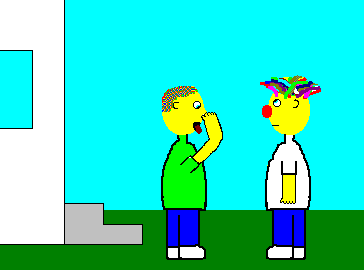
“Nice.  It’s pretty there.”  I looked at Martin’s shirt while he was talking to me.  It was white, with the words “VOTE BOB & LARRY IN 1996” at the top.  Below it was a strange cartoon drawing of a round, almost spherical red character and a tall green character, cylindrical with a rounded top, standing behind a podium like candidates running for President.  Both of these characters had oddly-shaped asymmetrical eyes.  Apparently their names were Bob and Larry, but whatever cartoon they were from was unknown to me.  I did not ask.

The game remained close until late in the game; neither team led by double digits until only 10 minutes remained, when the United States began to pull ahead.  Vlade Divac had fouled out by then.  When it became apparent that Yugoslavia was not going to make a miraculous comeback, I got up, used the bathroom, and wandered around what was left of the party.  It was getting late, and the crowd seemed noticeably smaller by then; the living room and kitchen were filling up with empty cups, soda cans, and paper plates.

“Are you having fun?” Vanessa, the girl who had answered the door when I arrived, asked me.

“Yeah.  I didn’t know much about this 20/20 group before tonight.”

“You should come check it out sometime.  Do you go to church?”

“Yeah.  I go to the Newman Center,” I said

I waited for Vanessa to give the predictable response that Catholics aren’t real Christians, and that the office of the Papacy is un-Biblical.  But instead, she just said, “That’s Catholic, right?”

“Yeah.”

“You’re always welcome to check out 20/20 and J-Cov if you want.  The class starts at 9:15, and the service at 10:45.”

“Thanks.  I might someday.”

By midnight, the party had quieted down even more.  Noah and Martin were still watching the Olympics; the final round of the men’s 5000-meter run was on.  “I don’t think I even realized the 5k was an Olympic event,” I said.

“They show it late at night because Americans don’t do well in it,” Martin said.

“Yeah,” Noah added.  “Usually those African long-distance runners dominate.” 

The race took fourteen minutes to finish.  The lead changed several times, and the lone American runner in the race, Bob Kennedy, remained in contention but fell to sixth place on the last lap.  Half of the contenders finished within a few seconds of each other, but a few others had fallen far behind.  The final runner, Aissa Belaout of Algeria, did not cross the finish line until 20 seconds after the next runner ahead of him, almost a full minute behind the winner.

“I always wonder with guys like that,” I said.  “You’re so far behind, there’s no way you can win.  But you just have to keep going, because making it to the final round of the Olympics is such an accomplishment.”

“Yeah,” Noah replied.  “Never give up.  Keep running.  They earned their spot in the Olympics.  As long as you’re still alive and still running, you never know what’ll happen.”


I said my goodbyes a few minutes later and drove home, going straight to bed after I arrived.  I learned a lot of new things tonight.  I knew that my friends from Jeromeville Christian Fellowship attended a number of different churches, but I always assumed that church was just something they did on Sunday.  Apparently I was wrong.  Jeromeville Covenant Church had a whole group for college students with activities and retreats, and this group included some people who did not also go to JCF.  My JCF friends who attended J-Cov had other Christian friends whom I did not know.

After the events of the last few weeks at the Newman Center, I was starting to question whether or not it was the best place for me, as a newly committed Christian, to learn about the Bible and grow closer to Jesus Christ.  Too many students at the Newman Center did not seem to take their faith very seriously, and the leadership put their agenda ahead of Scripture and the Church with their emphasis on liberal feminism.  Maybe I would try J-Cov and 20/20 sometime.  But, on the other hand, I was committed to singing at Newman, and I did not want to turn my back on the traditions of my Catholic family.  I did not have to decide right now.  Maybe, like the runners I had just watched waiting for the right time to surge ahead, I would just have to wait for the right time to try something new, and then see what happened.  Even though my life was full of unanswered questions, I was still alive and still running.

(Remember, I am almost 6’4″. I really am that much shorter than him; it’s not an awkward angle.)

July 27-29, 1996. Questioning my spiritual home. (#94)

The Dennison family got cable television in 1984.  I was in second grade, and we now got thirty channels with very clear pictures. This was a vast improvement over the six channels we got before, two of which were full of static and one of which was in Spanish.  I grew up watching MTV in the 1980s, and my mother absorbed knowledge of much of the popular music of that day.  However, my mother also had the habit of not paying close attention to lyrics and misunderstanding the meanings of songs.  To her, for example, “She Bop” by Cyndi Lauper was about dancing, rather than masturbation, and “Born in the USA” by Bruce Springsteen was a proud patriotic anthem, not a criticism of the United States government’s past involvement in Vietnam and subsequent neglect of veterans.

In 1996, after getting involved with Jeromeville Christian Fellowship and making new friends there, I discovered the new world of Christian rock music.  Bands like DC Talk and Jars of Clay filled two of the three discs on my CD changer, and I copied both albums to cassettes to listen to in the car.  A few of those Christian rock hits were getting played on mainstream secular radio stations, and in an attempt to connect with me, Mom would tell me whenever she heard one of these songs.  Mom would also tell me whenever she heard some other song that had a lyric that sounded religious and ask if that song was by one of my Christian bands, despite the fact that many of these words had meanings in ordinary English and were used by non-Christian musicians as well.  No, Mom, “Salvation” by the Cranberries is not Christian music.

My family had recently set up Internet access, and Mom had made the humorous email name “Peg Not Bundy” for herself, in reference to Peg Bundy, the wife from TV’s Married With Children, and the fact that her name was Peggy also.  I opened an email from Peg Not Bundy and read it.


From: peg_notbundy@aolnet.com
To: “Gregory J. Dennison” <gjdennison@jeromeville.edu>
Date: Sat, 27 Jul 1996 09:33 -0700
Subject: Re: hi

I finally have a few minutes to sit and write.  It has been such a busy week!  I’ve had a lot of work to do.  Today Mark has a baseball game, so I have to take him to that, then Cody is coming over afterward p[bdfg6t7sdvg78ysvd (Davey says hi).


Davey was a cat, and that gibberish meant that he climbed on the keyboard as Mom was typing.  This was not the first time this had happened, but it always made me smile when I read that in Mom’s emails.  I continued reading.


I heard a song on the radio today that I kind of like.  The chorus said, “Tell me all your thoughts on God.”  Do you know that song?  Is that one of your Christian bands?  How is your class going?  One more week, right?  Talk to you later.  Love, Mom


I replied to the email and told Mom that the song was “Counting Blue Cars” by Dishwalla, and it was definitely not Christian music.  If Mom had listened to the next line, she would know that the song actually said, “Tell me all your thoughts on God, ‘cause I’d really like to meet her.”  A real Christian band would not be referring to God as “her”; this would be extremely unpopular with listeners of mainstream Christian music, although the idea was not unheard of among liberal feminists in the Church.

Liberal feminists in the Church were not hard to find in a university town like Jeromeville.  I attended Mass at the Jeromeville Newman Center, and one time last year, before I was part of the choir, I remember we sang a familiar song called “On Eagle’s Wings.”  Since its publication in 1979, this had been a popular song for Catholic Masses; I had heard and sung it many times growing up at Our Lady of Peace Church.  The line at the end of the chorus said “and hold you in the palm of his hand,” with God doing the holding, but the first time I heard it at Newman, it sounded like they were saying something a little different, almost like “palm of her hand.”  Some time later, when I got to church, I looked at the sign that had the numbers of the day’s songs in the songbook, and next to the number for On Eagle’s Wings was a female ♀ symbol.  Just like the time before, the choir sang female pronouns for God.  I noticed as the year went on that they would occasionally change other lyrics to refer to God in the feminine. I was a little surprised at this, because in my experience, the radical feminists and hippies who used female pronouns for God were not Catholic.


The day after Mom asked about Counting Blue Cars, I drove myself to church.  I usually carpooled with Heather Escamilla, who lived in the same apartment complex as me, but she had blown off church to spend the weekend at the Great Blue Lake with her boyfriend.  I heard Counting Blue Cars on the way to church and promptly changed the station.  Hearing that song reminded me that we were singing On Eagle’s Wings with feminine pronouns today, and this still made me uncomfortable.  God did not have a gender or biological sex in the way that humans understand the concept, but making a point of using feminine pronouns in church, going against centuries of church tradition, just seemed arrogant to me.  The Bible was the Word of God, and if masculine pronouns were good enough for those who wrote it, why are they suddenly not good enough for Jeromevillians in 1996?  Changing God’s gender felt like a slippery slope toward changing God’s teachings.

“Hey, Greg,” Claire, the unofficial leader of the choir, said as I approached the other choir members.  “How are you?”

“Doing well.  One more week of class.”

“Nice!  Are you taking a class second session?”

“No.  I’m just going to hang out.  And I’m moving at the start of September.”

“Me too.  I’m getting an apartment with Sabrina and one other girl we know.  I’m going to have my own room for the first time!  I’m not going to need my bed loft!  Do you know anyone who wants to buy a bed loft?”

“Actually,” I said, “I might be interested.  I’m going to be sharing a room.  How much?”

“I was thinking fifty dollars.  We can talk about it later.  I’ll let you know.”

“Sounds good!”

I walked to my usual music stand, next to Ellen Stark.  “Hi,” I said.  “How are you?”

“Good!  We’re taking a family vacation this week, up to Portland to visit relatives.  I’m excited about that!”

“Fun!  I have my final exam on Thursday.”

“Good luck!  I’m sure you’ll do fine.”

“When do you go back to California?”

“Middle of September.  So I’ll still be here for a while.”

“Good,” I said.

Claire whispered at all of us to be quiet as Father Bill and Sister Mary Rose walked up to begin Mass.  On Eagle’s Wings was the offertory song, sung about halfway through while the offering plates were being passed.  I had sung it with feminine pronouns before, because that was just the way things were done at the Jeromeville Newman Center, but today, with Counting Blue Cars still on my mind, it felt especially wrong.

“And hmm will raise you up on eagle’s wings,” I sang, purposely making the pronoun unintelligible.  “And hold you in the palm… of mmm hand.”  I looked at Ellen next to me to see if she noticed; she was looking straight forward, not at me.  Probably not.

After Communion, as Father Bill and others were making announcements, I noticed Lisa, another singer from our choir who sang at the early service during the school year, coming out of the back room with Sister Mary Rose.  Lisa walked back to her music stand.  I wondered what she was doing; she had been singing with us just a few minutes ago, and I did not notice her step away.  We sang the final song, and after Father Bill dismissed the congregation, we began putting our sheet music and stands away.  Lisa accidentally knocked over her stand, then almost tripped over it trying to pick up the scattered sheet music.

“Sorry!” Lisa laughed.  “There was a lot of leftover wine today.”

“What?” I asked, certain that I had misheard.

“After Communion, Sister Mary Rose and I were finishing the bread and wine,” Lisa explained.

“You have to eat and drink the rest of it?” Matt Jones asked.

“Yeah,” Lisa explained.  “You can’t just throw it away, it’s the Body and Blood of Christ!”

“I guess I never really thought about that,” Matt said.

“I know sometimes I need to get a little tipsy from the wine to finish the last song,” Lisa said, laughing.  Matt and Claire laughed with her, while I just stood, shocked at this blasphemy I was hearing.  I had recently read in First Corinthians where Paul wrote that “whoever eats the bread or drinks the cup of the Lord in an unworthy manner will be guilty of sinning against the body and blood of the Lord.”  My understanding was that, unlike many other Christians, Catholics believe that the bread and wine actually become the body and blood of Christ, while retaining the appearance and taste of bread and wine.  This is why, as Lisa said, it could not just be thrown away.

Joking about getting drunk off of the blood of Christ had no place in a house of worship.  At this point, though, I did not expect much reverence from a congregation that prioritized being good feminists and calling God She over church teaching.  I immediately walked over to Sister Mary Rose.

“Hi, Greg,” Sister Mary Rose said.  “How are you?”

“Can I talk to you sometime?” I asked.  “I have some things I’ve been thinking about.”

“Sure.  What’s your schedule like this week?”

“I have class Tuesday and Thursday from 12 to 2, and Wednesday from 10 to 2.  I’m free tomorrow.”

“How about you just come by here tomorrow afternoon?  Around one o’clock, maybe?”

“That sounds good.  I’ll see you then.”

“Yes.  See you tomorrow.”


I decided to ride my bike to the Newman Center the next afternoon to talk to Sister Mary Rose, instead of driving.  That way I could continue on a recreational bike ride afterward.  The ride took about ten minutes, but it was hot enough that I was starting to sweat when I arrived.  I locked my bike and walked into the church office, slowly and carefully.

“Hi, Greg!” Sister Mary Rose said.  “Take a seat.”  I sat in a chair across from her at her desk, trying to get comfortable, as she asked, “So what’s going on?”

I took a deep breath, and then another one, trying to make the words come out right.  “When we sing songs like ‘On Eagle’s Wings’ with the feminine pronouns, that isn’t right to me.  It’s like you’re putting politics above church teaching and the Word of God.”

“Well,” Sister Mary Rose replied, “how do you think you would feel if you were a woman?”

I paused.  It seemed like she was setting me up to make me feel guilty for being a white male, a standard tactic used by liberals to make conservatives look bad.  I did not feel guilty for being who I was, but I also did not want to start an argument or say anything that Sister Mary Rose would find offensive.  “I don’t know,” I replied.  “I would probably notice that God is usually spoken of as if he were male, but I would like to think that I would submit to Scripture and Church teaching on the subject.”

“Well, God is not a man.  God has both male and female attributes.”

“I agree.”

“Then why is this a problem for you?”

“It just feels…” I shifted my position in my seat.  “Kind of arrogant, like you know better than hundreds of years of Church teaching, and the people who wrote the Bible.”

“Church teaching has changed.  And so has language.  It was normal at one time to use a word like ‘mankind’ to mean all men and women, but today we would say ‘humankind.’”

I nodded, but inwardly cringed.  I thought “humankind” was kind of a dumb word, when “mankind” did just as well with fewer letters and syllables.  It had only been twenty-seven years since Neil Armstrong’s famous use of the word “mankind,” and the language had already changed?  I remember being home at Christmas and noticing that this year’s songbook at Our Lady of Peace had replaced the word “mankind” in one of the later verses of “O Come, O Come, Emmanuel” with “humankind,” breaking the rhythm by adding an extra syllable.  Forcibly changing the language like that felt too much like George Orwell’s 1984 to me.

However, Sister Mary Rose brought up an important point: I was not a woman.  I did not know how it felt to live in a culture that historically treated women as second-class citizens, and while women had made a great deal of progress toward equality, old habits and scars remained at times.

“But,” I asked, “isn’t church teaching supposed to be based on the Bible?  And the word of God doesn’t change.”

“The word of God doesn’t change,” Sister Mary Rose reiterated.  “The Church will never do anything that goes against the Ten Commandments, or the teachings of Jesus.  And changing the language we use doesn’t go against any of that.  You agreed that God has male and female attributes.  So using male and female language to refer to God does not go against any teaching.”

I took a deep breath and said, “I don’t know.”

“Pray about it.  Pray that God will give you peace about this.”

“I just don’t know if I belong here anymore.”

“What do you mean?  Where?”

“The Newman Center.  I’ve been getting involved with Jeromeville Christian Fellowship, they are nondenominational, but the more I learn about the Bible, I see a lot of people here who don’t really seem to take their faith seriously.”  I shifted in my seat again, debating telling her about Lisa getting tipsy from the Communion wine; I decided not to.

“Greg, no one is perfect.  Everyone sins.  That is why we have the Sacrament of Reconciliation.  And if you are concerned about them, you can be a good example and take your faith seriously, and pray for them.”

I nodded.  “That makes sense,” I said.

“You’ve been a part of Newman for, how long?  Two years now?  I would hate for you to feel like this isn’t your spiritual home anymore.”

“Yeah.”

“May I pray for you?”

“Sure.”

Sister Mary Rose folded her hands and looked down, and I did the same.  “O Loving Parent, I pray for your blessing on Greg.  I thank you for bringing him to the Newman Center to be a part of our community.  I thank you for blessing us with his voice on Sunday mornings.  I pray that you will give him peace about these things that have been on his mind, and that he will listen for your guidance.”  She continued, saying the Hail Mary prayer, then lifted her head and opened her eyes.

“Thank you,” I said.

“Just find a quiet place and listen to God.”

“I’ve been trying to do that.”

“Good!  Keep doing that.”  We made small talk for a few minutes, and I left, feeling a little bit better, but still unsure of what to think of all this.


Later that night, when I got home from my bike ride, I turned on the radio and went to the kitchen to make dinner.  My sink was full of dirty dishes, and my little studio apartment did not have a dishwasher, so I began washing the dishes by hand.  Counting Blue Cars came on a few minutes into doing the dishes.  “Tell me all your thoughts on God,” lead singer J.R. Richards sang, “‘cause I’d really like to meet her.”  My hands were too wet and soapy to walk over and change the station, so I left it on.  It really was not a bad song, other than the use of female pronouns for God.  

I will tell you all my thoughts on God, J.R., I thought.  God created the universe and inspired holy men to write the Bible.  Those holy men referred to God with masculine language, so I will do the same.  A huge part of knowing God is knowing and obeying his Word, and not placing the cultural norms of this liberal university town above God’s Word.  I hope you do meet him someday.

But that in no way makes women second-class citizens.  Men and women are both created in the image of God, and both have roles to play in God’s kingdom.  And I had to admit that I had not studied the original languages of the Bible, so I did not know how gender and language worked when the Bible was originally written.

I still felt unsettled about all of this, and uncomfortable with the idea of a church referring to God in the feminine.  I felt just as uncomfortable, if not more so, with church choir members getting tipsy from Communion wine.  “Tell me all your thoughts on God,” J.R. continued, “‘cause I’m on my way to see her.  Tell me, am I very far?”  I was going through the same process as the character in the song, seeking God and wanting to know how to get closer to him.  Maybe that would happen at the Newman Center, or maybe I was looking for something else, but I was asking the right questions and moving in the right direction.

Summer 1996. The friendly neighbor. (#93)

According to an old saying, people come into your life for either a reason, a season, or a lifetime.  Some of the people I met in Jeromeville only crossed my path for a reason; I only met Moises a few times, and he showed me the gross misconceptions held by other Christians about Catholicism.  For the people who came into my life for a season, the season varied dramatically in length.  Megan McCauley, my older friend who became a hopeless crush, was part of my life for a little over a year, but Sarah Winters, one of my best friends at the University of Jeromeville, we were friends for about thirteen years until life got in the way and we gradually grew apart in our early thirties.  And, of course, some of the people I met in Jeromeville, like Taylor Santiago and Eddie Baker, have become lifelong friends whom I am still close with today.

One person who came into my life for a literal season, the summer of 1996, sat in a lawn chair reading one afternoon in front of apartment 224 at Las Casas Apartments, the apartment directly above mine.  The class I was taking had just started a few days earlier.  I rode my bike home from campus, checked my mail, and rode up to my apartment.  “Hi,” I heard a voice say above me as I walked my bike up to the door.  “Do you live downstairs from me?”

I looked up at the balcony and saw a short, stocky African-American woman with short curly hair and glasses looking at me.  “Yes,” I said.  “I don’t think I’ve seen you around before.”  As far as I knew, the leases at Las Casas ran from September 1 to August 31, to correspond with the UJ academic year.  I was not sure how I could have a new neighbor at the end of June, but she promptly answered my question.

“I’m Marie.  I’m Dan’s friend, I’m subletting this apartment from him; he’s gone doing research for the summer.”

“Nice to meet you.  I’m Greg.  I never actually knew Dan; I kept to myself a lot all year.”

“Nice to meet you too!  So what do you do?  Are you a student?”

“Yes.  I’m a math major.”

“Undergrad?”

“Yeah.  I just finished sophomore year.  What about you?”

“I’m just working at a temp agency.  I’m kind of at a point in my life where I’m trying to figure out the next step.  I’ve been moving around a lot, working here and there until I figure things out.”

“Where were you before this?”

“Southern California.  I liked it there, but I was just ready to move on.”

“That makes sense.  Have you been to Jeromeville before?”

“No!  But Dan has told me about it, and it seemed like a nice place to check out.  So here I am!  Are you from around here originally?

Plumdale.  Near Gabilan and Santa Lucia.”

“Oh, okay.  I’ve been to Santa Lucia a few times.  It’s so pretty there!”

“Yeah.  What about you?”

“I’m originally from North Carolina, but like I said, I’ve lived all over the country.”

“Wow.”

“Are you taking classes this summer?  You’re wearing a backpack.”

“Yeah.  I’m taking Introduction to Software.  I don’t need it for the math major, but it’s a prerequisite for an upper-division computer science class that counts toward the math major.  And I like fiddling around with computers.”

“Wow.  I’m not a techie at all.  I’ll come to you next time my computer isn’t working.”

“I don’t know if I’m that good,” I said, chuckling.

“It was nice meeting you!  I’m sure I’ll be seeing you around.”

“Yes!  It was nice meeting you.”


The next time I saw Marie was about a week later.  She knocked on the door as I was typing an email to my mom, who had just recently gotten Internet access for the first time and was writing to me almost every day.  “Hi,” I said after I opened the door.

“Hi, Greg!” Marie said.  “How are you?”

“I’m doing okay.  What about you?”

“I’m good!  Have you had dinner yet?”

“No,” I said.  “Why do you ask?”

“I decided to try this new chicken and rice recipe that I got from a friend, and I made too much for just me.  Want to come upstairs and try it?”

“Sure.”

“Great!  Come on up!” she said.  I locked the door behind me and followed Marie up the outside stairs into her apartment.  The apartment above me was a studio apartment with a loft; the loft was set up like a bedroom, but open to the living area downstairs.  A small dining table was next to the entrance to the kitchen, where I had my bookshelf in my apartment.  I was not sure which of the furniture and pictures on the wall were Marie’s and which belonged to Dan, who had the apartment the rest of the year.

Marie went into the kitchen and emerged with two plates.  Each plate had a chicken breast on top of rice with vegetables mixed in, and other vegetables on the side.  “Sit down,” she said gesturing toward the table.  “I’ll get you some water.”

“Thank you,” I said.  I waited for Marie to sit back down before I started eating, and after she did, I took a bite.  “This is really good.”

“Thank you!  Would you like the recipe?  I can write it down before you leave.”

“Sure,” I said.  “Honestly, though, I’m not very good at cooking.  I don’t know if or when I’ll make it.”

“That’s no problem.  It’s there if you need it.”

“True.”

“So how is your class going?  What are you learning about?”

“The programming language C,” I explained.  “It’s set up differently from the other programming I’ve done, but it’s ultimately a lot more powerful.”

“Interesting,” Marie replied.  “I told you before, I don’t know any of that stuff.  Why didn’t you major in computer science if you’re into that?  There’s a lot of good jobs out there for computer people.”

“Because most of my computer knowledge is out of date, so most of the people in my classes would be coming in with more knowledge of the basics than I have.  Also, I didn’t want my hobby to become work.”

“That makes a lot of sense.”

“I taught myself BASIC on a Commodore 64 when I was nine,” I explained, “but that’s useless already in today’s world.  Technology moves so fast.”

“That’s true,” Marie said.  “How old did you say you were?”

“I’m 19.  I’ll be 20 in August.”

“That’s right.  You said you were a sophomore.”

“Yeah.”

Marie paused, then said, “How old do you think I am?”

Uh-oh.  I did not like being put on the spot like this.  “I’m not good at guessing people’s ages,” I said.

“I’m just wondering, because people say I look younger than I really am.”

That made it even more difficult, because she looked a little big older than me.  Was she actually a lot older than me?  “25,” I guessed hesitantly.  Marie pointed upward.  “Older than 25?” I asked.  Marie nodded, and I guessed, “27.”  She pointed upward again.  She really did not look older than 27.  “30?” I guessed, apprehensively.

“Yes.  I’m 30.”

“Whoever says you look younger, they’re right.”

“Thanks,” Marie said, smiling.  “So what are you doing this weekend?”

“Probably just studying,” I replied.

“I’m thinking I want to go see a movie this weekend.  You want to come with me?  Maybe Saturday afternoon?”

I was not expecting this; instead of Yes or No, the first thing to come out of my mouth was, “What movie?”

“Have you seen Independence Day yet?  I’m seeing ads for it everywhere.  It looks interesting, for sure.”

“I haven’t, but I want to.  That sounds good.”

“Great!”

I stayed in Marie’s apartment for about an hour and a half that night, just talking about life.  She looked up the movie times at some point, so we could make plans for Saturday.  After I left, I sat in my apartment, trying to make sense of what was going on.  Marie was kind of acting like she was interested in me.  At least this is what I assumed it was like when a girl was into me; since no girl had ever been into me as far as I knew, I was not quite sure.  But she was thirty years old.  Surely she was not interested in a young kid like me.  She was just friendly.


On Saturday afternoon, I climbed the stairs to Marie’s apartment about half an hour before the movie started and knocked on the door.  “Hey!” she said when she opened the door.  “You ready to go?”

“Sure.  Want me to drive, or are you?”

“How about you drive, and I’ll pay for the tickets.  Does that work?”

“Sure,” I said.  “That’s my car down there, the red Bronco.”

“Nice,” she said.  As we headed down Andrews Road and turned onto Coventry Boulevard, she asked, “So do you ever take this thing off road?”

“I don’t,” I said.  “Well, this was our family car for five or six years before I moved here.  We used to visit my great-grandma in Bidwell a few times a year, and she lived at the end of a dirt road about a mile long.  Sometimes we’d use the four-wheel drive on that road.  But that’s about it.”

“You should go off-roading!  It’s so much fun!”

“Maybe someday.”

I turned right on G Street, just past Community Park, and headed south toward downtown.  The movie theater in Jeromeville was on the corner of G and First Streets, six blocks from the old part of campus.  I had not seen many movies in the last couple years, at least not during their first run in theaters; I had only been to this movie theater twice before.  It was in a gray building with a two-story parking garage above it.  I maneuvered my large vehicle through the narrow ramp leading up to the parking garage, barely wide enough for a car going up to pass a car going down.

“Can you fit in here?” Marie asked.

“I’ve done it before,” I said.  “Hopefully an even bigger car doesn’t come down at the same time.”

Marie laughed.  “Then we’d be in trouble.”

The stairs leading down from the parking garage were on the outside of the building, not a typical scary parking garage stairwell.  We walked to the box office, where Marie said, “Two tickets for Independence Day, please.”

“Are you sure you want to pay for both tickets?” I asked.

“Sure!  I asked you.  And it’s afternoon matinee prices.”

“Seven dollars, please,” the cashier said.  Marie gave the cashier the money, and he gave us our tickets, which the person at the entrance promptly tore in half a minute later.  We sat near the middle of the theater; seats were already starting to fill up.

“Do you like these kinds of movies?” Marie asked.

I had to think about this.  “I guess I don’t really have one specific kind of movie that I like best,” I said.  “Some movies I just like, and some I don’t.”

After sitting through several minutes of previews, the movie began with giant alien spaceships coming to Earth early one July.  The aliens positioned themselves over major cities, destroying them all simultaneously with massive energy beams.  A Marine played by Will Smith led attacks on the alien spaceships, which failed.  Jeff Goldblum’s scientist character eventually found a way to deactivate the force fields protecting the aliens, and Bill Pullman’s President of the United States character gave a rousing speech.  He said that July 4 is Independence Day in the United States, but now it would be the day that the whole world fought back against the aliens.  People watching the movies cheered on the fighter pilots on the screen.

After the movie ended, I turned to Marie and said, “I’m excited.  That was a nice feel-good movie.”

“It was!”  She grabbed her purse, then said, “So what do you want to do now?  Want to get something to eat?  Lyon’s is right across the street.”

“That sounds good.”

As we stepped outside, I had to squint, since my eyes had become accustomed to the dark theater.  We crossed the street and walked into the restaurant.  Lyon’s was a chain of restaurants serving American diner food.  When I was very young, I remember a few times going to breakfast with my dad at Lyon’s in Gabilan.  I usually got waffles.

“What are you getting?” Marie asked as we each looked through the menus.

“Probably a cheeseburger.”

“I’m going to get this chicken salad.  It looks good.”

“Sounds good,” I said.  I did not admit that I was not a big fan of salads.

“So what did you think of the movie?”

“It was a lot of fun.  But I’m kind of suspicious that the alien spaceships would be compatible with a human computer virus.”

“I hadn’t thought of that.  You’re the computer guy.”

“A computer virus is just a program that does something destructive,” I explained.  “If the computer can’t understand the instructions, the virus can’t do anything destructive.  If you took a virus for a PC and ran it on a Mac, nothing would happen; it would just look like gibberish to the Mac operating system.  The movie writers apparently don’t know how computer viruses work.”

“That makes sense.”

The food arrived a few minutes later.  I tried to break up a lull in the conversation by asking, “So how long will you be in Jeromeville?  Are you just here until your friend gets back?”

“Yeah.  He comes back in the middle of September.”

“And he has the same apartment for next year?”

“Yeah.  Do you?”

“No.  I’m moving into a bigger apartment with roommates, at Sagebrush Apartments on Maple Drive.”

“Oh, ok.  So, around the corner from Las Casas?  Past the shopping center?”

“Right.  What about you.  Where are you going next?”

“I’m gonna take some time off for a while.  I’m going to travel, see some of the National Parks in the Southwest and the Rockies.  I haven’t seen the Grand Canyon since I was little, and I’ve never been to Zion, so I’m definitely going to those two.  I haven’t really figured out where else.”

“That sounds fun!  I’ve never been to either of those places.  Where is Zion?”

“Utah.”

“Yeah.  We didn’t really travel much growing up.”

“Really?  You gotta get out there and see the world!”

“I will someday.”

“What’s the farthest away you’ve been?”

“Vancouver,” I said.  “My family took a long road trip to the Expo ‘86 World’s Fair when I was nine.  We went to Spokane first, to see Dad’s mother, then we all went to Vancouver in a rented RV.  That was my only time out of the country.”

“That sounds fun!”

“Oh!  And I’m going to Illinois in December.  That’ll be the farthest away I’ve ever been.  It’s for a Christian student and young adult convention, to learn about mission trips and service opportunities.”

“Are you looking to do that?  Be a missionary someday?”

“I’m not sure.  But I have friends who do things like that in the summer, and I want to learn more about what they’re doing, and stuff like that.”

Marie and I finished our meals, talking more about my faith journey and her options for life after she finished her trips to the Grand Canyon and Zion.  It must be fascinating to live that way, to wander the country working short-term jobs, never putting down roots.  I did not see that kind of lifestyle as my future.  I hoped someday I would settle down with a wife and children.  But there was nothing wrong with Marie’s way of life, if it worked for her.


My favorite part of the Jeromeville Bulletin local newspaper was the daily column written by Bill Dunnigan.  He often poked fun at the City Council and other prominent local figures.  One member of the City Council was an aging hippie named Jill Popovich, who had ideas like making long straight avenues curved so drivers would slow down.  Ms. Popovich was vocally against paving a muddy alley downtown that became a breeding ground for mosquitoes in the winter, because dirt alleys enhance the small-town character of Jeromeville, and she was a major proponent of adding a tunnel for frogs to a new overpass that opened that summer.  Bill Dunnigan often joked that she was an alien.  A few days after I saw the movie with Marie, Bill Dunnigan wrote, “If the City Council thinks that Jeromeville is so important, why didn’t the aliens in the movie Independence Day attack Jeromeville?  They probably feared the wrath of Jill.”

I ran into Marie around the apartment several more times between then and the end of August, when I moved out.  She was always friendly, and I always enjoyed talking to her.  In late September, in the new apartment, I got a postcard from Zion National Park.  It said:


Greg —

I’m enjoying my travels very much!  It is so beautiful here.  Utah looks so different from California.  So good to be out in nature again.  I’ve been on so many great hikes here!  I leave for the Grand Canyon tomorrow morning.  I hope you’re doing well, and that you like your new roommates.  Have a great school year!  –Marie


That was the last I ever heard from Marie.  To this day, I still do not know if she liked me or if she was just being friendly.  She was nice, but I just would not have felt ready to be in a relationship with someone a decade older than me.  We probably would not have worked out anyway, because of that.  Marie was part of my life for a season, but also for a reason: I got lonely sometimes that summer, and I needed a friend.  

July 18-20, 1996. A new creative project and a new cheeseburger. (#92)

In 1996, the Internet was coming into the mainstream.  Average citizens were communicating by email, discussing topics on a Usenet forum, chatting on Internet Relay Chat, and using the Netscape browser to surf the World Wide Web, a platform for informational documents that could be linked to each other.  Advertisements were beginning to include the websites of the companies involved, where anyone in the world with an Internet connection could look up information about the product in question.

The truly computer savvy individual in 1996 had a personal website.  The academics, scientists, and government officials for whom the Internet was created used personal websites to share about their careers, their research, and contact information, which was useful for their colleagues and students to have.  A few people I had met on the Internet had personal websites, and mostly they consisted of a picture or two and a little bit about the author, with links to other relevant websites.  Some of my friends had personal websites too.  Eddie Baker had a link to his personal website on his email signature.  Eddie’s website had a picture of himself, another picture with his seven roommates, some of his favorite Bible verses, and a link to the University of Jeromeville page.

I wanted so badly to make a personal website, although I had no practical need for one. Unfortunately, this feature was not possible with a UJ student account.  This guy named Carl who I met on IRC had access to some kind of personal server, where he gave me an account for free so I could fiddle with making a website.  I taught myself basic HTML, the code used for making websites.  I found a computer lab on campus with a scanner and scanned a copy of my senior picture from Plumdale High, so I could put that picture on my website.  I don’t know why I did, though; I always hated that picture.  I wrote a little bit about myself, with links to the pages for the University of Jeromeville and a Bay City Captains football fan page I found.  Back in those days, jokes and chain letters circulated by email, the forerunners of the memes and viral posts of the 21st century, and I copied and pasted some of my favorites on my page.

Eddie’s page was hosted by a UJ Computer Science Department account; he was an International Relations major, but had taken a couple of computer classes.  When I took Introduction to Programming in the spring, I got a Computer Science account, so I did not need Carl to host my site anymore.  At some point after I finished my current Introduction to Software class, I would have to move my site again, since I would not be taking a Computer Science class in the fall.  Eddie’s site would probably get deleted eventually as well.  I needed to find out if I could get a Mathematics department account and host a personal website on that.

One Thursday night, after I got home from Bible study, I was bored.  I was caught up with homework for my class, and I had finished reading everything I was reading for fun.  I sat down in front of the computer and dialed into the university’s computer network.  I got on my usual IRC chat channel and looked for someone to talk to.  A girl named Laura, whom I had been talking to for a few months, was on, so I messaged her.  Laura was 17 years old and lived in upstate New York.

gjd76: hi :)
lauragirl17: hi greg! how are you?
gjd76: really bored. i’m caught up with all my work.  how are you?  i haven’t talked to you in a while.  how were things with adam?
lauragirl17: i know, i wasn’t on as much when adam was here.  we had a good visit.  it was a little weird at the end though
gjd76: why?
lauragirl17: just some stuff happened and i think we’re just going to be friends
gjd76: aww.  i hope everything is ok.  i wish i could meet girls i knew on the internet
lauragirl17: have you ever met someone from the internet in real life?
gjd76: just once. it was another girl from jeromeville, turned out she lived right down the street.  we just hung out and talked for a while, i could tell she wasn’t really my type
lauragirl17: aww. she’s missing out :) maybe i’ll be able to come to jeromeville someday
gjd76: that’d be fun :) well, you could come right now, i gave you my address
lauragirl17: yeah you did! i leave on tuesday, i’m so nervous but so excited too, i’ll write to you as soon as i get settled.  it’s kind of weird to think that i’ll be in switzerland this time next week
gjd76: i’m excited for you :) this will be a great experience… one of my best friends in high school, she was an exchange student in austria, and she loved it
lauragirl17: i know, it’s just going to be a big adjustment
gjd76: of course
lauragirl17: well it’s really late here, i should get to bed… but it was good talking to you
gjd76: you too! good night, sleep well :)

I hoped Laura would actually write to me from Switzerland.  One of my friends from school, Kelly, was going to be studying in Hungary next year, so between Kelly and Laura, I could possibly be writing and receiving letters from Europe often next year.

Someone else from the chat posted a link to his personal website; I opened it in another window in between messages from Laura.  In addition to pictures of himself and links to his university, he also had a story about this party he had attended last month, with pictures from the story and paragraphs telling what happened.  I wished I owned my own scanner, so that I could share pictures on the Internet too.

That guy from IRC with the story about his party gave me an idea for something to add to my website.  A few years ago, Nintendo released a game called Mario Paint.  It was not a game at all, it was more like rudimentary but functional drawing and animation software.  It came with a mouse, which was easier to use for drawing than the standard Super Nintendo control pad.  Three years ago, I used Mario Paint, two VCRs, and a microphone to make a short film about two strange teenage boys with a weird neighbor.  The film was influenced by the buddy comedies of the time period, like Wayne’s World and Beavis and Butthead.  I called my creation “Dog Crap and Vince.”  I made a few other Dog Crap and Vince short films over the next couple years, and the most recent one I made after I bought this computer, so the screenplay was still saved on this hard drive.

I opened my screenplay and read it.  Dog Crap’s cousin came to visit, and while throwing a football around in the yard, Vince threw it too hard, and it got run over by a truck.  The boys found a football at a garage sale to replace the one they lost, but it was so old and hard and brittle that it cracked open when it landed on the ground.  That was inspired by an inside joke; once, a strange neighbor back home gave my brother and me an old football that had belonged to her son when he was young, and it hit the ground and cracked open just like that.

I opened Microsoft Paint, the drawing software that came with Windows 3.1, and drew the opening scene, where Dog Crap opens the door and lets his cousin in.  I then drew the next scene, where the two of them watch television with Vince.  Both Dog Crap and Vince always had strange multicolored hair, and I never explained their odd appearance in any of the short films.  I also never explained why Dog Crap’s name is Dog Crap, and in their fictional universe, no one questions this.

I continued illustrating scenes from this Dog Crap and Vince story until around one in the morning.  The following day, after I finished a morning bike ride, I continued working on Dog Crap and Vince, illustrating the rest of the scenes from the story.

Next, I began typing the HTML code.  I typed the lines of dialogue and description for the story, in prose instead of the screenplay format I had written for the Mario Paint film.  It did not feel like an actual story, since the illustrations left most of the descriptions unnecessary; the remaining text was very heavy on dialogue.  But this was a new format for me, and I did not really have a template or precedent on which to base my work.  This story really was designed for animation, but in the absence of that kind of technology, this would have to do.

When I finished writing and debugging the HTML, I uploaded it, and all of my drawings, to the website.  I also updated the home page, trying to think of what to call my creation… was it a story, or a comic, or a script, or what?  I ended up calling it a story.  “Read my story: ‘Dog Crap and Vince, episode 1: ‘Football,’” I typed.  I made that line a hyperlink, so that someone could click on it to go to the story.  I read through my entire Dog Crap and Vince story again.  I was proud of my work.  Now I just needed someone to share it with.


Many of my friends who lived in this part of Jeromeville left for the summer, but some of them were still around.  Ramon and Jason were still in their apartment on Hampton Drive, and Caroline still lived upstairs from them.  Liz, Ramon’s girlfriend and Caroline’s roommate, had gone home for the summer.  By Saturday afternoon, the day after I finished Dog Crap and Vince, I was in a mood to socialize, so I walked over to Hampton Drive, about a quarter mile away.  Caroline saw me first; she was standing on the balcony, attaching some kind of wire mesh to the balustrade and railing.  “Hey, Greg!” she said.

“What are you working on?”

“I’m going to let Henry come out here.  I’m putting this up so he doesn’t accidentally fall.”

“That’ll be fun.  The cats we had growing up were always outdoor cats.  It’s weird to me to think that Henry never goes outside.”

“When we got Henry, we knew he had to be an indoor cat,” Caroline explained.  “The apartment wouldn’t allow it otherwise.”

“Makes sense.”

I heard the door on the downstairs apartment open.  “Hey, Greg,” Ramon said.  “I thought I heard your voice.”

“I just wanted to come say hi.”

“Stick around.  Liz is on her way up; she should be here soon.  She’ll want to see you.”

“Oh.  Cool.”

I went inside to watch TV with Ramon and Jason.  Ten minutes later, Caroline came down to tell us that the cat-proofing of the balcony was finished.  All of us went to the living room of the upstairs apartment and watched as Caroline opened the door to the balcony, picked up Henry and put him outside.  Henry looked around skittishly, then cautiously walked around, sniffing things.  Caroline tossed him his toy, a plastic ball with a small bell inside; Henry sniffed the ball and swatted it away, then chased his little furry black and white spotted body after it.

“It’s like he doesn’t quite know what to think of the outside,” Caroline said.

Just then, we heard Liz’s voice saying “Hey, guys!”  She walked into the apartment and put her bag down.  When she saw me, she looked surprised for a second, then smiled.  “Greg!  It’s good to see you!”

“How are you?”

“I’m good.”  Liz turned to see what everyone was looking at on the balcony.  “Henry’s outside!” she said.

“Yeah,” Caroline replied.  “I just wanted to try it.”

“It looks like he likes it.”

Liz moved her bag into the bedroom.  After she came back out to the living room, Ramon said, “Jason and I have been wanting to try that new Arch Deluxe burger at McDonald’s.  Greg?  You can come with us if you want.”

“Sure,” I said.  “I haven’t eaten yet.  And I haven’t tried that either.”

“It’s supposed to have more of an adult taste,” Jason explained.

“What does that mean?  How do hamburgers have adult tastes?” Liz asked.

“I don’t know,” Jason said.  “It’s being marketed as more sophisticated.”

Across the street from their apartment complex was the back of a shopping center facing Coventry Boulevard.  After making sure Henry was securely inside again, the five of us walked there.  The McDonald’s was in the middle of the strip mall part of the shopping center and had no drive-thru.  We each took turns ordering; I got an Arch Deluxe, eagerly anticipating what this adult cheeseburger would taste like.

“What have you been up to, Greg?” Liz asked as we waited for our order numbers to be called.  “You’re taking a class, right?”

“Yeah.  Computer Science 40, Intro to Software.  It’s going well.”

“Good!”

“Today I made something new for my website.  Just for fun, not part of the class.”

“Oh yeah?  What is it?”

I told them about Dog Crap and Vince, how I had created the characters with Mario Paint a few years ago, and about the illustrated story I had written.  “I’ll show you guys when we get back to the apartment, if you want.”

“Sure,” Ramon said.

Jason’s meal had arrived by then; he bit into the Arch Deluxe.  “This is pretty good,” he said.  “It’s different, I’m not sure exactly what is adult about it, but it’s good.”

“What does Dog Crap and Vince mean?” Caroline asked.  “What does dog crap have to do with the story?  Does Vince always step in dog crap?”

“Dog Crap is his friend’s name.  So the title refers to the two main characters, Dog Crap and Vince.”

“Why is his name Dog Crap?”

“I’ve never explained that.  It just is.”

“Okay,” Caroline said, as if not sure what to make of this.

The cashier called my number, and I went up to the counter to get my food.  I sat down and opened the cardboard Arch Deluxe container.  The burger had a different kind of bun, looking more like a sandwich roll, but round.  I opened it and removed the tomato slice.  “You don’t like tomatoes?” Liz asked.

“No.”

“May I have it?”

“Sure.”

I passed my tomato to Liz and took a bite of what remained of the burger.  I liked it.  Definitely different from most other McDonald’s products; it tasted like it was made from higher quality ingredients.  “This is good,” I said.  Growing up, I was a connoisseur of Chicken McNuggets; I did not usually eat hamburgers at McDonald’s, but I was willing to reconsider this position because of the Arch Deluxe.

We sat together at McDonald’s catching up for a while.  Liz told us all about her summer with her family, and those of us who were taking classes shared how our studies were going so far.  At one point, during a lull in the conversation, Ramon said, “Has anyone ever noticed that this song is the same four chords over and over again?”

“Huh?” Caroline asked.

“This song,” Ramon repeated.  Blues Traveler’s “Run-Around” was playing in the background of the restaurant.  “It’s the same four chords over again.”

I listened carefully to the guitar and bass playing behind the energetic harmonica solo.  “You’re right,” I said, pretending to sound like I knew what I was talking about.  I had three years of piano lessons in my past, and I had been singing in the choir at church for almost a year, but Ramon was a much more accomplished musician than I was.  “I always thought it was catchy, though.”

“Oh, yeah, it’s catchy,” Jason agreed.

 We walked back to the apartment after we finished eating.  “Greg?” Ramon asked.  “Did you still want to show us that Dog Crap thing?”

“Sure.”

Ramon turned on his computer as Jason found something to watch on TV.  He opened Netscape and asked, “What’s the address?”  I typed the address for my website, then clicked on the link for Dog Crap and Vince.  Ramon began reading silently as Liz and Caroline and I watched the screen.  I felt slightly awkward. Was I supposed to read it out loud to them?  How would Ramon know when everyone was done reading?  At the end of the first page, Ramon asked if everyone was done reading before he continued to the next page.  That would work.  The others laughed a few times, such as when Dog Crap and Vince saw the Unabomber at the garage sale.

“That’s pretty funny,” Ramon said when he finished.

“You did a good job with the website,” Liz added.  “Are you going to do more Dog Crap stories?”

“Eventually, yes.”

“I’ll keep watching for those.”

“Thanks!”

The four of us hung out watching television and just talking for another couple of hours.  I walked home after that and got out a sheet of paper.  Future Dog Crap and Vince Ideas, I wrote at the top, then I added, Dog Crap is playing guitar, but he only knows four chords, and Vince says he can still play that Blues Traveler song.  I used a variation of that line in another episode later that year, and I made it a habit to write down anything funny that I thought of or saw that could be used in future episodes.

Today was a good day.  I would be eating many more Arch Deluxes in the future; this would become my new go-to order at McDonald’s.  However, sadly, the product was considered a massive failure.  The Arch Deluxe never caught on as a popular item once the initial hype faded, and a few years later, it disappeared from McDonald’s menus.

Dog Crap and Vince, however, did not disappear from my life.  I continued making new episodes of the series for eleven years, with more animated short films after that.  I also did numerous other side projects involving Dog Crap and Vince.  Many of my friends have been involved in a Dog Crap and Vince project at some point.  These two characters spawned a fictional universe that became a major part of my life for a long time.  The world of Dog Crap and Vince even seemed to take on a life of its own at times.  The cast of main characters grew from two to at least six, with many other recurring characters in their world, and at times, their stories seemed to take on lives of their own.  I never would have believed, on that day three years ago when I drew those two silly-looking boys on Mario Paint, that this would become such a major part of my life.


Author’s note: Dog Crap and Vince is not real.  It is based on an actual project called “Cow Chip & Lance.”  I’ve known the guys behind those characters for many years, and I’ve done some work behind the scenes for them.  They were thinking about reposting their web series from the 90s, and I’m writing about the 90s, so we decided to join forces on that project.  Go check them out.


July 12, 1996. Thinking about the future. (#91)

Everyone has those experiences of seeing a familiar face in an unexpected place or situation, and usually, such a moment turns out to be awkward.  Kids see their teachers grocery shopping and freak out, because it never occurred to them that teachers eat like normal humans and do not live at school.  In 1996, Kevin Johnson was playing basketball for the NBA’s Phoenix Suns, and in 2007, I saw him ordering at Chipotle, but I was too afraid to say anything.

I had one of those moments one Friday afternoon in the summer of 1996, when I was taking Computer Science 40, Introduction to Software, at the University of Jeromeville.  It was five o’clock, and I was still wearing the same old pair of shorts that I used for pajamas.  I had no class on Fridays, so I had not showered today.  I spent the morning in an IRC chat talking to a girl on the other side of the country, then I had worked on homework for a while, then I read a few chapters of a book for fun, and now I was going to go for a bike ride.  I put on a pair of real shorts and walked my bike out to the parking lot.  I looked up and saw Joe White.  “Hey,” I said.

Wait a minute.  Joe White, the teacher’s assistant for my computer class, does not live at Las Casas Apartments.  Or does he?  I had never seen him around here before.  He appeared to have just gotten out of the pool, and he was holding hands with a girl in a black bikini whom I had seen around the complex.

“Hi, Greg,” Joe said.  “You live here?”

“Yeah.”

“My girlfriend lives here.  It seems like a pretty nice place.”

“It is.  I like it.”

“How are you?  You seem to be doing really well in class so far.”

“I’m good.  I tend to figure out computers pretty easily.”

“Are you a CS major?”

“No,” I said.  “I’m a math major.”

“Do you need CS 40 for the math major?”

“No, but I needed 30.  And 110 counts in place of math units toward the major.  I’ve always liked computers, I want to learn more about programming, and 40 is a prerequisite for 110.”

“That makes sense.  Hey, I’ve been meaning to ask you, you were in Math 145 last quarter with Dr. Thomas, right?”

“Yeah.  Were you in that class?”

“Yes.  I’ve been wondering if all the math professors at Jeromeville are as bad as Gabby Thomas, or if that was just her teaching style.”

This comment caught me completely off guard, since Gabby Thomas had been my favorite math professor so far, and I was not sure what it was that Joe found so abhorrent about her teaching style.  I liked her class.  Not wanting to debate this, I simply said, “Every professor is different.  I’ve had good and bad experiences.”

“That makes sense,” Joe said as I nodded.  He continued, “So what do you want to do with your math degree?”

“I’m not really sure,” I explained.  “Math is just what I’m good at.  I’ll probably just stay here and go to grad school.”

“A Ph.D. from Jeromeville doesn’t really mean much if you’re going to be a serious academic.  But if your math grades are anything like how you’re doing in CS so far, you could probably get into a really prestigious program.”

“Hmm,” I said, nodding.

“I should get going,” Joe said.  “Enjoy your ride, and I’ll see you in class.”

“Thanks!  Have a good weekend!”

I pedaled out toward Andrews Road and headed south toward campus, thinking about what Joe had said.  It had never crossed my mind how degrees from different universities with different levels of prestige might affect future employment opportunities.  As a kid, I just went to whatever school was in my neighborhood; I never had to consider the school’s prestige, reputation, or history.  Apparently, a career in academia was a bit more complicated.  It also rubbed me the wrong way that Joe seemed to have a very low opinion of the University of Jeromeville.  He thought my favorite professor was awful, and that an advanced degree from here was worthless.  If he thought so lowly of UJ, why was he getting his degree here?  For all I know, maybe he did not get accepted anywhere else.

I rode my bike past the North Residential Area and Thong Bikini Hill, which was full of sunbathers and swimmers today, to the oak grove at the west end of the Arboretum.  I continued along the path on the south bank of the creek for the entire length of the Arboretum, emerging downtown on First Street.  I turned right on Cornell Boulevard, crossing under the railroad tracks near Murder Burger and then over Highway 100.  Another trail followed the dry creek bed on this side of the highway; I worked my way to this trail and followed it east to where it ended.  The grasses between the trail and the dry creek bed had turned brown in the dry summer heat, but the trees lining the trail were full of green leaves.

At the end of the trail, I turned around and headed back to the west, until I got to the greenbelt that led to the park at the end of Baron Court, where I turned right, away from the creek.  In May, I had been playing disc golf in this Greenbelt as part of the Man of Steel competition, an annual event among the men of Jeromeville Christian Fellowship involving disc golf, an eating contest, and poker.  I was looking forward to next year, hoping that I would not finish close to last place for a second time in a row.

As I pedaled past trees and a small playground, I got an idea.  Although I lived alone at Las Casas, part of the reason I chose that apartment was because thirteen of my friends from freshman year lived within a short walk of me.  I occasionally walked to one of their apartments just to visit.  During sophomore year, I got involved with Jeromeville Christian Fellowship, and two households full of my new JCF friends lived on Baron Court.  What if I dropped in on them just to say hi the same way I did for my friends who lived near me?

I stopped my bike in front of the closer of the two houses and walked it up to the door, nervously.  During the school year, Haley, Kristina, Kelly, and Jeanette lived here, with two other girls whom I did not know as well.  I was not sure who would be here today, except that I knew that Haley would not, since she went home for the summer.

I took a deep breath and looked back out toward the street, contemplating getting back on my bike and going home.  This was a bad idea.  Maybe none of my friends would be here.  Maybe they had other roommates in the summer who did not know me; what would I say if one of them answered the door?  Which roommate was I looking for?  Would it be weird to say that I knew multiple girls who lived here and I just dropped by to say hi to whomever was home?  Why was I even here?  If I was looking for a chance to talk to Haley, she was not in Jeromeville, so that would not happen.  I knocked on the door before I could talk myself out of this.  The thirty seconds that I waited for a response felt like several minutes as I played out all the scenarios in my head.

Kelly answered, wearing a t-shirt and running shorts.  “Greg!” she said.  “Hi!  What’s up?”

“Nothing,” I explained.  “I was just out on a bike ride, out your way, and just wanted to say hi if anyone I knew was home.”

“Come on in!  I’m the only one here right now.  You want some water?”

“Sure.  And I’m sorry that I’m all sweaty.”

“It’s fine,” Kelly said, walking toward the kitchen.  I followed her.  “I just got back from a run a little while ago, and I haven’t showered yet.”  As Kelly got a glass out of the cupboard and filled it from a pitcher in the refrigerator, I noticed something frying in a pan on the stove.  “I’m making a hamburger,” Kelly explained, handing me the glass of water.

“I see,” I said, drinking about half the water in my first sip.  “How’s your summer going?”

“Pretty good.  Two classes during a summer session is a lot of work, though.  But I’m keeping up with it.”

“Yeah, that sounds like a lot of work.  I’m only taking one class, and that’s a lot of work by itself.”

“Which class?”

“Computer Science 40.  Intro to Software.”

“That does sound like a lot of work,” Kelly said, chuckling.  “What are you learning about?  Intro to software, like making your own?  I’m not really a computer person.”

“Yeah.  We’re programming in C, which is a structured programming language.  A lot of more entry-level programming classes use languages that are simpler for humans to understand, but a lot less powerful.  Like last quarter in CS 30, when we learned programming in Pascal.”

“I see.”

“I don’t like working in the computer lab in the basement of Kent Hall, though.  I work better from home, with music playing and stuff.  But I have to be connected to the computers in Kent, and I don’t want to tie up the phone line.  So I’ll dial in around 10 at night, and stay up late getting my work done, and it works out because I don’t have to be up early in the morning.”

“That makes sense.”

“And I’ve trained myself to sleep in a little.  I don’t usually sleep in very well.”

“I… have the opposite problem,” Kelly said, chuckling.  “I sleep through my early morning classes.”

“I’ve found that most people do have the opposite problem.”

Kelly flipped over the hamburger patty with a spatula.  “So what else have you been doing this summer?  Did you go home at all?”

“Yeah.  The week in between spring quarter and summer session.  My brother and I turned all of our silly inside jokes into a board game.”

“That sounds fun!  How old is your brother?”

“Fourteen.  He starts high school this year.”

“Oh!  I was picturing older.  Is it just the two of you?”

“Yeah.  What about you?”

“I have an older sister.  She’s in grad school in California.”

“Nice,” I said.  “That’s about it for my summer.  I’ve just been going to my class, and going for a lot of bike rides, and going to the Bible study on Thursdays at Lillian’s– Oh!  And I mailed off my payment for Urbana!  I’m going, for sure!”

“That’s exciting!  I’ve heard such great things about Urbana!  I really wish I could go.”

“Why can’t you?” I asked, hoping it was not too personal of a question.

“Did I tell you what I was doing next year?”

“I don’t think you did.”  I hoped that I had not disrespectfully forgotten some key piece of information that Kelly had told me before.  I first wondered if she could not afford the trip to Urbana, then I wondered if she was going on a mission trip, the kind of thing I would learn more about at Urbana, like what Taylor and Pete and Charlie were doing in Morocco or Xander was doing in India right now.  Neither one was correct.

“I’m going to Hungary,” Kelly said.  “To study abroad.”

“Oh!” I said.  “That’ll be exciting!”

“Yeah.  I always wanted to study abroad.  I wanted to be an exchange student in high school, but it never worked out.  This time, the opportunity did work out.”

“When do you leave?”

“After first summer session ends, I’m going to go home for a little over a week.  I leave in the middle of August.”

“Will you have email?  Or is there an address I can write you?”

“Yeah!  I don’t think I’ll have email, but I’m keeping an address book so I can write to people.  I’ll send you my address once I get there.  Lemme go get it.”  Kelly left the kitchen and came back a minute later with the address book; she turned to the page for the letter D and said, “Will you be at the same place next year?”

“No,” I said.  “I’ll give you my new address.”  I wrote in the address book, Greg Dennison, 2601 Maple Dr. #K-5, Jeromeville (after Sept. 1).

“Who did you say you were living with next year?”

Shawn Yang, Brian Burr, and Josh McGraw.”

“So this is Brian’s address too?  I’d been meaning to get his address.”

“Yes!  And I will definitely write you.”

“Great!”  Kelly turned off the stove and put her hamburger on a bun, which she had on a plate.

“I should probably let you eat that,” I said.  “I need to get home.”

“Yeah, I need to eat and then get in the shower.  But thanks for stopping by!”

“Yeah!  Good luck with the rest of your classes!”

“Thanks!  You too!”

I left Kelly’s house and rode down Baron Court.  I thought about stopping by the house down the street where a bunch of guys I knew lived, but at this point I was ready to get home and make something to eat, so I did not stop.  Kelly’s hamburger smelled good.

I turned right on Valdez and right again at Cornell Boulevard.  I saw tractors and backhoes on the other side of Cornell from me; I had read that a shopping center was being built here.  Shopping centers always brought controversy in Jeromeville.  The city was run by aging hippies who fought tooth and nail to keep the city feeling like the small town it was forty years ago, in complete denial of the population growth brought on by the large and growing university adjacent to the city.  The construction of a shopping center always renewed debate about what kind of stores belonged in a proper small town like Jeromeville.  I thought the city council should just mind their own business and let the free market decide, because this was America.

I turned left on Willard Avenue.  This was my first time on this stretch of road.  An overpass had just opened a few weeks earlier, connecting Willard Avenue with Power Line Road on the other side of Highway 100.  In typical Jeromeville fashion, the overpass was controversial; new roads would bring more traffic, which would bring more crime from other cities, according to the very shaky logic of the people who ran this city.  Currently, only two two-lane roads connected the part of Jeromeville south of 100 with the rest of the city, and horrible traffic jams plagued both of them, especially Cornell Boulevard heading into downtown.  This new overpass in between those other two was desperately needed, in the eyes of anyone who could think logically and unemotionally.

When the need for the overpass became apparent, the people planning it decided that it would be a uniquely Jeromevillian overpass, with a landscaped median full of planters with trees.  Trees on an overpass made no sense to me.  Trees grow, and trees have roots, which would crack the concrete and dangle over the freeway below.  The trees and planters also would add weight to the overpass.  As I crossed Highway 100, riding past the trees, I thought about how the local newspaper columnist Bill Dunnigan had said the same thing I did about them.  But someone thought this was a good idea, and as if not to be shown up, the city of Nueces, 15 miles west on Highway 100, built their own overpass with trees a few years later.

North of the freeway, the overpass crossed a railroad track and Second Street, then passed between two undeveloped grassy areas.  One had a pond fed by storm drains that was full for most of the year.  The city paid thousands of dollars to design a tunnel under this road so that wildlife could cross the road, a move which many pundits from other cities in the region made fun of.  A local artist built some miniature buildings called “Frogville” which he placed near one end of the tunnel.  What makes this situation even more messed up is that much of the land was paved over within a few years, and no frogs or other animals were ever seen using the tunnel.  I always said that Tunneling Frogs would make a good name for a band.  Had I done more research into the quirky left-wing hippie local politics in Jeromeville before I came to UJ for school, there is a good chance I would not have chosen UJ.  However, after making so many friends here and discovering how much I loved bike rides, Jeromeville was definitely starting to grow on me.

As I continued riding home, north on Power Line Road, west on Coventry Boulevard, and then right on G Street into the Coventry Greenbelt, I thought about that afternoon’s conversations.  Joe White had brought into question my plan to stay in school forever, with his comment about the importance of getting into a prestigious graduate program.  Kelly Graham clearly had a plan for her year in Hungary.

What was my plan?  Was I really planning on staying in school forever?  What would I do then?  I would become a mathematician, teaching college classes while doing mathematics research.  Was that what I wanted?  What were my other options?  I was pretty sure I did not want to teach middle or high school.  If I changed my major to computer science or something involving computers, I would be competing with others who were much more knowledgeable than me about computers from this decade.  I also enjoyed fiddling with computers, and I did not want something fun to turn into work.  By the time I got home, I found that I was more frustrated than I had been when I started on this ride.

I stopped at the mailboxes on my way back to the apartment and took a deep breath.  I knew that I did not have to decide my future plans right now, but it felt more urgent than it had a few hours ago.  I opened the mailbox and saw a letter from Sarah Winters.  She was at home in Ralstonville for the summer.  I went home and read the letter before I got into the shower.  In my last letter to her, I had mentioned that the weather had been uncharacteristically cool.  I had also told her about my class, my week at home, and how I needed to coordinate with Shawn and Brian and Josh about moving into the new apartment and storing my things for a few days after I moved out of this apartment.  Sarah told me that she had been in a wedding for one of her high school friends, and that she had been going to the college group at her church.  She was going to Disneyland later this month, and she would be talking to her pastor about missionary opportunities over the next couple of years.  She closed her letter saying, “I hope your plans for next year fall into place and that the sun comes out soon.  Take care!”

The sun did come out; temperatures this week had been in the 90s.  And Sarah was referring to the moving plans falling into place, but after today, I felt like I had many other plans that needed to fall into place.  I still had time to figure out my future.  Or did I?  I had been at UJ for two years, and I had made virtually no progress in choosing a career.  I would graduate in another two or three years, and it would be better to come up with a plan soon, so that I could choose the right classes.

I seemed to remember the Math Club talking about career opportunities sometimes; maybe I should pay attention to those.  Or I may end up doing something entirely different.  In December, I would be attending the convention in Urbana, Illinois, to learn about Christian mission opportunities and ways I can serve God.  Maybe I would discover an entirely new career opportunity there.  The world was not an easy place, but I was learning, and I would figure out my future when I was ready.  Things seemed scary and confusing now, but my sun would come out soon.

July 2-5, 1996. I could go to jail for this. (#90)

When I was a student at the University of Jeromeville, I drove a 1989 Ford Bronco.  At the time, many people associated the Ford Bronco sport-utility vehicle model with retired football player and acquitted murder suspect O.J. Simpson, who led police on a nationally televised chase in a white Bronco two years ago.  Mine was red and tan, which conveniently enough were similar colors to my favorite football team, the Bay City Captains.  Technically my parents owned the car.  Dad bought it new when I was in seventh grade.  Between Dad driving to and from work, Mom picking me up from school, and all of my brother Mark’s baseball and basketball games and tournaments, we wore that car out quickly, putting a hundred thousand miles on it in less than five years.

Shortly before I left for Jeromeville, we were coming back from watching some of Mark’s friends in a baseball tournament in San Tomas, and the Bronco broke down.  My parents spent a fair amount of money to get it running again so they could send me off to school in the Bronco.  They got another car, and when they needed multiple cars, they often borrowed a car from my grandparents, who still had two cars and did not drive as often.

The Bronco was a big car.  It was great for when I had to move a lot of things, which pretty much had only happened once, when I moved out of the dorm at the end of freshman year.  It also had four-wheel drive, but I never drove off pavement, so this was not particularly useful to me either.  I would find advantages over the years to having a large vehicle, but those are stories for another time.

A car this size had two major disadvantages.  The Bronco only got around 13 miles per gallon, and it was difficult to park.  The first point was not something I thought about often.  The Bronco had a 30-gallon gas tank, and Mom and Dad gave me a credit card for Chevron gas stations on their account, so I did not have to pay for gas.  But I did often have trouble parking the Bronco in the parking spaces in Jeromeville, which seemed to be narrower than the parking spaces I grew up with.  One night, as I was coming home from the grocery store, this minor annoyance became something I needed to deal with immediately, as I tried to maneuver into a parking space at my apartment complex and felt a bump as I turned sharply to the right.

I had hit the car parked next to me.  What do I do?  My first thought was to finish parking, so I would not be in the way of anyone else trying to get by.  I carefully wiggled the Bronco into the parking space without further incident; I would have rather parked elsewhere, but the lot was full.  When I got out, I saw that the Bronco was fine, but the car next to me, a black Honda Civic, had a small crack in the taillight.  I vaguely remembered something from driver training class about having to leave my contact information and my car insurance information when I hit a parked car, but instead I ran in the house and called my parents.

“Hello?” Mom said.

“It’s me,” I replied, speaking quickly and panicky.  “I hit a parked car.  What do I do?”

“Where are you?”

“At home.  It was parked next to me.”

“How bad is the damage?”

“My car is fine.  The other car has a small crack in the taillight.”

“Don’t panic.  It’s not a big deal.  Do you know whose car it was?”

“No.”

“So just write down your name, and phone number, and insurance information, and put it on their windshield, under the wiper,” Mom said.  I heard Dad’s voice in the background, and Mom told Dad, “Greg hit a parked car.”

“Is my insurance rate going to go up?” I asked.

“Wait,” Mom said. “Dad is talking to me.”  I waited a minute, hearing muffled voices in the background.  “Greg wants to know if his insurance is going to go up,” I heard Mom ask Dad, followed by more muffled voices.  Finally, Mom said, more clearly, “Are you still there?”

“Yes,” I said.

“Dad says if you’re worried about getting insurance involved, if it’s just a tiny crack, it probably isn’t that expensive to fix.  You can offer to pay for it yourself, out of pocket.”

“That could work.”

“And if you’re worried about money, we can send you some to help.”

“I think I’ll be okay,” I said.

“Are you sure you’re okay?”

“Yes.  I should go now so I can leave a note on the car.”

“Good idea.  Just let us know if you need anything else.”

“I will.”

“Okay.  Bye.”

“Bye.”

I tore a sheet of paper out of a notebook and wrote: I accidentally bumped your car and hit the right taillight while I was parking.  I’m sorry!  If it’s not too expensive, I will pay for it without getting insurance involved.  If that doesn’t work, I can give you my insurance information.  Greg Dennison, apt. 124, 555-0159.  I went outside and walked down to where I had parked, so I could leave the note on my neighbor’s car.

It was not there.

The parking space to the left of me was empty.

I checked the car on the right, just to make sure I did not somehow get confused as to which car I hit.  The car on the right had no cracks in its taillights.

I was now officially guilty of the crime of hit and run.  I could go to jail for this.

Maybe no one would notice.

I waited about five minutes; the other car did not return.  I had not thought clearly enough to get the license plate number.  I went back in the house, picked up the telephone, and called Mom again.

“The car left before I could get back outside,” I said.

“Oh no,” Mom replied.  “I guess you just keep looking for the car around your apartment complex.  Do you remember what kind of car it was?”

“Black Honda Civic, but I don’t remember the license plate or anything like that.”

“Then just keep looking for a black Honda Civic with a cracked taillight, and when you find it, explain what happened.  That’s all you can do.”

“I guess.  I just don’t want to go to jail.  This is a hit and run now.”

“You won’t go to jail.”

“But I could.  I left the scene.”

“You really didn’t.  You went inside to get a pen and paper, and when you got back, the other car was gone.”

“I shouldn’t have spent five minutes on the phone with you,” I said.

“Five minutes is no big deal.  You’ll be fine.”

“I guess.”

“What are you doing the rest of the night?”

“Just working on homework.  I don’t usually work on it until late at night, because I need to dial in to a computer on campus to work from home, and I don’t want to tie up the phone line.”

“Should I let you go?”

“I guess.  I just hope I don’t go to jail.”

“You won’t go to jail!  Just keep looking for the car, and explain what happened.”

“I will.”

After I got off the phone with Mom, I listened to the sounds of the dialup modem connecting to a server from the Computer Science Department.  I worked on my assignment until around midnight.  Tomorrow was Wednesday, the day that I had to be on campus at 10:00 for the discussion, so I did not want to stay up too late.  Before I went to bed, I made one last walk through the parking lot, looking for a black Honda Civic with a cracked passenger side taillight.  I could not find it.  I looked at all the cars parked on the street nearby, as well as the two other parking lots for this large apartment complex, and I did not find the car there either.  I went to bed, hoping that I would not go to jail for this.


Wednesday was a fairly uneventful day.  After I got back from class in mid-afternoon, I checked all the parking lots again, still looking for the Honda with the cracked taillight; I did not find it.  We got our new weekly project for this week, and I worked on that during the night, starting at ten o’clock so I did not tie up the phone line during the day.

There was no school the following day, Thursday, because it was July 4, Independence Day in the United States.  All across the nation, in all fifty states, proud Americans celebrate our founding ideals of independence and freedom by attending barbecues and watching fireworks.

I did very little of that growing up, mostly because I lived in Plumdale.  I love my country, and I want to celebrate freedom, but Plumdale was too rural to have a big fireworks show.  The nearby cities of Gabilan and Santa Lucia did, but the cold ocean currents off of the West Coast often created a layer of fog in the evening, even in summer, obscuring the view of aerial fireworks shows.  Backyard home fireworks shows were also out of the question, since fireworks were illegal everywhere in Santa Lucia County.  Beginning in my preteen years, we began traveling north to Bidwell over the July holiday to see Dad’s relatives.  My great-grandmother lived in an old ranch house in the foothills on the edge of town, and from her house we could see two fireworks displays off in the distance, one at the fairgrounds and one downtown.  But until the first summer I spent in Jeromeville, I had never seen fireworks up close.

I spent the morning in my pajamas, reading, looking for girls to talk to on IRC chats, and working on the novel I had been writing off and on.  I also read the newspaper, a big part of my morning routine for many years.  Last year I subscribed to the major newspaper for this region, the Capital City Record, but I canceled my subscription last fall, when they missed my delivery three times in one month.  Since then, I had been reading the Jeromeville Bulletin, a much smaller newspaper with more of a focus on local news.  The Bulletin had a hilarious daily columnist named Bill Dunnigan who loved to make fun of all the little quirks of living in Jeromeville.  He said something about how Jeromeville always begins their local fireworks display with a speech by someone from the City Council, and how he wished that for once, they would just do away with the speech, and just say, “Let the fireworks begin!”  That would be nice.  The people who tend to win elected office in Jeromeville usually had the kind of political views that made me not want to hear them speak.

I found information about tonight’s fireworks display in the newspaper.  It was at Jeromeville Community Park at the corner of Coventry Boulevard and G Street, about three-quarters of a mile east of me.  The celebration would begin at six o’clock, with food booths and carnival games for children, and the fireworks themselves would begin at nine-thirty, after it was dark.  The article recommended walking or riding a bicycle to the park, since parking was limited and it would likely take a while to get out of the parking lot.  

I started walking east around eight o’clock.  Community Park was next to Jeromeville High School, and I saw the setup for launching fireworks on the school football field, along with a fire truck.  The park itself consisted of a large grassy expanse, with a playground, a few groups of picnic tables, and sports fields scattered throughout the park.  Oaks, sycamores, and pines were planted in small groups throughout the park, as well as a grove of redwoods.  The redwoods were the tallest trees in the park, although they did not grow as tall in this climate as they did in their native habitat on the northern California coast.  I found a place to sit where no one else had sat or placed a blanket to sit on.  It was far enough from the redwoods that my view of the fireworks would not be obstructed.

The park was already crowded, and I was glad I had chosen not to drive.  A band played in the distance; it was no one I recognized, but they sounded pretty good, so I listened until their show ended.  After that, I just sat and watched people for a long time as the sky grew darker.  Having come to Jeromeville as a student, like thousands of others, I spent most of my time in a sort of student bubble, living most of my life on campus and in a student-oriented apartment complex.  Although Jeromeville is known as a university town, children and families live in Jeromeville as well, many of whom have no connection to the university.  That side of Jeromeville, which I did not often come face to face with, was all around me now.  Children ran around the park playing with water guns and glow sticks, and young parents fed babies in strollers with bottles.  It was definitely a change of scenery.

At nine-thirty, I heard a woman’s voice on speakers.  It was hard to make out exactly what the voice was saying, but I heard her say something about the Jeromeville Bulletin newspaper, and then, “Let the fireworks begin!”  A cheer erupted from the crowd.  Apparently the people running this show had actually taken Bill Dunnigan’s suggestion to keep the speech short this year.

The lights in the park went dark, and immediately I heard rockets launching into the sky and loudly bursting in colorful displays, while recordings of marching bands performing America the Beautiful, The Stars and Stripes Forever, and other patriotic music played over the speakers.  After about ten minutes, I expected the show to be ending soon in some sort of grand finale, but the fireworks went on and on.  Fifteen minutes.  Twenty.  Would this show go on forever?  Even the fireworks I remembered watching from my great-grandmother’s house in Bidwell never seemed to last this long.  Finally, a few minutes before ten o’clock, I saw and heard many rockets launching at once; they lit up the sky as they all went off within seconds of each other.  Then the sky went dark, with only faint clouds of smoke blowing away from the park visible, and everyone cheered.  This was the best fireworks show I had ever seen.

When the lights in the park came back on, I immediately began walking back to the west toward Coventry Boulevard.  I had no blanket or children’s belongings to pack up, so I walked ahead of most of the people heading the same way.  It took less than fifteen minutes to get home.  Before I entered the apartment, I checked the parking lots again, still hoping to find the car with the cracked taillight, so I could make that right.  There was a black Honda Civic parked near my apartment, but both taillights were intact; also, this one had Oregon license plates, and if the car I hit had license plates from a different state, I probably would have noticed.

I walked across to the west side of the complex and checked that parking lot next.  I found another black Honda Civic there, and sure enough, it had a small crack in the passenger side taillight.  I memorized the license plate number, just in case the car was gone again by the time I got back to it.  I returned to my apartment, found the note I had written two days ago when I hit the car, and added a postscript about how the car had left while I was inside writing the note, and I had been searching for two days.  I then walked back to the car, which was still there, and left the note tucked under the windshield wiper.  Now all I could do was wait for the owner of the car to call.


I had no class on Fridays this summer, so I went for a bike ride in the early evening.  Early evenings in the summer were the best time for bike rides in Jeromeville, with trees full of green leaves and their shadows long, with the sun low enough that it was not quite as hot as it had been a few hours earlier.  I rode along the Greenbelts that connected directly to my apartment complex, ending in the same park where the fireworks had been the night before.  I continued east along Coventry Boulevard to the edge of the city, where a new housing development was being built.  I then worked my way back west on Fifth Street to downtown Jeromeville and the north end of campus, coming back home north along Andrews Road.

When I got home, the light on my answering machine was blinking.  I pressed the Play button.  “One. New. Message,” a robotic voice said.  The tape forwarded to where the message began, and I heard a woman’s voice.  “Hi.  My name is Dana Forbes, and you left a note on my car about the cracked taillight.  If you could call me back, so we could talk about that, my number is 555-0133.”

I was nervous.  I did not want Dana to be mad at me.  But I knew that I had to do this.  I called the number, and Dana picked up on the second ring.  “Hello?” she said.

“Hi.  My name is Greg Dennison, I left you the note about your cracked taillight–”

“Yes,” she said.  “Thanks for calling me back.”

“I’m so sorry,” I explained.  “I have a big car, and it just bumped a little, and I went inside and it took me a few minutes to write the note, and when I went back outside to put it on your car, you were gone.”

“Thanks for finding me, though,” she said.  “I noticed it yesterday, and I thought, I don’t remember that being there.  So did you want to just pay for it out of pocket?  I was going to get it fixed tomorrow.”

“Do you know how much it’ll cost?”

“He told me over the phone it probably would be around a hundred dollars.”

“That’ll be okay,” I said.  A hundred dollars was a little more than I was expecting to pay in my mind, but I really had no idea what I was dealing with.  I had never had to pay for a cracked taillight before.  “Again, I’m sorry that this happened.”

“Don’t worry about it!  Accidents happen.  I’m just glad you came back and let me know.”

“Yeah.  So do you want cash, or a check, or what?”

“Why don’t you come over with a check around this time tomorrow?  It should be done by then.  I’m in apartment 241.”

“That’ll work,” I said.  “Thanks for calling back.”

“No problem.  Have a great night!”

“I will.”

Everything else happened without incident.  Dana told me the next day that she had paid ninety-one dollars to get the taillight fixed, and I wrote her a check for exactly that amount.  I was relieved that Dana was not upset with me, and that I would not be going to jail.  I made a note to learn my lesson and be careful parking in the future.  With a car the size of a Ford Bronco, I had to be careful of this kind of thing.

As strange as this sounded, though, I kind of wished that my parents had not offered to pay for it.  I did not need them covering for my mistakes.  I already felt guilty that they were paying my rent, and gas.  They also paid all my university expenses, although I still had a scholarship for my grades that covered most of that.  I had my tutoring job, but that did not come anywhere close to covering everything I had to pay for.  Last night I had celebrated Independence Day at the park, but was I really independent if someone else was paying most of my bills?  I decided that once I was on my own with a full time job, I would no longer accept this allowance from my parents.  And when I did get my first full time job, I stopped using my parents’ Chevron credit card, and they stopped sending money to cover rent.  I was not independent yet, but I was working on a degree from the University of Jeromeville, and someday I would be.

June 25-27, 1996. The first week of summer session. (#89)

The architecture and landscaping around the University of Jeromeville are not the old brick buildings and towering, stately trees commonly associated with universities.  The towering trees are there, in the older parts of campus, but the buildings are a mix of architectural styles.  The traditional brick Wellington Hall, the wooden shingles of Old North and South Halls, the Spanish stucco and tile of Harper Hall, and the bizarre angled concrete of the Death Star Building are all visible just from the Quad.  Some criticize the campus for its lack of architectural unity, but I always found that this gave it character.

One of the sections of campus with the least glamorous architecture was far to the southwest of the Quad, just past the engineering buildings, east of the South Residential Area.  Two prefabricated buildings, resembling the portable classrooms on most elementary and secondary school campi in this state but larger, stood surrounded by several feet of bare dirt on each side, and more interesting buildings in view nearby.  One of these buildings was divided in half, with a sign calling it “Temporary Classrooms 1 & 2,” and the other had only one door, labeled “Temporary Classroom 3.”

I parked my bike and walked into Temporary Classroom 3.  A chalkboard ran along the side of the building to the left, and about eighty chairs with the little writing desks that fold out faced the chalkboard.  The room was about half full so far, and most of the empty seats filled up by the time the instructor arrived at noon.  I assumed that this man was the instructor, at least, because he carried a binder and stack of papers to the front of the room.  He was slender, with wavy light brown hair, wearing a dress shirt and slacks, and he appeared fairly young, probably in his early thirties.  A darker-haired man of about that age, dressed more casually, had been sitting in the front of the room the whole time.  The instructor handed the other man a stack of papers, which they began passing out to the class.

“Welcome to Computer Science 40, Introduction to Software,” the instructor said.  “My name is Tom Kroger.  This,” he said, gesturing to the darker-haired man passing out papers, “is Joe White.  He will be the TA for this class, and he will lead the discussion section on Wednesday mornings.”  The syllabus was among the papers Joe White passed out, and neither of their names had the title “Dr.” in front.  I assumed that Joe White, like most teaching assistants, was a graduate student studying computer science, and I wondered, because of his youth and lack of title, if Tom Kroger was a graduate student as well.  In my department, mathematics, graduate students sometimes taught first-year classes as the actual instructor, not just the teaching assistant; perhaps computer science did the same thing, particularly during the summer session.  (I would learn later that I was correct.)

Tom spent the first part of class explaining our assignments, the grading policy, office hours, computer lab hours, and other procedural items.  We would be using the programming language C, and the textbook for the class was called C How To Program, the only textbook I ever had with a pun for a title.  An optional supplementary book taught the basics of Unix operating systems; I bought this book too, since I had little familiarity with Unix.  For the rest of the 110-minute class, Tom lectured about high-level structured programming languages and the C standard library.  While some elements are common to most programming languages, C seemed fundamentally different than the Commodore 64 BASIC programming that I taught myself at age nine, or the Pascal language that I learned last quarter in my Introduction to Programming class.

Summer session classes teach ten weeks of material in six weeks, so the class met more often during the week than classes do during the regular school year.  The class met from 12:10 to 2:00 every Tuesday, Wednesday, and Thursday afternoon, with a discussion section Wednesday morning from 10:00 to 11:50, right before the lecture.  We would have weekly projects that would be discussed at that time.  This was the only class I was taking this summer, and I had no job, so I had plenty of time to study and get work done.

After class, I went to the Memorial Union and got a slice of pepperoni pizza.  I had not packed a lunch, I just figured that I would eat when I got home, but being back on campus for the first time in almost two weeks made me want to sit back and take in the atmosphere.  I took my lunch to a table in the courtyard by the fountain that was now kept perpetually dry.  I read the Daily Colt campus newspaper as I ate.  The name was a bit misleading, since during the summer, the newspaper only published twice a week, in a smaller tabloid format only about half as long as the regular edition. 

The campus was much quieter today than I was used to, since the majority of the student population was not in class for the summer.  Those fun times last year of running into friends around campus between classes, and all the interesting conversations that happened around those encounters, probably would not happen as often this summer.  The last time I sat at this table was when Haley Channing was sitting here, and I asked if I could join her.  For a girl-crazy, socially awkward guy like me, getting to have lunch with Haley was like winning the lottery.  Of course, I embarrassed myself in front of her a few minutes later; Claire Seaver from church choir walked by, and I tried to introduce Haley and Claire, not realizing that they already knew each other.  I would have no random encounters with Haley this summer, since she was home working a summer job, 400 miles away.

 The Daily Colt still included a crossword puzzle, which I did after I was done eating.  Even though the campus was emptier than usual, I was not completely alone.  I still had choir practice at church on Wednesdays, and I was in a Bible study that started this Thursday, so I would see some of my friends then.


The discussion Wednesday morning was also in Temp 3.  It was required, and the class was not split into multiple small discussion groups, so all of the students were there.  Joe White introduced our first project.  It seemed fairly straightforward, a project designed mostly just to acquaint students with the system and the basics of coding in C.

At two o’clock, after the lecture with Tom Kroger, I went to the computer lab in the basement of Kent Hall.  It was spread out across five rooms, and being an afternoon in summer when only a few computer science classes were offered, all of them were mostly empty.  When I had come here during Intro to Programming last quarter, there were usually many more people down here.  These computers ran X Window, a graphical interface for Unix-based computers that bore a superficial resemblance to the Microsoft Windows 3.1 that I was familiar with.  I opened a text editor in a new window, where I typed my code as a text file, which I would later compile into an executable.

I stayed in the lab for about an hour working on my project, and by that time I felt comfortable with how this system worked, as well as with C in general.  I still had a lot of work to do on the project, but I had a week to do it.  I was in no hurry; I just wanted to make sure I was familiar with the computer system before it was too late.


Since many UJ students leave to spend the summer at home or get summer jobs or internships elsewhere, the Newman Center only offers two Sunday Masses during the summer instead of three.  I would learn later that many other churches in Jeromeville also decrease the number of services during the summer, for the same reason.

When I got to choir practice on Wednesday night, some familiar faces were missing, and others had taken their places.  I knew that the Coronado sisters had both gone home to Desert Ridge for the summer, and a few others, including Phil Gallo and Melanie Giordano, were absent as well.  I recognized a few people from events that the church had held, and I assumed that these new people were singers from the early morning Mass, who were combined with us now.

“Greg!” Claire said when I walked in.  “You’re here!  Are you gonna be here all summer?”

“Mostly,” I replied.  “I wasn’t here last week because I went home to see my family.  But I’m back for the summer.  At least most of it.”

“How was that?”

“It went well.  My brother and I made a silly board game out of all of our inside jokes.”

“That sounds fun!”

“It was!”

I walked over to the music stand with my copy of this week’s music.  A girl I did not know stood next to me.  She was short, with short chin-length brown hair and brown eyes.  “Hi,” I said.  “I don’t think I know you.”

“I’m Ellen.”

“I’m Greg,” I replied.  “Nice to meet you.”

“You too.”

“Are you from the early service?” I asked, assuming that the answer would be yes.

“No,” Ellen said.  “My family goes to Mass here.  I’m going to school in San Diego, and I’m home for the summer.”

“Oh, I see,” I said.

“Do you know Kevin Stark?  He’s my dad.”

“I think I know who he is.  He’s a professor of pomology, or something like that?”

“Yes!  It’s funny, that’s what everyone seems to remember about him.”

“I remember him talking about his research once.”

“Yeah, Dad always tells people he studies fruits and nuts.  Then he adds, ‘The kind that grow on trees.’”

“That’s funny,” I said, laughing.

“Yeah, but it’s less great when you hear him say it all the time.  Dumb jokes get old.”

“True.  That makes sense.  So what’s your major?”

“Marine biology.  You?”

“Math.”

“Wow.  That was never my favorite class.”

“I get that reaction a lot,” I said.

At this point, I realized that the rest of the room had become quiet and was staring at us.  “I was just saying, it’s time to get started,” Claire explained.  We mostly did familiar songs that week, so we got through choir practice relatively quickly.  Ellen had a nice voice.  I was looking forward to singing on Sunday.  While I still held out hope that something would work out with Haley eventually, I could not help but wonder if Ellen had a boyfriend.  


Thursday felt like a Friday to me, since I knew that it was my last class for the week.  With only one class this summer, I was going to have a four-day weekend every week.  I liked this schedule.  After class was over, I rode my bike into downtown Jeromeville and went to Tower Records.  After browsing the entire store, I bought the new Dave Matthews Band CD, Crash.  I listened to it as soon as I got home.

That night, after dinner, I drove to Pine Grove Apartments, about a mile to the south.  Jeromeville Christian Fellowship did not have their large group meetings on Fridays during the summer, but there were two Bible studies meeting this summer, one here near campus and one on the other side of Jeromeville.  I found the apartment I was looking for and knocked on the door.  “Come in,” someone said from inside.

“Greg!” Lillian greeted as I opened the door.  Lillian was a year older than me, and she had co-led my Bible study during the school year.  Her co-leader this summer with a guy her year named Chris.  

“Hey, Greg,” Chris said.  “What’s up?”

“Not much.  Just taking a class and hanging out.”

“Which class?” Lillian asked.

“CS 40.  Intro to Software.”

“I’ve heard that’s really hard,” Chris said.  “My roommate is a CS major.  And you’re taking it in the summer, packed into six weeks?  Good luck.”

“I like it so far,” I said.

“Do you need computer science for the math major?” Lillian asked.

“CS 30 is required; I took that last quarter.  110 is optional, it counts in place of math units, and 40 is a prerequisite for 110, so I figured I would take 40 in the summer, when it’s easier to get into.  And programming is something I was always interested in.”

About five minutes after I arrived, we started with worship music as Chris played guitar and we all sang.  When it came time to begin the study, Lillian explained that we would be studying the First Epistle of John this summer.  I knew most of the people in this Bible study, after having spent most of the last school year going to JCF.  Tabitha Sasaki read the first half of the chapter out loud, and Jason Costello read the second half.  A verse that Tabitha read stuck out in my mind: “We proclaim to you the eternal life, which was with the Father and has appeared to us.”

We spent the next forty minutes or so discussing what John meant in writing these verses.  I kept thinking about that verse about proclaiming eternal life, which I was not good at.  I preferred to mind my own business when it came to telling people about my faith, this came more naturally to me, but I often worried that this was not enough.  I had friends who were good at inviting their friends to JCF; some people, including myself, had come to faith by being invited to JCF.  I had friends who were proclaiming eternal life this summer in Morocco, India, and other nations where Chrsitianity was not a dominant part of the culture.

The parent organization of JCF, Intervarsity, put on a convention every three years in Urbana, Illinois, for young adults to learn about mission trips and service opportunities.  Many of my friends were going, and I was considering going as well, although the thought of spending a few hundred dollars to register for this, and a few hundred more to fly to Illinois, was overwhelming.  An early bird price offered a significant discount to anyone who signed up before the end of June, which was only a few days away.

After we finished studying the chapter from 1 John, Chris asked, “Are there any prayer requests?”  A few of the others shared concerns about sick relatives and overwhelming school workloads.

I spoke up after a few minutes.  “I still haven’t decided whether or not I’m going to Urbana,” I said, “and I want to decide before the price goes up.  That’s in a few days.”

“I think it’ll be a really good experience for you,” Lillian said, “but I know, it’s a lot of money if you’re not really committed.  We’ll pray for you.”

After everyone shared their prayer requests, we all went in a circle, praying for the person next to us.  “God,” Tabitha said, “I pray for Greg.  I pray that you will give him wisdom to know whether or not Urbana is right for him.  I pray that Greg will know your will, and that you will speak to him all the great things you plan on doing through him.  I pray that he will find a way to make the finances work out, if this is your will.”

“Lord, I pray for Jason,” I said after Tabitha was done.  “I pray for his busy schedule, that you will help him stay focused on classes.  I pray that he will manage his time well, and find a balance between spending time in the Word and spending time on studies.”

After we finished prayer requests, and the study ended, Tabitha asked, “What are you up to tonight?”

“Just going to work on my project for class,” I said.  “I’m going to see if I can figure out how to connect to the CS computer lab from my computer at home, so I don’t have to go into the lab.”

“Let me know as soon as you’ve decided on Urbana.  I still want to get a few people to go in together on a flight.  I told you about that, right?”

“Yeah.  I will let you know.”

“Perfect!”

After I got home, I turned on the computer, listened to the beeps and whirs of the dialup modem connecting, and connected to the computers in the basement of Kent Hall.  I opened a second window and connected to my usual IRC chat channel, so I could find people to send messages to while I was working.  I put on the new Dave Matthews Band CD for the second time that day.

By the end of the night, I had decided that I preferred this setup over physically going to the basement of Kent Hall.  Writing code from home gave me the opportunity to listen to music and have a chat room open at the same time.  For certain types of studying, like those involving large amounts of reading, I do not do well while listening to music, but I enjoyed listening to music during other types of studying, like math homework or computer science projects.

The obvious drawback of doing computer science work from home, of course, is that I could not use the telephone while I was connected to the Internet.  Anyone who tried calling me would get a busy signal.  Although I did not get many calls, I did not want to tie up the phone line; I always held out hope that maybe I would get a phone call from a cute girl, or that someone would invite me to something awesome.  But since I did not have to get up early most days, I could wait until after ten o’clock, when I was unlikely to get phone calls, and work on coding late into the night.  I managed to train myself to sleep in until around ten in the morning, since my class did not begin until noon, although I had to make sure to get to bed earlier on Tuesdays so I could get up in time for the Wednesday morning discussion.  Once my body got used to staying up late and waking up late, that schedule worked very well for me.  I did not set foot in the basement of Kent Hall again for the rest of the summer.

When I finally went to bed that first night, at 1:46 AM, I closed my eyes and prayed again that God would show me the right decision about going to Urbana.  By that time, though, I felt like I already knew the answer.  I had found Jesus, and I needed to know what the next step in my faith journey would be.  I also had many friends who were traveling overseas to spread the Gospel, and I did not know how to support them, or even the nature of their work in the first place, in some cases.  I mailed my registration form the following morning.  I now had six months to work out the details, but I already had a head start since Tabitha was putting a flight together.  It was a wonderful first week of class, and as I drifted off to sleep, I felt optimistic for the rest of the summer.