April 14-17, 1998. Proud of myself for speaking up. (#169)

The warmer-than-average spring in Jeromeville in 1998 continued through the first few weeks of April.  I wore shorts to class pretty much every day.  I only had one class on Tuesdays, Fiction Writing, but after that class got out, I wanted to stay on campus for a while longer, to get work done with fewer distractions than I would have at home.  I had not packed my lunch that day; I woke up that morning wanting to treat myself to something at the Coffee House in the Memorial Union.  Despite the name, the student-run Coffee House had many food options besides just coffee.

I got two slices of pepperoni pizza and walked outside toward the Quad.  As soon as I stepped outside, I paused to take one bite, beginning with the crust at an outer corner instead of at the center like most people usually did with pizza.  Coffee House pizza was surprisingly good, especially the fresh baked crust.  I let the hot bread, with the small amount of sauce and cheese that my bite also included, sit in my mouth, taking in the flavor as I began walking across the Quad, looking for a place to sit.

I saw some familiar faces on the Quad about halfway between the Memorial Union and Shelley Library.  Ben Lawton and Alaina Penn sat in a circle with about five others, some of whom I recognized.  These people attended University Life, the college group run by First Baptist Church of Jeromeville.  I attended Jeromeville Christian Fellowship and Jeromeville Covenant Church, but I had met a number of people from U-Life over the years.  The different Christian clubs on campus typically got together about once a year for a multi-denominational worship night.  Also, sometimes students new to Jeromeville tried out multiple Christian groups before deciding on one, and some who became more involved with one group would continue to visit other groups sporadically.  I also had friends from U-Life whom I met in classes, or through mutual friends. And I had attended U-Life myself a few times last year, when I was frustrated with the way things were going at JCF.

Ben waved as I approached their circle; Alaina looked up after she saw Ben waving and started waving too.  “Hey, guys,” I said.  “May I join you?”

“Sure,” Ben replied.

“Hey, Greg,” I heard another familiar voice say.  I looked and saw Jed Wallace sitting among the U-Life people.  I knew Jed from JCF, so I did not expect to see him with this group.  Jed was a freshman with bushy blond hair.  He wore a gray collared shirt and blue slacks.  Jed had a very unique style of dress; I had known him for a few months now, and I had never seen him wear a t-shirt or jeans.  He often also wore a fedora or a flat driver’s cap, but today he was not wearing any hat.

“Hey,” I said to Jed.  “How do you know these guys?  Do you go to U-Life too?”

“Yeah.  I go to both U-Life and JCF.  Ben was one of the first friends I made in Jeromeville.  How about you?”

“I knew Ben to say hi to because he’s been to JCF occasionally.  I used to see him around campus a lot last year, and sometimes I’d hang out with these guys between classes.  And I went to this awesome party at Alaina’s house.”

“The coffee house party!” Alaina said.  “We need to do something like that again this year.  We’ve all been so busy, though.”

“We better do it soon,” a girl in the circle whom I did not know said.  “You and Corinne are both graduating.”

“Maybe,” Alaina said.

“Did you still have an opening at your house for next year?” Ben asked Alaina.  

“We found someone.  Heather is gonna take that spot.”

“Oh, good.  I know she was looking for a place, but wasn’t sure how much she could afford.  I’m glad it worked out.”

“What about your house?” Alaina asked.

“I’ll still be in Jeromeville next year.  Jason is graduating, and Phil is living with Dave and those guys next year.  Matt and Jonathan are moving in.”

I did not know most of the people that Ben and Alaina and the others were currently talking about, so I tuned out of the conversation for a while.  With the U-Life friends discussing their housing plans for next year, my mind turned to the fact that I had none.  The rental market in Jeromeville was extremely tight, because of the juxtaposition of the large, growing university next to a city of only fifty thousand, combined with the anti-development snobbery of the local politicians running Jeromeville.  Virtually every rental in Jeromeville went on the market every March 1 for the following school year, six months in advance, and virtually all of those were booked within a few weeks.

I had experienced struggles in the past making housing plans.  When I was a freshman, all of my friends made their plans for sophomore year before I knew what was going on.  I ended up living alone in a studio apartment, paying more than I wanted to, but my parents were okay with helping me.  The following year, I had some friends tell me they had an opening in an apartment they would be getting, and I told them I would think about it and get back to them in a couple days.  When I went to tell them that I wanted to move in with them, they had given my spot to someone else minutes earlier.  I was fortunate to find people to live with for junior year eventually, and one of them, Josh McGraw, brought me along to the new house he moved into this year.  Now, I was staying in Jeromeville next year for my teacher training, but Josh was getting married, and one of our other housemates, Sam Hoffman, was moving in with some other people, so Sean Richards and I had two openings in our house.

My attention snapped back to the conversation in front of me when I heard Jed ask Ben, “Do you know of anyone who still has an opening in their house next year?”

“I don’t think so,” Ben replied, “but I’ll let you know if I hear of anyone.”

This was it, I thought.  It was now or never.  I liked to have time to think about major decisions like housing and roommate plans, but I learned two years ago that waiting leads to missed opportunities.  So I leaped out of my comfort zone and spoke up.  “Wait.  Jed?  You’re looking for a place to live for next year?” I asked

“Yeah,” Jed replied.  “Why?  Are you looking too?”

“Sean Richards and I were hoping to stay in our house, but the other two guys moved out.  Our landlord hasn’t formally asked yet if we’re renewing, but if we do, we’ll need two more people.  Are you interested?  I’d have to check with Sean first, make sure he’s okay with it and doesn’t already have people lined up.”

“Sure!” Jed replied.  “Where is the house?  Is it far from campus?”

“About a mile from the edge of campus.  Right behind J-Cov.  And easy access to two different bus routes.”

“That sounds perfect.  Keep me posted.”

“Definitely.  And,” I continued, addressing the rest of the group, “if any of you know of a guy who might want the fourth spot, let me know.”

“Yeah,” Jed said.

“We will,” Ben added.

I turned to Jed and added, “I’ll let you know.”  This felt like a huge weight off my shoulders.  My struggles to find a place to live in the past had been almost traumatizing.  I was also proud of myself for speaking up.  This was a major accomplishment for me.


By Wednesday evening, I had checked with Sean, and he was okay with Jed joining us at the house at 902 Acacia Drive next year.  He had not asked anyone else about moving in, so we still had one spot open for next year.

I made the short walk from my house to Jeromeville Covenant Church, where I was a volunteer with the junior high school youth group.  The leaders would meet an hour early, at six o’clock, to go over the schedule for the night, as well as prayer requests and any other relevant concerns.  I was running behind that night, and most of the other leaders were already there when I arrived at 6:14: Noah Snyder, Taylor Santiago, my roommate Josh McGraw and his fiancée Abby Bartlett, Hannah Gifford, Erica Foster, Cambria Hawley, Martin Rhodes, Marlene Fallon, 3 Silver, and Adam White, the youth pastor.  Courtney Kohl and Brody Parker were missing, which did not surprise me.  Brody was frequently unshaven with unkempt hair, giving off a disorganized feeling, and Courtney, although well meaning and a good friend, was just a little ditzy sometimes.

Adam called the group to order and began going over the activities for the night.  Brody and Courtney walked in at 6:22, giggling and sipping drinks from In-N-Out Burger, which caught my eye because of my recently discovered love for In-N-Out Burger.  I waved at them as Adam continued.

Later in our meeting, Adam asked if there were any prayer requests.  I raised my hand.  “I have both a praise and a prayer request,” I explained.  “With Josh getting married, and Sam moving out, Sean and I have two open spots in our house.  I found someone to take one of the spots today.”

“Oh, yeah?” Taylor asked.  “Who’s that?”

“Jed Wallace.”

“I don’t think I know him.”

“I know Jed,” 3 said.  “Nice guy.”

“He’s a freshman this year,” I explained.  “He goes to JCF, and to church here.  Bushy blond hair, usually well-dressed, and he wears hats a lot.”

“Oh, okay,” Taylor said.

“I think I know who you’re talking about,” Courtney added.  “But I don’t really know him.”

“So praise God for that,” I said, “and pray that we’ll find someone else.”

“Okay,” Adam said, writing down a short note about what I said.  “Anyone else?”

“I’ll move in with you guys,” Brody said.

“Really?” I asked, turning to face Brody.  Here we go again, I thought.  Things were happening suddenly, and if I hesitated, I might miss an opportunity.

“Yeah,” Brody answered.  “I know your house, I’ve been there before, and it’s right across the street from my apartment now so I won’t have to change how I get to campus or anything.”

“Sounds good,” I said.  “I’ll have to run it by Sean and Jed, but I don’t see them objecting.”

“We should all get together sometime soon and talk about expectations, and who will be in what room, and stuff.  That way, there won’t be any surprises.  And I don’t really know Jed that well, so it would be nice to all hang out sometime.”

“Yeah,” I replied.  “I’ll talk to everyone and let you know.”

“Sounds like a prayer was just answered,” Cambria noticed out loud.

“Definitely,” I said.  “Praise God.”


After talking to Sean, Jed, and Brody, it became apparent that the four of us were all free on Friday afternoon, and we wanted to get together sooner than later.  Sean and I were home when Jed arrived first.  I started by showing Jed around the inside of the house.  Since Brody had been here before, I figured I could begin Jed’s tour without him.  Sam was home, and he let Jed see the inside of his room.  I also opened the door to Josh’s room, hoping that he would not mind the invasion of his privacy.

After Brody got here, the four of us sat and talked for about fifteen minutes, sharing about ourselves.  Jed was from the opposite side of the state, and he entered the University of Jeromeville as a mechanical engineering major, but he was not sure he was going to stick with that major.  Brody was majoring in computer science, and as I knew, his family had lived in Jeromeville.  They moved here from the rural north part of the state when Brody was twelve years old, and Brody had graduated from Jeromeville High School in 1996.

“Who is going to have what room?” Brody asked.  This was probably the most important question on everyone’s mind, since the bedrooms were different sizes, and two of us would have to share a room.  I knew that Sean wanted his own room next year.  I was really hoping that Brody and Jed would be okay with sharing a room.

“I want my own room,” Sean said.  “I’ve had to share a room for four years in a row.”

“I want my own room too,” Brody added.  Well, I thought, so much for getting my own room.

“I was hoping to share a room, to keep the rent down,” Jed said.  “Greg?”

“I share the big room with Sean right now,” I explained.  “So it sounds like I’ll stay in the same place, and you can take Sean’s spot.”

“That sounds good,” Jed replied.

“I don’t need a ton of space,” Brody said.  “I can take the small room, and Sean can take the big room.”

“Okay.  We got that worked out.”

“I was thinking,” Brody said, “as Christian roommates, we should have some kind of community building.  Like make dinner together once a week.”

“That makes sense,” Jed said.  “I like to cook.”

“Sure,” Sean agreed.

“Yeah,” I added.  “I just hope you guys don’t get sick of spaghetti, cheeseburgers, and baked chicken with Stove Top stuffing, because I don’t really know how to make a whole lot of things.”

“Don’t feel pressured to be a great cook,” Brody said reassuringly.  “It’s more about just hanging out and spending time together.”

“That makes sense.”

“How do you guys handle chores?” Jed asked.

“We mostly take turns,” Sean explained.  “The two people in the front room take turns cleaning the front bathroom, and the two of us in the big bedroom clean the back bathroom.  We rotate everything else that needs to be done in any given week.”  Sean pointed to the chore wheel on the bulletin board, which he had made out of two paper plates at the start of the school year.  Each week, we rotated the wheel, moving a different name to each of the four sets of chores.  “We’ll just replace Sam and Josh with your names.”

“Works for me,” Brody said, shrugging.

We sat around making small talk for a while, until Jed said that he needed to get back to his dorm and get something to eat before JCF that night, and Brody said that he had things to do too.  “That went well, I thought,” I told Sean.

“Yeah,” Sean agreed.

“One less thing to worry about for next year.”  I told Sean that I would contact the landlord, a professor at UJ named Dr. Wong, and tell him that we would be staying in the house for next year.  I called Dr. Wong over the weekend, and with his permission, I passed on his contact information to Jed and Brody if they had any questions.

So far, the roommate and housing plans for next year had come together more smoothly than any of the others I had made in Jeromeville.  I felt relieved.  Brody and Jed and I ended up together at that house at 902 Acacia for three years, until the summer of 2001, still to this day the longest period of time I have ever lived with the same people other than my family.

For the first few years after we moved out of that house, Jed was within day trip distance, and I still saw him off and on until he moved to a different state.  I am still friends with him today on Facebook, although he does not post often.  Brody stayed in Jeromeville for several more years, then moved across the Causeway to Capital City.  I saw Brody a couple times a year for most of our twenties, and today we still hang out every once in a while.

As these plans came together in the spring of 1998, I felt especially proud of myself for speaking up.  Asserting myself in a situation like that, opening my home to a roommate who I might end up not getting along with, was not easy for me, but I managed to do it.  I easily could have talked myself out of it, getting a reason stuck in my head that Jed or Brody would not make a good roommate and letting the moment pass.  Of course, there were inconveniences and conflicts during those years; none of us was the perfect roommate all the time.  But we stayed away from the major drama that some of my friends had in their living situations..  And had I not said something, the moment may have passed, Jed and Brody never would have lived at 902 Acacia, and parts of my life would have turned out completely different.


Readers: What has been your best experience living with someone? Or your worst? Tell me about it in the comments.

If you like what you read, don’t forget to like this post and follow this blog. Also follow Don’t Let The Days Go By on Facebook and Instagram.

Early April, 1998. Trash. (#168)

I wore shorts to class on the Thursday of the first week of spring quarter.  I had read in the newspaper this morning about an arriving heat wave, with the warmest days of 1998 so far coming this weekend.  Today was supposed to reach 87 degrees, with temperatures in the 90s possible for the weekend.  In most years, the Fake Spring of early March gives way to cooler temperatures for much of the rest of March and April, but that had not happened this year.  March stayed mostly warm, and April was looking to begin warm as well.

I had two classes on Thursday, Fiction Writing and the discussion section for Christian Theology, with a break for lunch in between.  I arrived on my bike early and sat in the Memorial Union, reading the Daily Colt and studying until it was time to go to class.  I got up and walked south across the Quad.  I saw a girl with straight brown hair and glasses approaching me; I instinctively got ready to wave and say hi, but as she got closer, I realized that this was not Sasha.  Sasha wore those glasses with the lenses that automatically get darker in sunlight, and it was bright enough outside that her glasses would have been dark by now.  This girl’s glasses were not.

I looked around to see if Sasha was anywhere nearby; I did not see her.  That made sense, though.  My schedule had me walking from the Quad to Orton Hall every day this quarter, but it was on Monday and Wednesday when I had seen her walking the other direction, and not on Tuesday.  Sasha was a friend from church.  She was a senior at Jeromeville High School, but in a special program for high-achieving students where she took classes here at the University of Jeromeville while still in high school.  My schedule on Tuesdays and Thusdays was different from my schedule on the other days, and hers probably was too.

Yesterday, when I saw her, she was wearing this black hat that kind of looked like a beret.  I normally did not like that kind of hat, but on her it looked cute.  “Nice hat,” I blurted out as she approached.

“Thanks!” Sasha replied, smiling.  We proceeded to make small talk for several minutes, and I was almost late to class because of that.

Fiction Writing met on Tuesdays and Thursdays, so today was the second day of class.  I had gone into the first day not entirely sure what to expect.  It was a small class, meeting in the smallest-sized classroom.  The instructor was a Ph.D. student in the English department named Serena Chang.  Students working on advanced degrees at the University of Jeromeville often worked part-time as teaching assistants, graders, and laboratory assistants, but some departments actually allowed graduate students to teach lower-level undergraduate classes.  I had not had a class taught by a graduate student since the first two mathematics classes I took freshman year.

Serena said to call her Serena, not Ms. Chang, probably because she was used to teaching freshmen, who in turn were used to calling their teachers Mr. and Ms. in high school.  Serena was short, slim, and of Asian descent.  I was expecting the class not to be too difficult, since it was an introductory class and I was a senior, but Serena seemed to want to set the tone early that this would not be the case.  “Don’t expect this class to be an easy A,” she said.  “I taught this same class last quarter, and I only gave one A in a class of twenty-five.”  I’m in trouble, I thought.  English was not my strong point.

I recognized one familiar face in the class, Tim Walton, a freshman whom I knew from church and Jeromeville Christian Fellowship, with dark curly hair and glasses that reminded me of pictures I had seen of Buddy Holly.  Today, there was an empty seat next to Tim. “May I sit here?” I asked, motioning to the empty seat.

“Hey, Greg,” Tim replied.  “Sure.”

Today’s class was all about setting.  The textbook for the class was an anthology of short stories compiled specifically for use in creative writing classes.  Serena lectured on the importance of setting to a story, then assigned us a story to read from the textbook and a worksheet with writing exercises on establishing setting.  By the time I left class, I was already thinking about my responses to the exercises, what I could write in order to establish a setting for a story.


I said hi to Sasha again on the way to class on Friday, but I did not see her in the usual place on Monday.  Saying hi to Sasha on the way to Dr. Hurt’s Christian Theology class had already felt like part of my routine this quarter, and although it should not have been a big deal, it kept bugging me all day that I had not seen her today.  I hoped that she was all right, and that she was not sick.  I also hoped her schedule had not changed, and that I would be seeing her around campus regularly again.

That night, my roommate Sean was on the couch in the living room watching television, and I was sitting alone in the bedroom that we shared, at the desk under my lofted bed.  I worked on mathematics homework while listening to music, and the computer was on although I was not doing anything with it at the moment.  After finishing a particularly long problem, I stood up to take a study break, stretched, and got an idea.

I knew Sasha’s email address.  I could write to her and just say hi, and say something about not seeing her on campus.  I could try to make it sound humorous that talking to her had become part of my routine.  It would be another several years before I realized that some women would find such an unsolicited email creepy, especially since Sasha had never explicitly given me her email address.  I emailed Internet friends to see how they were doing all the time, and I occasionally did so with real life friends as well, especially if I had seen them recently and remembered something I forgot to say to them.  So I saw no problem with emailing Sasha just to say hi since I did not see her in person today.  And I did not consider it creepy that I knew Sasha’s email address.  I had a contact list of all the youth staff from church, since I was a volunteer with The Edge, the group for junior high school students, and Sasha was on the list as a volunteer with Next Generation, the preteen youth group.  Sasha’s email also appeared in the To: field of group emails that I had received from Erica Foster.

I opened a new email window and began typing.


To: sdtravis@jeromeville.edu
From: gjdennison@jeromeville.edu
Subject: hi

Hey!  How are you?  I just wanted to say hi since didn’t see you on the way to class today.  Saying hi to you feels like part of my routine now.  Everything ok?  How was your weekend?  I’ll talk to you soon!

-gjd


I went back and deleted the sentence about part of my routine, since that sounded a little awkward.  I clicked Send.


When I got home from class the following afternoon, I checked my email, and felt the adrenaline rush through my body when I saw that Sasha had written me back.  I had experienced that feeling before when I got a message from someone I was nervous about hearing from.


From: “Sasha Travis” <sdtravis@jeromeville.edu>
To: “Gregory Dennison” <gjdennison@jeromeville.edu>
Date: Tue, 7 Apr 1998 12:07 -0700
Subject: Re: hi

Hi Greg! Yeah, I was at class yesterday morning, but I didn’t have to hurry back to Jeromeville High because they’re on spring break this week. So after class I went down to the Arboretum to read for a while.  It’s so pretty there!  It’s kind of annoying having two different spring breaks that don’t line up, but at least I don’t have class all day.

Last night was Next Gen.  Do you know Mariah Foreman?  We were playing a game called Human Foosball, where it’s like soccer but everyone is holding hands so you can only move side to side like the people on a foosball table, and Mariah was lined up right in front of the goal, but she tried to kick the ball and ended up tripping on it… I felt so bad for her, but it was hilarious!

How are your classes? I’m going to go run errands with my mom now.  Thanks for writing! I’ll see you soon!

Zee,
Sasha


That made sense about the different spring breaks.  Jeromeville’s spring break falls a certain number of weeks after the start of winter quarter, which always puts it in late March.  Most of the public school districts in this area, however, tie their spring breaks to Easter, typically the week before Easter, even though they cannot legally refer to it as the Easter holiday since Easter is a religious observance.  Easter was this coming Sunday, April 12, so most of the public schools would be off this week.

As I read Sasha’s email, and read it again, and thought about my encounters with Sasha over the last week, I came to a horrifying realization: I liked Sasha.  No.  This could not happen.  Sasha was too young for me, and that just felt wrong.  She was only seventeen years old, and still in high school.  She was born in 1980.  I was born in the ’70s, and that was a whole other decade.  We lived in completely different worlds.  Yet I enjoyed talking to her.  She was funny, and friendly, and the kind of talkative person that I needed to draw my introverted self out of my shell to a reasonable degree.  And I seemed to be seeing more and more of her around these days.

I went back to my math homework, but I kept thinking of Sasha, wanting to write her back and tell her about my day, and wanting to ask her what “zee” meant at the end of her message.  I decided to focus on homework and write her back at the end of the day, just before I went to bed.

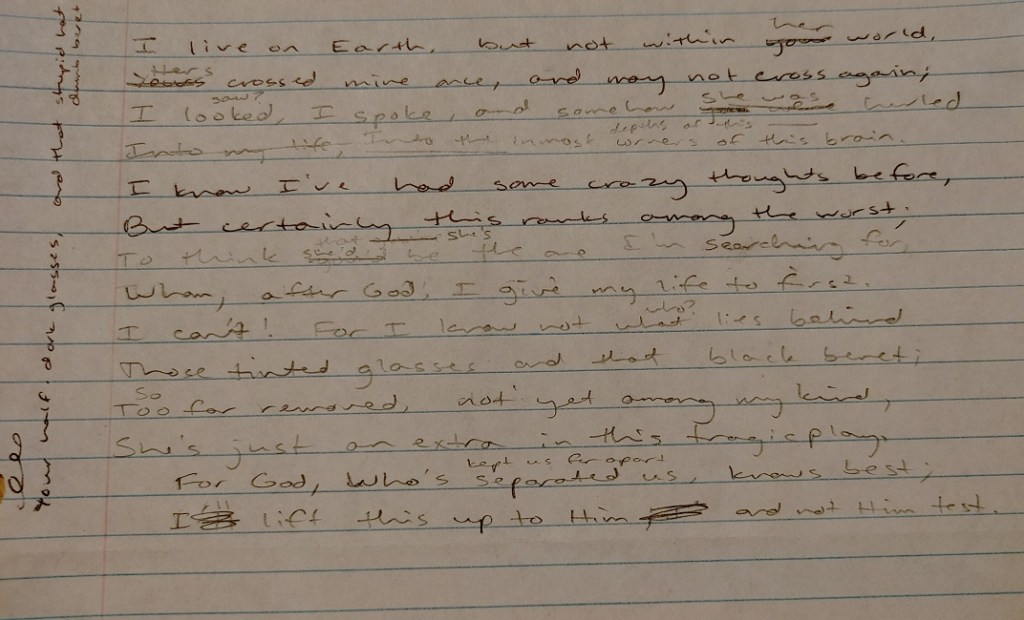
I took a nap on the bed after I finished math, with my mind still full of thoughts about Sasha.  Could this work?  Could we be together?  Or did I need to stop thinking about this?  I was about to finish my bachelor’s degree, and she was in high school.  We lived in two different worlds.  I live on Earth, but not in her world.

I repeated that thought to myself, but slightly reworded: I live on Earth, but not within her world.

Iambic pentameter.

I may have been taking Fiction Writing that quarter, but I felt a poem forming in my mind, a poem about Sasha, and so far it was taking the form of a Shakespearean sonnet.  I jumped back down off the bed and grabbed a pen and paper and wrote that line down.  I climbed back up to the lofted bed and lay on my back, staring at the ceiling, occasionally rolling over to write more Sasha-related lines of iambic pentameter when they came to mind.

I know I’ve had some crazy thoughts before

Your half-dark glasses and that stupid hat

No, I thought, not stupid hat. I crossed this out and wrote “dumb beret,” but I did not like this either.  It would have looked dumb on anyone else, but it looked cute on her.  “Black beret,” that was better, and emotionally neutral.  Calling her fashion sense dumb would definitely be out of place in this poem.


Later that night, just before I went to bed, I opened Sasha’s email from earlier and clicked Reply:


From: “Gregory Dennison” <gjdennison@jeromeville.edu>
To: “Sasha Travis” <sdtravis@jeromeville.edu>
Subject: Re: hi

What exactly does “zee” mean at the end of your message?

That totally makes sense about the two schools having different spring breaks.  I forgot about that.  I might have to deal with that next year when I have student teaching.  The school where I end up will probably have a different break than Jeromeville.  I’m supposed to find out before the end of the year where I’ll be next year.  I’ve heard we usually don’t place student teachers at Jeromeville High, because Jeromeville isn’t representative of what public schools in most of the state are like.  More kids from educated backgrounds in Jeromeville, I would think.

That’s hilarious about Human Foosball… I hope Mariah is ok.  I don’t know her, but she’s Shawna and Cory’s sister, right?  My classes are okay.  This math class isn’t too hard.  Christian Theology is really interesting; a lot of historical stuff that’s deeper than what comes up at church or Bible study.  I really like the Fiction Writing class.  We’re going to have to write two stories later in the quarter and share them with people in the class.  I’m a little nervous about that, but curious to see what kinds of things other people write.

I’m going to bed now… have a great day tomorrow!

-gjd


Sasha explained “zee” the next day in her next email to me.  Apparently, none of the traditional endings to letters like “love” or “sincerely” or “your friend” ever seemed to work for her, so she just made up “Z” to represent the end, because Z was at the end of the alphabet.  But she spelled it “zee” so it looked like an actual work.  I liked that.  Maybe I would start using that.  (I did not, except for in a few other emails to Sasha.)

With my routine for the quarter becoming established, I was now trying to get back into the routine of reading my Bible every day between classes.  I was now in my sixteenth month of a plan I was following to read the Bible in a year, since I was not reading every day, but I was nearing the end: I was just now beginning the readings for December.  I also started praying for wisdom, to know whether being romantically interested in Sasha was a good idea, and if so, what to do about it.  I had heard many talks in those days about letting God guide my love life and not forcing things, so maybe I just needed to leave it in God’s hands and not do anything.

Over the course of the next few days, I carried around the paper with the poem on it, writing words and lines and rhymes as I thought of them.  By the weekend, I had this:

I live on Earth, but not within her world,
Our paths cross now, but may not cross again;
I looked, I spoke, and somehow she was hurled
Into the inmost reaches of my brain.
I know I’ve had some crazy thoughts before,
But certainly it ranks among the worst
To think that she’s the one I’m searching for
Whom, after God, I’ll give my life to first.
I can’t! For I know not what lies behind
Those tinted glasses and that black beret;
So far removed, not yet among my kind,
She’s just an extra in this tragic play.
For God, Who’s kept us far apart, knows best;
I’ll  lift this up to Him, and not Him test.

“Half-dark glasses” became “tinted glasses” at one point in the thought process.  That just flowed better.  I liked the way this poem turned out.  I liked Sasha, but it probably would not work out, since she was only seventeen.  I needed to trust God with my relationship status.

Now the poem needed a title.  I often took the titles of poems from words in the poem itself, usually something in the beginning so that the title would not give away the ending.  I was about to write “Not Within Her World” at the top of the page when suddenly I stopped, remembering something that Sasha had said a few weeks ago after church when I was standing around talking to her and some others.

I had said something about other kids being mean to me in elementary school and calling me every sort of name imaginable, and the others nearby began sharing ways they had been teased in childhood.  “I got called ‘Sasha Trash’ sometimes,” Sasha said.  “It’s so dumb.  These stupid people think they’re being so clever, just because my last name starts with the same letters as ‘trash.’  Like I’ve never heard that before.”

Trash.

The poem would be called Trash.

I wrote the title at the top of the page.  It was cryptic and mysterious on the surface, but that just made it better.  I often put hidden references and messages in poems, and the title of this one would be just another one of these hidden references.  Plus, by titling the poem after something negative associated with Sasha, maybe I would start to form a negative association with Sasha in my mind and talk myself out of this crush, since it  probably would never work.

I put the poem in the folder in my file cabinet where I kept physical copies of my writing.  I was not sure if I would ever share it with anyone.

For as much as I enjoyed talking with Sasha, I knew that I needed to put away all of those thoughts of ever being more than friends with her.  The rational side of my mind was convinced that it would not work, even though the romantic side enjoyed being with her.  I just hoped that these thoughts would go away eventually.  I had no immediate plans to act on these feelings; I would just wait and see what the next few months brought.  Unfortunately, now that I had actually taken the time to write a poem, that forever established that I did have feelings for Sasha.  To that, I now would never be able to say zee.


Readers: Have you ever been interested in someone who just seemed wrong for you on the surface, but you couldn’t get that person out of your head? How’d that work out for you? Tell me about it in the comments.

If you like what you read, don’t forget to like this post and follow this blog. Also follow Don’t Let The Days Go By on Facebook and Instagram.


March 30, 1998.  My last first day of class as an undergraduate. (#167)

I opened the door of 105 Wellington and sat down.  After four years here at the University of Jeromeville, so much was familiar about everything I was doing this morning.  I rode my bike to campus on the usual route.  Wellington Hall had two floors above ground and a basement, full of nothing but classrooms of all sizes, and I had had many classes in Wellington before.  I was pretty sure I had even had a class in room 105 at some point, although I did not remember for sure which one.  Most of the people taking this class were juniors and seniors majoring in mathematics, with a few computer scientists and engineers in the class too.  I recognized many familiar faces from other math classes.  Jack ChalmersKaty HadleySilas Penfield, whom I also knew from church and Jeromeville Christian Fellowship.  A guy named Alan, who bore a striking resemblance to the actor and comedian Norm MacDonald.

“Greg!” Jack whispered loudly, waving.  He motioned to an empty seat next to him.  I waved and nodded, walking toward the empty seat and waving to Silas on the way.  Katy was not looking at me.

What was unfamiliar was the subject itself.  The class was called Linear Programming, Mathematics 168.  I needed one more upper-division math class to finish my Bachelor of Science degree in mathematics, and the only prerequisites for this one were lower-division calculus and linear algebra, both of which I enjoyed and found relatively easy.  But I knew very little about what linear programming actually meant.  The word “programming” made me think of computers and writing code, but the description in the course catalog did not seem to mention computers.  It said something about solving optimization problems, which I assumed meant determining the best way to do something.

The professor, Dr. Wu, was also unfamiliar to me.  I had not taken a class from him before.  He began the class by giving an example of the kinds of problems we would be studying.  “Suppose you’re planning meals with two different foods,” he said.  “Each serving of food A contains 2 grams of fat, 1 gram of carbohydrates, and 5 grams of protein, and each serving of food B contains 3 grams of fat, 4 grams of carbohydrates, and 4 grams of protein.”  Dr. Wu paused to write these measurements on the board.  “And let’s say you know that the meal has to have at least 15 grams of fat, 20 grams of carbs, and 30 grams of protein.  And you know that each serving of food A costs, say, 35 cents, and each serving of food B costs 50 cents.”  After writing the rest of the problem on the board, he continued, “How many servings of each food should you buy to minimize the cost, but still have the required amount of protein, fat, and carbohydrates?  That is a basic example of a linear programming problem.  We have something we need to maximize or minimize, but it is subject to constraints.”  I nodded, writing an abbreviated version of all of this in my notebook.  Linear programming seemed fairly straightforward as a concept, something I could visualize in the real world and express symbolically using the language of mathematics that I already knew.

The rest of that first day of class was even more straightforward.  Dr. Wu quickly reviewed some key topics of linear algebra that would be important this quarter.  I remembered all of them well, but I still took notes anyway, because of my tendency to be overly cautious when it came to studying.

After that class, I had a two hour gap before my next class.  I walked across the street to the Memorial Union and read today’s Daily Colt, completing the crossword puzzle successfully. I tore out the completed crossword puzzle to hang on my wall at home with all the other crosswords I had completed this year.  With nothing else to do for two hours after finishing the crossword puzzle, I got an early start on math homework, reading the beginning of the book and working on the first homework assignment.  I found the same example about nutrition that the professor used; he took it directly from the textbook.

When it came time for my next class, I walked south across the Quad toward Orton Hall, the other major classroom building here on the older side of campus.  As I headed across the Quad, I saw a slim, bespectacled girl with straight brown hair walking toward me.  I noticed that this girl kind of looked like Sasha Travis from church, which made me realize sadly that I would not get to say hi to her every day this quarter.  Last quarter, I did an internship every morning helping out in a math class at Jeromeville High School, where Sasha was a student, finishing her last year.  I would always see Sasha in the hallway, or at her locker, as I headed to where my bike was parked after my class was done.  Even though Sasha was still in high school, I felt like she and I had gotten to be friends, through those conversations in the hallway, and the fact that she was Erica Foster’s best friend.  Erica, a freshman at UJ, was part of my social circle already, since we were both youth group leaders at church.

As I approached this girl who looked like Sasha, I kept looking at her, realizing more and more that it was not just a resemblance; I was pretty sure this actually was Sasha.  But what was she doing on the UJ campus during the school day?  She smiled at me and waved.  Yes, definitely Sasha.

“Sasha?” I asked.

“Hi, Greg!” Sasha replied.  “How are you?”

“What are you doing here?”

“Jeromeville High has a program for high-achieving seniors to take classes at UJ during the day,” Sasha explained.  “I just got out of English 10.”

“That’s cool!” I said.  “I’m pretty good.  Three classes today.  I’m on my way to Christian Theology, with Hurt.”

“I’ve heard such good things about Dr. Hurt!  Erica took one of his classes last quarter.  I didn’t see you this morning.  Are you still TAing with Mr. Gibson?”

“No.  That was just for a quarter.”

“I have to get back to the high school,” Sasha said.  “I’ll see you later.”

“Yeah.  Have a good one!”  As I continued walking to my class, I felt a little jealous that Sasha grew up in a university town where high-achieving students had opportunities like that.  Taking university classes as a high school senior was even better than taking AP classes for college credit.  Growing up in working-class Plumdale, I was discouraged from taking too many AP classes, and the nearest university was in Mount Lorenzo, forty miles away.

I continued walking toward Orton Hall.  Dr. Hurt’s class was in one of the larger classrooms of Orton Hall, with about sixty seats, and the class was about two-thirds full by the time I got there.  I expected a lot of my friends from church and from Jeromeville Christian Fellowship to be in this class, and while a few of them were, it was not as many as I had expected.  I sat down against the wall, on the opposite side of the room from the outdoors-facing windows, and looked around as Dr. Hurt prepared to begin his lecture.  My eyes moved toward a corner of the room I had not seen as I was walking in, where I saw Carrie Valentine sitting with a notebook on her desk.  She looked up and made eye contact and waved at me.  I did my best to smile, nervously, and waved back.  Dr. Hurt began speaking just at that moment, saving me from having to decide whether or not to go talk to Carrie.

Last year, Carrie was always friendly to me, but things seemed a little tense the last few months ever since she turned me down for a date.  She had said that everything was okay, that I had done nothing wrong, but I was not sure if she really was treating me differently, or if it was mostly in my head and I was avoiding her.  I felt relieved that Dr. Hurt had started class before I could talk to her, which I guess meant that I ultimately did not want to talk to Carrie right now.  I wondered if things would ever feel normal with us.

Dr. Hurt explained an overview of the class.  We would be studying the development of Christian theology from the period of the early Church through modern times.  Our study would include different schools of thought for subjects in which different branches of Christianity had slightly different beliefs, as well as some rejected schools of thoughts that had been deemed to be heresy over the years.  We would learn about the natures of God, Jesus Christ, and the Trinity; salvation, sin, and grace; and the role of the Church, among other topics.

I was still fairly new to practicing my Christian faith, and while this class did not satisfy any specific requirements other than giving me enough units to be classified as a full-time student, it was definitely something I wanted to learn.  Jeromeville was a secular public university, but our Religious Studies faculty included Dr. Hurt, a renowned New Testament scholar.  It was nice that I could still learn about Christianity in this context, even though secular public education did not include things like prayer and worship time.

When class ended, I looked up; Carrie was talking to someone I did not know, absorbed in conversation.  I got up and left before she saw me, avoiding the question of what to say to her and whether or not things would be awkward.  My next and final class on that Monday was in an hour, back in Wellington, on the other side of the Quad from Orton.  I began walking back toward the Memorial Union looking for a place to sit, but decided to just sit on the grass of the Quad instead.

The Quad was a square lawn about five hundred feet on each side.  The University of Jeromeville was founded in 1905 as an agricultural campus, with crops growing on the area that later became the Quad.  After becoming surrounded by buildings over the first three decades of the campus’ growth, the Quad was converted to a permanent lawn.  It was ringed by tall, mature European cork oaks, with other trees scattered across it at irregular intervals.  To the east were the oldest surviving buildings on campus, Old North and Old South Halls.  The Quad also bordered the Memorial Union building on the north, Wellington Hall and one other building on the west, and the library on the south, with Orton Hall on the southeast corner.

The weather was pleasant, on the warmer side but not uncomfortably hot, mostly sunny with blue skies dotted with a few clouds.  People sat on the Quad, reading, talking, napping, and eating.  I sat cross-legged and took the lunch I had packed out of my backpack, and I ate as I watched people walk past.

About ten minutes before class was scheduled to start, I walked across the street to the west to Wellington Hall, then took the stairs down to the basement.  The class was in room 6, which was a small lecture hall with around a hundred fixed seats, sloping toward the front of the room as in a theater, with an aisle down the middle.  Physical Education 43, Healthful Living, was not a class that would have been on my radar to take.  My lifestyle would not exactly be considered healthful, but the class was required for the teacher training program that I would be in next year.  And it was only two units, meeting for one hour twice a week, so it would not be as much work as most classes.

I sat in a row that was still mostly empty, one seat in from the aisle.  As the room gradually filled over the next few minutes, I looked around to see if anyone I recognized was in the class.  I saw two or three faces that I recognized from various places, but no one I knew in particular.  Then my eyes reached the door in the back of the room.

You have got to be kidding me, I thought.

Carrie Valentine walked through the door.  She saw me and immediately made eye contact, smiling and waving, noticing the empty seat next to me.  I waved back.

“Hey, Greg!” Carrie said, sitting in the seat next to me.  “Looks like we have two classes together!”

“I know,” I replied.  “What did you think of Hurt’s class so far?”

“Looks like it’ll be interesting.  There’s a lot of that kind of stuff I don’t really know.”

“Yeah.  Same.  I grew up Catholic, and going to Jeromeville Covenant now, I’m always interested to know about differences between Catholics and other Christians.”

“How was your spring break?”

“It was good.  I went to see my family for most of it.  We had an 80th birthday party for my grandpa.”

“Oh, how nice!  Are you and your grandpa close?”

“Yeah.  This is Mom’s dad, and they always lived just a mile away growing up, so we saw them all the time.  I got to see some relatives I don’t see often.  Some came all the way from Oregon.  A lot of Grandpa’s friends were there too.  What did you do over break?”

“Really nothing.  Just relaxed at home.  Hung out with my parents and my sister, and saw one of my friends from high school.”

“That’s nice.”

The professor, Dr. Payton, began speaking, introducing herself first, and telling us to make sure that we were all in the right class, PE 43, Healthful Living.  “The class is always around this size every quarter,” Dr. Payton explained, “so I am not going to get to know every one of you personally.  But if you ever see me around campus, feel free to wave at me and just say, ‘Forty-three!’  That way, I will know that you were a student of mine in this class.  I’ve been doing this class for twenty years, and you wouldn’t believe some of the places I’ve run into people who recognized me.  I’ve had strangers on airplanes come up to me and say, ‘Forty-three.’  My husband and I went to an opera in Bay City, and one of the ushers at the theater remembered me.  The strangest one of all was when we were on vacation in France, and we toured a historic monastery.  Some actual monks walked past the tour group, and one of the monks leaned over to me and whispered, ‘Quarante-trois.’”  A few in the room chuckled.

As Dr. Payton continued outlining the class, it became apparent that I was not sure what I was expecting from this class, but what she was describing was not exactly it.  I expected somewhat of a rehash of what I had learned in high school health class: nutrition, exercise, hygiene, and of course sexuality.  But in addition to that, this class would cover other topics, including stress management, relationships, and alternative medicine.  “Please be respectful if there is anything you don’t agree with in this class,” Dr. Payton said.  “One year, I was reading the teacher evaluations at the end of the year, and in regards to the homeopathic medicine presentation, someone wrote, ‘I don’t believe in voodoo.’  Homeopathic medicine is not voodoo.  It is a type of medicine with theories and methods practiced by people around the world.”

Since UJ was a secular public university, and I was a Christian, I expected that I would probably have disagreements with some of the material in the chapters on relationships and sexuality.  But Dr. Payton’s request to be respectful certainly seemed reasonable.  And while I generally associated homeopathic medicine with New Age hippie nonsense, I would even approach that with an open mind when we got to that chapter, since I knew little about it.

I stood and stretched when class was over.  “Do you have any more classes today?” Carrie asked me.

“No.  I’m done.  I’m headed home now.”

“Nice!  I have a discussion now on Mondays, but I’m done after this class on Wednesdays.”

“Enjoy your class,” I said.  “I’ll see you around.”

“Yeah!  Have a great afternoon!”

I walked back to my bike, unlocked it, and rode north to the end of West Quad Avenue, where I turned left onto a road heading generally northwest.  I passed more classroom and lab buildings, then rode through the North Residential Area to the intersection of Fifth Street and Andrews Road.  I continued north on Andrews Road for almost a mile, then turned left and zigzagged through the neighborhood to my house at 902 Acacia Drive.  The house was quiet; I was the first one home today.  I connected to the dialup Internet and got on Internet Relay Chat.  A nineteen-year-old girl from Texas named Melody, whom I had met in this same chat channel a few days earlier, was on; I messaged with her for about half an hour, telling her all about my day, about my new classes and the uncomfortable situation of having two classes with a girl who said no to going out with me a couple months ago.  Melody told me about a party she and her friends went to over the weekend.  I heard someone else get home and told Melody that I needed to go, but I would email her later.  I did not want to tie up the telephone line during the day with other people in the house. 

I had finished my last first day of class as an undergraduate.  So far, this quarter did not seem too difficult.  I had one more class that did not meet today, Fiction Writing, Tuesdays and Thursdays at 10:30.  That class sounded like fun, and hopefully it would not be too tough, especially since I liked writing fiction to begin with.  This would be a good way to finish off my bachelor’s degree.

About a month later, we reached the lesson in health class about homeopathy, and we had a guest speaker that week.  About five minutes into that lecture, I completely understood why the anonymous former student had called homeopathy voodoo.  Nothing about the presentation made any sense from a scientific perspective.  I questioned why this belonged in a serious class at a prestigious university, but Jeromeville was enough of a hippie town and school that I was not entirely surprised either.

Although none of these classes had assigned seats, it was human nature for most people to sit in or near the same seat each time class met.  Because of this, Carrie and I typically sat on opposite sides of the room in Dr. Hurt’s class, but we almost always sat next to each other in health class.  By the second week of the quarter, I genuinely felt that whatever awkwardness might be lingering between Carrie and me was gone.  We did not talk about my failed attempt to ask her out; I just did my best to put that in the past and move on, and Carrie never did anything to make me feel bad about what happened.  That incident did come up in conversation once, three years later, in a respectful and productive way that gave me a lot of closure regarding why she said no.  That mutual respect is part of the reason why Carrie is the only one of my many unrequited crushes from my Jeromeville years with whom I am on speaking terms today.


Readers: Have you ever had an experience where you were in close proximity to someone with whom you had issues in the past? How did that go? Tell me about it in the comments.

If you like what you read, don’t forget to like this post and follow this blog. Also follow Don’t Let The Days Go By on Facebook and Instagram.


March 6-21, 1998.  The end of a memorable basketball season. (#166)

My sixteen-year-old brother Mark got all the athletic talent in the Dennison family, playing baseball and basketball for pretty much his entire life up to now.  I played tee-ball for one year, when I was six, and I remembered very little about it, except that I thought it was dumb that we did not keep score.  I also had a brief high school football career that lasted one day.  I worked out with the football team the summer after ninth grade, because a lot of people encouraged me to play football because of my large build, and I saw football players as the cool kids who got all the girls.  I also took time that summer to learn more about football.  I read books about football rules, strategies, plays, and the history of football.  I quit after the first full day of practice, because I was so out of shape, but that experience of learning about the game gave me a greater appreciation for watching football.

Since I was tall, almost six feet four inches, many well-intentioned but ill-informed people told me that I would make a good basketball player.  I was not fast, I was not coordinated, and I was not disciplined enough to be in good shape.  But even with no experience as a player, I watched University of Jeromeville Colts football and basketball games frequently during my time as a student there.  These were the most popular collegiate sports in the United States.  UJ did not play at the highest level of competition, and few UJ Colts went on to play professionally, but the players were good enough to make the games fun to watch.  A student-run cheering section called the Colt Crew created a lively, energetic environment full of loud chants and cheers, silly skits, and free prizes tossed into the crowd.

The UJ football team had consistently won more games than they lost each season for well over a decade now.  They made the national playoffs for their division of play in two of the four years that I had been there, advancing to the semifinals in the most recent season.  The basketball team had also been winning in recent years, but this year, the team was having one of their best seasons in school history.  They were undefeated against conference opponents, only losing two games all year early in the season.

That record earned UJ the right to host a regional tournament in Jeromeville.  The playoff schedule had them playing back-to-back nights, Friday and Saturday, March 6 and 7.  That was the week of Fake Spring, the brief spell of unseasonably pleasant days that typically appeared that time of year, followed by another storm or period of cloudy weather.  On that Friday, the day after my final long conversation with Sadie Rowland, I decided to eat the lunch I had packed outside.  As I walked around the Quad, looking for a place to sit, I noticed a commotion forming around a guy holding a large sign, about three feet high, on a pole above him.  He periodically blew a whistle and pointed and yelled at someone.  I knew what was going on here; I approached the mob closely enough to observe, but far enough to not get involved.

About once a year, I would see a shouting man like this show up on the Quad, physically brandishing a Bible and pointing at it, but never actually opening or reading it.  I did not know if this was the same guy I had seen before, nor did I know if all of these people were part of the same organized group.  The large sign he held said:

LIARS, HYPOCRITES, SLUGGARDS, DRUNKS, STONERS, FORNICATORS, PERVERTS, EVOLUTIONISTS, CATHOLICS, JEWS, AND MORMONS… REPENT! OR BURN IN HELL!

“If God gave us pot, why can’t we smoke it?” one random person from the crowd screamed.  The shouting Bible man pointed at the student asking the question and blew a whistle loudly, then began ranting about temptations from the Devil.

This pattern continued as I ate my lunch, with students saying things to get a reaction from this man, and the man blowing his whistle and shouting things that sounded somewhat Biblical in nature but were certainly not spoken with Godly love.  No one in this crowd was actually interested in a relationship with Jesus Christ.  The students asking the man questions just wanted to make fun of him; they were not curious about Christianity.  And the man with the answers did not want to meet these students where they were and show them God’s love through the way he lived his life.  He just wanted to yell at people and get attention.  People like this give real Christians a bad name in the eyes of students like these.

After watching this for half an hour or so, I noticed out of the corner of my eye two more people approaching, also holding large signs like the one the shouting man had.  At first I wondered if the shouting man had sidekicks, but as one of the signs came into clear view, I could see that it was different from the shouting man’s sign.  It was hastily made of cardboard and duct tape, not painted on wood.  The sign said:

GOD WANTS YOU TO WATCH COLT BASKETBALL
7PM REC PAVILION
WEAR YOUR COLT CREW SHIRT

I laughed out loud when I realized what had happened.  The Colt Crew had seen the angry Bible man with his sign, and they made their own signs to stir up school spirit for the basketball playoffs.  The Colt Crew students mingled among the mob of students surrounding the shouting Bible man, and students from the mob cheered when they saw the Colt Crew signs.

About five minutes later, I was done with lunch.  I got up and walked past one of the Colt Crew sign holders, and told him, “Great sign.  That’s brilliant.”

“Thanks,” he replied.  “Are you coming to the game tonight?”

“I can’t make it tonight.  But if we win, I’ll definitely be at tomorrow’s game.”

“We’ll win.  Think positive.”

“Yeah.”


Jeromeville Christian Fellowship met that night, so I could not make it to the basketball game.  People at JCF do not blow whistles and shout judgmental slogans; if they did, I probably would not have learned through them two years earlier what it really meant to follow Jesus.

UJ won their game that Friday, so they played again on Saturday, against Northwest Methodist University from Washington state.  I did not go with anyone to the game; I just showed up that night, since I had no other plans.

As much as I hated to do so, I paid the three dollars to park in the lot next to the Recreation Pavilion.  I thought about riding my bike to the game, it had been a nice day, but by the time I left, the sun was setting, the temperature had cooled down, and it would be cold and dark for the bike ride back home.  Also, I needed to get batteries for my bike headlight.

As I approached the building, I noticed that there was no Colt Crew line for students; instead, a sign said that students must purchase a ticket.  I remembered reading in the Daily Colt that, because this was a playoff game, the ticket office was required to sell tickets at prices set by the league administrators.  Normally students could watch all home athletic events free, but that did not apply for playoff games.  I overheard some students standing in line who were upset and surprised about this; apparently they did not read the Daily Colt every day like I did.

The Recreation Pavilion had an expandable upper level.  Areas normally used for things like student weightlifting classes and gymnastics team practice were cleared out to add another level of retractable bleachers for certain events, such as basketball games expected to draw large crowds and graduation ceremonies.  The Colt Crew student section was in the same place as usual, but tickets had to be sold at the general admission price.  I sat in the Colt Crew section and looked around me; I did not know any of these people, but I said hi to them anyway.  One guy said hi back.  I could tell right away that this would be no ordinary game as crowds walked in and filled the seats on all levels.

The students who led the cheers and skits for the Colt Crew, one of whom was the guy whose sign I complimented yesterday, led us in booing the Northwest Methodist team as they took the court for warmups.  The Colts ran out onto the court a few minutes later, and the entire Colt Crew section, along with the rest of the Pavilion, cheered loudly.  I saw five guys who looked like fraternity brothers in the section next to me who had taken off their shirts, revealing painted chests spelling out C-O-L-T-S in the school colors of navy blue and gold, but they were standing out of order, so their chests said CLOTS.  I laughed.

The Eagles of Northwest Methodist University were one of the only two teams to beat Jeromeville in the regular season.  That was back in December, in a non-conference game, and I did not remember this until I read it in the Daily Colt earlier this week.  Despite that early setback, though, the Colts had a much better overall record for the season, 26 wins to the Eagles’ 17.  That storyline alone made this game interesting, especially since the winner would advance to the national tournament with the winners of seven other regional tournaments like this one, and the loser’s season would be over.

For much of the first half, the game was close.  Neither team was able to stay very far ahead.  It seemed like one team would score, and then the other would score right away, and if one team missed, the other team would usually miss also.  Eight minutes before halftime, the game stopped for a media timeout, to run commercials on the radio broadcast.  The Colt Crew announcer shouted, “It’s time for Tube Sock Madness!” He and the other students leading the Colt Crew cheers began throwing rolled-up tube socks into the crowd.  I was still not clear on how this tradition began, but it was always fun to try to catch them, even though I had yet to wear the one pair I had caught in the past, at a football game freshman year.

When play started again, the Colts were a few points behind, but they proceeded to go on a tear, scoring ten unanswered points and blocking NWMU’s shot attempts.  I was not sure if this was because of what the coach told them during the timeout, or the excitement generated by the crowd during Tube Sock Madness, or something else, but I liked it.  The crowd did too, becoming more lively every time the Colts scored or made a big defensive move.  Jeremy Fox of the Colts made a three-point shot late in the half.  As was usually the case, everyone in the Colt Crew stuck both hands in the air as the ball was in the air, and we all put our hands down and said “Whoosh!” as the ball sailed through the net.

I turned to the guy next to me, the one who had said hi when I arrived in my seat.  “YEAAAH!!!” I shouted, raising my hand to give a high five.  He shouted back and high-fived back.  While I was turned, I noticed that the CLOTS guys had rearranged themselves into the correct spelling of COLTS.

The Colts now led by nine with a minute to go until halftime, and after a few more scores on each side, the Colts led 38-31 at halftime.  During halftime, the marching band played a few songs, and the Colt Crew students, after a costume change, did a silly lip-synching skit that involved girls dressed as the high-voiced young boys from the band Hanson, and guys dressed as the Spice Girls.  I laughed.

The Colts were even more dominant in the second half than they were in the first.  Jeremy Fox’s three-point shooting heated up in the second half; he made another four successful three-point shots, in addition to a number of two-point shots.  Jeremy Fox finished the game with twenty-six points, and the Colts won by a score of 82-58.  Cheers erupted from all over the Pavilion, especially from the Colt Crew section.

The Colts had beaten a team that had beaten them earlier in the season in order to advance to the national championship for this division, with seven other teams.  Three more wins, and we would be national champions.  I extended both arms and gave a high ten to the guy sitting next to me, and we continued shouting cheers as we followed the rest of the crowd outside.  Sports victories have a way of bringing strangers together. 


The national tournament, held over two thousand miles away in Louisville, did not begin until a week and a half after the eight regional tournaments.  This led to the odd situation that the Jeromeville Colts players had games during the week that they should have been taking finals.  Most of the schools competing were on a semester schedule, with no such thing as winter quarter finals in March, so this issue did not affect most of the tournament participants. I was not sure how or when these players would take their final exams, but I imagined that exceptions could be made in this extraordinary circumstance. 

I tried to arrange my study breaks so that I could listen to the games on the radio while I was not studying, or while I was doing things that did not require intense concentration, like practicing math problems.  UJ won the first two games of the tournament decisively, setting up a showdown with the Lions of Central Kentucky Christian College.  CKCC was a six-time champion who also had only lost two games all year. Also, the school was located less than a hundred miles from Louisville, so there would be many more Lions fans in the crowd, a possible disadvantage for the Colts.

The final game was on national television, on Saturday morning right after my finals week ended.  The schools that played in the top level of competition of college basketball had games on television often, but this one championship game was the only nationally televised game for this division. It was the first time in history that a UJ Colts sporting event was on national television.  The game began at 1:00 in Louisville, which was 10:00 in the morning in Jeromeville’s time zone.  Yesterday was the last day of finals, and tomorrow after church I would head to my parents’ house in Plumdale for a few days.

“Hey,” said my roommate Sean, emerging from the shower during the pre-game show.  “Is this the Colts basketball championship?”

“Yeah!” I said.  Sean sat on the couch next to me to watch the game.

The announcers told the story of the Jeromeville Colts, how they breezed through the season and the regional tournament with only two losses, qualifying for the national tournament for the first time.  Then they pointed out that Central Kentucky Christian was a perennial champion in their conference and, although none of the current players had won a championship, the coach and program in general were no strangers to winning.  The Colts certainly had an uphill climb ahead of them.

“It’s kind of weird to see Jeromeville on TV,” Sean said.

“I know.”

The game was close for most of the first half, much like the game I went to against Northwest Methodist.  My ears always perked up when I heard the national broadcasters talking about Jeromeville.  The University of Jeromeville was not very well known beyond the far western states, and I liked hearing what outsiders had to say about my school.

“Jeromeville is in between Capital City and Bay City,” they said.  Technically true, although it was so much closer to Capital City that this seemed like a misleading description.  “The University of Jeromeville has been a football power in recent years, and it is also known as an academic powerhouse.”  Very true; I felt like part of that academic culture.  “This game really is a contrast between two different kinds of universities, with UJ being a large public school, and CKCC being a small private liberal arts college.”  I had never been to CKCC, but that sounds right.  “Jeromeville is on a quarter schedule, so these students had to take their winter quarter finals from the hotel room here in Louisville earlier this week.  They brought a proctor on the trip with them.”  That answered one of my questions.

UJ made a strong showing in the first half and led 42-35 at halftime.  But, although CKCC’s last championship was eight years earlier, many of their players had played in high-stakes playoff games before.  They used this experience to fight back, taking a one-point lead with a little over a minute left in the game.

“I don’t like this,” I said, my teeth slightly clenched as I looked at the television.

“I know,” Sean replied.

A player from CKCC missed a shot.  Jason Simmons rebounded the ball for the Colts and passed it to Jeremy Fox.  Fox dribbled up to the three-point line and shot; the ball swished through the hoop.  Three points for the Colts, who now led 76-74 with 37 seconds left.

“YESSS!!!!!” I shouted, jumping up and motioning to give Sean a high-five, even though he was still sitting on the couch.  Sean raised his hand and slapped mine.

I then sat nervously to watch what CKCC would do on their possession.  They passed the ball around, trying to get away from Jeromeville’s pressure defense.  The Lions’ tall center, who was so far had led all players in scoring, took a shot from somewhere near the free throw line, unable to get the ball any closer because of Jeromeville’s defense.  He missed, and the rebound shot out directly to Jeremy Fox.  I breathed deeply, finally feeling better about the outcome of this game.  Twenty-eight seconds remained on the clock, a shorter time than the 35-second shot clock, meaning that the Colts could theoretically hold on to the ball and run out the clock. The only way the Lions could get the ball back was by intentionally fouling the player with the ball and forcing him to shoot free throws.   A Lion player did just that, intentionally fouling Fox, but Fox made both free throws, giving Jeromeville a four-point lead.  CKCC missed a shot on their next possession, and then intentionally fouled once more.  After Jason Simmons made his two free throws, CKCC missed a desperation shot as time expired.  Jeromeville had won, by a score of 80 to 74.

“WOOOOOO!!!” I shouted, standing up and attempting again to high-five Sean, who stayed on the couch despite also being visibly excited.  It was more like a medium-five.

The banner proclaiming UJ national champions of their division still hangs in the rafters of the Recreation Pavilion to this day.  Jeromeville moved to the top division in 2008, and since then, UJ has made that division’s national tournament only once.  They were promptly eliminated by one of the major basketball powerhouses, to the surprise of exactly no one.

One major change happened on campus after the national championship that lasted for a while.  When the athletics department had to send information to the national media, they realized that the campus sports teams did not use a consistent logo.  The official logo, appearing occasionally around campus but not on any jerseys or uniforms, was a letter “A” with a horse’s head on one side and ears of wheat on the other.  The A stood for Agriculture, presumably; the university had originally been the College of Agriculture affiliated with the University of the Bay, sixty miles away.  This was the logo that appeared on the television broadcast, and it seemed strange and confusing as the logo of a large, modern university with a sports program.

After the television broadcast used that logo, the UJ administration hired a professional design firm to make with a new logo, and soon, the university had a much better-looking head of a colt to use as their logo.  I bought numerous t-shirts and hats with that logo on it.  But then, for no apparent reason, in 2019 the Colts reverted to an updated version of the old “A” logo.  I never understood this, since neither “Jeromeville” nor “Colts” started with A.  I recognized the value of connecting to campus history and traditions, but I still preferred the colt head logo.  UJ is not well-known enough nationally to be recognized by a logo with a different letter on it.  But I supposed that, if I were to wear something with this confusing “A” logo on it, it could become a conversation starter if someone asked me what the logo meant.


Readers: What is your best memory of watching sports? Tell me about it in the comments.

Disclaimer: Northwest Methodist University and Central Kentucky Christian College are, like the University of Jeromeville, fictional.

If you like what you read, don’t forget to like this post and follow this blog. Also follow Don’t Let The Days Go By on Facebook and Instagram.


March 5, 1998.  My heart will not go on. (#165)

Disclaimer: I had this episode planned and partially written before the news broke about the missing tourists trying to explore the wreck of the Titanic. I am not trying to capitalize on a tragedy.


As finals approached for the 1998 winter quarter, Titanic was the biggest movie in the world.  The movie, a fictional love story set against the backdrop of the historical 1912 sinking of the British ship Titanic, had been the highest-grossing film of 1997 despite having been released just two weeks before the end of the year.  It won many major awards, and it was still the number one movie in theaters now, almost three months after its release.  As is often the case with major successful movies like that, the soundtrack spawned a hit pop song, “My Heart Will Go On” by Céline Dion.  Like the movie, the song went on to become one of the most commercially successful songs of all time.

I had never seen the movie.  Nor had I ever heard the song; I did not listen to that crap.

I never thought of myself as much of a moviegoer.  Going to movies was something people did with friends, and I had never had much of a social life until recently.  Something did not feel right about going to a movie by myself, so if I wanted to see a movie, and plans never came up to see it, I just did not watch it.  

However, although love stories were not my preferred movie genre, I was intrigued by Titanic.  I wanted to see it for the special effects; the filmmakers built and sank an actual replica of the Titanic.  That was impressive in its own right.  But I had no plans to do so.

One Thursday, I had a bit of free time on campus, so I walked into the Memorial Union building, looking for a place to sit and do math homework for the next two hours.  I walked through the doors of the east entrance, near the bookstore, and began heading toward the Coffee House at the other end of the building, where I planned to look for a place to sit.  But before I even got to the Coffee House, I found something more interesting to me, something about five foot five with straight brown hair halfway down her back and smiling blue eyes.

Hey, Sadie,” I said, waving.

“Greg!” Sadie replied.  “What’s up?”

“Just looking for a place to sit and hang out until my next class.”

“Me too!  Come on!”  Sadie walked in the same direction I was about to go, and I followed her.  It was a relatively nice Fake Spring day outside, sunny and pleasant, typical of the week or two of nice weather that Jeromeville always got around this time of year before it turned cold and dreary again.  The indoor tables were not excessively crowded, as they would be on a rainy day.  “How about here?” Sadie said, gesturing to a table near the far end of the Coffee House.

“Looks good,” I said.  Sadie sat facing south, toward the window looking out at the Quad, and I sat across from her.  “How are you?”

“I had a midterm this morning.  It was kind of hard.  I don’t think I did very well.”

“What class?”

“History.  I didn’t study as much as I could have.  I’m pretty good at BS’ing essay questions, though, so I might have done okay.”

“Nice,” I replied.  “I’m not good at BS’ing.”

“Really?”

“Yeah.  Like, if I have a paper to write, I have to start planning it at least a week or two in advance.  I need time to go to the library and do research, and usually half of what I’m looking for is already checked out.  And I need to think things through.”

“Wow.”

“And with essay questions on tests, I have to do a lot of studying in advance, to the point that I’m ready for whatever they might ask.  Believe me, I wish I could BS a paper like you can.”

“You probably have a better GPA than those of us who BS papers, though.”

“That’s true.  And, as a math major, I don’t have to write papers as often.”

“Yeah.  That too.  When do you write papers, anyway?”

“Classes for general ed requirements.  And the English classes that everyone has to take,” I explained, “although I took AP English in high school, so I only had to take Advanced Comp.  And this quarter I have Ed Psych, as a prerequisite for the teaching program next year.”

“Yeah, I guess you would still have to write papers.”

“Next quarter I’m taking Fiction Writing.  For the teaching program, I need to have a certain number of units in English, no matter what subject I’ll be teaching, and I’m one class short.  It can be anything, and Fiction Writing looks like the most fun option.”

“That does sound fun!  Have you written fiction before?”

“I write stories for fun sometimes.”

“That’s really cool!” Sadie exclaimed.

“Would you ever want to read some of my stories?”

“Sure!  I mean, I don’t know how much time I’ll have now with finals coming up, but maybe once that’s out of the way.”

“I’ll send you something sometime after finals, then.”

“Thanks!”

“Anyway, I was saying, Ed Psych is the only final I have to write for this year.  I have two math classes with regular math finals, and no final for my internship at Jeromeville High.”

“How’s that going, by the way?” Sadie asked

“It’s good, but it’s been eye-opening,” I explained.  “When I did this last year, it was with a class of pretty much all college-bound kids.  These kids aren’t all like that.  A lot of them aren’t motivated to work as hard, and they don’t pay attention in class.”

“That makes sense.  But you’ll probably get a lot of that when you’re an actual teacher someday.”

“Yeah.  Speaking of internships, you’re leaving for Washington, D.C., soon, right?”

“Yes!  I leave the week after spring break.  I’m so excited!”

“And what will you be doing exactly?  Something in the House of Representatives, was it?”

“Yeah!  Working for the Congressman who represents our district back home.  My parents have helped out on his campaign before.  He’s great.”

“Good!” I said.  I knew enough about Sadie’s political leanings to know that if she liked this guy, he must be good, and I probably would agree with the way he voted most of the time.

“Mostly just office work,” Sadie explained, “but I’ll get to learn a lot about how the process works.”

“That’s really cool.  I’m excited for you.”

“Thanks!”

“Keep in touch after you leave.”

“Yeah!  I will!”  Sadie replied.

We continued talking as time passed, about everything from classes to future plans to high school friends back home, of which Sadie still had many.  “I don’t hear from any of my high school friends anymore,” I said.  “I guess I wasn’t super close to them to begin with.  I didn’t really do anything with friends until I was a senior, old enough to drive.  Plumdale is spread out, and I lived kind of far from everyone.”

“That makes sense.  I lived near a lot of my friends from high school.  They all went off to school after we graduated, but we still try to get together when we’re home on break.”

“That’s good.  I wish I had that.  I made some new friends senior year too, and then all of a sudden they were gone after we all moved away.”

“That’s too bad, but it happens,” Sadie said.

“One of those new friends I made senior year, I saw her here once, walking across the MU.  It was the weirdest thing.  She was younger, she was still a senior in high school at the time, but her boyfriend and her brother both went to Jeromeville, and Plumdale High had a day off, so she and her friend came up to visit.”

“And you just bumped into each other?  That’s weird.”

“That was the last time I ever heard from her,” I said, nostalgically and wistfully.  I had not thought about Annie Gambrell for a long time, until now.  “But, I don’t know, maybe it’s for the best.”  I lowered my voice, leaned in a little closer to Sadie, and explained, barely above a whisper, “I had a big crush on her, and she had a boyfriend.”

“Oh yeah,” Sadie replied with a slight chuckle.  “That’s rough.”

“Story of my life.”

“Aww.”  Sadie yawned, and continued, “Sorry!  I’m tired.  I didn’t sleep well last night.”

“I hate that.”

“My roommate and her boyfriend got home late from the movie theater last night.  They went to see Titanic, because I guess he had never seen it.  And then they came home and woke me up, and they stayed up in the living room talking.”

“That’s annoying,” I said.  “I’ve never seen Titanic either.  I want to.”

“It was so good!  I saw it once when I was home for Christmas.  I want to see it again.”

Every once in a while, an opportunity would drop into my lap perfectly.  And some of those times I would actually get brave and take the opportunity.  “Do you want to see it with me sometime?” I asked.  “Will you have time before you leave for D.C.?”

“Yeah!” Sadie exclaimed.  “I have a lot to do before I leave, and finals are coming up, but I should be able to work something out.  I’ll figure out my schedule and get back to you.”

“Perfect!” I said.

“Oh crap,” Sadie said, looking at her watch.  “I need to get going.  I have class.”

“What time is it?” I wondered aloud, while looking at my watch.  Almost two hours had passed since Sadie and I had sat down in the Memorial Union.  “Wow.  It doesn’t feel like it’s this late.”

“I know!”

“It was really good hanging out,” I said.  “Hope your class goes well.  And keep me posted about the movie.”

“Yeah!  I will!  It was good talking to you.”

“You too!”

As I watched Sadie walk away, I thought about how this was not the first time this had happened to us, getting lost in conversation and losing track of the time.  Sadie was one of those rare people whom I could talk to for hours, all while feeling that no time had passed at all.


By the middle of the following week, I still had not heard back from Sadie about going to see Titanic.  I wrote her an email one night during a study break:


To: srrowland@jeromeville.edu
From: gjdennison@jeromeville.edu
Subject: movie

Hey!  How is studying going?  Are you ready for finals?  I think mine will be ok.  Ed Psych is the one I’m most worried about, mostly just because it’s not math, and I’m going to have to write an essay, and you know I don’t BS essays very well. :)

What’s your schedule like?  Are we still going to see Titanic?  How is all of the preparation for your internship going?  Good luck with finals, and I’ll see you soon!

gjd


The next day, I checked my email frequently during study breaks for the whole time I was home.  I got excited when I saw that I had a message from Sadie, but I became considerably less excited as I read the message:


From: “Sadie Rowland” <srrowland@jeromeville.edu>
To: “Gregory Dennison” <gjdennison@jeromeville.edu>
Date: Wed, 11 Mar 1998 13:46 -0800
Subject: Re: movie

Hi Greg!  Unfortunately, I don’t think I can.  I just have too much to do this week, getting ready for finals and packing for DC.  Sorry!  I hope you have a great finals week!  Good luck!


I wrote back later, just making small talk about life and finals and stuff, and asking Sadie about her upcoming internship back east.  Finals came and went, I went home for spring break without my computer or access to email, and I returned to Jeromeville a few days before classes started.  A couple days into spring quarter, almost three weeks after my last message, Sadie finally wrote back. 


From: “Sadie Rowland” <srrowland@jeromeville.edu>
To: “Gregory Dennison” <gjdennison@jeromeville.edu>
Date: Tue, 31 Mar 1998 19:34 -0500
Subject: Re: movie

Hey!  Sorry it took me so long to write back!  I’ve had so much going on.  The trip here went well, and I’ve gotten situated here.  Today was my second actual day of work for the internship.  It’s been great so far!  I love it!

I had to pack in a lot during my spring break, trying to get everything ready and seeing all my friends and family here before I left.  It was good, but mostly just hanging out and catching up with people.  The weekend before I left, I went to the beach with a bunch of my friends, and we had a great time.  Oh yeah, this one guy I dated off and on for part of high school, he and I reconnected while we were here, and we got back together! We’re doing long distance now, obviously, but it works out perfectly because he’s busy with school, and he’s going to come stay with me in DC for three weeks in the summer because he’s never seen the East Coast.  And he’s moving to Jeromeville in the fall for grad school, so then we’ll be together!

How was your spring break?  Did you do anything exciting?
-Sadie


Of course it had to end this way.  It always ended like that, I liked someone and she met someone else.  But at least Sadie was still a good friend, and she had access to email in Washington, so we could stay in touch while she was doing her internship with the House of Representatives.

Or so I thought.

I replied to Sadie’s message and told her about my spring break, but Sadie never wrote another email to me that entire spring or summer.  When school started again in the fall, Sadie was no longer going to Jeromeville Christian Fellowship, and I never saw her hanging out in the Memorial Union anymore.  I did see her once, in November, while I was walking across campus on the way to class.  She was walking in the opposite direction, with a guy who appeared to be the boyfriend she had told me about in March.  They looked like she had somewhere to be.  I waved, and she said, “Hey,” and kept on walking.

And that was the last time I ever saw her or spoke to her.

I never saw Titanic, with Sadie or with anyone else.  It was for many years the highest-grossing film of all time, yet I have never seen it.  For a while, the thought of seeing Titanic brought back sad memories of not being friends with Sadie anymore.  Then, several months after that happened, I heard my friend Jed Wallace give his opinion about how Titanic was a terrible movie, and everything he said made sense to me.  Jed’s thoughts, combined with stories I heard over the course of that year about creepy old ladies going to see Titanic ten times on the big screen because they thought 23-year-old Leonardo DiCaprio was so hot, turned me against the idea of seeing the movie.  By the end of 1998, never having seen Titanic had become a badge of honor for me.

I also never did get around to sending Sadie any of the stories I had written.  In light of  the emotional shock of being turned down from seeing the movie and learning about Sadie’s new boyfriend, I just never brought that up again.

I have learned over the years that sometimes friends naturally grow apart, and that it does not necessarily represent failure on my part.  But I still find it discouraging.  I remembered what it was like to not have friends, when I was younger, so every friendship felt exceptionally valuable to me.  It especially hurt to grow apart from someone like Sadie, since I always felt like we clicked so well.  Of course, she came back to Jeromeville with a boyfriend, and he may have had a problem with her having a lot of guy friends.  It is natural that Sadie’s friendships with guys would change when a boyfriend came along.  But I still did not like it.  I wanted my close friends to stay close, and while I thought Sadie was a great girl, I had no intention of trying to steal her away from her boyfriend.  I could do nothing about it when people grew apart from me like this, except to do everything in my power to make sure I did not grow apart from the people I cared about when my own circumstances changed.


Readers: Have you ever abruptly lost touch with someone you thought was a close friend? I’m sorry… tell me about it in the comments, if it’s not too painful to talk about.

If you like what you read, don’t forget to like this post and follow this blog. Also follow Don’t Let The Days Go By on Facebook and Instagram.


February 26, 1998.  Learning things about my roommate and the Apostle Paul’s friends, and a hot redhead. (#164)

I got off the bus in the afternoon on Andrews Road across the street from Jeromeville Covenant Church.  This was the church I attended on Sunday mornings, and I was there Wednesday nights as a volunteer with The Edge, the junior high school youth group, but now, on a Thursday afternoon, I was not headed to church.  I crossed the street and walked past the apartments just north of the church.  At the far end of that apartment complex, I turned, walking across their parking lot.  This apartment complex backed up to another apartment complex on another street, built separately but owned by the same company, with an opening in the fence between the two, three parking places wide.  Metal poles three feet high across this opening prevented cars from passing through, but one could easily walk from one parking lot to the other, as I did now.

This other apartment complex was across the street from my house.  I walked to the street, crossed it, and continued walking to my front door.  My roommate Sean was home; his compact pickup truck was parked in the driveway.  His license plate frame caught my eye: MY OTHER CAR IS A ZAMBONI, it said.  I had seen this on his truck many times, it was not new, and Zamboni machines were just inherently awesome for some reason.  But that day, reading those words brought me to a puzzling realization I had never had before.  I had known Sean for well over two years at this point, and we had both lived in this house for almost six months.  Yet I had never heard him talk about hockey, watch hockey, or perform any activity related to ice hockey in any way.  Why would Sean have a Zamboni license plate frame?  Hockey was not popular in Jeromeville; the nearest professional hockey team played a hundred miles away in San Tomas, whereas basketball, which was played during the same time of year, had a team nearby in Capital City.  Maybe Sean was a hockey fan, but without many hockey fans in Jeromeville, did not talk about it much.  Or maybe someone in Sean’s family liked hockey and put the license plate frame on the truck; I knew nothing about Sean’s family beyond that he had two brothers.

I walked in the house.  Sean was at the dining room table, studying a textbook about birds.  He was majoring in wildlife biology.  “Hey, Greg,” he said.  Pointing to a picture in his book, he continued, “Name that bird.”

I had no idea what kind of bird it was.  “I name it ‘Bob,’” I said.  Sean laughed, then I asked him, “I was just wondering.  What’s the story behind your ‘My Other Car Is A Zamboni’ license plate frame?”

As if it were the most ordinary, mundane fact in the world, Sean explained, “Frank Zamboni was my great-grandfather.  My relatives own the company.”

I stopped what I was doing and stared wide-eyed.  “Wow.  That is the coolest thing ever.”

“I guess,” Sean said.  “What are you up to tonight?”

How did I go all these years not knowing the important fact that my friend was a direct descendant of the inventor of the ice resurfacer?  I suppose that for Sean, though, it was less of a big deal, since he had grown up always knowing this about his family.  “I have Bible study at Joe Fox’s place,” I said, answering his question.

“Is that the group that you were telling me is really big?”

“Yeah.  I think it kind of serves them right for having all these specialized groups for different categories of people, and only one group for people who don’t fit those categories.  It means that JCF will have to acknowledge that there are some issues with how they’re doing small groups.  But Joe and Lydia found a way to make it work, even as big as it is.  I like it.”

“That’s good.”


After talking with Sean, I went to my room to check email and study for a while.  I lost track of time and left for Bible study about ten minutes later than I had wanted to.  I did not have far to go, Joe’s apartment was only about a mile away, but I knew I was getting there later than I wanted to.

I had felt a little frustrated with the way Jeromeville Christian Fellowship did small groups this year.  They always had some groups specifically meeting on campus in freshman dorms; I had no problem with that.  They also had Bible studies specifically for training students for leadership in ministry; these groups were hand-picked by their leaders, and from my perspective on the outside, they formalized and perpetuated cliques within the groups.  Many other students were leading Bible studies for specific purposes: two only for women, but none for men; one for transfer students; and groups for other categories I was not part of.  Joe Fox and Lydia Tyler, both fifth-year students, led the only group without a special focus, and all of the students who did not fit into those cliques or subgroups ended up in this one group.  With over twenty students on an average week, it could hardly be called a small group.

I could tell before I got inside that the living room was full, because I could hear voices from the other side of the front door.  I opened the door without knocking, since I was here every week, and stepped inside.  I waved at everyone who said hi to me, then carefully walked to an open spot on the floor.  With over twenty people attending each week, Joe’s living room got quite crowded, and this week I did not get a spot on the couch or in a chair.  A blond sophomore guy named Colin Bowman sat next to me.  “Hey,” I said.

“What’s up?” Colin asked.

“Not much.  I have a lot of work to catch up on, but I don’t think I’ll get anything more done tonight.  It can wait until the weekend.”

The only other open spot on the floor was all the way on the other side of the room next to Kendra Burns, a junior girl whom I had known for a while.  I would have rather had the other open spot near me, because two minutes after I arrived, an attractive, physically fit girl walked in and sat in the other open spot.  She had dark red hair, and she wore tight jeans and a tight-fitting shirt exposing her midriff.  She started talking to Kendra; apparently they knew each other.  She carried a Bible, and it appeared to be somewhat worn from reading; apparently this other girl was a Christian, not just checking out the group.  She turned her head slightly in my direction, and I looked down so she would not notice I was staring.  That was not exactly appropriate behavior for a Bible study.

Joe got everyone’s attention, and the group got quiet.  “Welcome,” he said.  “Before we start, we have announcements, and we also have a new person.”  Joe looked in the attractive redhead’s direction.

“Hi,” she said.  “I’m Rachael.  Kendra invited me.  We had a class together last quarter.  I used to go to U-Life and First Baptist, but I wanted to try out something new.”

“Welcome, Rachael,” Joe replied.  “Hopefully you enjoy the study.”

Lydia took over speaking next, making announcements about an upcoming spring retreat and a fundraiser for people from JCF who would be on summer mission trips.  Joe got out a guitar, and we sang two worship songs.

“Tonight we’re finally going to finish our study of Romans that we’ve been doing all year,” Joe explained.  “Then we have something else planned for the next two weeks, and when we come back from break, we have another study planned for the spring quarter.  So, tonight we’re reading both chapters 15 and 16.  You’ll do that after you break into your groups.”

Since this Bible study was so big, we had developed a routine of doing announcements and worship together as a large group, then dividing into three smaller groups for the actual Scripture reading and discussion.  If this group had to be so big, this was the best compromise, the best way to deal with it so that everyone got to participate in discussions.  The three groups were not fixed; one of the leaders would split the groups at the spur of the moment depending on where we sat during worship and announcements.  One group usually stayed in the living room, one went in Joe’s room, and one went in Scott’s room.  Scott was never home during our Bible study, because he led a Bible study for freshmen on campus at the same time.

This week, I was assigned to Scott’s room.  I sat on the floor against his bed as the rest of my group walked in: Evan Lundgren, Courtney Kohl, Colin Bowman, Silas Penfield, Anna Lam, and Alyssa Kramer.  Alyssa was Joe’s girlfriend, and she had become a de facto third leader for the group; each week, Lydia took one of the three smaller groups, Joe another, and Alyssa the third.  I was a little disappointed that Rachael and Kendra were not in my group.  Maybe I would get a chance to talk to Rachael afterward.

“So we’re gonna start by reading Romans 15 and 16,” Alyssa announced.  “Just read it to yourselves, and we’ll discuss any impressions you have first before we get to the discussion questions.”  I opened my Bible and began reading, starting in chapter 15.  There was a lot in the chapter, including one verse which had become very familiar to me recently.  Earlier this month, I spent a long weekend at Winter Camp with the kids from church.  The youth pastor always makes a mix tape of Christian music, called the Edge Mix, to give to the kids.  Edge Mix ’98 included audio clips of students from the youth group sharing testimonies, and one girl quoted from Romans 15 in her testimony: “May the God who gives endurance and encouragement give you a spirit of unity among yourselves as you follow Christ Jesus, so that with one heart and mouth you may glorify the God and Father of our Lord Jesus Christ.”

No one had mentioned why we were doing two chapters tonight.  We always had only read one chapter per week in the past, and some of the longer chapters with more theological depth, like chapter 8, we had further split into two weeks.  We were not pressed for time, since we had two weeks left of the quarter to do something else before starting our study for the spring quarter.  My guess was that chapter 16 was not the kind of Scripture that gets taught or preached about often in terms of being practical for Christians living in 1998, so Joe and Lydia expected us to have little to discuss from chapter 16.  Most of the chapter consisted of the Apostle Paul telling the Romans to greet specific people he knew.

A few months ago, I had attended the National Youth Workers’ Convention, and the free gifts for attendees included something called the Serendipity Student Bible, which included discussion questions specifically for youth groups.  I was using this Bible at the time, and the questions for Romans 16 asked what kinds of things Paul pointed out about the specific people mentioned in the chapter, and what this could mean for us.  I noticed this as I read chapter 16.

When I was about halfway through the chapter, Alyssa interrupted, announcing, “You don’t have to read all the names in 16.”  Apparently I was correct that we were not planning on studying this part of the book.  But, in light of what I had recently read in my youth group study Bible, I felt a need to speak up.

“But,” I said, “by studying who Paul wrote to, and what he said about those people, we can learn a lot about what he valued in people.”

“That’s a really good point,” Alyssa replied.  “So maybe go ahead and read 16.”

After a few more minutes, Alyssa asked if any of us had any insights about anything we read.  “Looking at the people Paul greets in chapter 16,” I said, “there’s a recurring theme of helping each other.  ‘Greet Priscilla and Aquila… they risked their lives for me.’  ‘Greet Mary, who worked very hard for you.’  ‘Tryphena and Tryphosa, those women who worked hard in the Lord.’ ‘Persis, another woman who has worked very hard in the Lord.’  Working hard for the Lord and the Church was obviously important to Paul.”

“Yeah,” Courtney added.  “Especially at that time, early in the Church’s history, facing persecution.”

“Good point,” Alyssa said.  “Anyone else?”

“Some of these people from chapter 16 appear in other parts of the Bible,” Evan said.  “Like Priscilla and Aquila, they were in Acts.  Paul met them on his travels.”

“Gaius,” Silas added.  “Gaius is mentioned somewhere else.”

“What’s this ‘I, Tertius, who wrote down this letter?’  Verse 22?” Anna asked.

“What?” Courtney said.  “Tertius?  But Paul wrote this letter.  That’s weird.”

“Tertius was the scribe,” I explained.  I remembered learning about this in Professor Hurt’s New Testament class last year.  “Paul dictated his letters to someone else who wrote them down.  In some of the other letters, at the end, there will be a verse where it says something like, ‘I, Paul, write this in my own hand,’ because the rest of the letter was written by a scribe.”

“Yes,” Alyssa said.  “That’s what I always learned too.”

“Verse 3,” Evan said.  “‘Greet also the church that meets at their house.’ Priscilla and Aquila’s house.  It’s important to remember that churches met in houses in ancient Rome.  They didn’t have church buildings like we do today.”

“Yeah,” Courtney added.  “And later he says something about Gaius’ hospitality.  Hospitality was a big deal to Paul and the early church.”

We continued discussing Romans for a total of about half an hour.  Many more discussions emerged from analyzing Paul’s greetings in chapter 16, and eventually someone brought up some of the verses in chapter 15, the part we were actually expecting to study before I made my suggestion about chapter 16.  At one point, Courtney said, “I love how we spent most of our time on the verses that you said we could skip.”  Everyone laughed.


After our Bible study, we shared prayer requests as a group, then we returned to the living room.  Lydia’s group was there, in the middle of prayers.  Joe’s group had not come back out to the living room yet.  I quietly sat on the couch, next to where Rachael was sitting on the floor, and waited for them to finish praying, praying with them when I could.  When they finished, they looked up and opened their eyes.

“Welcome back, Alyssa’s group,” Lydia said.

Rachael looked up at me and made eye contact.  “Hi,” I said.  “Rachael, was it?”

“Yeah!” she said, smiling.  “What was your name?”

“Greg.”

“Nice to meet you!”  Rachael shook my hand.

“You said you go to University Life?” I asked.

“Yeah.  I wasn’t really clicking with my small group there, so I decided to come with Kendra to her Bible study instead.”

“That works,” I said.  “I’ve been to U-Life a couple times last year, when I was having some issues with JCF.  I know a few people there.”

“I wasn’t there last year.  I just transferred to Jeromeville this year.  I’m a kinesiology major, and the kinesiology department at my other school made some changes that aren’t really the direction I want to go with my studies.”

“Are things going better for you here?”

“Definitely!”

“Where was your other school?”

“Grandvale State.  In Oregon.”

“Really!” I exclaimed, surprised.  “I was there last summer!

“You were in Grandvale?”

“Yeah, doing the summer research internship with the Grandvale State math department.”

“That’s crazy!  I wonder if we knew any of the same people?  Did you go to a church in Grandvale?”

“Yeah,” I replied. “Grandvale Baptist.”

“I went to Valley Community Church.  I don’t know anyone from Grandvale Baptist.  What was it like?”

“I went to the college and career Bible study.  It was okay, but I probably would have taken my time and looked at other churches if I’d been staying in Grandvale for longer.  And I didn’t have a car, so I needed something close by.”

“That makes sense.  But, hey, it was nice meeting you.  I need to get going, I have a midterm tomorrow to study for.”

“Good luck! I’ll see you around!”

“Thanks!”

I stuck around a little longer to make small talk, particularly with people who were not in my discussion group.  Kendra asked me about The Edge and said that she was considering youth ministry.  That would be nice, to have a new leader whom I was already friends with.  I told her that Adam White, the youth pastor at church, would be the best person to contact with questions.

Unfortunately, I never saw Rachael again.  She did not come back to Bible study, and I never saw her on campus.  That seemed to be a recurring theme in my life; I would meet someone that I wanted to get to know better, and I would never see the other person again.

On the way home, the rest of the night, I kept thinking about our extended discussion of Romans 16.  I usually thought of the Apostle Paul as some kind of great Christian leader; after all, he wrote about a third of the New Testament.  But back in his time, before there was a New Testament, he was a guy doing God’s work, and he had friends, brothers and sisters in Christ who were important to him.  Paul’s books in the New Testament were originally written as letters, personal correspondence between him and important people in his life.

I had brothers and sisters in Christ who were important to me too: my Bible study, the rest of my friends from JCF, the other leaders at The Edge, everyone else I knew at church.  Rachael may not have become part of my group of friends, but that was okay.  Wherever life took me in the future, I could always find a community of believers just by looking for a church.

At this point in my life, though, I was hoping that life would not take me very far; I was happy enough as a part of Jeromeville Covenant Church, volunteering as a leader with The Edge, that I was content to stay in Jeromeville for the rest of my life.  There was a time when I never would have expected to feel this way, given the liberal university town politics that dominate Jeromeville, and I knew that life would change once I was no longer a student.  But I was putting down roots in the community, something I never had back home in Plumdale, and Jeromeville was really starting to feel like home.  Of course, life would not turn out the way I had planned, but I had no way of fully understanding all that would happen to me at that time.


Readers: Tell me about someone you met once and never saw again, and why you wished you had met that person again.

If you like what you read, don’t forget to like this post and follow this blog. Also follow Don’t Let The Days Go By on Facebook and Instagram.


February 14-16, 1998. Where are you going? (#163)

I turned into the parking lot for the camp, exhausted.  This trip up the mountain had taken about two hours longer than it would have taken in good weather.  A few feet of snow blanketed the ground, but the parking lot had been plowed, and it was no longer snowing.  Much of the snow from the parking lot had been piled in one spot, a little ways away from the entrance to the lodge.  I found that somewhat odd, but I thought nothing of it since I had not had much experience with snow in my lifetime.  I parked and went inside.

A student named Samantha Willis was the first one to see me.  “Greg!” she said.  “Where have you been all day?”

“I just got here,” I said.  “I had to take a test.”

“On a Saturday?”

“Yes.  It’s the test to get into the teacher training program.  It’s given all over the state, but the testing dates are always Saturdays so it doesn’t conflict with anyone’s classes.”

“Greg!” I heard Taylor’s voice from the next room.  He walked to where I was and continued, “Glad you made it.”

“It was crazy getting up here!  I guess they were only letting one car up the mountain at a time.  Is that so there aren’t as many cars on the road in the snow?”

“I think so.  Erica and the other kids who stayed back are outside, playing in the snow.  Or you can hang out here inside.  You can put your bags over there.”

“I’m gonna go outside for a bit, then I’ll come back in later.”  I put my bags where Taylor pointed, then walked outside.  About ten kids were out there with Erica Foster, who was helping a girl onto a sled as her younger brother Danny, one of the students, playfully dumped snow on her head.  Erica pushed the girl down a gently sloping hill as the others built snowmen and threw snowballs. Around thirty kids came to this camp; today was the day for skiing and snowboarding, and the rest of the kids and leaders were doing that at a resort about twenty miles away.

I would have enjoyed coming to something like this when I was of middle school age.  This camp was part of The Edge, the youth group at Jeromeville Covenant Church, and I knew that not all of the kids who came to youth events came from families at the church.  Some came from small churches with no youth groups, and some got invited by friends at school.  For some of these students, this youth group is the first they really hear about Jesus.

One of the snowballs flying across the grounds came right at me, and I jumped aside just in time.  “Hey!” I shouted at Shawna Foreman; I could tell from her arm position, and the way she was giggling, that she had thrown it.

“Did you just get here or something?” Shawna asked.

“Yes,” I said, explaining to her about the test.

I wandered over to the hill and tried sledding a few times.  Each time, the same thing happened: about halfway down the hill, the combination of my large size and the sled’s small size caused me to fall off the sled on my back.  I was not going fast enough to be hurt, though.  It was fun.

About an hour after I arrived, I had returned to the lodge to dry off, and I heard cars outside, then voices and footsteps. The skiing and snowboarding group had returned. My brain was wrapping around the significance of the numbers for the first time.  The majority of these students knew how to either ski or ride a snowboard, and most of those were experienced enough, and from wealthy enough families, that they brought their own equipment.  This was very different from where I grew up; Plumdale was a much more blue-collar community than Jeromeville, and a bit farther from anywhere with snow in the winter.

“What did they do?” Martin Rhodes asked as he walked in with the students.  “They plowed the parking lot while we were gone, and they piled all the snow on top of my car!”

“Wait!” I said, remembering what I had seen in the parking lot when I arrived.  “That pile of snow in the parking lot?  That’s your car under there?”

“Yes!” Martin replied.  “How am I supposed to get out?  Oh, hey, Greg.  You made it.”

“Yes.  But it took forever.  They were only letting one car up the mountain at a time, so we all had to take the off-ramp at Apple Canyon, stop at the stop sign, and get back on.  It took almost two hours to get from Blue Oaks to Apple Canyon.”

“Two hours?” Adam White, the youth pastor, said; he had walked up as I was talking to Martin.  “That’s only eight miles!  So you averaged four miles per hour?”

“Pretty much,” I said.  I noted in my mind that that was such a typical Adam comment.  Although he had a degree in psychology, I heard someone else at the church once describe Adam as a math guy who just didn’t study math, and as a mathematics major myself, I would definitely agree that Adam had a mathematical brain.

We had dinner about half an hour after everyone returned from the ski resort, then we gathered in the main room for Bible study.  The Bible study was led by a guy named Jonathan, not someone from our church; he was a youth pastor from a church in a different part of the state who had this side gig speaking at youth camps.  The theme for this camp was “Where Are You Going?”; a large banner with this title on it hung on the wall behind where Jonathan stood to teach.  That evening’s session was about Jesus calling the first disciples; they were fishermen, but Jesus said he would make them fishers of men.  He gave their lives a new direction.

Adam got up in front of everyone after Jonathan finished.  “Today is Valentine’s Day, as you know, and you might have noticed, on the walls here, there are hearts with each of your names on it.  For the next fifteen minutes, we are going to go around and write Valentines to each other.  Sign as many people’s hearts as you can.  Write encouraging notes to each other.  Say something nice.  Tell people what you like about them.  But keep it appropriate.”

This kind of activity made me both excited and nervous.  I was very interested in what others would say to me, but I was nervous to be honest with others, because I did not want anything I said to be taken the wrong way.  I wrote to several of the kids I knew well how much I enjoyed seeing them at youth group every week.  I added slightly more personal messages for a few of them, like the ones who helped me with my Dog Crap and Vince movie a few months ago.  I also wrote to all of the leaders: Adam, Noah, Taylor, Martin, Erica, Courtney, Brody, Marlene, and Robert A. Silver III, who went by the nickname 3.  To each of them, I wrote something along the lines of how I enjoyed having gotten to know them over the last year.  For Taylor, I added something about having been friends since Day 1 of freshman year, and about having gone to In-N-Out Burger on the day it opened.

“Okay, now,” Adam announced after a while.  “You can go look at your own Valentine and see what people wrote to you.”  I walked over to mine, half expecting it to be mostly empty, and was pleasantly surprised to see that it was not.  About twenty kids had written messages to me, some of them just saying things like “hi,” but a few of them meaningfully expressing appreciation for my presence on the youth leadership, and reminiscing some of the fun memories of the last year.  All of the leaders had also written on my Valentine.  Abby, whom I had known since sophomore year and who was engaged to my housemate Josh, wrote:

Greg – I’m so glad you’ve gotten involved with The Edge! You’re great around these kids.  God has really given you a heart for youth, and it’s been good to see you discover that. You’ll make a great teacher too!  Your sister in Christ, Abby

In a corner of the Valentine was an unsigned message in Josh’s handwriting.  He had drawn a small dog with a speech bubble next to it, as if the dog were speaking, and inside the speech bubble he had written a quote from a well-known television commercial that I often laughed at and quoted around the house:

“Yo quiero Taco Bell”

I laughed at this.  It was silly, but having an inside joke of sorts is a way to know that someone really knows me and pays attention to me.  I really did feel appreciated tonight.

“Hey,” I said walking up to Abby and Josh.  “‘Yo quiero Taco Bell.’  That was funny.  And, Abby, thank you for your kind words.”

“I meant it.  You really are going to be a great teacher.”

“You are,” agreed Josh, who was currently in the teacher training program, to teach science.

“Thanks,” I said.


We sang worship songs and had another Bible study with Jonathan on Sunday morning.  He spoke about John 14, where Jesus tells Thomas, “I am the way, the truth, and the life.”  Thomas did not know where he was going, but following Jesus was the way, just as it is for us.

After lunch, we had the afternoon to play in the snow, or hang out in the lodge.  I hung out in the lodge for a while, then went outside.  Danny Foster, Zac Santoro, and two other boys appeared to be making a snowman, but as I walked closer to them, I realized that the object they were shaping out of snow was not a snowman.

“Hey, Greg,” Zac said.

“Wait,” I replied.  “Is that–”

“A snow toilet!” Danny exclaimed.

“I have to remember this,” I said.  I pulled out my camera and took a picture of the snow toilet, with the boys posed around it.  A couple minutes later, Danny tried to sit on the snow toilet, and it collapsed.

“Oh, no,” Zac said.

“Can you rebuild it?” I asked.

“Let’s go!” Danny exclaimed, attempting to repair the snow toilet.

I walked a little farther from the lodge.  Courtney, Brody, Marlene, and 3 had engaged several students in a playful snowball fight.  Others were riding sleds and innertubes down the hill.  Playing in the snow was so much fun.  This was only the fourth time in my life that I had ever touched snow, since I grew up somewhere where it did not snow, and my family had no concept of fun family vacations or outdoor recreation.  Almost all of our family vacations consisted of driving long distances to visit relatives, where my brother and I had to sit still as the adults talked about boring adult things.  Although I sometimes lamented all of the experiences I missed out on in childhood, it was kind of nice to still be able to enjoy simple things that were new to me, like playing in the snow.

After dinner, and another Bible message from Jonathan, someone suggested playing a giant game of Mafia.  I had learned this game recently from one of the other Edge leaders, and we had taught it to some of the kids.  Mafia was a social deduction game that inspired many other similar games over the years, including the 21st-century Ultimate Werewolf card games and Among Us smartphone game.  A master of ceremonies would secretly give each player a role by drawing cards.  Two players were the Mafia.  Each round, all the players would close their eyes, and the two Mafia would open their eyes and silently decide on someone to eliminate.  Another player, the Doctor, had to guess whom the Mafia would eliminate, and if correct, the player would be revived and not leave the game.  A fourth player, the Detective, made one guess each round as to who the Mafia was, and the master of ceremonies would silently answer yes or no.  Then, everyone would open their eyes and discuss the results, eventually voting on one suspect to eliminate.  If both Mafia members were eliminated, the citizens would win; otherwise the Mafia would win.

Almost everyone from our group decided to play. I had never played with a crowd this big; the game could take a while if the Mafia were not flushed out quickly. Brody was the MC; he dealt cards to determine roles, and I was the detective.  “Close your eyes,” I heard Brody say.  While my eyes were closed, I heard him ask the Mafia to open their eyes and choose a victim, then he asked the Doctor for a player to revive.  Continuing, he said, “Detective, open your eyes.”  I looked up at Brody, and he said, “Point to a player to find out if they are Mafia.”  I pointed at Erica Foster, just because it would be hilarious if the sweet, innocent leader was Mafia.  Brody’s eyes widened, and he shook his head yes.  Perfect.  I guessed one right on the first try.  I did not want to be too obvious during the discussion, though, because that would put a target on myself.

 “Wake up,” Brody announced.  “Adam.  You mysteriously crashed into a tree while snowboarding.  They did a good job of making it look like an accident.”

“Aww, come on, really?  First one out?” Adam said.  I mostly kept quiet during the ensuing discussion.  The group voted to eliminate Zac Santoro.

“Zac was not Mafia,” Brody announced.  “Everyone close your eyes.”

I waited until it was my turn to open my eyes as the Detective.  I pointed at Shawna Foreman, still remembering the afternoon before when she threw the snowball at me.  Brody nodded in the affirmative, with an even more surprised look on his face.  Thirty-five people were playing, not including myself, and I had picked out the two Mafia on my first two guesses.  After I closed my eyes, I was distracted from the discussion because I was trying to work out the probability that I would choose correctly on my first two guesses.  The number of combinations of 2 out of a group of 35, that would be 35 times 34, divided by 2… which simplified to 35 times 17.  I knew 35 times 10 was 350. Then add 35 times 7, which would be, umm, 5 times 7 and 30 times 7.  So, 35 plus 210, or 245, and 350 plus 245 was 595.  So the probability of picking out the Mafia on the first two tries was 1 in 595, or less than 0.2 percent.  As I was doing the math, not paying attention to the discussion, I heard that Erica Foster was eliminated.  Perfect. One of the Mafia gone already, without me having to look suspicious as the Detective.  Maybe this would be a quick game after all.

It was not a quick game.

On the next round, when it was my turn to guess, I did not need to do anything, since I already knew who the two Mafia were.  Brody had to ask for my guess, though, because the other players did not know that I knew.  I pointed at Brody; he silently laughed while shaking his head no.  On the fourth round, I pointed at myself, also obviously not Mafia.

Brody began telling more and more gruesome stories about how the people died. “Samantha, you were found decapitated in the town square.  3, you were ripped apart by wild dogs.”  Danny Foster started a campaign to get me eliminated after the Mafia took out 3, and just like that, I was out.  I had information as the detective, and I never got a chance to use it.

One by one, Shawna, as the Mafia, continued eliminating all of the players, drawing no suspicion to herself.  And one by one, the townspeople continued eliminating everyone but Shawna, drawing a collective gasp every time Brody announced that the eliminated suspect was not Mafia.  Finally, the game was down to just one leader and two students: Taylor, Shawna, and Stanley Houston, one of the boys who had built the snow toilet.  Shawna was trying to convince Stanley that Taylor was the Mafia.  In desperation, Taylor said, “This is our last chance to get this right.  If we pick the wrong person this time, then the Mafia will win, because the last townsperson will be dead after the next round.  So here goes: I’m the detective.  And Shawna is Mafia.”

“He’s lying!” Shawna replied.  “I’m the detective, and Taylor is Mafia!”  I knew they were both lying, but it was interesting to see how desperation had inspired this bold move.  When it came time to vote, everyone held their breath and looked at Stanley, since they knew Shawna and Taylor would be voting for each other.  Stanley pointed at Shawna.

“Shawna is Mafia!” Brody exclaimed.  Everyone except Erica and Shawna erupted into cheers.  The townspeople finally won the game, after the Mafia had taken out all of them except two.  We won at the last possible chance.


We had one last “Where Are You Going?” Bible study on Monday morning. We chose this weekend for Winter Camp because today was Presidents’ Day, a federal holiday, so there was no school even though it was Monday. The Bible study was about the beginning of Acts, when Jesus appeared to his disciples forty days after his resurrection.  He told them, “You will be my witnesses in Jerusalem, and in all Judea and Samaria, and to the ends of the earth.”  Now they knew where they were going: far away to carry the Gospel to other lands.

After this, we packed up and headed home.  Since I had arrived late, no one was assigned to my car, but Zac and Danny asked if they could ride home with me.  I was fine with it; those two were a lot of fun.

In addition to our Valentines, we each got to keep two other things from the weekend.  One was an annual tradition for Winter Camp with The Edge: a mixtape with ninety minutes of Christian music of all different genres.  There were songs from some bands I was familiar with, like Jars of Clay, Five Iron Frenzy, DC Talk, and the children’s video series VeggieTales, of which I had seen two episodes.  Many artists on Edge Mix ‘98 were new to me.  Track 3 was called “What Would Jesus Do,” by a band called Big Tent Revival.

“What would Jesus do?” I said as the singer sang the same phrase, holding up my left wrist.  The other gift we all received that weekend was around my wrist, an embroidered bracelet with the letters “W.W.J.D.?,” which stood for this phrase.  These bracelets had recently become trendy among Christians, especially in youth and young adult groups, but some Christian celebrities and athletes had been seen wearing the bracelets too.

Zac and Danny fell asleep within the first half hour of the trip home, but I kept the music playing. Several tracks deep into side 2 of the mixtape, a song came on that kept asking in the chorus, “What’s your direction?”  This song seemed appropriate for a weekend with the “Where are you going?” theme.  I did not recognize the voice, so when it was safe to do so, I looked at the liner notes.  There was no song called “What’s Your Direction,” or any other phrase repeated in the song, but I analyzed the song list and discovered that this song was the oddly-titled “Ode to Chin,” by a band called Switchfoot.

In addition to being only my fourth time seeing snow, that weekend also held the distinction of being the first time I had ever heard Switchfoot.  They had another good song on Edge Mix 2001, but their major turning point in my consciousness would come in 2003, when they released the album The Beautiful Letdown.  This album was a crossover hit, one of the most successful Christian albums of all time, eventually going on to sell three million copies and spawn two mainstream top twenty hits.  Switchfoot’s music stayed true to Christian principles, but they presented these principles lyrically in a philosophical manner, without sounding preachy, gaining them fans outside the church as well.  They have been one of my favorite bands since my late 20s.

I would learn years later that Ode to Chin, as well as the album it came from, The Legend of Chin, were named after a childhood friend of the two brothers who founded Switchfoot.  I liked that song.  It made me think.  What was my direction?  Where was my life going?  I was going to be a teacher, I had that at least, but life still had many unanswered questions, and I would probably spend the rest of my life seeking the will and heart of God to figure those things out.


Readers: Does it snow where you live? Have you ever been to a winter camp? Tell me about it!

If you like what you read, don’t forget to like this post and follow this blog. Also follow Don’t Let The Days Go By on Facebook and Instagram.


February 8, 1998. A new weekly tradition. (#162)

“Friday at 2pm?” Adam, the youth pastor, asked me after church.

“I’ll be meeting you up there on Saturday,” I explained, “because I have to take the test Saturday morning for the teaching program.  Remember?  I told you?”

“That’s right.  You did.  Did you get directions to where we’re going?”

“Yes.”

“And you have chains, just in case?  It might be snowing on the drive up.”

“Yes.”

“The kids who are going skiing and snowboarding will be leaving Saturday morning, and the rest of the kids will be back at the retreat center playing in the snow all day.  So whenever you get there, you can hang out with the kids playing in the snow.  Erica and Taylor will be staying back too.  We’ll get back from snowboarding around dinner time.”

“Sounds like a plan.”

“Great!  I’ll see you there!  And good luck on that test.”

“I hear it’s not that hard.  But thanks.”

Adam walked off to find all of the other youth group leaders who would be at junior high school Winter Camp next weekend, to finalize plans with them.  I saw Erica and Courtney nearby, and Adam had already talked to them, so I went to say hi to them.

“You ready for Winter Camp?” Courtney asked.

“Kinda,” I replied.  “I’m not going to get there until Saturday afternoon, because I have to take that test to get into the teacher training program.”

“Oh, that’s right!”

“Good luck!” Erica said.  “I’m sure you’ll do fine.”

“Yeah.  It doesn’t seem hard,” I explained.  “What are you two doing the rest of today?”

“Swing dancing!” Erica replied excitedly.

“Have you ever been?” Courtney asked.  “You want to come?”

“No thanks,” I said.  “I don’t dance.  But I keep hearing about all these people getting into swing dancing all of a sudden.  Scott and Amelia and Joe and Alyssa were talking about it the other day.”

“Yeah.  We just started going last week.  It’s a lot of fun!  You should try it someday.”

“Maybe,” I replied, just to be polite.  I had no interest at all in swing dancing.  I just found the whole thing strange.  All of a sudden, this style of music and dancing from my grandparents’ childhood and youth was popular again, with people sometimes even dressing in fashions from that era for swing dance events.  And the people I knew who had gotten into swing dancing talked about it obsessively, as if swing dancing had become their entire lives, whereas I had never heard those people talk about any kind of dancing previously.  Swing dancing almost felt like a cult.  But if these people are having fun with it, good for them; I will not stand in their way.

Two new leaders had recently joined the youth group staff, freshmen from the University of Jeromeville whom I knew from the church college group and from Jeromeville Christian Fellowship: a tall, sandy-haired guy who went by the nickname 3, because he was the third one in his family to have that name, and a curly-haired girl named Marlene.  Everyone thought they were a couple, but they insisted they were just good friends.  They met on the first day of school this year; they lived on the same floor in the same dormitory.

I walked over to 3 and Marlene and said hi.  “How’s it going?” I asked.  “Are you two going to Winter Camp?”

“Yes!” Marlene exclaimed.  “I’m so excited!  You’re going, right?”

“I’ll be getting there a day late.  I have to take a test to get into the student teaching program next year.  I’m not worried about it, but it’s only given a few times a year, so I have to miss part of Winter Camp.”

“That’s too bad, but you do what you have to do,” 3 said.  “What are you up to the rest of the day?”

“I don’t know,” I replied.  “I have some reading to do, but that shouldn’t take long.  I was hoping to find something more interesting to do.”

X-Files!” Marlene exclaimed enthusiastically.

“Huh?” I asked, not expecting that response.  I had been watching The X-Files since the middle of season 1, during my senior year of high school, and the show aired on Sunday nights.  So, yes, I would be watching it tonight, but it seemed an odd thing for Marlene to get excited about.

“You should come!” Marlene continued.

“Come where?” I asked, now even more confused.

“To X-Files, at the De Anza house!”

“I don’t know about this.  People watch X-Files at the De Anza house?”

“Yeah!  This just started not too long ago.  They invited a bunch of people over to watch X-Files on Sunday nights.  They said we can invite anyone, and they’ll be doing this every week.”

“That sounds good.  Thanks for letting me know.”

“We’ll see you there?”

“Yeah.  Probably.”

I still felt a little uneasy about crashing the party, and I was disappointed that no one had told me about this new X-Files gathering.  I already felt like I got left out of things too often.  I looked around to see if any of the residents of the De Anza house were at church this morning.  I knew that some of them went to Jeromeville Assembly of God, so I would not see them here at Jeromeville Covenant.  I saw Ramon, so I walked over to him.  “Hey, Ramon?” I said.

“Yeah?”

“3 and Marlene just told me that you guys watch X-Files at your house on Sunday nights now.  Is that true?  Can I come over?”

“Sure!”

“So, just like, show up at 9?”

“Actually, at 10.  We record the show and play it an hour later, because there’s a JCF leadership meeting on Sundays, and they don’t always get done by 9.”

“Okay.  I see.  I’ll be there then.  Tonight at 10.”

“Great!  I’ll see you then!”


The X-Files was a weekly supernatural science fiction television series.  The series followed two government agents, Fox Mulder and Dana Scully, who investigated cases involving unexplained and possibly paranormal events.  Mulder was a stereotypical conspiracy theorist, with his views shaped by a childhood incident in which his sister was supposedly abducted by aliens.  Scully, with a background in medicine, was assigned to be Mulder’s partner in order to bring a more rational view of the events of these cases.  Some episodes featured standalone storylines, whereas others had continuing story arcs about the existence of aliens and government coverups.

As I drove toward the house on De Anza Drive, my thoughts drifted back toward the fact that I had not been invited to this event.  No one would admit it formally, but I was of the perspective that JCF had a serious problem with cliques, mostly because I was usually on the outside.  For example, the Kairos ministry within JCF featured Bible studies specifically designed to prepare future student leaders.  These groups were handpicked by their leaders, and they often spent time with each other away from everyone else during retreats.  No one had ever considered inviting me, and sometimes it felt like I was growing apart from friends because of it.  Also, I never got asked to be housemates with the people who seemed to be at the center of these cliques.  Although I was friends with all six residents of the De Anza house, Eddie, John, Xander, Lars, Ramon, and Jason, I did not live there, and I felt like they were a sort of inner circle that I desperately wanted to be part of.  It stung a little that they had started this new weekly group around The X-Files and not invited me, particularly since I had been a fan of the show for longer than I had known any of them, even since before I had started school at UJ.

Ten o’clock on a Sunday night was not an ideal time to socialize.  That would get me home after eleven, and I had class the next morning at eight.  But I did not care.  It would be worth it.  I parked on the side of De Anza Drive and walked up to the house where my friends lived. I knocked on the door.

“Come in!” someone shouted from inside.

I walked in, not expecting to see what I did.  About fifteen or twenty people filled the couches and the floor of the living room.  Apparently this was a big gathering  “Hey!” Marlene said, waving at me; she sat next to 3 on the smaller of the two couches.  I recognized most of the people there, including some of the guys who lived there and other familiar faces from JCF.  “Who’s there?” I heard Eddie’s voice from the kitchen.

“Hey, Greg,” Xander, the sixth resident of the house, said, coming down the stairs.  “Glad you could make it.”

“Thanks,” I said, finding a free spot on the floor.

“Greg!” Eddie called out, emerging from the kitchen.  “Good to see you here!  You like X-Files?”

“Yeah.  I’ve been watching since the middle of season 1.  Marlene and 3 invited me.”

“Welcome!  We’ll be doing this every week there’s a new episode.”

I found an empty space on the floor, next to a freshman girl named Jen Powell.  “Hey,” she said to me.  Jen Powell was one of those people I often referred to by her first and last name, since I knew so many girls in those days named Jennifer or variations thereof.  There were three Jennifers among just her freshman class at JCF, plus several more among the older students, and two of them were here at the De Anza house tonight.

“What’s up?” I replied.

“Nothing.  Just had to study all weekend.  What about you?”

“Same.  I just found out about this group.”

“They’ve only done this a couple times.  Everyone from my Bible study came last time.”

“Nice!” I said.

“Are we all here?” Eddie asked.  “Ready to start?”

“I think so,” John replied.  He got up and walked to the VCR, rewound the tape, and began playing.  Someone turned the living room lights out, but the attached dining room light was still on, so it was not completely dark.

The episode began with a mom going to a grocery store with her daughter, who was carrying a creepy doll.  The daughter began complaining, the doll spoke in a creepy voice, and suddenly everyone else in the store began clawing at their own faces, with one store employee fatally stabbing himself.  It appeared that this would be a standalone episode, not connected to the government’s involvement with aliens. The first commercial began, and John pressed the fast-forward button on the remote control. The tape skipped forward past the commercials.

“Dude,” Lars said.  “That doll is totally making me think of Chucky, except it’s a girl.”  I had never seen any of the Child’s Play movies, featuring Chucky the murderous doll, but the comparison made sense.

As a commercial for an upcoming show on the same channel sped by on the screen quickly, John pressed Play, trying to time the button press so that the tape would go back to normal speed exactly at the end of the commercial.  As the tape slowed down, the screen transitioned to the next scene in the episode, where Mulder, in his office, calls Scully, who is on vacation in Maine, in the same town where the grocery store employee stabbed himself.  The opening credits began flashing at the bottom of the screen over the next few minutes of the episode.

“Nice,” 3 said, commenting on John’s timing.

“Did that say ‘Written by Stephen King and Chris Carter?’” John asked.  “Is it that Stephen King?”

“Yeah!” I said.  “I saw a commercial that this week’s episode was by Stephen King.  And that makes sense why they’re in Maine.”  Chris Carter, the other co-writer, I knew that name; he was one of the show’s creators.

“Do Stephen King stories always take place in Maine or something?” Jen Powell asked.

“Mostly,” I said.  “That’s where he’s from.”

“I wouldn’t know.  I was never allowed to read Stephen King.”

I had read several of Stephen King’s books, and I still was not used to the concept that some of my Christian friends grew up in the kind of environment where their parents did not let them watch or read certain things that they deemed inappropriate.  

At the next commercial, John attempted to skip the commercials again, but he missed the right time to start the show at normal speed again.  As Scully and the local police drove up to the house where the little girl with the doll lived, having noticed from security camera footage that she and her mother were the only people not acting strangely in the grocery store, we watched it all happen in high speed.  John had to back up and restart the tape at the correct point.  “Boo,” 3 taunted jokingly, and others joined in, booing John for missing the right time on the tape.

I continued watching the rest of the episode.  At one point, Scully realized that the doll was connected to these attacks, and the next time Mulder called her from the office, she asked him what he knew about folklore involving haunted dolls.  Mulder referenced Chucky, and Lars shouted, “I told you so!”  At the end, Scully destroyed the doll, but the final scene implied that someone else had found the now-mutilated doll, which still seemed to have its powers to possess people.

“That was creepy,” Jen Powell said.

“I know,” I said.  “Creepy dolls always make me think of my grandma.  She has some.”

“What is it with grandmas and creepy dolls?”

“Your grandma has creepy dolls too?”

“Hey, guys,” Eddie said, walking to me and Jen.  “How’s it going?”

“Good,” Jen said.

“Greg?  Will you be joining us every week?”

“I think so,” I said.  “This was fun.  It was nice getting to watch this with other people.”

“Great!  Hey, did you hear there’s gonna be an X-Files movie coming out soon?”

“I did, but I don’t know much about it.  That’ll be fun to see.”

“We’ll probably get a big group together to go.  I’ll let you know.”

“Thanks!  Definitely!”


That one episode was the only time the producers of X-Files collaborated with Stephen King.  It was creepy, and I would probably be thinking about that as I tried to fall asleep that night, but I enjoyed the episode. I also found the episode interesting, because Mulder, in his phone calls to Scully, was the one suggesting more rational explanations. Typically Scully was the more rational of the two.

The more I thought about it, I was probably not intentionally left out of the X-Files group because of cliquishness.  The group had just started recently at the time, and I was not very outspoken about being an X-Files fan, so the guys from the De Anza house probably just would not have thought to invite me right away.

The X-Files group at the De Anza house would become a regular weekly activity for me for much of the rest of the time I lived in Jeromeville.  The group continued even after some of that year’s residents of the De Anza house graduated and moved away.  I continued watching new episodes of The X-Files at the De Anza house all the way until November of 2001, a few months after I moved away from Jeromeville.  That night, I made the trip to Jeromeville, an hour drive from where I lived at the time, for the first episode of season 9, the show’s return after a break for the summer.  This ended up being the final X-Files watch party at the De Anza house; many of the remaining regulars had all moved away in 2001, and there were not enough people to keep the tradition alive.  After I heard that they had not continued their weekly watch parties, I wondered if maybe I was in fact the glue that kept that group together, although it probably had more to do with the fact that all of the original people at the De Anza house had graduated by then.

Season 9, in 2001-02, was the final season of the original run of The X-Files, although one more feature film was released in 2008, and the series was revived twice for short seasons in the 2010s.  I stayed with the show even through those revivals.  I definitely made the right decision to watch The X-Files at the De Anza house that night.  In addition to being an enjoyable show, The X-Files provided me with lots of great memories of socializing with some of the best friends I had in those days.  I was confident that I had way more fun there than I would have had if I had gone swing dancing.  I have more to say about swing dancing, but that is another story for another time.

The De Anza house, as it appeared in 2016

Readers: Did you ever have a tradition of watch parties, or watching a certain show with certain people? Tell me about it in the comments.

If you like what you read, don’t forget to like this post and follow this blog. Also follow Don’t Let The Days Go By on Facebook and Instagram.


January 23, 1998.  An almost perfect Friday. (#161)

In the winter of 1998, I began every school day with my internship in Mr. Gibson’s class at Jeromeville High School.  I was starting to feel like I was learning more about what not to do when I was a teacher someday.  Jeromeville was a university town, the locals placed a high value on education, and parents often bought their students fancy, expensive graphing calculators for math class.  The predominant model at the time was the Texas Instruments TI-82.  In those days, the Internet was emerging as a mainstream technology, and the kids all knew either how to download games onto their graphing calculators or copy games from their friends’ calculators.  Mr. Gibson’s teaching style was lecture-based and kind of dry, and half the class was tuned out, playing games on their calculators.  That just made me sad.  I thought about telling this to Mr. Gibson, but as a 21-year-old undergraduate intern, I did not feel right questioning a veteran teacher on his teaching style.

 As I was leaving, I passed by Jeromeville High students on their way from first to second period.  I saw a familiar slim brown-haired girl with glasses approaching; she was a senior named Sasha Travis, and she and her family went to my church.  I usually saw her in passing as I was leaving the high school after Mr. Gibson’s class, and I knew her well enough to wave and say hi.

“Hey, Greg!” Sasha exclaimed.  “How are you?”

“Pretty good.  Glad it’s Friday.”

“Me too!  Have a good weekend!”

“Thanks!  You too!”

I went straight to the university campus after I left Jeromeville High, as I always did.  I parked my bike near the Memorial Union and walked inside.  With almost an hour before my next class, I had time for one of my favorite daily rituals: reading the school newspaper, the Daily Colt.  At some point in my childhood, I started reading the local newspaper regularly every day, and I have done that ever since.  Jeromeville has a local newspaper, but my roommates subscribed to the nearby big-city newspaper, the Capital City Record, before I had any input into the issue, so these days I read the Record every morning before I leave the house.  That was how I got most of my news on the major issues of the day.  Then at some point during a break between classes, I would read the Daily Colt to get campus and local Jeromeville news.

I did not always read every story; I skimmed or outright ignored the ones that were less interesting.  I saw a story buried on page five about some plant pathology professor who had won some award, which I was about to skip until I noticed the by-line under the headline: “BY SADIE ROWLAND, COLT CAMPUS WRITER.”  Sadie was my friend, so I always read her articles.  I might see her tonight at Jeromeville Christian Fellowship, and if I told her I read her article, maybe she would like that.  It would give me something to say to her, at least.

After I read Sadie’s article, I found Joseph Tomlinson‘s weekly column. The Daily Colt was published Monday through Friday, and each of the five days of the week featured a different student columnist.  Typically two of them wrote about political issues, one from a liberal perspective and one from a conservative perspective, and the other three just wrote about their lives as students at the University of Jeromeville.  Joseph Tomlinson was in his second year of being the conservative columnist, and his column this week was on Jeromeville’s obsession with “small-town feel.”

The Jeromeville City Council had a distinct anti-corporate bias in those days, which is still the case today.  A running joke among Jeromevillians was that one cannot buy underwear in Jeromeville.  The local leaders believed that large chain department stores did not belong in a small town like Jeromeville.  While I saw the value in supporting small, locally owned businesses, I was hesitant to support government interference in the free market.  Also, this position was built on false pretenses to begin with, because whatever it was once, Jeromeville was not a small town anymore.  Sixty thousand people lived in the city limits, and another eight thousand lived on campus just outside the city limits.  And with no clothing stores in Jeromeville, people had to drive eight miles north to Woodville or twenty miles east to Capital City to shop, putting more pollution in the air.  The chain stores all went to Woodville instead, even though Woodville had only three-fourths the population of Jeromeville.

Recently, the corporate chains won a rare victory in Jeromeville with the opening of Borders Books.  This upset many people, but a bookstore was classy enough that it did not anger Jeromevillians as much as something like Walmart would have.  Joseph Tomlinson pointed out in his column that one of the City Council members owned a bookstore, so he should have recused himself from votes related to Borders because of a conflict of interest.  I agreed.  “Vote no on Small Town Feel,” Tomlinson concluded.  “Small Town Feel violates the American concept of freedom.”  I always do, Mr. Tomlinson.  I always do.


On Friday nights, I attended the large group meetings of Jeromeville Christian Fellowship, back on campus.  When I arrived that night, I found an empty seat and sat down.  A guy with bushy blond hair wearing a collared shirt, slacks, and a flat gray driver cap sat next to me a few minutes later.  I had seen this guy around JCF before; he always stood out to me because he was more well-dressed than the typical university student, and because he wore cool hats.  “Hey,” I said as he sat down.  His name tag said “Jed.”

“Hi,” Jed replied.  “What’s up?”

“Not much.  Just glad it’s the weekend.”

“I know!  What was your name again?”

“Greg,” I said.  Then I pointed to his name tag and asked, “Jed?  I know I’ve seen you around before.”

“Yeah.  Jed.  It’s nice to meet you.” Jed shook my hand.  “What year are you?”

“I’m a senior.  You?”

“Freshman.”

“They’re starting, so we should probably be quiet,” I said in a loud whisper as I heard the worship team start playing. “But It was nice to meet you.”

“You too!” Jed replied.

As I stood and sang along to the music, I turned around and saw that, while I had been talking to Jed, Sadie Rowland had arrived, sitting in the row behind me.  I smiled and waved, and she waved back.

An hour and a half later, after the talk and more worship music, I still had no plans for afterward.  I was about to ask Jed if he was doing anything, but he spoke first.  “I need to get going,” he said.  “I’ll see you next week?”

“Sure,” I replied.  “Have a good weekend!”

I turned around, hoping that Sadie was still sitting behind me; she was.  “Hey,” I said.

“Hi, Greg!  How are you?” Sadie asked.

“Good.  Just been busy with school.  How are you?”

“Same.  I had a paper due today.  I finished it at the last minute.”

“You finished it.  That’s what’s important.”

“Right?”

“Hey.  I saw your article in the Daily Colt today, about that professor who won the award.  It was good.”

“Thanks!” Sadie replied.  “It was interesting researching and writing that story, but I’m hoping to get moved to local politics next year.  That’s really what I want to write.”

“I know.  They need a conservative voice on the Colt, even though they probably don’t want one.”

“Yeah, really.”

“I guess they have Joseph Tomlinson, but he’s just a columnist, not a reporter.”

“Joseph Tomlinson is great!”

“Yes!” I agreed.  “He’s hilarious, and insightful too.  I loved his column today on Small Town Feel.  Jeromeville can be pretty ridiculous.”

“I know!  You’ve been here two years longer than I have, so I’m sure you’ve seen more of the Jeromeville ridiculousness.”

“Definitely.  Like the ‘historic’ muddy alleys where mosquitoes breed, but they won’t pave them because of the neighborhood’s historic character.”

“Wow,” Sadie said, rolling her eyes.

“And you know about the frog tunnel, right?”

“Yeah.  That’s so weird.”

“I know.  One City Councilmember was quoted as saying she wanted to build connections to the frog community.”

“Like the frogs have any idea what’s going on,” Sadie added.  “But, yeah, the media is so biased.  The newspaper back home keeps calling our house trying to get us to subscribe, and my dad is like, ‘Stop calling me.  I don’t want to read your Commie trash.’”

I laughed.  “That’s a good one.  I should try something like that next time someone calls me trying to sell me something.”

“That would be funny.”

“Yeah.  So how was your week?  What else did you do?”

“We had Bible study yesterday.”

“Nice,” I said.  “My Bible study is huge.  We do a few worship songs together, then we split into three groups to do the actual study part.  We come back together for prayer requests at the end.”

“Which one is that?  Who are the leaders?”

“Joe Fox and Lydia Tyler.”

“How big is huge?”

“We average probably between twenty and twenty-five each week.”

“Twenty-five!  That’s too big for a study group like this.  Why is it so big?”

“It’s exactly what I said was going to happen. JCF has moved so much toward groups for specific populations.  You’re in a Kairos group, right?”

“Yeah.”

“Those are handpicked by their leaders, and people like me never get included. And there’s the group for transfer students, and the group for student athletes, and the two groups just for women.  All of us who don’t fit those categories only had one group left to choose from, so that group ended up huge.”

“I don’t think the Kairos ministry is supposed to be about excluding people, but I get what you’re saying,” Sadie observed.

“I’m concerned with the direction JCF is going.  There’s also a group specifically for Filipinos, and I’ve heard someone say that next year they want to make more groups specifically for people from certain cultural backgrounds.  How is that not racist?  Aren’t we supposed to treat each other equally and not be segregated by race?”

“That’s messed up.”

“I know.  Paul said in Galatians that there is no Jew nor Greek, for all are one in Christ Jesus.”

“Exactly!  Maybe you should tell Dave or Janet or one of the leaders your concerns.”

“I have.  Didn’t do any good.”

“That’s too bad.  What are you guys studying?”

I told Sadie that we were going through Romans, and I tried to remember specifically what insights I had that I could share with her.  She told me about her Kairos group and everything that they had learned.  Her group seemed to have the same kind of studies as other groups, but with a specific focus toward preparing student leaders, which was the stated mission of the Kairos ministry.

“You have any exciting plans coming up?” Sadie asked me a bit later.

“Not this weekend.  But in a few weeks, I’m taking the basic skills test I need to get into the teacher training program.  And then I’m going straight from there to meet up with the kids from church at Winter Camp.  I’ll be joining them a day late.”

“Winter Camp sounds fun!  What is this test?”

“It’s required for anyone wanting to be a teacher, or a substitute, or anything like that.  It looks like it’ll be pretty easy.  It’s just meant to show that you have the equivalent of a ninth grade education.”

“Really?  Only ninth grade?”

“Yes.  And a lot of people are complaining that teachers shouldn’t have to take the test.  They say it excludes people who would otherwise be good teachers.”

“How?  How can you be a good teacher without a ninth grade education?”

“I know!  They say it’s racially biased.”

“Of course.  Everything is racially biased these days.”

“If I had kids,” I said, “I wouldn’t care what color skin their teacher had, but I certainly would insist on a teacher who could do ninth grade reading and math.  If you’re a teacher, you need to understand more than just the material you’re teaching.”

“And that’s why you’re gonna be a great teacher.”

“Aww,” I smiled.  “Thank you.”

“We definitely need good teachers.  A lot of my teachers in high school were ready to retire and just there for the paycheck.  And, of course, I had a history teacher who was really liberal.  He and I used to get into arguments all the time.”

“That would have been fun to watch.  I wish I had been in your class to see that.”

Sadie laughed.  “I could have used your support.  I did have one other friend who used to jump into those arguments and take my side.”

“That’s good.  I had a friend kind of like that in history class, but he usually started the argument with our teacher, and I’d join in.  He was kind of annoying, but we had a lot of classes together, and I liked having a conservative friend.”

“Annoying how?”

I told Sadie about Jason Lambert and how he could be kind of loud and argumentative, and also about the time he asked out the girl that I wished I had the guts to ask out.  But I also told her some good things about Jason, like the project we did in Spanish class where I was a bully taking his lunch money.  Jason’s character used a magical growth drink called La Leche de Crecer, at which point we paused the recording and replaced Jason with a six-foot-seven football player, who proceeded to take revenge on my bully character.  Sadie told me about some of her more memorable high school friends, and some of the parties she had gone to with them.  She had a bit more active social life than I did in high school, apparently.

“Hey, did I tell you I’m going to Washington, D.C. for the spring and summer?” Sadie asked after the conversation about high school reached a lull. 

“I don’t think so.  What’s this for?”

“An internship with my Congressman from back home.”

“That’s great!”

“Yeah!  I’ve met him a few times.  My dad volunteered for his campaign.”

“That’ll be good experience for you.  When do you leave?”

“April.  I’ll go home for spring break, then stay there for two weeks, then I’ll be gone until the middle of September.  I’m going on planned leave for spring quarter.”

“That’s exciting!  I’ll miss seeing you around spring quarter.”

“I know!  I’ll miss everyone here.  And I’ll miss Outreach Camp.  I had so much fun there this year.”

“I know.  I have to miss Outreach Camp too, because I will have started student teaching by then.  The school where I’m teaching will start earlier than UJ.”

“Do you know where you’ll be student teaching yet?”

“No, but probably not Jeromeville High.  The professor who runs it says the student population in Jeromeville doesn’t reflect what we’ll see in the average teaching position around here.  Jeromeville families tend to be wealthier and more educated.”

“That makes sense,” Sadie observed.

“Greg, Sadie, time to go, you two,” I heard Tabitha Sasaki’s voice call out from across the room.  I looked up, confused.  The room was empty, except for me and Sadie, and Tabitha, who was carrying the last of the worship band’s equipment toward the door.  I looked at my watch.  Sadie and I had been talking for over an hour, long enough for all of the hundred or so others to go home and the staff and student leaders to put everything away and clean up the room.  And I had not noticed any of this.

“I guess we have to go now,” Sadie said.  “I should get home and go to bed anyway.”

“Did you drive here?  Where’d you park?”

“I’m over in the lot by Marks.”

“I’ll walk you to your car,” I said.  I grabbed my Bible, Sadie grabbed hers, and we walked out into the dark but clear night, with no moon and only a few stars visible beyond the streetlights lighting the path we walked.  “You said you just turned in a paper?  Does that mean this will be a relaxing weekend?”

“Unfortunately, no.  I have a midterm Monday.”

“That sucks.  But good luck.”

“Thanks.”

We had arrived at Sadie’s car by that point.  “It was nice talking to you,” I said.

“You too!  I’ll see you around.”

“Yeah.”

“Good night, Greg.”

“Good night.”

I walked toward my car, but before I unlocked my car, I watched Sadie drive off.  I got in the car and began the trip home a minute later.

If I could live my university years again, knowing what I know now about life as an adult, I would take more chances.  I would not have wasted this opportunity, getting thoroughly lost in conversation with a cute girl, and walking her to her car, only to watch her drive off without attempting to make some kind of future plans.  I did not know exactly what to do; I was always just trying to be a good Christian and be friends first and not rush into dating.  But this did not work for me, because I did not know what to do once I was friends with a girl.  As a student, I was surrounded by others in more or less the same stage of life as me.  I did not come to realize until my thirties that life would never be like that again.  As I write this in my mid-forties, I have grown apart from many of my friends, and I have found it difficult to meet people and  make new friends.  If I had been able to see the future on that winter day in 1998, if I had known the directions that mine and Sadie’s lives would take, I would have done everything imaginable not to let her just drive away that night.  Things might not have worked out between us, but at least I would have known that I tried my best.


Readers: Tell me in the comments about a night you wish could have ended differently.

I updated the Dramatis Personae. Some of the entries were badly out of date. And Sadie didn’t even have an entry; she was just listed, with no last name, under “Others from JCF.” If anyone is looking for hints of what will happen in the rest of Year 4, it is noteworthy that two characters who were just briefly introduced in this episode now have their own entries already…

If you like what you read, don’t forget to like this post and follow this blog. Also follow Don’t Let The Days Go By on Facebook and Instagram.


January 16, 1998.  A fresh cheeseburger, and a fresh take on relationships. (#160)

A few days before my high school graduation, our class took an overnight trip to Disneyland, in California.  For a few designated days in May and June, the park closes early to the general public and stays open late for these all-night graduation trips.  On the way home the next morning, near the start of the long all-day drive, we drove past a fast food restaurant on a frontage road within view of the freeway.  The restaurant had the familiar white and red building, and red and yellow sign, used by many fast food establishments, but the name on the sign was one unfamiliar to me: IN-N-OUT BURGER.

“That place looks like such a total ripoff of McDonald’s,” someone on my bus said.

“No way!” someone else replied.  “Have you ever been to In-N-Out Burger?  It’s way better than McDonald’s!”

I would learn eventually that In-N-Out Burger had been a southern California mainstay since the late 1940s, when they opened their first location based around a concept that was new for the time period: the drive-thru lane.  The earliest In-N-Out Burgers only had drive-thru lanes, a walk-up window, and a couple of picnic tables; indoor seating came eventually with future locations.

On that day I first heard the name In-N-Out Burger, they had around ninety locations spread out throughout southern California.  Unbeknownst to me, in the last couple years, In-N-Out Burger had begun expanding beyond southern California, and a month or so after that graduation trip, I would learn that In-N-Out Burger had a location under construction not far from my house.  I never got to eat there, though, because I moved to Jeromeville for school the same weekend that it opened.  My parents went there a few months later, and Mom said she liked the burger but the fries were not very good, so I spent the next three years thinking that In-N-Out Burger was not a big deal.

A few months ago, early into my senior year at the University of Jeromeville, I started hearing people say that a new In-N-Out Burger was under construction in Jeromeville.  My friends who had grown up in places with In-N-Out Burger locations all seemed excited.  In November, I took a road trip in the church van to a convention for church youth group leaders in San Diego, with the youth pastors and a few other volunteers.  On that trip, when Taylor Santiago found out that I had never eaten at In-N-Out Burger, he insisted that we go to In-N-Out Burger on the way home, so I could experience this cheeseburger.  I was instantly hooked, although by now, two months after that trip, I had only eaten In-N-Out Burger one other time, at a different location on the way home from winter break.

The last few times I had driven past In-N-Out Burger in Jeromeville, the building had looked complete, but it was clearly not open yet.  One day earlier this week, I took a walk there between classes and saw an employee outside of the closed building.  I asked him when it would open, and he said Friday, at 10:30 in the morning.

Last Wednesday, I was at church in my role as a youth group volunteer, and I mentioned to the others that In-N-Out Burger opened on Friday.  “I want to eat there as soon as possible,” I said.  “It’ll probably be crowded, but it would be fun to go on the first day.”

“I can’t go Friday,” Noah Snyder, replied.  “I’m busy all day.  And I’ve heard the lines can be pretty long on the first day.  Last year, someone I know back home drove up to Valle Luna to eat at the one there on the day it opened, and he said he had to wait almost two hours.”

“I’ll go with you,” Taylor said.  “What time are you free on Fridays?”

“I have a three-hour gap from 11 to 2.  So even if there is a two hour wait, we should make it back in time.  Hopefully if we get there early, though, the wait won’t be that long.  The guy said they open at 10:30.”

“Sounds good.  You want to walk over from campus?”

“Yeah.  That works.  Where should I meet you?”

“The flagpole at 11?  Does that work?”

“Sure!”


On Friday morning, I had my internship in Mr. Gibson’s geometry class at Jeromeville High, then I returned to the UJ campus for Abstract Algebra.  I had trouble concentrating that whole time.  It was Friday, I had Jeromeville Christian Fellowship that night, and I was looking forward to relaxing and catching up on studying over the weekend, but right now all I could think of was In-N-Out Burger.  I just wanted that hot and fresh hamburger, dripping with melted cheese and soaked in special sauce, in my mouth right now, accompanied by the hot French fries that my mother did not like for some reason.

When Abstract Algebra got out, I walked across the Quad to the flagpole outside the Memorial Union.  It was a cool and cloudy day; I was wearing a jacket, the big one that I had gotten a year ago for the trip to Urbana.  I looked around; Taylor had not yet arrived.  I stood near the flagpole, slowly pacing and looking in different directions, unsure from which direction he would be coming.  A number of other people were standing around the flagpole, presumably waiting for their friends also.  The flagpole was a common meeting point on campus, particularly in 1998 when the technology of text messaging was in its infancy.  Most university students did not have cellular phones, and the phones and phone services available in 1998 typically were not capable of sending text messages. Students looking to meet face to face had to agree on a location and a time in advance.  I started to get nervous that Taylor would not show up, or that I had misunderstood and arrived at the wrong time.  Maybe Taylor had left already and was going to In-N-Out Burger without me.  What would I do if that were the case?

It was not.  Taylor showed up around 11:10.  “Hey, man,” he said.  “You ready?”

“Yes.  Let’s go.”

Taylor and I walked diagonally southeast across the Quad, toward Orton Hall, passing Old North and Old South Halls on the left.  We turned left, to the east, on the street in front of Orton Hall, called Shelley Avenue, which then became First Street off campus.

“So how are classes this quarter?” Taylor asked at one point.  “You’re graduating in June, right?”

“Yeah, and I don’t need to overload my schedule in order to complete everything.  I’m only taking 14 units.  Two math classes, Ed Psych, and interning at Jeromeville High.”

“How’s that?  You did that last year too, right?”

“Yes.  This class isn’t all college-bound students, like the one from last year was. It’s a different experience.  A lot of them are tuned out during class and don’t do their work.”

“That would be me if I were in that class,” Taylor said, laughing.

“Ha,” I replied.

“You’re not taking the Paul class with Hurt this quarter?”

“No,” I replied.  “I couldn’t fit it into my schedule.”  I had really enjoyed all of Dr. Hurt’s other Religious Studies classes on the New Testament, but the Paul class was at the same time as Abstract Algebra.  “I’ll be able to take Christian Theology next quarter, though.”

“That’s a good one.  I took it last year.  So what will you be doing next year?”

“I’m staying at UJ for the teacher certification program.”

“Oh, good!  You’ll still be around.”

“Technically I haven’t heard yet if I’m accepted, but I know the professor who runs it.  He’s the supervising professor for my internship at Jeromeville High.  And he said he doesn’t see any reason I wouldn’t get in.  What about you?  Are you graduating in June?”

“December.  I’m gonna need one more quarter.”

“And your major will be Religious Studies?” I asked, uncertain because Taylor had changed his major multiple times in the last three and a half years.

“Yeah.”

On our left, across First Street, we walked past hotels, old houses made into office buildings, and a couple of fraternity houses.  On the right, our side of the street was lined with olive trees.  When I started at UJ, a vacant field of dirt, technically part of the university, sat between these olive trees and the eastern end of the Arboretum, but last year a new housing development, around thirty small houses specifically for university faculty, opened on that lot.

“Last week,” Taylor said, “I was hanging out with Brent one night, and we were thinking of taking a road trip this summer to go to every In-N-Out Burger.”

“That’s awesome,” I said.  “How many of them are there?”

“Like a hundred and twenty, or something like that.  But they’re only in a few states, so we wouldn’t be going all the way across the country or anything.  We’d probably take about a month for it.”

“That’s still averaging four In-N-Outs every day.”

“It’s pretty intense, but it can be done.  It’ll be a memorable experience.”

“That sounds fun,” I said.  Part of me wanted to be invited along, but another part of me did not want to give up the summer after my graduation, a shorter summer than usual since my student teaching placement next year would not be on the same schedule as UJ, to eat the exact same thing multiple times per day.

“I’ve been hanging out with Brent a lot lately.  We stay up all night talking.”

“That seems exactly like something you two would do,” I said.

“Really.  Like another time recently, we were talking about women, and dating.  And how, you know, at church and at groups like 20/20 and JCF, all they ever teach you is to wait until you’re married and not rush into things.  But they never teach you the right way to form relationships.  So, we said, it would be nice if there were a group that encouraged emotionally and spiritually healthy dating among Christians.”

“That would be helpful,” I said.  “That’s a good idea.  I know I could use some guidance on that.  I have no idea what I’m doing.”

“We were talking about all these ideas, how the married couples could mentor the newly dating couples.  And everyone could encourage the singles.”

“I wonder if a real group like that could ever happen?”

“Oh, yeah, then we were talking about what you’d call a group like that.  I told Brent, ‘We should name it after you.  The Brent Wang Fellowship.’”  Taylor laughed.

“That’s hilarious!” 

“Yeah, and I told Brent we could make t-shirts with his face on them.”

“Ha!”  I laughed loudly.  “That would be awesome!”

“So we can count on you to be a member of the BWF?”

“The BWF,” I repeated.  “You even have an acronym.  Yes.  I’m in, for sure.”

By now, we had turned right onto Cornell Boulevard, under the railroad track, and we could see In-N-Out Burger across the street on the left, between the railroad track and Highway 100.  Murder Burger, an independent restaurant that had been an institution in Jeromeville for a decade, was on the right.  Many of the locals complained about In-N-Out’s proposed location, right across the street from an established local competitor, and portrayed them as a big chain store trying to put the little guy out of business.  Murder Burger countered by expanding their menu, which already offered more variety than the minimalist menu of In-N-Out.  This is the proper response to such a situation in the business world, rather than the regulations seeking to rig the system that many Jeromevillians support.

As we crossed the street, I could see a long line of cars in the In-N-Out drive-thru and a line of people extending out of the building into the parking lot.  It was long, but not as long as I had feared.  I would make it back to campus in plenty of time for my class at two o’clock.

“How is dating going for you anyway?” Taylor asked.  “Any women in your life?”

“No,” I replied dejectedly.  “I got brave and asked someone out at the end of last quarter.  She said no.”

“Aww.  Who was it?”

I hesitated.  I never liked to tell people who I liked.  I had a history of being made fun of and embarrassed on the few occasions when I did.  I trusted Taylor, though.  “Carrie Valentine,” I said in a slightly hushed voice.  “Do you know her?  She goes to JCF.”

“I’ve heard that name, but I don’t think I know her.  Sorry, it didn’t work out, man.”

“I don’t know.  Nothing about dating makes sense to me.”

“That’s why the world needs the Brent Wang Fellowship!”

“Exactly!”


We waited in line for about half an hour, but the wait for the food once we ordered was much more reasonable, about ten minutes.  It appeared that In-N-Out Burger had anticipated the large crowds and scheduled more people than usual to work today, so that all of the customers would receive their food quickly.

I sighed happily as that first bite of cheeseburger hit my taste buds.  The French fries were unusually hot as well.  I would realize over the next few months, as I made more visits to In-N-Out, that their fries have a very short half life.  They are wonderful when you eat them fresh, but they quickly become cold and turn into what are basically long potato chips.  I reasoned that this must have been why my mother did not like In-N-Out fries: they probably got cold by the time she got home and ate them.

We were done eating by 12:30.  There were many people wandering the restaurant waiting to take our table, so we went back to campus and let someone else sit in our spot.  As we were leaving, Taylor asked if we could take a picture.  He handed his camera to someone just arriving, who stepped back and took a picture of both of us outside the restaurant.

When we got back to campus, Taylor had other things to do, so we parted ways back at the Memorial Union.  I walked inside and sat down, finding a copy of the Daily Colt and turning to the crossword puzzle.

The rest of the day was a typical Friday, although I kept thinking of that wonderful lunch.  I had Educational Psychology at two o’clock, then I took the bus home and took a nap.  After I made a plate of spaghetti for dinner, I went back to campus for Jeromeville Christian Fellowship.  I arrived about ten minutes early and walked into the room, still mostly empty.  The first person I saw was Brent Wang, who was always there early because he was in the worship band.

“Hey, Greg,” Brent said.  “How was In-N-Out?”  It was no surprise to me that Brent knew that Taylor and I had gone to In-N-Out for lunch, since Brent was one of Taylor’s best friends.

“So good!” I said enthusiastically.

“What’s so good?” Scott Madison asked, walking up behind me.  He was with his fiancée Amelia and two freshmen from the dorm-based Bible study he led, a cute curly-haired blonde girl named Brianna and a tall, messy-haired guy named Blake.

“My lunch today,” I replied cryptically.

“Where’d you go?” Amelia asked.

“I know!  I know!” Brent exclaimed, smiling slyly.

“Did you make something or go out somewhere?” Amelia said.

As Brent continued, I realized what he was doing.  He was not saying “I know”; he was actually saying the letters “I-N-O,” the initials for In-N-Out Burger, in a way that intentionally sounded like he was saying “I know.”  “I-N-O!  I-N-O!”

“Taylor and I went to In-N-Out Burger,” I explained.

Brianna then joined the conversation, blurting out excitedly, “It’s open?”

“It opened today.”

“No way!  My roommates and I need to find a time to go!  I used to go to In-N-Out back home all the time!”

“That sounds delicious,” Amelia said.  “Glad you were able to make it.”

“We’ll have to go this weekend,” Scott added.


Taylor and Brent never did their In-N-Out road trip.  But that conversation planted a seed in my mind, a new ongoing goal in life: eat at as many different In-N-Out Burger locations as possible.  I started looking up In-N-Out Burger locations nearby every time I went on a road trip, so that I could go to one that I had never been to before.  Within a few years, I was having to make side trips or take less direct routes in order to find In-N-Out Burger locations new to me.  Sometimes, I have traveled through areas with In-N-Out Burger locations where I do not often go, stopping at multiple In-N-Out Burgers for the same meal, getting a cheeseburger at one place, French fries in the next town down the road, and a drink still somewhere else.

After a quarter-century of keeping track of all the In-N-Out Burgers I have been to, my total today, in the spring of 2023, stands at 125.  In-N-Out has been expanding steadily, now with almost 400 stores across seven states and plans to expand to two more states.  In-N-Out’s roots are in California, and most of their recent expansion has been focused on the states where Californians have fled in great numbers, as California’s quality of life has declined sharply in the 2010s and 2020s.  This is a brilliant marketing strategy, giving them a built-in fan base in their new cities.  On the average, they have opened about three new locations for every time I add one to my list.  I will likely never eat at every In-N-Out Burger in my lifetime, but this goal of finding In-N-Out Burgers new to me will nevertheless give me adventures to go on for years to come.

Taylor and Brent’s ideas for the Brent Wang Fellowship seemed silly at the time, something that a couple of girl-crazy but single university students might come up with.  But the more I thought about this over the next few weeks, it actually made a lot of sense.  Taylor was exactly right; there is a lot of discussion in church youth and college groups about what not to do as far as dating and relationships are concerned, but very little discussion about what to do.  I needed this kind of guidance.  No one had taught me anything about relationships in childhood or my teens, so I had no concept of how to express interest to a girl, or how to go on a date, or what kind of activities constituted a date and what did not.

I had not yet driven myself crazy with another unrequited crush, but there were a few girls I kind of wanted to get to know better.  Like Sadie Rowland from JCF.  I had not talked to her in a few days, she was not at JCF that week, but when we did talk, the conversation just seemed to flow naturally and effortlessly.  Or Brianna Johns, the curly-haired blonde freshman.  She had gotten excited when I said that In-N-Out Burger was open, so we definitely had one thing in common right there.  Yet something told me that if I had asked her on a date and chosen In-N-Out Burger as the destination, this probably would not be seen as particularly romantic.  But I did not know any romantic date restaurants, nor did I know what did and did not constitute a place to ask someone on a date.  This was all so confusing, and thinking about it just made me discouraged.  Maybe one day I would actually meet someone in a way that I would not have to worry about doing something stupid.


Readers: Have you ever been to In-N-Out Burger? Do you have any chain restaurants specific to your part of your country that you love? Tell me about it in the comments!

Also, this is not a sponsored post. In-N-Out Burger is not paying me to say any of this.

If you like what you read, don’t forget to like this post and follow this blog. Also follow Don’t Let The Days Go By on Facebook and Instagram.