August 7-9, 1998.  I made a third and final movie. (#188)

“I’ll take ‘The Rapists’ for 200,” said Darrell Hammond on the television, impersonating Sean Connery.

“That’s ‘therapists,’” Will Ferrell replied, impersonating Alex Trebek, as I laughed loudly.  “Not ‘the rapists.’”

“Have you seen any of the other times they’ve done ‘Celebrity Jeopardy’ on Saturday Night Live?” Mark asked.

“You showed me one last year,” I said.  In those days, my brother Mark stayed up on Saturday nights recording Saturday Night Live, and if one sketch was not funny enough for his liking, he would rewind during the commercial and record over it.  This way, he had a tape of the best parts of Saturday Night Live to rewatch later, which he inevitably did every time I came back to Plumdale to visit my family for a few days.

I continued watching “Celebrity Jeopardy,” as guest host David Duchovny impersonated Jeff Goldblum, rambling incoherently like his character from the movie Jurassic Park, and Sean Connery continued acting hostile to Alex Trebek for whatever reason possible.  “That’s where you got that Jeff Goldblum impression earlier,” I said.

“Yeah,” Mark replied.  Earlier that afternoon, Mark’s friend Cody Kaneko had been over at the house, and they were outside showing me a new game they invented called Celebrity Baseball.  One of them would pitch to the other while they were impersonating celebrities, and in character, they would strike out, get hit by the pitch, and generally mimic horrible baseball injuries.  Mark was acting just like David Duchovny’s impression of Jeff Goldblum on Saturday Night Live; I did not get the reference earlier.

“I’m the cock of the walk!” Sean Connery shouted on the screen.  Mark repeated the line in the same voice.

“Okay, then,” I replied.

A little later, after the tape ran out, something uninteresting came on the television.  I asked Mark, “What do you wanna do now?”

“I don’t know,” Mark answered.

“Do you have any new Nintendo games?”

“Not really.  Not since last time you were here.”

I looked around trying to think of what else we could do.  Today was Friday, but that did not matter since there was nothing exciting for me to do.  I did not visit my family often these days, because I often got bored quickly.  I had no friends left in Plumdale whom I was still in touch with.  My family was not involved with any activities that would lead to meeting new people.  And Mark was often busy with basketball or baseball practice, depending on the time of year, although that was not the case right now in early August.  He was now sixteen, almost seventeen, and spending time with his own friends like Cody took priority over spending time with his older brother who lived two and a half hours away.  But suddenly an idea popped into my head, and I said something that ended up defining the rest of my trip home, without even knowing when I said it whether Mark would approve or not:

“You wanna get the Legos out?”

“Yeah!” Mark shouted.  We both ran to the closet in Mark’s room and began pushing the two large boxes containing our entire Lego collection into the living room.

Mom, drawn to react instinctively to the sound of plastic bricks shaking against each other, emerged from elsewhere in the house and stopped us.  “No,” she said.  “We don’t have room to set up the Legos in the living room right now.”

“What if we build them in Mark’s room?” I asked.  “Mark, is that ok?”

“Sure,” Mark said, shrugging.

“I guess,” Mom replied unenthusiastically.

“Yes!” I said, helping Mark push the Lego boxes back into his room.


I do not remember when I first took interest in Lego.  My earliest distinct Lego memory came on Christmas morning, 1980, when I opened a set called Main Street, which had just been released that year.  The box showed two buildings, a car dealership and a hotel, along with a construction crane, a car, a truck, and a popcorn stand, on two road base plates.  I was still an only child in 1980; Mark was born in late 1981.  Being a precocious child who could read from a young age, my excitement quickly turned to disappointment when I pointed to the box and said, “But this says, ‘Ages 6 to 12,’ and I’m only four.  I’m too young for this.”

“If you can read that, I think you’ll be ok,” Dad replied.

Although the 1980 Main Street set was the first Lego set I remember getting, it was not my first.  I already had a few assorted Lego sets that I still to this day do not know where they came from.  They might have been given as gifts earlier than Christmas 1980, or we might have gotten them from neighbors who were getting rid of them.  I accumulated many more sets throughout my childhood, as did Mark once he was old enough.  Our Lego collection got played with continuously until I moved away for school, and still occasionally since then. We did not often keep the buildings and cars from the sets built as they were intended to, though, preferring to take them apart and rebuild custom buildings.  Sometimes we got quite creative in what we built.  The last time Mark and I played Lego, a couple years ago when I was home, Mom saw Mark building urinals for his strip club.  “If the people who make Lego could see what you boys do with them, they would be shocked,” Mom said.

I had read once in a Lego product catalog that the toys were properly referred to as “Lego bricks” and not “Legos.”  I would come to understand later in life that there was a legal reason for this distinction: if “Legos” became a common generic noun for interlocking brick toys, then The Lego Group could lose their trademark on the name.  At the time, though, I did not understand the need for such picky behavior, and I referred to Lego bricks as “Legos” regularly.

By the time Mark and I went to bed that night, we had built a small city on his bedroom floor, with houses, stores, a police station, and a hospital.  We had also begun building a stadium for Moport, the sport that Mark and I played with his friends combining elements of soccer, football, and hockey.

Starting at some point in my teens, whenever Mark and I would build a new Lego city, we would have the same recurring characters living in our city.  One of my characters was a guy named Rico Suave; I got his name from a silly hip-hop song from my teens by a one-hit wonder named Gerardo Mejia.  Rico hung out with another guy named James who wore a do-rag.  Mark had more colorful and interesting recurring characters, including a strange woman named Griselda and a monkey figure, originally from a pirate set, named Spank the Monkey.  For this Lego city, Mark added a new character, a king figure from a castle set who rode around town on a horse, talking like Darrell Hammond’s Sean Connery impersonation from Saturday Night Live.

Griselda ran a store called Griselda’s Bargain Center that sold random assorted objects.  For this Lego city, Mark wrote “We fix cars” on a piece of paper and taped it next to the door of Griselda’s Bargain Center.  I drove Rico Suave to Griselda’s Bargain Center and said that the car wasn’t working.  “What’s wrong with it?” Mark asked in character as Griselda, making a screechy old lady voice.

“I think one of the cylinders isn’t firing,” I said, trying to pretend that I knew something about cars.

“We can get that fixed right up for you!” Griselda shouted.

I got up to use the bathroom, telling Mark out of character that I would be right back.  When I returned to the Lego city, Mark had attached small round pieces to every available stud of Rico’s car.  “It’ll work great now with all these cylinders!” he said, in character as Griselda.

“That’s not where cylinders go!” I protested.  “They’re in the engine!”

“Do you want your car to run right or not?”

I removed the cylinders from Rico’s car and began driving it through the Lego city.  Mark took it from me and disassembled it into two pieces.  “It won’t work without the cylinders,” he said in Griselda’s voice.

“Fine.  Whatever,” I said.  I reluctantly replaced the ridiculous cylinders on Rico’s car and drove it around the city.  “Rico had a date tonight.  Now she’s not going to like him if his car looks weird like this.”

“I guess she’s not the one for him,” Mark replied.


The following morning, while we were eating breakfast, Mom asked Mark, “Boz is coming over today, right?”

“Yeah.”

I got an idea and debated for a few seconds whether or not to say it.  I spoke up eventually.  “Can you ask Boz to bring his camera?  We should make another movie, using the Legos.”

“Yeah!” Mark agreed.

I never owned any sort of video camera growing up.  The modern-day technology enabling everyone to have a video recording device in their pocket did not arrive in the world until I was into my thirties.  I always wanted a video camera, because I had so many creative ideas, but video cameras were too expensive, according to my parents.  Last fall, I made a movie with the youth group kids from my church in Jeromeville, based on my Dog Crap and Vince characters.  I borrowed a camera from one of the families at church.  When I went home for Christmas, Mark and I got another spontaneous movie idea; we hurriedly wrote a script and borrowed a camera from Mark’s friend Boz.  Boz played the title character, listed in the credits under his real name, Matthew Bosworth, while Mark and I had the two major supporting roles.  We got that idea approximately three days before I was planning to go back to Jeromeville, so we were on a tight schedule in addition to a nonexistent budget.  In reference to that, we called our production company “72 Hour Films.”

Within about an hour, we had written a script, a story about aliens invading a peaceful town and a band of citizens coming together to fight the aliens.  When Boz arrived at our house, Mark and I were working on moving the Lego city outside, because the yard would provide better lighting, and because we had some scenes planned that would be too messy to film indoors.

“Looks good so far,” Boz observed.  “How are we going to do the animation?  I don’t know if stop-motion will work on this camera.”

“Nothing fancy like that,” I said.  “You’ll be able to see our hands moving the guys, and their mouths won’t move.  This isn’t going to look like a big-budget production.”

“I see,” Boz said, chuckling.  “So what’s our first shot?”

“First we need to build a few more buildings.  The rest of the Legos are in Mark’s room.”

“Okay!” Boz exclaimed.  The three of us went back inside the house and built everything we still needed to make the movie, starting with a farmhouse where the farmer’s animals would be found mutilated.

Boz picked up Rico’s car and asked, “What’s wrong with this car?” Boz asked.

I explained to Boz about the cylinders, then I got an idea.  “Mark?” I asked.  “Will you let me take the cylinders off if I make Rico drive an El Camino instead?”

“You can make an El Camino with Legos?” Mark asked.

“I can try.”

“Okay.”

For some reason. Mark and I found the Chevrolet El Camino inherently humorous.  The car, popular with gangbangers and low rider enthusiasts, looked like a sedan or station wagon from the front but had the bed of a pickup truck in the back.  Mark referred to it as a “cartruck.”  I looked through the pile of loose pieces and rebuilt Rico’s Lego car to have a truck bed in the back.  “How’s this?” I asked.

“Perfect,” Mark replied.  Boz laughed enthusiastically.

We shot our movie, which now had the intentionally bad title “The Alien Killers,” mostly in order, although we saved the messy shots for last, so that we would not have to clean up in between shots.  I moved the farmer figure around his farm as he said something about missing and disfigured animals, which were not present in the shot.  He then came upon a giant egg, which was actually a water balloon filled with shampoo and other gooey substances.  To record him driving into town, I pushed his truck along the sidewalk and let go of the truck.  Boz recorded the moving truck, but not my hand.

By the time Boz finished recording the farmer talking to the police, with my hands moving the figures up and down as they spoke, Mom had come outside to watch us.  “Does it matter that you can see your hands on camera?” Mom asked.

“No,” I said.  “This is a low-budget production.”

Next, we recorded the alien spaceship, propelled by Mark’s hand, crashing into Rico’s house while he was not home.  With their spaceship damaged, the aliens, portrayed by regular Lego figures with brick-shaped heads, needed a getaway vehicle.  Portraying one of the aliens, Mark said, “This looks like a high-quality, fast Earth vehicle,” in the kind of nasal voice with which aliens typically speak in low budget science fiction films.

“What is this writing?” I said, in character as the other alien.  “‘El Camino,’” I continued.  Apparently these aliens had been observing Earth culture long enough that they could both speak English, even when speaking to other aliens who shared a native language, and pronounce Spanish words correctly.  We certainly were not making this movie with the goal of winning an Oscar for best screenplay.

In our next scene, the human citizens of the town along with Spank the Monkey would be coming together to discuss what to do about this alien threat.  I had it written on my script that Mark would be playing the character who stepped up to lead the Alien Killers, but that his lines would be ad-libbed.  Boz held the camera, so Mark explained to Boz, “After you say all the lines, just let it keep recording.  I’m going to do something.”

“That’s the character whose lines aren’t in the script,” I said, “right?”

“Exactly.”

Boz pressed Record, and I began speaking in character as several different people.  The townspeople decided to form a group called the Alien Killers, who would seek out and destroy the alien invaders.  “Who’s gonna be our leader?” I said in character as the farmer who discovered the giant alien egg.

At this point, from off camera, Mark’s new character wearing the king clothes jumped into the meeting.  “I’m the cock of the walk!” he exclaimed, in the voice of Darrell Hammond’s Sean Connery character from Saturday Night Live.  I rolled my eyes and tried to suppress laughter, since we were still recording.  Mark continued rambling some of Sean Connery’s lines.

We continued recording as the Alien Killers wandered outside of town to find where the aliens had landed.  When Rico saw his stolen El Camino parked on the side of the road, the Alien Killers began exploring the countryside.  When they came across the giant egg, the Darrell Hammond-Sean Connery character cut it open with a sword, and we punctured the water balloon, showering all of the nearby Lego figures with a wet sudsy mess.  “Ew!” Boz shouted with the camera still running.  We decided to leave that line in the movie, since someone would probably be expressing disgust after getting hit with all of that slime.


After we finished recording the rest of the scenes that involved alien slime, we cleaned everything up.  I moved all of the Lego city back into the house, a little at a time, while Mark and Boz played GoldenEye on Nintendo 64.  Boz went home around dinner time.

The following day, we recorded opening and closing credits, and I borrowed a second videocassette recorder from my grandparents so that I could edit the film.  I was done by mid-afternoon.  We called ourselves 72 Hour Films, but we made The Alien Killers in only 31 hours.  It was silly, but since it looked like it was intentionally supposed to be bad, it worked.

The Alien Killers was my last attempt at making a live-action film.  Over the next couple months, I tried getting the kids from church together to make a second Dog Crap and Vince movie, but it was too hard to work around everyone’s schedules to get them together.  We only recorded one day, and we only got a few scenes recorded on that one day since Ted Hunter, who played Vince, flaked on us.  I have done many other creative projects since, but not another live action movie.

At some point after I went back to Jeromeville, Mom disassembled the Lego city and put everything in the attic.  But every time I heard the topic of Lego come up in conversation, I would tell people that I was still playing Lego up until I was almost twenty-two years old, and I was not ashamed of that fact.

All of our Lego stuff, including the bricks, baseplates, instructions, catalogs, and idea books, sat in the attic collecting dust until 2022.  That year, at age forty-five, I went to visit home for a few days in June after my year as a teacher ended, and Mom, now seventy-two years old, showed me the attic, which she had been trying to clean and organize.  She pointed to the two large Lego boxes and said, “If you ever want to take the Legos back home with you, you can.”

“I think I might do that,” I said.  “It would be fun to see what I find.  Maybe build some stuff again, just for fun.”

“But if you do, check with Mark, since some of those were his.”

Later that day I texted Mark, who was living in another state at the time; he said it was fine for me to take all of the Lego stuff back home.  It sat in my garage for a few weeks, then I brought it into the house to organize pieces and see what all was in the box.  I still had instructions for most of my old sets; I built some of them and made some custom buildings with the rest of the pieces.  I eventually moved them to the spare room in my house.  Most of the cars and buildings we made in 1998 had been disassembled, but while I was looking through everything, I found Rico Suave in his El Camino, perfectly intact.

Having a hobby in today’s world, at an age where I have a job and can choose what to spend money on, is different from having a hobby as a child.  I discovered the Pick-A-Brick feature on the Lego website, where I could order individual parts rather than buying a set, and a few months after that, I found a used Lego store in my city that also sold individual parts.  Pretty soon, my little Lego city had grown to take over the entire spare room.  I have also made friends with many other adult Lego fans on social media.  With money not being tight for me, it was the perfect time for me to rediscover an expensive childhood hobby.  So far, no aliens have destroyed my city and laid slimy eggs, but anything could happen with a hobby that enables and encourages creativity.
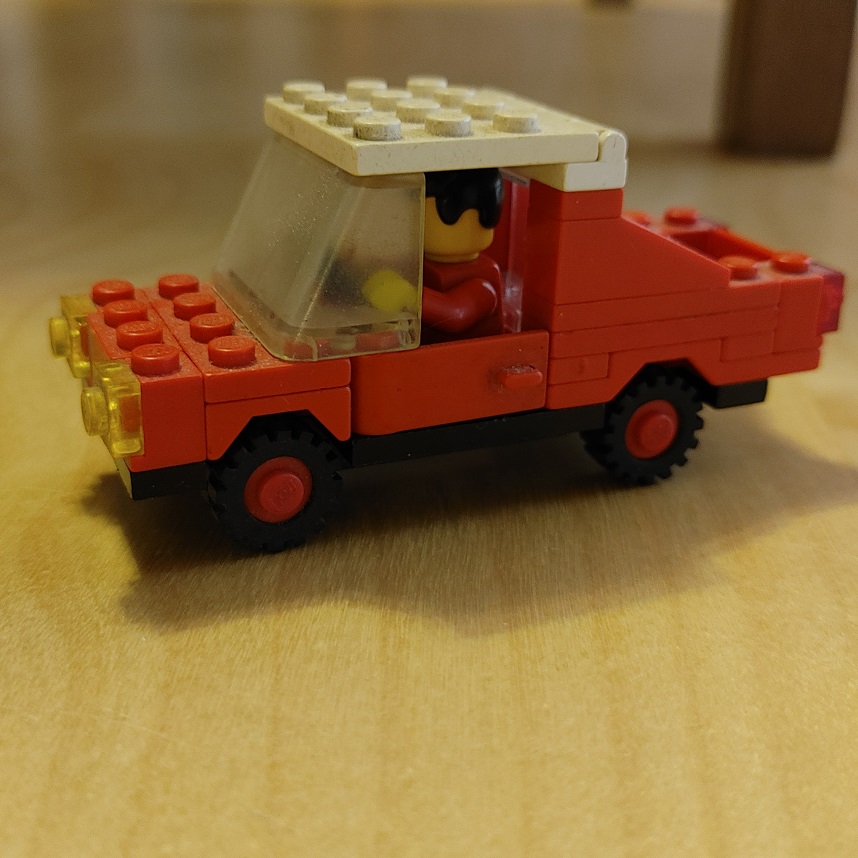
Rico Suave in his El Camino

Readers: Do you have a childhood hobby that you rediscovered in adulthood? Or any childhood hobbies you would like to get back into? Or, if you are not an adult yet, do you have any hobbies that you hope stick with you into adulthood? Tell me about your hobbies in the comments!

If you like what you read, don’t forget to like this post and follow this blog. Also follow Don’t Let The Days Go By on Facebook and Instagram.


August 24-25, 1996. The Moport tournament. (#98)

When I was in middle and high school, everything in my family revolved around sports.  My brother Mark played baseball and basketball, and I worked the scoreboard and snack bar, because I had no athletic talent and not enough discipline to work out and eat well.

Mark and I made up some of our own sports to play in the yard.  Some were variations of actual baseball and basketball, modified to be played one-on-one in small spaces.  Some were combinations of existing sports, and some were just silly.  We would pretend to be playing as teams with multiple players, so that, for example, if a goal was scored from a certain part of the field or court, it would be credited to a different player than if it was scored from a different place.  I usually lost, since I had no athletic talent, but I enjoyed keeping statistics, such as who led the league in scoring or who needed to beat whom to make the playoffs.  We would draw posters, pennants, and trading cards representing our fictitious teams and players, most of which had names based on puns, inside jokes, poop jokes, or double entendres.

Many students will have a class at some point in which they strongly dislike the subject matter, but love the teacher.  For me, that teacher was Mr. Alfred Pereira, whom I had for physical education in ninth grade.  PE was my least favorite class.  Part of my grade was based on how fast I could run, how many pull-ups I could do (zero), and the like.  I participated every day, and I got Bs for it because I was not athletic.  But Mr. Pereira was funny, and he found ways to make his class enjoyable.  We played a game in his class called Pereiraball, which was basically soccer with hands.  A player could pick up the ball and run with it, but the other team could steal the ball by tagging the player carrying the ball.  A goal scored by throwing the ball into the goal was worth one point, and a goal scored by kicking, the normal way in soccer, was worth two points.  A header goal, hitting the ball into the goal off of an attacking player’s head, scored three points.

I taught Mark to play Pereiraball in our yard, using a Nerf soccer ball, and some old sawhorses I found in the garage for goals.  We decided to add another element to the game: hockey sticks.  All of the normal rules of Pereiraball applied, but players could also move the ball with the stick, as in hockey, and a defending player could tag a player running with the ball with the stick, as long as the tag did not aim for the head.  A goal scored off of the stick was worth two points, the same as by kicking, and just for laughs, we added a rule that a goal scored by bumping the ball off of the scorer’s own rear end was five points.

I needed a name for my modified Pereiraball, but I was embarrassed to name something after my teacher.  I called it “Modified Portuguese Football,” since Mr. Pereira had a sticker of the flag of Portugal on his file cabinet at school to honor his ancestry, and I quickly shortened that name to “Moport.”  Mom, who has a tendency to get names wrong, called it “Ball Soccer” the first time we played; after I corrected her, she called it “Mopo-Hockey” the next time.

In addition to our usual one-on-one games, we would sometimes play Moport two-on-two, with a slightly larger field, when Mark would have multiple friends over.  We used our own names as players when I kept statistics, but we had names for our teams.  Mark and Eric Kingston were the Ice Monkeys of Rage, wearing homemade uniforms of black and light blue along with matching light blue bandanas.  Cody Kaneko and Matt Bosworth were the Jammin’ Janitors; they also made uniforms, in red and navy blue.  Two of Mark’s other sports friends, Danny Tsao and Nate Fisk, did not have their own Moport uniforms, but they called themselves Team Discovery Channel, referencing a scene from The Simpsons.  Bart Simpson and his friends declare war on kids from the neighboring town, and tough kid Nelson begrudgingly pairs up with nerdy Martin, who calls their duo Team Discovery Channel.  I played with anyone who was left over not on a team, or I acted as referee and scorekeeper.  The Ice Monkeys usually dominated those games, and Team Discovery Channel had never won.

When I visited my family in June, I suggested to Mark that we have a two-on-two Moport tournament when I came back in August.  The players were Mark’s friends, not mine, but I was mostly looking forward to keeping score and statistics.  Mark liked the idea, and he found two other friends who were interested in playing, John McCall and Drew Schmidt. They did not have a name, I suggested the Unabombers, after the recently captured domestic terrorist with the wanted poster photo that I found humorous for some odd reason.   We would play the games on a Saturday and Sunday, with each team playing each other team once, and the top two teams after that playing each other for the championship.

Cody was the first to arrive, in his Jammin’ Janitors uniform, as I was outside measuring the field and placing the goals.  “Hey, Ogre,” he said, using the nickname that many of Mark’s friends had for me.  “Are you playing this year?”

“If someone doesn’t show up, I might.  Otherwise I’ll just referee and keep score like I always do.”

“Nice.”  Cody went inside to play Super Nintendo with Mark until the tournament started, and I watched them play after I finished setting up the field.

“When are you going to start playing?” Mom asked, walking into Mark’s room.

“As soon as people show up,” I said.

“I have chips and salsa, bananas, grapes, Capri Suns, and Gatorade.  I was going to make taquitos for lunch today and chicken nuggets tomorrow.  Does that sound good?”  No one said anything.

“Who are you asking?” Mark asked.

“Sounds good to me,” I said.

“Whoever.  No one is saying no.”

Over the next half hour, Eric, John, Nate, and Danny showed up.  “Where’s Boz?” I asked.  “The Ice Monkeys are playing the Jammin’ Janitors first.  The game was supposed to start twenty minutes ago.”

“I don’t know,” Cody said.

“I have an idea.  There’s no reason the games have to be played in order, as long as everyone plays each other once.  I had the Ice Monkeys against the Jammin’ Janitors first, but what if the Ice Monkeys play Team Discovery Channel first?  Everyone is here for that game.  And if the others don’t show up soon, then we’ll figure something out.  I might have to play.”

“Whatever,” Mark said, shrugging.

“Eric?  Nate?  Danny?  Is that okay with all of you?” I asked.  All three boys replied in the affirmative.  “Let’s go, then!  Or you guys can finish your game first,” I said, turning to John and Nate, who were now playing Nintendo.

After they finished, we all went outside to start the game.  As referee, I dropped the ball at the center of the field, as in a hockey face-off.  Eric used his hockey stick to pass it to Mark, who picked it up and passed it back to Eric.  Eric threw the ball toward Nate, defending the Team Discovery Channel goal; Nate deflected it sideways toward Danny.  Mark quickly ran back to defend the Ice Monkeys’ goal.  In a two-on-two game of Moport, the positions had evolved such that the goalkeeper typically would run forward to participate in offensive plays, then quickly return to the goal once his team was on defense.  The forty-foot-long field was small enough to do this effectively.

Danny threw the ball toward Mark just as he got to the goal, and Mark missed it.  Team Discovery Channel was up 1-0.  Danny and Nate high-fived and cheered.  Team Discovery Channel’s good fortune did not last, though; Mark quickly scored a kicking goal, putting the Ice Monkeys ahead 2-1, and by halftime, the Ice Monkeys were leading 8-4.

Mom emerged from the house holding a plate of taquitos.  “Do you guys have a break coming up?”

“It’s halftime,” I said.

“And how long is that?”

“Five minutes, and each half is 10 minutes long.”

“You can eat after this game, then.”

“Sounds good.”

Boz arrived as Mom was talking, leaving Drew as the one remaining player we were still waiting for.  “Should someone call Drew to find out if he’s coming?” Mom asked.  I really hoped she did not mean me.  I hated calling people, and I did not know these people well in the first place  They were Mark’s friends.

“I will,” Mark said.  He went inside and came back outside a minute later, saying that Drew would arrive soon.

During the second half, Mark decided not to play with a hockey stick at all.  When Mark had the ball on offense, I noticed that he would dribble the ball and pass to Eric as if he were playing basketball.  The game of Moport had continued to evolve as different players brought different strengths and experiences to the game.  At one point, Danny attempted to pass the ball to Nate, but Eric intercepted it; Mark had already run down the field, positioning himself near the empty goal.  Mark turned around and bounced the ball off his butt into the goal just before Nate arrived.  Five points.  The Ice Monkeys went on to win the game, by a score of 21 to 9.

The Unabombers played the Jammin’ Janitors next; Drew had arrived in time.  He and John used their hockey sticks much more often than the Ice Monkeys did.  The Unabombers did not have matching uniforms, but Drew and John wore the same color, by coincidence.  Cody and Boz played a game heavy on passing, like the Ice Monkeys did, but their defense was not as good, and the Unabombers scored the first goal off of John’s stick.  Cody quickly scored a goal by throwing just seconds later, narrowing the Unabombers’ lead to 2-1.  “Yes!” Cody said, giving Boz a high-five.  The game stayed close throughout, but Cody’s speed proved to be just a bit too much for John and Drew’s stick and throwing skills.  The Jammin’ Janitors ended up winning by a score of 18-16.

After a snack break, the Jammin’ Janitors played again, this time against the Ice Monkeys.  Mark and Eric were collectively taller than Cody and Boz, and they often used their height to pass the ball downfield effectively.  The Ice Monkeys won that game easily.  The final game of the afternoon was between the Unabombers and Team Discovery Channel, and it was also the most unusual result of the day.  The Unabombers led by a score of 11-4 at halftime; five of the Unabombers’ points came on a butt goal while Nate left the goal unattended, just as had happened in Team Discovery Channel’s first game against the Ice Monkeys.  While most of us were snacking on chips and drinking Capri Suns through straws awkwardly poked into the plastic pouches, Danny and Nate actively discussed strategy.

“Game on!” I shouted when halftime ended, resetting the timer on my watch to ten minutes.  In that second half, Nate spent more time in the backfield playing defense, so as to make sure not to give up any more empty-net butt goals.  Danny used his stick to score more often, whereas Drew and John scored most of their goals by throwing.  With about twenty seconds left in the game, Team Discovery Channel had narrowed the Unabombers’ lead to two points, with the score 18-16.  Nate passed the ball forward to Danny, who passed it back to Nate, narrowly avoiding being tagged by John’s stick.  Nate passed to Danny, who put the ball on the ground next to his stick, and hit it toward Drew in goal.  Drew blocked the shot, but Nate kept trying to tap it in with his stick; eventually Nate scored, tying the game at 18 points each.  As I counted down the final seconds, Drew threw a desperation shot that went over Nate’s head and over the goal.

“Tie game,” Danny said.  “So does it go to overtime now?”

“No,” I explained.  “It just ends in a tie, and that counts as half a win for determining who will make the final round.”

“Did we make it?” Nate asked.

“I think we still have to play tomorrow,” John said.  “Right?”

“Yeah,” I answered.  “Everyone plays against everyone, so the Ice Monkeys need to play the Unabombers, and the Jammin’ Janitors need to play Team Discovery Channel.  Then after that, the top two teams play for the championship.  So far, the Ice Monkeys are in the lead with 2 wins, then the Jammin’ Janitors at 1-and-1, and Team Discovery Channel and the Unabombers are tied with one tie and one loss.”

“So if we beat the Jammin’ Janitors, we’ll move into second place?” Danny asked.

I thought about it.  “Yes.  But if the Unabombers beat the Ice Monkeys, then they’ll be tied with you for second place, and the goal differential, the difference between goals scored and allowed, will determine who advances.”

“So we need to score a lot tomorrow.”

“Definitely.”


The Unabombers did not beat the Ice Monkeys on the second day of the tournament, surprising exactly no one.  The Ice Monkeys finished the preliminary round of the tournament with a perfect record of three wins and no losses, guaranteeing them a spot in the championship game.  Everyone showed up on time today, much to my relief.  I got a bit stressed out waiting for Boz and Drew to show up yesterday, but it all worked out in the end.

Next, the Jammin’ Janitors played Team Discovery Channel.  The winner of this game would finish in second place and play the Ice Monkeys next for the championship; in the case of a tie, the Jammin’ Janitors would advance with the better record of the two.  Danny and Nate continued their strategy of playing defense and scoring stick goals, and they kept the score close.  With less than a minute left, Team Discovery Channel trailed 14-12, and Boz tried to kick the ball to Cody, to set up a goal, but Nate poked the ball away with this stick, right in the direction of Danny.  Danny ran down the field to the empty goal, turned to face Cody and Boz who were quickly approaching, and bounced the ball off of his rear end into the goal before Cody or Boz could get to him.  Team Discovery Channel led, 17-14.  “YEAAAAAHHHH!!!” Danny and Nate screamed as they ran back across the field to defend their goal.  They blocked two more shots in the little time that remained, and when I imitated the sound of the time-up buzzer, Danny and Nate jumped up and down, cheering, as their first win in two-on-two Moport history advanced them to the final round.

“What’s going on?” Mom said, bringing a plate of chicken nuggets outside.

“Team Discovery Channel got their first win,” I explained.  “And with their tie yesterday, that’s enough to make the final round.”

“That’s Nate and Danny?”

“Yeah.”

“Good job!”

Since there were only three games today, instead of four, we took a break for about an hour to eat and let our food digest.  Someone had brought a portable stereo and was using it to play rap and hip-hop.  Dad’s pickup truck was parked in the street, and when it was time for the game to start, John, Drew, and Cody climbed in the back to watch, bringing the stereo with them.  Boz sat in a lawn chair next to the truck, and I sat on the porch next to the scoreboard.  Mom occasionally stepped out onto the porch to watch too.

Before the game started, I went into the house and came back outside holding a small trophy, about nine inches high, made from cardboard and aluminum foil.  I took the trophy to the center of the field, where Mark, Eric, Danny, and Nate had gathered.  “This is the Big Al Cup, given to the champions of Moport,” I said.  “It will be awarded to the winners of this game.”  I did not tell them why it was called the Big Al Cup.  It was named after Mr. Pereira, but no one actually called him Big Al; that was an inside joke regarding something my mother said once and some of the inappropriate humor that my family seemed to enjoy so much.

 “Shake hands and get ready for the face-off,” I said.  The boys each shook the hands of both of their opponents, then moved into position to take the face-off.  I dropped the ball and moved out of the way.  Eric hit it backward slightly with his hockey stick, where Mark was ready to pick it up.  He dribbled and passed it to Eric, who got open just as Danny was about to tag Mark.  Eric passed it back to Mark, who threw the ball toward the goal.  Nate caught it and passed it down the field to Danny, who made a throwing shot that Mark blocked.

As I watched the game and ran the scoreboard, I noticed how I had always explained Moport to people as a hybrid of soccer, football, and hockey, but now the game had evolved to the point that Mark and Eric were playing it more like basketball, and Mark was not using his stick.  They were breaking no rules.  On an actual soccer field with healthy well-watered grass, like the one we played on in Mr. Pereira’s class, it would have been more difficult to dribble the ball, but real sports sometimes have different quirks depending on what field or stadium hosts the game.  This was the same sort of thing.

I made a loud buzzing sound with my mouth ten minutes after the game started.  “That’s the half,” I announced.  “Team Discovery Channel is leading, by a score of nine to eight.”  If Moport fans existed, this score so far would have shocked them.  The Ice Monkeys had always been the dominant team when we played two-on-two Moport, and before today Team Discovery Channel had never actually won a game.  But now, Team Discovery Channel was just ten minutes away from the championship, if this score held.

When the second half began, Team Discovery Channel moved the ball forward using hockey sticks, leading to a shot on goal that Mark blocked and picked up.  Mark and Eric began advancing down the field, passing the ball to each other to avoid Danny and Nate’s tags, but Nate blocked Mark’s thrown shot.  Both teams played defense well, and no one scored again until four minutes had passed, when the Ice Monkeys tied the game.

“Come on, Nate, we can do this,” Danny shouted as Nate passed the ball using his stick.  Danny faked a shot as Eric ran toward him, then stepped toward the goal and shot the ball off of his stick; the shot caught Mark off guard and went into the goal.  Each team scored a few more times as the game continued, and with about thirty seconds left, Team Discovery Channel led by a score of 16-14.

“Thirty seconds!” I called out.  Mark dribbled the ball and passed it to Eric, who held it waiting for Mark to get closer.  As Eric looked to the side of the field toward the street, waiting for the right moment to pass it to Mark, Danny approached Eric from the other side of the field and tagged him with his stick.

“Tag!” I exclaimed.  “Discovery Channel’s ball!”

“Aw, man,” Eric said as he dropped the ball to the ground.  Danny picked up the ball and threw it behind him to Nate, who then threw it back to Danny.

“Five seconds!” I called out.  Danny threw the ball up in the air vaguely in the direction of the goal; all he had to do at this point was stall for time, since his team led.  Mark caught the ball just before I made the sound imitating a buzzer.  “That’s game!” I exclaimed.  “Team Discovery Channel are the champions of Moport 1996!”

“Wooooo!” Danny shouted, hugging and high-fiving Nate.  The two of them ran to the porch and held up the Big Al Cup.

“Wait,” I said.  “If you’re going to pose with the Big Al Cup, you need to wear these.”  I ran inside and got out the gold medals I had made from string and yellow paper, and strung them around Danny and Nate’s necks.  “Good games, everyone,” I announced.  “Thanks for coming, and we’ll do this again next year!”

Team Discovery Channel, the perennial underdogs of two-on-two Moport, had won the championship.  It was their only championship; we did this tournament a total of three times, and the Ice Monkeys won both of the other ones.  I was glad that Moport was over for the year.  I had a lot of fun, and the players seemed to as well, but it was stressful getting everything organized and worrying that some of the players might not show up, especially yesterday.  That happened the following year; Drew did not show up the second day, so I got to play in one game for the Unabombers.  We lost that game.

Although we played Moport off and on for several years, to my knowledge no game of Moport has been played since the 1990s.  But many important life lessons can be learned through sports.  Never give up.  Do not underestimate anyone, especially someone who is determined to succeed.  Most importantly, though, I noticed that some of the teams had changed their strategies depending on what their strengths were, like Mark and Eric bringing moves from basketball into Moport.  My future seemed uncertain, but I knew that my strength was being good at school, particularly at mathematics.  I had two years left as an undergraduate, and I needed to start thinking about my strengths, so I could make a decision about what I would be best suited to doing after I finished my degree.

June 18-21, 1996. The time my brother and I turned a bunch of silly inside jokes into a board game. (#88)

It had been two years since I graduated from high school, and I had only heard from two high school friends in the last couple months: Melissa Holmes and Rachel Copeland.  Neither of them was in town during the week that I came home, after the end of the school year at the University of Jeromeville and before the start of my summer class.  Plumdale was not exactly the world’s most exciting place; neither was Gabilan or Santa Lucia or anywhere else in Santa Lucia County.  Santa Lucia was on the beach, but it was usually windy and not very warm, not what I call beach weather.  Gabilan had a low-level minor league baseball team; in the long tradition of unusual team names in Minor League Baseball, the team was called the Peppers.  I went to one Peppers game with my family that week.  The Peppers lost.

Usually, when I came home on school breaks, the only friends I saw were my brother Mark’s friends, who were all 14 and 15 years old.  There was Cody Kaneko, a teammate and opponent of Mark in baseball and basketball whose parents had known mine for decades.  Another one was Matt Bosworth, Boz for short, a unique combination of silly and intellectual who also had no sense of smell, so we could fart in front of him all we wanted.  Mark and his friends and I had a lot of inside jokes.  Many of them came at the expense of Mark’s other friends, like Ryan Lathrop, who always seemed a bit out of it, or goofy Eric Kingston.

Eric Kingston came over one day during the time I was home.  I was in Mark’s room playing Donkey Kong Country on the Super Nintendo, alone, while Mark and Eric played basketball in the backyard.  After my game ended, I went outside to watch them.

“For three!” Mark shouted, shooting the ball some distance from the court. The ball cleanly sailed through the hoop.  Eric took the ball to the back of the half-length court, then he ran around the court, holding the ball instead of dribbling and flapping his arms like wings, making a vaguely bird-like noise that sounded like “Ba-caa!  Ba-caa!”

“What’s that?” Mark shouted.  “Traveling!”

“No, it’s not traveling,” Eric explained.  “It’s the Flying Bacaa.  That means I don’t have to dribble.  Ba-caa!  Ba-caa!” Eric shot the ball from just a few feet away; it missed.  All three of us started laughing hysterically.

“Ba-caa!  Ba-caa!” I crowed, running around the yard and flapping my arms in imitation of Eric.  Eric and Mark started laughing harder.

After Eric and Mark got tired of basketball, all three of us went back inside to Mark’s room, trying to decide what else to do.  I saw a Monopoly game through the open closet door, and suggested, “Let’s play Killer Monopoly.”

“Okay,” Mark said.

“Killer Monopoly?” Eric asked.

“Yes,” I explained.  “It’s like Monopoly, but with a few extra rules.  We use the house rule about getting money on Free Parking.  And also, there’s no limit to how many houses and hotels you can build, and you can build more houses after you build a hotel.”

“Can’t you always do that?”

“Not according to the actual rules.”

“Well, that’s how I’ve always played.”

“But the most important rule change is, when you land directly on Go, instead of the two hundred dollars, you get a bomb.  And if you land on someone’s property and you don’t want to pay rent, you use the bomb to blow up their houses and hotels.  And if you use two bombs, the whole property goes back to the bank.”

“That sounds cool,” Eric said.

We began playing, aggressively buying property.  After a few times around the board, Mark had all three of the light purple properties.  He landed on Free Parking on that round and used the money to put two houses on each property.  Eric landed on Go on his next turn, just as Mom opened the door to check on us.  Julio, a large orange and white striped cat, one of four cats who lived here, walked into the room when the door opened.

“I got a bomb!” Eric said.

“A bomb?” Mom asked.  “In Monopoly?”

Killer Monopoly,” I corrected.  “I tried teaching it to you a few days ago, but you weren’t interested.  You just said you hated Monopoly.”

“I do!” Mom said.

“No, no, Julio,” Mark said, pushing Julio away to make sure he did not walk across the board and knock over pieces.

“You come with me,” Mom told Julio, picking him up.  She patted him on the head, saying, “You feel better now, don’t you.”  Turning to Eric, Mom explained, “He had worms in his butt.  But the doctor gave him medicine, and now he’s all better.”  Eric got a horrified look on his face.  He looked at Mark, then back at Mom.  “Oh!” Mom said, laughing.  “You thought I was talking about Mark!  No, I meant Julio.  The cat.”

“Oh!” Eric said, laughing.  I laughed too.

“I don’t have worms in my butt!” Mark shouted.

After Mom left with Julio, I took my turn and landed on Mark’s St. Charles Place, with two houses.  I begrudgingly handed over the rent, leaving me with very little money left.  “I wish I had a bomb,” I said.  “Maybe we need something so you can escape paying rent, but without blowing up the property.  I know!  We should make a Community Chest card that you can keep, like the Get Out Of Jail Free card, and when you play it, you just run away and reappear somewhere else. Like, it takes you the space farthest away from where you are.  It can be the Flying Bacaa card.”

“Ba-caa!  Ba-caa!” Eric squawked.

“We can use the ‘You have won second prize in a beauty contest’ card for that.  I always thought that card was silly anyway.”

Eric went home late in the afternoon.  Mark went out to the living room and put in a VHS tape of shows he had been recording.  First on the tape was a recent episode of The Fresh Prince of Bel-Air, a popular sitcom starring Will Smith as a city kid who moved in with wealthy relatives to keep him out of trouble.  Will’s cousin Hilary had gotten a job hosting a television talk show, and the family was talking about William Shatner being a guest on the show.

“Have you seen this one, Greg?” Mom asked me.

“No,” I replied.

“It’s hilarious!  We have to watch it!  You know the show ended this season, right?”

“I don’t know if I knew that.”

“Mark?  Do you have the last episode on this tape?”

“I think so,” Mark answered, sounding annoyed.  “I’ll look for it later.”

I continued watching as Carlton embarrassed himself trying to impress William Shatner, accidentally breaking his tooth with a pool stick and taking him to the dentist. William Shatner got doped up on laughing gas just in time for the interview on Hilary’s show.  Mom and Mark and I laughed hysterically through the entire episode.  Mark pressed fast-forward to look for the finale of The Fresh Prince of Bel-Air, but stopped when an episode of Beavis and Butthead came on.  “This one!” he said.  “Plant Man!”

“Yes!” I shouted. The show Beavis and Butthead alternated between a silly story involving the two teenage boys of less than stellar intellect and scenes of the boys watching music videos.  In this episode, they were watching a very strange video called “Plant Man,” by Gary Young.  One part of the song featured Gary Young banging on the drums, and Beavis commented that he could play drums like that.  It was not the first time seeing this episode for any of us.

“Beavis and Butthead sure do watch the strangest music videos,” Mom said.

“I know!” I replied.

Mark found the other episode of The Fresh Prince of Bel-Air on the tape.  While he fast-forwarded to skip commercials, I said, “I like that idea of adding a Flying Bacaa card to Killer Monopoly.”

“Ba-caa!  Ba-caa!” Mark said.

“We also need to get Plant Man in that game somehow.”

“Maybe Plant Man should fight the Monopoly guy.”

“That would be funny,” I said.  “Or maybe we should leave Killer Monopoly alone and make a new game with the Flying Bacaa and Plant Man.”

“And Erzix,” Mark added, using an old nickname for Eric Kingston from a few years ago.  Eric was playing a video game that asked for your name, and he started entering Eric but finished with nonsense letters.  Erzix was pronounced “air-zicks,” with the first syllable pronounced like the first syllable of Eric.

“Yes!” I said.  “The Adventures of Erzix.  You have to go around the neighborhood fighting Plant Man and a bunch of other weirdos.  And you can get items to help you win a fight.”

“If you land on the same space as another player, you have to fight the other player.”

“But first, you have to ask them, ‘Pardon me, sir, but do you have any Grey Poupon?’” I suggested, quoting a TV commercial.

“Yes!”

“Let’s go work on this!”

We went back to Mark’s room with a pen and paper.  I began drawing four glorified stick figures resembling Erzix wearing a basketball jersey and colored them different colors.  “Don’t forget, he has an earring now,” Mark said.  I drew an oversized hoop earring on each of the four Erzices.  (Since I was one to use irregular plurals facetiously, I had decided years ago that the plural of Erzix was “Erzices,” analogous to the plurals of “matrix” and “vertex” being “matrices” and “vertices.”)

“Who else should you have to fight besides Plant Man?” I asked as I drew Plant Man.

“Putnam,” Mark said.

“Who’s Putnam?”

“You don’t know Putnam?  Let me bring you up to Putnam.”

“Huh?” I asked.  Mark told me about some funny-looking annoying kid at his school named Putnam, then proceeded to draw a caricature of a face with a bad haircut and exaggerated features. I cut out the Putnam picture and glued it to the front of a playing card, from a deck that was missing cards anyway. Those cards would become the cards for the Erzix game.

Mark had a stuffed figure of Pepe the Pepper, the mascot of the Gabilan Peppers baseball team, on a shelf.  Pepe was an anthropomorphic jalapeño with a mustache and baseball cap.  As I stared at that shelf, I asked, “What about Pepe? Should he be one of the enemies?”

“No!” Mark said.  “Pepe is awesome!  He should be on your side instead!”

“What about, you can go to the stadium and get Pepe, and then he follows you and helps you in the next fight?”

“Yeah!  Let’s do that!”


The next day, I typed the rules for The Adventures of Erzix on the family computer.  When I went to print the rules, I noticed the printer was not working, so I asked Mom about that.

“We just got a new printer,” she said.  “And we haven’t set it up yet.  We were waiting for you to come home so you could help.”

I rolled my eyes.  The directions for setting up a printer were not difficult.  You plug it in, you put the CD in the computer, and you follow the prompts it gives you.  I did exactly that.  About halfway through the installation process, I said, “It wants you to name the printer.  What do you want to name it?”

“Carlton!” Mom said, after the character from The Fresh Prince of Bel-Air.

“Really?” I asked.  “You’re gonna name your printer ‘Carlton?’”

“Sure!  Why not?”

I typed “Carlton” in the box and waited for the printer to finish installing.  When it was done, I printed the rules to The Adventures of Erzix; it worked.  “Printer works!” I called out.

“Good!” Mom replied.”


Later that week, Cody and Boz both came over on the same day.  While waiting for a turn on the Super Nintendo, I said, “We should play The Adventures of Erzix.  All four of us.”

“Yeah!” Mark said.

“We should play what?” Boz asked.

“The Adventures of Erzix.  Mark and I made a board game.”

“You made a board game about Erzix?” Cody asked.  “I gotta see this.”

I unfolded the game board and set up the pieces as I was explaining the rules to Cody and Boz.  “I have the rules right here,” I said, holding up the typed rule sheet, “so you know I’m not making anything up.”

We began the game, taking our turns and drawing Item cards when we landed on certain spaces.  Boz was the first to land on a Fight space.  He drew an Enemy card.  “Putnam,” he said, laughing at the drawing.  “The items that say ‘roll 1 to win fight,’ I can play that now and I also win by rolling a 1, is that how that works?”

“Yes,” I said.  “With no item, you have to roll higher than whatever the card says.”

“Then I’m going to play this Giant Otter Pop, and hit Putnam with it.”  Boz rolled the die; it was a 1.  “Got him!”

Cody took his turn next.  He landed on an Item space and drew a card.  “Go to Ryan’s Fart Station,” he read aloud.  He laughed, then asked, “What the heck is Ryan’s Fart Station?”

“One time we were playing Legos with Ryan Lathrop,” I explained.  “He found a piece that said ‘STATION,’ it’s supposed to be for a train station, and he goes, ‘I’m going to build a fart station!’  I have no idea what it means.”  I pointed to Ryan’s Fart Station on the board, and as Cody moved his piece there, I added, “You have to shuffle your items and discard the top one.”

“What?  Why?”

“Because Ryan’s Fart Station stinks so bad, it makes you drop something!”

“Like this?” Mark said.  He farted loudly, and the rest of us laughed.

“Eww!” I screamed as the smell of Mark’s fart hit my nose.

“Boz!” Mark exclaimed.  “You’re lucky you can’t smell that one!”

Just then the door opened.  “What’s going on in here?” Mom asked.

“Mark farted, that’s what’s going on,” I said.

“Whew!  I can smell it!” Mom exclaimed, and the four of us all started laughing again.  “Are you actually playing that Erzix game that you’ve been working on?”

“Yes!” I said, proud of my creation.

“I want to see how this works.”

“Okay.  Whose turn was it?”

“Mine,” Mark said.  Mark rolled the die, moved, and landed on Flying Bacaa.  “Ba-caa!  Ba-caa!” he shouted, flapping his arms, as he moved his Erzix token across the board.

“Wha– what?” Boz asked.  “What even is a Flying Bacaa?”

“Some weird Erzix thing,” I said.  “My turn.”  I landed on a Fight space and drew an Enemy card.  “Ogre,” I said, as I drew a card with a drawing of myself on it, complete with Jeromeville T-shirt.

“Ogre, like the nickname that Mark’s baseball team used to call you when you worked in the snack bar?” Mom asked.  “You’re in this game?”

“Yeah.  It was Mark’s idea.  But my Erzix doesn’t have to fight Ogre, because I have this,” I said, playing an Item card from my hand.  “I’m going to use the White Bronco to drive away!”

“Yes!” Cody said, laughing.

“White Bronco?” Boz asked.  “Like O.J. Simpson’s car?”

“Yes!” I shouted.  “My turn is done!  Your turn, Boz.”

Boz drew the Item card that says to challenge another player to a game of one-on-one.  He took Mark’s piece and moved them both to the Basketball Court space. Mark rolled higher, so Boz had to give Mark his last two Item cards.

Cody took his turn next.  He landed on a Fight square and drew an Enemy card.  “Plant Man!” he said, laughing at the drawing resembling Gary Young in his furry green suit. Cody pulled an Item card out of his hand, saying, “I’m going to use this Picture of a Butt, to get an extra chance to win.”

“What?” Boz said, reading the card to make sure he heard right.

“You guys are silly,” Mom said.  


A couple weeks after I moved back to Jeromeville for my summer class, I heard from Mom that Eric Kingston had come over and played The Adventures of Erzix with Mark.  He got a good laugh out of the whole thing, although he said that my drawing of him did not look like him.

We dragged the game out a few more times when I came home on school breaks.  After that, it spent twenty-four years in a closet at my parents’ house, where it remains today.  The game was not a regular activity for our family for long, but it had an important legacy in my life.  It served as a sort of first draft for another silly board game I would write a couple of years later.  The later game had a very similar style of play to The Adventures of Erzix, but with the game rules reworked and improved a little.  Over the years, I taught that later game to many other groups of friends, and I was still playing it regularly for most of my adulthood.  One of my friends who now lives in another state just recently, a few days before I wrote this, dragged out her copy and taught it to some people she knows now.  That other game is another story for another time.

This story has had one more lasting legacy in my life.  In the years since I helped Mom set up Carlton the printer, I have bought three more printers, and every one was named after a Fresh Prince of Bel-Air character.  I keep print copies of all of my writing, so if you will excuse me, I need to go print this on my printer, Aunt Viv.

February 19, 1995. Mom and Dad and Mark visit Jeromeville. (#25)

Building C was quiet at ten-thirty on that Sunday morning.  I had just written emails to Brittany from Texas and Molly from Pennsylvania.  It was also my turn to email Renee, my friend from high school. I opened the message and reread what she had written about yesterday.  I figured I might not have time to write back right now, because I was expecting guests, and I needed to go down to the common room to let them in.  But as I was reading Renee’s email, I heard a knock at the door, and I opened the door to see my expected guests in the hallway.

“Hi, Greg,” Mom said, giving me a hug, which I returned.

“Hi,” I replied.  “How’d you guys get in?”

“Tall curly-haired guy let us in,” Dad said.

“Jonathan,” Mom added.  “He was downstairs studying.  Do you know Jonathan?”

“Um, yeah,” I said.  “Don’t you remember how the IHP works?  You guys came to that preview day last year.  Everyone in this building has classes together.  Come in,” I said, gesturing for Mom, Dad, and Mark to come into the room.

“I know that,” Mom continued.  “I meant, is Jonathan your friend?  Do you talk to him?”

“I guess,” I said, a little confused about where Mom was going with this line of questioning.  “I mean, we don’t talk a lot, but I don’t ignore him either.”

“Why is this important?” Mark interrupted loudly.  Until that moment, he had just been standing quietly in the background.

“Good point.  Is it time to go to church yet?” Mom asked.

“Mass starts at eleven,” I said.  “We should probably leave in about ten or fifteen minutes.  We don’t want to be late.”

“Can we just sit around until then?” Dad asked.  “I’m tired from the drive.”

I sat on the bed, Mark sat next to me, Dad sat in the desk chair, and Mom stood near the closet.  We talked mostly about my classes for the next ten minutes until it was time to leave.

“Are we dressed okay for church?” Mom asked.  She was wearing a long sleeve shirt and slacks.  Dad wore a sweater, with jeans and Birkenstocks. Mark wore a solid color t-shirt and jeans. “You’ve been going to church all your life.  Why would this one be different?”

“I don’t know.”

“If anything, people would dress more casually, because this is Jeromeville, with a lot of college students.”

“You’re fine,” Dad said.  “Let’s go.”

We walked out of the building and turned toward the parking lot.  “What’s that smell?” Mark asked.

“That’s the dairy over there.”  I pointed at the buildings across the street from Building C.  “It’s cows.”

“Later on today, I want you to give us a tour of the campus,” Mom said.  “I still haven’t seen all of it, and there’s a lot I don’t remember.”

“We’ll do that after lunch,” I said.

Danielle saw us as soon as we entered the church building.  “Hey, Greg,” she said. “Is this your family?”

“Yes.  This is my mom, and my dad, and my brother Mark.”  I turned to my family and said, “This is Danielle. She lives down the hall in room 216.”

“Nice to meet you,” Mom said.

“Can you save me a seat?” Danielle asked.

“Sure,” I said.  Turning to Mom, I explained, “She sings in the choir.  She’ll sit with us during the homily.” Mom nodded.

During the Gospel reading, Mom nudged me.  She was pointing at a tall guy in the choir with dark hair and features that suggested mixed European and Asian heritage.  “Is that Matt Jones?” she whispered. I shrugged my shoulders and gave her a confused look. “He’s from Gabilan. He’s Josh Jones’ brother.”

“You’re talking during the reading,” I whispered, as Danielle, the guy who might have been Matt Jones, and the rest of the choir sang the Alleluia at the end of the Gospel reading.  Mom turned to Mark and continued whispering, probably asking whether Mark knew if that guy was Matt Jones.

Josh Jones and Mark were on a baseball team together a few years earlier.  Or maybe it was a basketball team; I don’t really remember. I don’t remember ever meeting the Joneses, but Mom had told me at some point that Josh Jones had an older brother named Matt who was a year ahead of me at UC Davis.  I think Matt Jones had gone to St. Luke’s High School in Gabilan, a Catholic school, so it made sense that he might be at a Catholic Mass. However, many students at St. Luke’s weren’t practicing Catholics; they just had parents who wanted them somewhere more prestigious than public school.

At the end of the service, Mom said, “I’m going to go ask that guy if he is Matt Jones.  Come on.”

“I don’t want to just go talk to a stranger,” I said.

“I know it’s him.  Let’s go talk to him.”

“That doesn’t change the fact that I don’t know him.”

“Just come on,” Mom said, walking directly over to the guy she thought was Matt Jones.  She turned around, looking at the rest of us, as if to say that we too had to come in order to make her not feel weird.  I followed her, even though everything about this was weird to me.

“Excuse me,” Mom asked.  “Aren’t you Matt Jones?”

“Yes,” Matt said, turning around and looking puzzled.  “Do I know you?”

“I’m Peggy Dennison.  I’m from Plumdale. My son Mark was on a baseball team with your brother Josh,” Mom explained, gesturing toward Mark.

“Oh, yeah!” Matt said.  “I remember you guys. What are you doing up here?”

“Our other son, Greg, goes here.  He’s a freshman.”

Matt extended his hand to shake mine.  “Hi,” I said. “Nice to meet you.”

“You too,” Matt replied.  “Are you guys just visiting for the day?”

“Yes,” Mom explained.  Then, gesturing toward Dad, she said, “He has to work tomorrow.  It isn’t a holiday for everyone.”

“That makes sense.  Travel safely.”

“Thanks.  It was good seeing you.”  Mom turned to me. “Are you ready for lunch?”

“Sure,” I said.

“Sounds good to me,” Dad added.


At age 18, I did not have anything at all resembling a sophisticated culinary palate.  I liked McDonald’s, and that was where we often went when we were eating while on vacation.  Jeromeville only had one McDonald’s, and it was completely on the other end of town from where we were.

Dad was driving.  “Which way?” he asked at the stop sign outside of the Newman Center building.

“Left,” I said.  Dad turned left, and we began heading east on Fifth Street.  The street was narrow, with room for two lanes of cars in each direction but not much else.  Old houses and large trees lined the street, along with a few office buildings.

“This looks like a really old neighborhood,” Mom said, looking out the window.

“Yeah,” I replied.

As we continued farther east, we passed by some much newer apartments and office buildings.  “Those apartments look really nice,” Mom said. “I wonder who lives there? College students?  Regular people?”

“I don’t know.”

Eventually Fifth Street curved to the left and ended in a very new neighborhood that appeared to be still under construction.  Dad turned right, then right again, on a road that crossed over Highway 100, while Mom continued talking about one of Grandma’s old lady friends.  “Turn right at the first light,” I said as Dad drove down the other side of the overpass. Dad turned right, and McDonald’s was just past this intersection on the left.

We sat down with our food a few minutes later; Mark and I both ordered Chicken McNuggets.  I dipped a nugget in barbecue sauce as Mom said, “Danielle seems nice.”

“She is.”

“Do you know the girl who was standing next to Danielle in the choir?  To our right, from where we were sitting?”

“Her name is Claire, and she’s a sophomore.  But I don’t really know her.”

“She sure is well-endowed.”

“That’s an understatement,” Dad added, chuckling.

“Why do you guys always have to talk about people behind their backs like that?” I asked.

“I’m not,” Mom said.  “I’m just stating a fact.”

“Yeah, but you’ll never see these people again.  I have to see Claire every week at church, and now I’m going to think about her boobs next time I see her.”

“Doesn’t Greg think about boobs all the time anyway?” Mark chimed in.

“You’re not helping,” I said.  I stopped talking and concentrated on eating until the conversation turned away from Claire’s boobs.

We returned to downtown Jeromeville a different way.  Cornell Boulevard ran parallel to Highway 100 on the south side of the freeway, mostly through newer suburbs.  Just outside of downtown, Cornell Boulevard turned slightly to the right and crossed over Highway 100, then narrowed to two lanes passing through an old and narrow railroad underpass and emerging on the other side at an intersection with First Street.  Cornell Boulevard became E Street continuing past First Street.

“Which way are we going?” Dad asked.

“Left,” I said.

“Fraternity houses,” Mom said after Dad turned, pointing to the right side of First Street.  On the left side was a row of olive trees and a vacant lot. “We must be near campus.”

“Right up there,” I said, pointing straight ahead of us where First Street entered campus and closed itself to automobile traffic.  “But we want to turn left here.”

Dad turned left onto Old Jeromeville Road, which crossed the University Arboretum and an on-campus apartment building for adult students.  “Is that part of the campus?” Mom asked. “It looks like apartments.”

“It is part of campus,” I said.  “I think it’s for older students who have families.”

We continued driving, past a few small research laboratories on our left and the Arboretum on our right.  “What are all those trees on the right?” Mom asked.
“That’s a creek, isn’t it?”

“Yeah.  And there’s an arboretum lining both banks.”

“That looks like a nice place to take a walk.”

“It is.  Are we going to do that later?”

“Sure.  After we get back to the parking lot, I’ll show you around campus.  We can take a walk in the arboretum, and then on the way back to the building, I’ll show you where my classes are and stuff like that.”

“Sounds good.”

We turned onto Andrews Road, crossing back to the north side of the creek and then making a 90 degree left turn to run parallel to it.  “See that road down there?” I said, pointing straight ahead as we made the 90 degree turn. “That first time we drove around campus, that’s where Dad got stuck in that driveway.”

“I remember that,” Mom said.

“Hey, I was only going where your mother told me to go,” Dad said, laughing a little.

“That looks like more agriculture stuff over there,” Mom said, pointing to the left.  In between Andrews Road and the creek was a row of tall pine trees, with what appeared to be barns behind them.  Between the barns were pens with cows and goats inside.

“The Milking Facility is somewhere back there, I know that,” I said.

“Have you ever milked a cow?”

“I think it’s just for people taking those classes and working in those departments.”

“Yeah!” Mark said loudly from the back seat.  “It’s not like just anyone off the street can walk up there and say, ‘Pardon me, may I please milk your cow?’”  Mark asked that last part in an exaggerated falsetto. I laughed.

“I don’t know these things!” Mom said.  “Stop making fun of me!”

“Well, you have to admit, it was kind of a strange question.”


Dad pulled into the parking lot a minute after we saw the cows.  “Are we ready to walk around?” he asked.

“Sure,” Mom said.  Mark and I voiced no objections.  I may have only been here for five months, but given my natural inclination toward maps and roads and the exploring I had done on my bike, I felt ready to play tour guide.

We walked east, back the way we came along Andrews Road.  That part of the campus wasn’t very exciting; we had already seen the pine trees and barns across the street, and our side of the street was all parking lots, except for one building called Mayer Hall.  I wasn’t sure what happened in that building, but there were no classrooms as far as I knew.

“That’s the water tower,” I said, pointing ahead of us toward a fenced-off area that appeared to contain maintenance vehicles.  “That’s kind of a campus landmark. It’s on the university seal. You can see it from the freeway.”

We continued toward the water tower to the 90 degree turn in the road, where I led the others off of the main road into the Arboretum.  “This is nice,” Mom said. “The kind of place where you could go read or study in between classes. Do you ever do that?”

“Not really,” I said.  “I usually go home if I have a long gap between classes.  But eventually if I’m living off campus, I could do something like that.  Besides, this time of year it’s usually a little too cold for sitting outside..”

“Have you thought about where you’ll be living next year?”

“Not yet.”

Mom looked at a sign next to a small, bare tree next to us.  “‘Western redbud,’” she read. “This will have pretty flowers in the spring when it starts blooming.”

I looked at the sign.  “Yeah.”

After the redbuds, we walked past some large desert plants, many of which looked similar to the potted succulents found on suburban patios, except much larger.  Past these was a very large live oak tree with a bench underneath. On the other side of us was a large building three stories high. “That’s the law school building.  And that,” I said, pointing around the corner to an even taller building as we crossed a street, “is Marks Hall, where the Chancellor’s Office is.”

“I remember that building,” Mom said.

On the other side of Marks Hall was an area of large trees native to Asia.  The creek widened into a small lake, with a grassy area on the bank on our side.  One student wearing a hoodie sat on the grass reading, with his bike next to him. We passed the grassy area toward a grove of redwood trees, but instead of continuing through the arboretum, we walked to the left.  “These are the art, drama, and music buildings,” I said.

“I still wish you would get back into music someday,” Mom said.

“I know.  I have classes to focus on right now, though.”  I wondered if getting into music again would be less intimidating as an adult, since Mom would not be around to pressure me to perform.  I had to play piano every time Grandma came over, I had to record myself playing so we could send it to other relatives, and all of that made me very self-conscious to the point that I quit playing piano at age 10 and have not done anything musical since.

We crossed Davis Drive and continued walking north, under tall trees that would grow long, thin leaves in the spring.  I’m not sure what they’re called. “That’s the library,” I said, pointing at the large gray building on our left, “but the entrance is on the other side.”  I pointed to the right a few seconds later, to a courtyard in between three buildings. “And over there, those olive and fig trees, there’s a plaque over there that says they were planted in 1855 by the Jerome family, before there was a town or a university here.”

“Wow,” Mom said.

“And I had a class in that building over there.”

I continued pointing out landmarks around the campus as Mom asked questions and Dad and Mark followed quietly.  We walked along the Quad next to a row of tall, aged cork oaks, stepping on years of shed leaves and acorns. Across the street from us, facing the Quad, were the oldest buildings on campus, built in 1906 as dormitories and now housing offices for various student services.  The outside walls of the buildings were covered in wooden shingles. I pointed out the Memorial Union, and Mom and Dad commented on how they remembered that building from the IHP preview day last year. We walked past Wellington Hall, where around half of my classes had been held so far.  I turned left on Colt Avenue and walked past the chemistry building and the barns and silos that had been converted into a second student union, the bike shop, and an arts and crafts center. These buildings had a shingled appearance similar to the old buildings facing the Quad.

“That building has a funny round tower thing on it,” Mom pointed out.

“It’s a silo.  It used to be an actual silo.  And these other buildings were barns.”

“That’s neat the way they made those buildings into something else.  Does that one say ‘Bike Barn?’”

“Yeah.  It’s a bike shop, run by Associated Students.”

“Have you ever been there?”

“I got fenders there, so I don’t get dirty biking in the rain.”

“Why are there big square rocks piled up over there?” Mark asked, pointing to what looked like a pile of big rectangular rocks.

“It’s art,” I explained.

“More like fart.”

“Yeah.  I don’t always get art.”

We turned right on another pedestrian and bike path just after the confusing artwork, walking past a small cluster of walnut trees.  After the barns, the path curved to the left past Kent Hall, one of two buildings used specifically by the various engineering departments.  Just past Kent Hall, scattered among oaks, pines, and other trees I could not identify, were the twelve letter buildings of the South Residential Area.

“Now we’re back to your dorms,” Mom said as we walked between Buildings L and M.

“Yes,” I replied.  “Building C is on the other side.”  I pointed out the dining commons building as we walked past.

“Greg!” I heard a voice say.  It was coming from above where we were walking.  I looked up and saw Taylor Santiago sitting on the balcony at the end of the third floor of Building C.  “How’s it going? Is this your family?”

“Yeah.  This is my mom and dad, and my brother Mark.”  I turned to my family and continued, “That’s Taylor.  He lives in that room next to the balcony.”

“Hi, Taylor,” Mom said.

“So you guys just here for the day?”

“Yeah.”

“From Plumdale, Santa Lucia area, right?”

“Yes.  Greg was just showing us around.  We’re leaving later this afternoon.  Greg’s dad has to work tomorrow.”

“Well it was nice meeting you!  Enjoy your visit!”

“Thanks!”

I walked with the rest of the family around to the main entrance of Building C.  Liz came up the back stairs just as I was letting everyone back in my room. “Hey, Greg,” she said.

“Mom, Dad, Mark, this is Liz.  Liz, this is my family.”

“It’s nice to meet you,” Liz said, smiling.  “Are you having a good visit?”

“I am,” Mom replied.

“I have a paper to write.  But it was nice meeting you guys!”

“You too!”

Liz went back into her room just as we entered my room.  “You were going to show me how all that stuff you do on the computer works,” Mom reminded me.

“I can do that,” I said.  I showed her my email inbox, with a list of messages received, and as I was hoping, she didn’t ask me who all those people were.  I got on an IRC chat after all the dings and whistles went through, and explained to the others what IRC chat was. I typed a greeting to the rest of the room and waited to see if anyone would reply.

gjd76: hey
c: hi gjd!
Alicia: hi
BONER: yo gjd, m/f?
*Alicia gives gjd76 roses @}–}–}—–

“Did that Boner guy just call you a MF?” Mom asked.  “That was mean.”

“No,” I explained.  “With the slash and the question mark, it means he’s asking if I’m male or female.”

“And Alicia gave you roses.  What are all those symbols?”

“Turn your head sideways to the left.  It looks like a rose.”

Mom tilted her head.  “Oh! I see. How clever.”  Mom didn’t ask anything more about this; she just wanted to see what it looked like.  I was glad. I really didn’t want to tell my mother what Alicia and I were doing on IRC last night.  And I really hoped Alicia would still be on later tonight after Mom and Dad and Mark left.

gjd76: thanks, alicia :) i’ll be back on later tonight.  my parents are visiting right now, and i’m just showing them how irc works
Alicia: ok! i’ll see you later =)
c: bye gjd
BONER: bye

“You seem to be fitting in here and making friends,” Mom said a while later, after I showed her the Pink Floyd Usenet group and a few other wonders of the text-based Internet.  “That Taylor guy seems really nice.”

“He is,” I said.

“Remember when we came here for the preview day last year?  That one guy said that people in the program often find lifelong friends.  I wonder if you and Taylor are going to end up being lifelong friends.”

“Maybe,” I said.

We spent another hour or so sitting in my room talking.  Mom told me about Mark’s basketball season. Mom told me about the latest gossip she had heard the other day when Mary Bordeaux called her.  Mom told me about drama at her work involving people whom I had no idea who they were. Dad said very little, although he did mention something about some guy he knew from work.  Mark didn’t say much, except to correct Mom when she got a minor detail wrong about one of his basketball games.

In the late afternoon, around four-thirty, Mom said, “Well, it’s probably time for us to go.  We don’t want to be out too late.”

“Sounds good,” I said.

“But it was good seeing you.  I enjoyed you getting to show us around.”

“I did too.”

“When are you coming home next?  When is your break?”

“End of March.”

“Then I’ll see you at the end of March.”  Mom hugged me.

“Dad loves you,” Dad said, also walking toward me and giving me a hug.

“Bye,” Mark said.

“Drive safely,” I told them as they left the room and closed the door.


At dinner that night, I saw Taylor, Pete, Danielle, Gina, and Skeeter sitting together.  I sat next to them.

“Did your folks leave?” Taylor asked.

“They did,” I said.  “About an hour ago.”

Gina spoke up.  “I saw you guys earlier.  Your dad doesn’t look at all what I expected him to look like.  I can’t believe you came from that.”

I laughed.  “Yeah, I definitely don’t have the scruffy Deadhead look.”

“Your dad is a scruffy Deadhead?” Skeeter asked.

“Yes,” Gina explained.  “Birkenstocks and facial hair and everything.”

“Wow.  Yeah, I wouldn’t have thought that either.”

“So why was your mom talking to Matt Jones after church?” Danielle asked.

“He grew up near me, and our families know each other.  Our brothers played baseball together. But it was so embarrassing!  I don’t know Matt except that I recognize his face. I didn’t want to just go up and talk to some stranger.  And now that I know him, he’s going to think of me as the guy with the weird mom.”

“Maybe your mom could put in a good word for me.  Matt is pretty hot.”

I laughed.  “I don’t know.  I’ll see what I can do.”

I really wasn’t all that upset at Mom embarrassing me.  It got old after a while, but I was used to it. And with me now living almost three hours away, Mom was not around as often to embarrass me.  But Mom was right about one thing that day: Taylor and I did in fact end up lifelong friends. And he is one of the few people from this time period in my life who actually knows about this blog.

2007 taylor's wedding1
Taylor’s wedding, 2007 (with faces removed because I didn’t ask if I could use this picture, and I don’t want to show my real face).  Taylor is third from the left, and I’m the tall guy on the far right.  Pete Green is next to me, and two other guys in this picture will be part of this story eventually.

2019 taylor baseball game1
Taylor (left-center), his wife (lower left), and me (foreground on the right) at a baseball game in Bay City, 2019.