January 17-21, 1999.  Writing from a dark place. (#204)

My mind had been in a dark place all weekend.  Friday morning, in my student teaching class, I had problems with a student talking back to me.  I started to argue back, and Ms. Matthews told me condescendingly that I could not do that as a teacher.  Friday evening, I was at Jeromeville Christian Fellowship, but everyone was either too busy to hang out afterward or already had specific plans.  Sunday morning at church, I was talking to Pete Green and Caroline Pearson, and they mentioned having taken a day trip to Ralstonville yesterday for Sarah Winters’ wedding.

Sarah, a mathematics major like me, was one of my best friends during my undergraduate years. Sarah and I, and Pete and Caroline, were all in the same dorm as freshmen.  I had heard from Sarah much less frequently after she graduated in June and moved back home, where her fiancé was.  While weddings often left me feeling bittersweet at best, dwelling on my own lack of a girlfriend, I certainly would have gone to Sarah’s wedding, had I been invited.  “No one told me about Sarah’s wedding,” I said, feeling confused and left out.

“They wanted a really small wedding,” Caroline explained.  “There were only about twenty people there.”  This was no consolation to me, because if I were to get married right now, Sarah would probably be among the first twenty people I would want to invite.

To add insult to injury, I had a song stuck in my head: “Kiss Me,” by Sixpence None the Richer.  This song had been all over the radio in the last few weeks, and I was still making up my mind how I felt about this song.  I had heard of this band before; they got their start in Christian music, and these days, I took notice whenever a Christian band had a hit song on mainstream radio.  But this was not a Christian song; it was about kissing. I had spent the last three years listening to talks and sermons about taking things slow in relationships, not rushing physical contact, so I still had yet to experience my first kiss.  Now, vocalist Leigh Nash was over here singing in her soft, breathy voice about that thing I was not supposed to think about.  It was unfair.  Yet the song was hauntingly catchy, and growing on me.

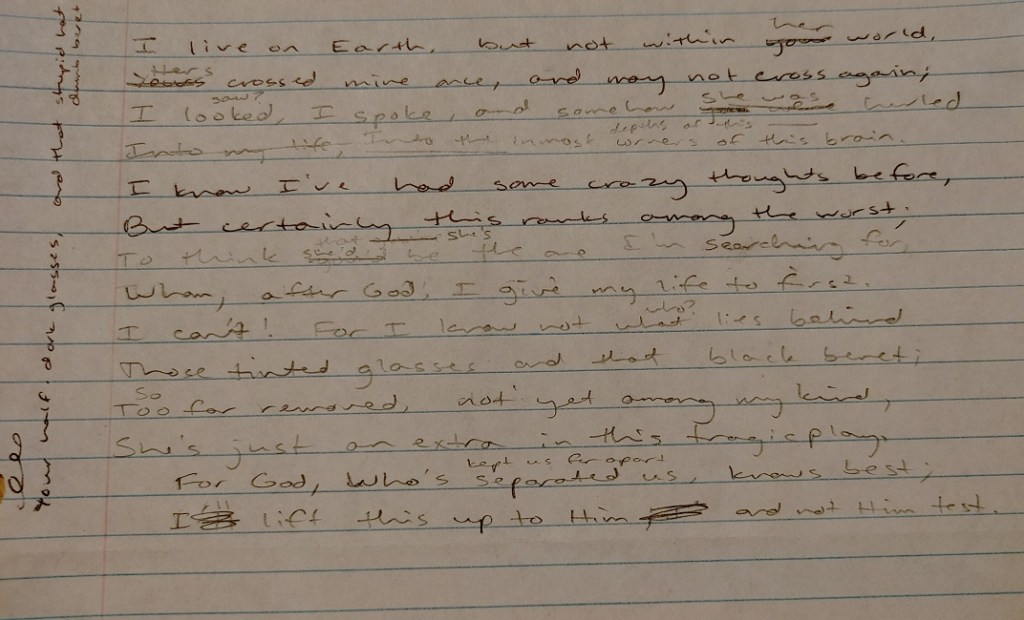
What if I never met anyone?  What if I grew old and died alone?  Would anyone remember my life?  Would anyone care?  Would these intense feelings of loneliness and rejection, coupled with the romantic and sexual fantasies frequently playing in my head, drive me to madness?  I got home and made myself a sandwich for lunch, and by the time I finished eating, the ideas in my head were coming together to form a short story.

I sat down and started typing.  When it came time to name the characters, I still had that Sixpence None the Richer song stuck in my head, so the love interest character became “Leigh,” after the band’s vocalist.  I wrote for about three hours that night. I had time to finish a first draft the next day, because of the school holiday for Martin Luther King’s birthday. I did some editing during study breaks over the next few days.  By Thursday night, I had perfected the story enough to print and share.  I clicked Print on the computer, and the inkjet printer on my desk buzzed and whirred as five pages of my story emerged.


“Leigh’s Boyfriend”
By Gregory J. Dennison

“It’s good to see you tonight, Leigh,” Ryan said as they met outside the theater.

“Good to see you too,” Leigh replied, kissing Ryan on the lips.  “Shall we go in?”

“Sure,” Ryan replied, putting his arm in Leigh’s.  They walked into the theater and gave the employee their tickets.  The theater was not very crowded, so Ryan pointed toward the middle of the room, not too close to the screen but not too far in the back, and turned toward Leigh with a questioning glance.  She nodded.  He would have been happy sitting anywhere but the back row, though; the back row held bad memories for him.  The last girl Ryan brought here had wanted to sit in the back.  Ryan told her after the movie that he was interested in a relationship, and she turned him down.  Six days later, she started going out with his friend.  None of that mattered anymore, now that he had Leigh, but he still wanted to sit in the middle of the theater.  Leigh walked to the seats first, and Ryan followed her.

The lights dimmed a minute later, and the previews began.  Ryan took Leigh’s hand again.  He could sense her smile in the dark as her hand tightened around his, and he responded with a smile of his own.  He had felt so happy ever since he and Leigh had started dating.  Ryan had only had a girlfriend once before, in high school, and that had lasted about a month.  But Leigh was everything Ryan could ever want in a woman.  For years he had hoped for a woman he could take to the movies, or to dinner, or shopping, or just somewhere where they could talk and share each other’s lives.  And at last, Leigh was that woman.  He put his arm around her and began kissing her.

Ryan woke up Thursday morning at six to the sound of his alarm.  He looked at the empty bed next to him, and reconstructed the events of the previous night.  He brought Leigh home after the movie, and they snuggled on the couch for a while.  She left a little after midnight, and Ryan went up to bed.


Ryan showered, ate breakfast, and drove to work still thinking about Leigh.  When he arrived, he went to his desk to get his stuff prepared for the day.  He looked at his watch and saw that he was right on time, as usual.

“Good morning, Ryan,” his coworker Paul said on his arrival.

“Hi, Paul.  How are you?”

“I’m doing well.  Finishing up a project.  How about yourself?”

“Not bad.  I saw a movie with Leigh last night.”

“Which one?  How was it?”

Ryan gave Paul the movie’s title.  “I actually enjoyed it.  I wasn’t sure what to expect going into it, but it looked good,” Ryan said.

“I haven’t seen it yet.  I’ll have to tell my wife we should see it.  How is Leigh doing?”

“She’s doing well.  She started working at Value Foods a month ago.  She likes her job.”

“Good!  You’ll have to introduce me to Leigh sometime.  I’ve never met her.  Do you want to come over for dinner sometime?  You and Leigh, and me and Maria?”

The thought of a well-cooked meal appealed to Ryan’s bachelor taste buds instantly.  “Sure,” he said.  “When’s good for you?”

“How about Saturday night?”

“Sure.  I’ll check with Leigh and call you this afternoon to make sure it’s okay.”

“Sounds good.  Maria and I are looking forward to meeting Leigh.  She sounds nice.”

“Oh, she is,” Ryan said.  Another co-worker walked up to Paul’s desk as he finished his sentence, so Ryan turned his attention back to his work.


Ryan looked around the coffee shop.  “It’s not usually this full,” he told Leigh.

“You’re right.  I don’t know why it’s full tonight.”

“Excuse me.  May I join you?” a strange voice said.

Ryan jumped in his seat, startled, as if awakening from a dream.  He looked up to see a man standing next to his and Leigh’s table.  The man held a cup of coffee and was looking for an open seat.  Ryan’s table had only two chairs next to it.  “Sorry.  We’re busy,” Ryan explained.

The man looked at Leigh, then looked at Ryan, as if he were having difficulty processing Ryan’s response.  “Sorry,” the man said.  He walked away.

After the man walked away, Ryan turned back to Leigh.  “That guy scared me.  Is it just me, or was it rude for him to ask to share with us?  I mean, this is a two-seat table, isn’t it?”

Leigh nodded in agreement.  Ryan turned and looked out the window as it began to rain.  Rain used to make Ryan depressed, but he hasn’t been as depressed in general the last couple months.  He looked at Leigh.  “It’s raining,” he said.

“I know,” she replied.

Ryan looked into Leigh’s watery blue eyes and smiled.  She smiled back.  He took a sip of his mocha.

“I don’t suppose you’re up for a walk in the rain?” Leigh asked.

“Not particularly.  I’d rather do something indoors tonight.”

“Me too, now that you mention it.”

Ryan watched a car drive by out the window.  “You ready to go?” he asked.

“Sure,” she replied.  Ryan opened the door of the coffee shop, holding it open for Leigh.  He opened his umbrella, and they both stood under it as they walked back to Ryan’s car.

“Where do you want to go now?” he asked.  “My place?  Yours?  Somewhere else?”

“How about your place?” she suggested.

“Sounds good.”  Ryan suddenly remembered something.  “Paul and Maria invited us to dinner Saturday night.  Can you make it?”

Leigh thought for a minute.  “Sure.  I don’t have to work at all on Saturday.”

“Paul keeps saying he wants to meet you.”

“I want to meet your friends too.  That’ll be fun.”

Ryan pulled into his driveway.  He opened the umbrella again and shared it with Leigh as they walked up to the porch.  He unlocked his front door, and she walked in, with him following.

“Can I get you anything?” he asked.

“No, thanks,” she replied, smiling.  “Come on,” she said, taking his hand.  Leigh turned the corner and went into Ryan’s bedroom.  She sat him down on the bed and joined him.  She took off her sweater and then proceeded to remove Ryan’s sweatshirt.  She put her arms around Ryan and kissed him passionately.

Ryan put his arms around Leigh and ran his fingers through her straight brown hair.  Leigh grinned and giggled; he knew she liked that very much.  Leigh reached down and pulled Ryan’s pants down around his ankles; Ryan did the same to Leigh.

Soon afterwards, Ryan and Leigh began a beautiful love-making session.  Ryan told Leigh how much he loved her several times.  And he did love her.  She was everything he could ever ask for in a woman.  Ryan had always known that the woman he ended up with would be someone who knew him inside out, someone who could understand all his quirks.  When he was with Leigh, he felt like she did understand.  He could, and did, talk to her about anything, and he could always trust her to help him through.  And now he and Leigh shared the most intimate parts of themselves with each other.

“Hold me,” Leigh said after they finished.

“Of course,” Ryan whispered.  He pulled Leigh’s back toward him and put his arms just below her bare breasts.  This was the last thing he remembered before he fell asleep.


Ryan woke up to the sound of his alarm, as usual.  One more day of work, and then the weekend.  As he crawled out of his empty bed, he realized that something felt wrong to him.  He also noticed that it was probably time to wash the sheets again.

Ryan walked into the office Friday morning with a smile on his face.  He replied to an asynchronous chorus of greetings with a wave.

“Hey.  I saw you at the coffee shop last night,” Paul said.

Ryan looked puzzled at first, but the look of puzzlement soon disappeared.  “Oh, yeah.  I had coffee with Leigh last night.”

“With Leigh?  I didn’t see anyone else with you.  It looked like you were sitting by yourself at a table in front of the window.”

“Hmm,” Ryan said.  “Maybe she was hidden behind something.”

“Maybe.  Are you two still coming for dinner tonight?”

“Yeah.  I’m looking forward to it.”

“I’m looking forward to meeting Leigh.”

“I have to go make some copies.  I’ll be right back.”


Paul had just sat down to watch a basketball game on Saturday afternoon when the telephone rang.  Maria answered, and then called out to Paul, saying that the telephone was for him.  Paul walked to the telephone and took the receiver from Maria.  “Hello?” he said.

“Paul?  It’s Ryan,” the voice on the phone said.

“Hi, Ryan.  Are you and Leigh still coming for dinner tonight?”

“Well, that’s what I was calling about.  Leigh just found out she has to work today.”

“Oh, no,” Paul replied.  “I was looking forward to finally meeting her.”

“I’m really sorry about this.  There wasn’t anything I could do about it.”

“Well, Maria was still planning on having company tonight.  I know it won’t quite be the same, but do you still want to join us?  Just the three of us?”

“If it’s not too much trouble, sure.”

“Great,” Paul said.  “Tell Leigh I said I’m sorry she couldn’t make it.”

“I will.  Bye, Paul.”  Ryan hung up.

Paul replaced the telephone receiver on its cradle.  “Leigh can’t come,” he said to Maria.  “I told Ryan he could still come, though.”

“That’ll be nice to have him over,” Maria said.  “I just noticed a few minutes ago that we need tomatoes for the salad.  I’m going to run up to the store and get some.”

Paul thought about this.  “Can I get the tomatoes for you?”

“Sure,” Maria said.  “That’ll help.”

“I’ll be back in a few minutes.”  Paul grabbed his keys and wallet and left.


Something had told Paul that he should be the one to buy the tomatoes, and he thought he knew why.  He was curious about something, and in the heat of the moment his curiosity exceeded his patience.  He drove into the Value Foods parking lot and walked toward the store.  As he got there, he noticed a young woman with shoulder-length brown hair gathering shopping carts left in the parking lot.  Paul walked up to the young woman.  “Excuse me?” he called out.

“Yes?” the woman said, turning around.

Paul’s eyes instantly darted down to her name tag.  LEIGH, EMPLOYEE SINCE 1998.  Paul’s hunch was correct after all.  “Aren’t you Leigh Hawkins?”

”Yes,” Leigh said, examining Paul to determine how he knew this.  “Do I know you?”

“I’m Paul Richards.  I work with Ryan.”  Paul expected that Leigh would suddenly make the connections necessary to determine why she would know him.  However, her face maintained its prior look of confusion.  “Ryan Mathewson.  You and Ryan were supposed to have dinner with my wife and me tonight, but he told me you had to work.”

“Ryan?  He never invited me to dinner.  Are you sure you have the right person?  How did you know how to find me?”

“Ryan told me where you worked.  You’re Leigh Hawkins.  Ryan’s girlfriend.  Right?”

“I’m Leigh Hawkins, but I’m not Ryan’s girlfriend.  Ryan and I went out twice last month, but we’re not dating.  Things didn’t really work out like that.  What did he tell you about me?”

Suddenly, things seemed clear to Paul, and he did not like what he was figuring out.  “I’m sorry, Leigh,” he said.  “I didn’t mean to scare you like that.”

“That’s okay.”

“I guess I got my stories a little mixed up.”

“That’s okay.  Have a nice day.  And tell Ryan I said hi.”

“Okay,” Paul said, although he was pretty sure that he wouldn’t.  It would do more harm than good at this point.


“Could you pass the mashed potatoes, please?” Ryan asked.

“Sure,” Maria replied.

“Thanks for still having me over.  I’m sorry I had to come alone.”

Paul waited for about a five-second lull in the conversation.  Ryan was about to break the silence when Paul spoke.  “I know why Leigh isn’t here,” Paul explained.

“Because she got called to work,” Ryan replied.  “I told you.”

“Ryan, it’s okay.  I don’t know why you’re doing this, but you can be honest with me.  I was at Value Foods today, and I talked to Leigh.”

Ryan looked at Paul.  His jaw dropped slightly.  No words came out of his mouth, though.  The look on his face was one of pure terror.  His last line of defense had fallen.

“Ryan, I want to help you.  I don’t know why you created this delusion, but you can get help for it.  It’s okay.  You don’t have to be embarrassed.  Let’s just finish dinner.”

Ryan stood up.  “I’m insulted,” he said.  “First you go spy on me by talking to Leigh behind my back, then you claim that I’m lying about our relationship.  Well, I’m not!  We—”

“Ryan, I didn’t spy on you.  I had to go to the store for something else, and I thought I would go meet Leigh.  And I’m trying to help you.  As a friend.”

“Some friend you are.  I’ll be sure to get your permission before Leigh and I go out again,” Ryan said sarcastically.  He stomped out the door, leaving his food uneaten.

Ryan started his car and pulled away from Paul’s house.  He had probably lost Paul as a friend for a while, but he thought that was all the better since he did not want friends who spied on him.  He was probably just jealous.

Ryan opened the door to his apartment.  “Hey, babe,” Leigh said from the couch.

“Leigh?  I thought you were at work.”

“I got off early,” she said.  “I thought I’d come hang out here for a while.”

Ryan sat on the couch next to Leigh.  She immediately snuggled up next to him.  Ryan put his arms around her and kissed her.  He loved everything about Leigh’s kisses, especially the way they always tasted like couch cushions.  He reached down and slowly unzipped Leigh’s pants; he felt her smooth legs as his hands ran along the surface of the cushion foam filling.  He took off his shirt and rubbed the cushion against it, with a blissful grin on his face.


“It’s weird,” Jed said after reading the story.  “But I like it!”

“Thanks,” I replied.  I wanted to share my story with someone, particularly to see how someone else would react to the twist in the ending, and since my roommate Jed was home, I started with him.

“What’s weird?” Brody, another of our housemates, asked, walking into the living room.

“I wrote a story,” I replied.

“Can I read it?”

“Sure.”  I handed Brody the printed copy of my story, and he said he would read it later.  Shortly before bedtime that night, he told me he thought the ending was hilarious.  That was not a word I would expect one to use to describe a serious, dark story, but he was right.  It was hilarious.

Fortunately, my actual life had not yet gotten to the point where I was making up an imaginary girlfriend.  But I had no one special in my life, except for a couple of silly unrequited crushes, and every time I tried to express interest in a girl, one of three things happened.  She was often not interested back, like Haley Channing junior year.  My words might get taken the wrong way, like what happened with Carrie Valentine last year.  Or I would get to know a girl as a friend first, the way that I was told to, and while I was getting to know her, she would run off and find someone else, like Sadie Rowland had.  This weekend, I would be attending something that I hoped might give me some answers about all of this, so I was feeling slightly optimistic and not completely consumed by darkness yet.  But that is a story for next time.  


Readers: Tell me about a time you channeled your dark thoughts into something creative.

If you like what you read, don’t forget to like this post and follow this blog. Also follow Don’t Let The Days Go By on Facebook and Instagram.
July 23, 1998. Cosine. (#186)

Previously on Don’t Let The Days Go By, Greg had been emailing a girl who randomly found him on the Internet, and he had learned some things about her that made him uncomfortable…


I pedaled my bike across campus after leaving my house and looping around west Jeromeville.  A while back, I came up with a ride for when I was feeling particularly ambitious, around the entire perimeter of Jeromeville.  The ride was about fifteen miles, and my goal was to get home in under an hour.  I had done this same ride about five times in the last year, and my fastest time was 59 minutes, 11 seconds.  I tried to concentrate on the thrill of pedaling fast and the challenge of racing the clock, but all I could think of was a girl two time zones away whom I had only known for a month and a half, and never met in person.

Casey Gauthier was a community college student from Texas.  She randomly found my website and sent me an email, and we seemed to hit it off right away.  Her grandparents lived in East Bayside, an easy day trip from Jeromeville, and we had mentioned meeting in person the next time she visited them. But I quickly realized that she was not exactly the good Christian girl that I thought she was.  Furthermore, it had been over a week since I had heard from her.  It happened quite often than I would have great conversations with girls from the Internet who would then disappear completely.  I was angry for both reasons, even though if she were to write back, she still would not be the kind of person I once thought she was.  I wanted the girl I had in mind when I first met Casey back, even though she did not technically exist.  At this point, I kind of wished I had never met her.  If I had a time machine, I could just go back and delete her first email before I had a chance to open it, and none of this would have happened.

As I crossed Highway 100, on Cornell Boulevard near In-N-Out Burger, dripping sweat as the morning sun rose higher, it suddenly occurred to me that I could deal with the Casey situation the same way I had with other girl problems: by writing about it.  I could play with this time machine idea and write a story with elements of science fiction.  I loved movies and TV shows involving time travel and changing history.  What happened with Casey and me, though, did not feel like a dramatic enough reason for someone to want to change history.  For the rest of my ride, as I crossed back over Highway 100 and headed west on Coventry Boulevard before detouring into the Greenbelts of north Jeromeville, I tried to come up with ways to embellish the story, in order to make the character’s desire to change history more plausible.

I pulled up in front of my house and looked at my watch, pressing the button to stop the stopwatch from counting.  58 minutes, 56 seconds.  A new record.  More importantly, I had an outline in my head of what happened between these two characters, as well as how the character acquired a time machine in the first place, and how the story would end.  I also had a title, a word that would figure into the plot but also carried a hidden meaning because it sounded like “Casey.”  After I got out of the shower and dressed, I sat at my computer and wrote for the next few hours.


“Cosine”

The young man landed in the middle of a field about a mile from the city limits.  He wondered what time it was.  He had given himself adequate time to complete his mission, but still, he did not want to be late.  He knew that he had to do what he had to do and then return home quickly.  If anything did not go according to plan, he and Dr. Bowman could both get into serious trouble.

He walked down the road to a bus stop.  He waited for ten minutes, but no bus came.  He looked at his watch.  It said 3:04 PM, Tuesday, May 25, 1999, but he knew that was wrong.  A large-sounding vehicle turned the corner.  He looked; it was the bus.

The bus driver asked the man for his fare.  In this, a college town, students could ride the bus free.  The man started to reach into his pocket and pulled out his student ID card, but then caught himself.  He gave the driver the fare instead, in quarters, each of them well worn so that the lines in George Washington’s hair barely showed.  The man took a seat in the back of the bus next to a college-age girl with a nose ring.  It reminded him of Cameron’s nose ring, a nose ring he was risking his life to forget.  The man waited for the bus to approach the university campus.

The man knew that he wanted to speak with as few people as possible in this place, but he just had to know.  He looked at the watch the girl with the nose ring wore.  It was 12:06 PM.  This made him feel better.  It didn’t give him a whole lot of time, but it was enough.  Michael was currently taking a calculus midterm, until 1:00.  The bus would arrive at 12:20, giving him plenty of time to go to the computer lab and read Michael’s e-mail before Michael could get out of the midterm and do the same.  The exam was very difficult, and there was no chance Michael would finish early.

The man looked around the bus.  The person sitting next to him, on the other side from the girl with the nose ring, wore a Bay City Captains sweatshirt.  Nice shirt, he thought.  He thought of how Cameron loved the Captains.  In fact, that was one of the first things that Michael, the person whose life he was about to change, and Cameron discovered they had in common.  And one of the only things they had in common.

The man looked on the seat next to him and found a discarded copy of the school newspaper.  Friday, November 14, 1997.  Top story: the chancellor issued a press release regarding his views on affirmative action and diversity.  Weather: partly cloudy and breezy.  Highs in the mid-60s.  Showers tonight.  So far, so good, the man thought.  It looked like his first major concern worked out.

A tall blond guy walked onto the bus.  The man recognized him as someone he knew named Steve.  The man instinctively waved at Steve.  But Steve looked back at him with a puzzled look of non-recognition.  Steve took a seat in the back of the bus.  Of course, the man realized.  He and Steve had met in a class they had together at this university, in the spring of 1998.  Steve would not recognize him yet here, in the fall of 1997.  Although the man had seen all of the Back to the Future movies around eight times, he still wasn’t used to actual time travel.

The man got off the bus at the school.  He made sure to avoid seeing Steve to prevent further confusion.  The fewer people he interacted with during his mission, the better it would go.  The man looked around at the university, just as he had remembered it a year and a half before.  The new social studies building was still under construction, but everything else looked pretty much the same.  It made him think.  He might still be going to school at that university, in 1999, if not for his nervous breakdown.  But all that might change shortly if things go as planned.

As he understood it, sometime earlier that week in November 1997, a thousand miles away, someone named Cameron Gross had been surfing the Web when she came across Michael’s home page.  She noticed that they both liked the Captains.  Also, Michael lived just a few miles away from a city where Cameron used to live, where she still had relatives.  Michael had written back asking this mysterious person to tell more about herself.  This time traveler’s plan, as he understood it, began with an eight minute walk to the computer lab across campus.  He knew from experience that this computer lab was rarely full, so the man could get on and off quickly before Michael got there.  He knew Michael’s password, so he would not appear suspicious at all.  Cameron should have replied to Michael’s message that morning; all the man had to do was delete that message.  Then, later that afternoon, Michael would go to that lab to work on a project.  He would take a break to check his e-mail, he would find no message from Cameron, and he would quickly forget that she ever existed.

The man walked past a brick building full of classrooms.  He knew that building well.  In fact, he knew Michael was in room 115 taking the calculus midterm.  He decided, in a move that could risk the mission’s success, to check and make sure that Michael was there, to make sure this in fact was happening.  In fact, it felt like none of this was happening.  Nothing had felt right since his life began falling apart, beginning during spring break 1998, leading to his nervous breakdown, causing him to drop out of school, and culminating in this X-File that he was standing in the middle of now.  In fact, he remembered having seen something like this before on “The X-Files” on TV.  An old man caused a mysterious death while trying to change history.  The man liked that episode, because five minutes into it he guessed who the old man was and what he was trying to do.  This made him happy because he never knew what was going on in “The X-Files.”

The man slowly cracked open the door to room 115.  He knew exactly where Michael would be, in the corner away from the window.  Michael was there, all right, frantically trying to erase something as if his entire future depended on it.  The man knew that Michael had written “cosine” where he should have written “tangent,” and this had thrown his entire answer off.  The man knew this because, a year and a half ago, it had been him sitting in that corner trying to erase the cosine.

The man, Michael, gently closed the door to room 115 so as not to bother any of the students.  He walked down the hall and out of the room.  He remembered leaving that exam, feeling okay about it, like he had done well but not spectacularly.  He also remembered that that was the day he had gone to the computer lab and found the message from Cameron.  He remembered being surprised yet happy that Cameron was a girl.  When she first wrote him, he had figured that Cameron was a guy, since she talked about football and also since one of his good childhood friends was a guy named Cameron.  Apparently, since he knew a male Cameron, he tended to assume that people named Cameron were male.  He remembered that this was the day it happened because he told Cameron how he did on the exam.  He remembered Cameron’s reply, that she was no good at math.  Sometimes it scared Michael just how much he remembered.

Just outside of the building, Michael saw his friend Jennifer.  “Hi, Michael,” she said.  “Didn’t you have a midterm now?”

Michael didn’t know what to say.  “At one o’clock,” he lied.  He hoped that Jennifer wouldn’t notice that he was wearing different clothes.

“Oh,” she said.  “I thought it was now.  Oh well.  See you later.”

Michael glanced at Jennifer’s watch as she left.  It was 12:30.  He needed to hurry.  If something happened to the time machine, Dr. Bowman wouldn’t be very happy with him.  He thought about how amazing it was that he was walking around one day, minding his own business, when Dr. Bowman, a physicist from a major defense contractor approached him and asked if he wanted to take part in a top secret experiment.  It was risky; not only was time travel technology in its infancy, but afterwards he would have to undergo something they liked to call “amnesia therapy” so that the secret time travel research remained a secret. God certainly makes people meet for interesting reasons.

Michael found that, as he walked across campus, he kept remembering the events leading him to this point.  Michael’s friendship with Cameron had grown fairly well for the first few months; he even got over the initial shock at seeing her nose ring when she first sent him a picture.  Things first started to come apart during spring break of 1998, when Cameron came out to visit her relatives and met Michael in person.  The two of them spent a very interesting day together.  It began when Cameron arrived at Michael’s apartment.  They took a walk around the neighborhood and the university, and then had lunch.  It was then that Michael first began to see that behind the happy, outgoing, fun-loving girl he saw in her e-mails lay a girl who liked to drink, party, and rush into relationships.  In his sheltered conservative Christian upbringing, Michael tended to stay away from people with problems like that, and a lot of times it bothered him to find that people he considered friends would make such dumb decisions.

Yet as the day went on, despite all this, he found Cameron more and more intriguing.  He found that he really enjoyed spending time with her, and that despite their differences they seemed to get along well.  He sort of put it out of his mind that she liked to get drunk at parties.  That night, they had gone downtown to see a movie and they ended up making out at his apartment.  He figured that he was digging himself into a deep hole, since he probably would not see Cameron for months after that night.  But he went ahead and did it anyway, mainly because this was the first time in his life that he had ever had the opportunity to get close to a woman.  He felt that Cameron would have been ready and willing to go even further as well if he had let her.

Cameron left Michael’s apartment a little after midnight.  It seemed to them that there just might be something between them more than just a friendship, and that they would talk about it after Cameron got home.  Michael, however, felt really uneasy about the situation, and he did not sleep at all that night.  He suspected that Cameron would experience a lot of pain in the future because she rushed into relationships, and he, the one person who could have broken that cycle, instead just fed it further.  He remembered looking down at the red and white “What Would Jesus Do” bracelet he wore on his left arm and thinking about how he had just defeated its whole purpose.

About a week later, Michael called Cameron on the phone.  They talked for a long time, reaching the conclusion that this was probably not the best time for a relationship for them, but that they wanted to stay friends.  Things went okay again for about another month.  Cameron had e-mailed Michael, in early May of 1998, about some serious problems in her life.  She was sleeping with her older brother’s best friend, and she suspected that her brother knew but she couldn’t talk about it.  Michael tried his best to understand, to be a friend to Cameron, but he really wanted to drop her right there, telling her that she got herself into this mess and that she should get herself out.  He always thought this kind of thing only happened on Melrose Place and the Jerry Springer show, and it made him mad that people could be so stupid and careless.  He had no idea how to react when these things happened to people he called friends.

The next week, Cameron experienced a painful breakup when she found out that her lover was seeing someone else.  Michael was glad to hear that she had gotten out of her misguided relationship, but disappointed again to hear, two days later, that she had met a new “boyfriend” while drunk at a party.  That was the breaking point.  Michael found himself unsure of what to do.  Nothing he could advise was reaching this girl.  He found himself so irrationally upset over what Cameron had done that he could no longer concentrate in school or relate to his old friends.  He had a nervous breakdown with just a few weeks remaining in the term.  He withdrew from school, taking incompletes in his classes, and began a long process of therapy and medication.  He had hoped to enter school again in the fall of 1999.

But that was before he found the scientist and the time machine.  Now he had an easy solution to all his problems.  He would simply prevent himself from ever meeting Cameron and then return to 1999, where he would be living a perfectly normal life.

Michael looked up and narrowly avoided running into a tree.  As he turned to dodge it, he saw Jim, a friend from his freshman dorm.  Jim waved, and Michael waved back.  Here in 1997, Michael and Jim were still friends, although in about a month Jim would find a sleazy girlfriend and completely ditch all of his old friends.  Michael still felt hurt and betrayed whenever he thought of Jim.  On Valentine’s Day of 1997, Jim had given an anti-love party, and Michael had himself a great time there.  Michael had been looking forward to Jim’s next anti-Valentine’s party all year, but when February 14, 1998 came, Jim spent it at an expensive restaurant with his girlfriend while Michael spent it surfing the Web at home, looking at the electronic greeting card Cameron had sent him.  She was the only person who wished him a happy Valentine’s Day that year.  That made an otherwise miserable Valentine’s Day not so bad.

But none of that mattered now.  The computer lab loomed about twenty yards away, and then Cameron would be just a memory.  No—she wouldn’t even be a memory.  He would have no memory of Cameron at all, except perhaps as some guy who liked the Captains and never answered his e-mail a year and a half ago.  He thought of the other Michael, the one who was still working on his midterm.  He remembered taking that midterm.  The other Michael would soon realize that his initial answer of problem 3, where he had written “cosine,” was correct after all, causing him to fix the problem quickly before time ran out.  Time would run out soon, and then it would take Michael a few minutes to get over to the lab.  That gave Michael, the time-traveling Michael, enough time to delete one message from the other Michael’s e-mail.

As he opened the door to the building, he smiled widely, anticipating his coming success.  He saw someone he recognized across the hall, his friend Jeff, but Jeff did not see him.  Jeff had really helped him through some tough times.  During Michael’s freshman year, he had many difficulties adjusting to college life.  Jeff, who was on Michael’s dorm floor that year, really helped Michael gain perspective and get closer to God that year.  It was during a talk with Jeff that Michael really felt like his Christian faith meant something personally.  Michael really needed a friend with a strong relationship with God at that time in his life, and God had provided one in Jeff.

Michael pressed the up button on the elevator; the computer lab was on the fourth floor.  Sometimes he wondered where he would be—or wouldn’t be—if he and Jeff had never had those talks during freshman year.  He felt bad sometimes.  A few times, when he got really upset, he felt that he should be doing something else rather than burdening Jeff with his problems.  But he was so thankful that Jeff had not abandoned him, so thankful that he often wondered if God would ever give him a turn to be the Christian friend in another troubled peer’s life.  If Jeff hadn’t been there to help him through the hard times, to invest in their friendship, he might have given up on school altogether… or worse.  What if Jeff hadn’t been there?  What if Jeff had decided Michael wasn’t worth his time?

What if Jeff, deciding that he couldn’t handle Michael as a friend, hopped into a time machine to change history so that he and Michael never met?

The real purpose of Michael’s mission suddenly became clear to him.  The bell rang, signaling that the elevator had arrived, but Michael turned around and left the building instead.  He walked out, careful to avoid the route that the other Michael would walk after getting out of the midterm, toward the bus stop.


I went to Bible study the night after I wrote “Cosine,” and I reread the story after I got home.  It felt like it still needed work.  I took a fiction writing class a few months ago, and today I had been concentrating on just getting my ideas typed, not using the new writing skills I had learned.  In that class, when we had to share our writing with the class, I also learned that most people did not relate to my conservative Chrsitian views on relationships and sexuality.  If I shared this story with someone who had not heard frequent sermons on Christian purity and dating as preparation for marriage only,as I had, this reader would not understand Michael’s regret at making out with Cameron, or why he was upset at her promiscuity when he had agreed not to date her.  I needed to tell that part of the story differently.

But I was tired when I got back from Bible study.  And tomorrow I had to pack for a weekend trip to Bay City with Taylor, Noah, and Cambria.  So I saved everything, turned off my computer, and went to bed.

I never came back to this story.  My weekend sufficiently distracted me from thinking about Casey that I never really felt inspired to perfect my tale of Cameron and time-traveling Michael.  I never did hear from Casey again in real life, and I was okay with that.

The draft of “Cosine” sat in my hard drive, and got transferred to my next new computer, and my next one, and my next one, and this one that I use now, over a period of twenty-six years.  Normal people would probably clean out their hard drives and not bother to transfer files they did not need, but I always wanted to save as much as I could.  I always found it interesting to look through things from my past, and think about who I was, who I have become, and what I have learned.  Old files have value, and so do old memories, even unpleasant ones.


Readers: Have you ever, or do you currently, wish you could travel back in time to change history? Would there be any drawbacks to changing the past in your case? Tell me your thoughts in the comments.

I actually did write “Cosine” in 1998. It is mostly intact as it was the last time I worked on it, although I cut a few things out to make this episode not be too long, and I also made a few minor modifications to make some of the details consistent with what has happened in the DLTDGB storyline. In 1998, it was more common to write “e-mail” with a hyphen, as opposed to the modern “email,” so I left this spelling as it was at the time. I am also planning to write a behind-the-scenes post about this episode… update, I finished that, so click here for that.

If you like what you read, don’t forget to like this post and follow this blog. Also follow Don’t Let The Days Go By on Facebook and Instagram.


(February 2024. Year 4 recap.)

If this is your first time here on Don’t Let The Days Go By, welcome. DLTDGB is a continuing story set in 1998 (currently), about a university student making his way in life. I am currently on hiatus from writing; the story will continue eventually at some unspecified time. This break is taking a lot longer than I expected; real life in 2024 is kind of overwhelming right now.  Today’s post is a recap of the highlights of year 4.

(Also, in case you need it, click here for the recaps of year 1, year 2, and year 3.)

If you are new to DLTDGB and want the complete story, start by clicking here for Episode 1, and then click Next at the end of each episode.


I was not in Jeromeville or at my parents’ house for most of the summer of 1997.  I was hundreds of miles away, doing a math research internship in Oregon.  I applied to this program on the suggestion of Dr. Thomas, one of my favorite professors.

June 22, 1997. My arrival in Oregon. (#135)

I met the other students in the program, found a church, and borrowed a bicycle so I could get around.  I did not have a lot in common with the other students in the program, other than mathematics itself, but I did my share of social activities with them.

June 28 – July 4, 1997. Outings with my new classmates. (#137)

I got to see my great-aunt and uncle a few times that summer; they lived not too far from me in Oregon.  My parents came to see me and other Oregon relatives one weekend.  I missed home terribly, but I made the most of my time in Oregon.  The most life-changing thing that happened during that summer was the realization that I did not want to do mathematics research as a career.

August 12-15, 1997. My final week in Oregon. (#142)

After a couple weeks at my parents’ house, I returned to Jeromeville and moved into a house with Josh McGraw, Sean Richards, and Sam Hoffman.  Josh had been my roommate the previous year as well.  I went to two retreats back-to-back just before school started, one for Jeromeville Christian Fellowship and one for the youth leaders at Jeromeville Covenant Church.

September 15-19, 1997. Seeing my friends again at Outreach Camp. (#145)

Late September, 1997. The retreat with the youth group leaders and a step outside my comfort zone. (#146)

I did chorus again that fall, and we performed at a ceremony for the renaming of a building on campus.  My future plans also solidified at the start of that school year.  With math research off the table, I put all my efforts into becoming a teacher, and I figured out that I would be able to graduate on time in June.  I made a silly movie, based on my Dog Crap & Vince stories, with the kids from the youth group at church.

Late October-early November, 1997. I made a movie. (#150)

I did a lot of things with the youth group at J-Cov that year.  Some of the leaders pulled a memorable prank on the kids, toilet-papering seventeen kids’ houses on the same night.  We also took a nine-hour road trip to San Diego for the National Youth Workers’ Convention.  I saw a lot of Christian bands play there.  Although most of my experiences at J-Cov over the years were positive, I saw a darker side when someone I knew there began harassing and almost stalking me.  He eventually had his church membership revoked; I was not the only one whom he had done this to.

November 30 – December 8, 1997. But he won’t admit he has a problem. (#155)

I had my eye on a few girls that year.  Carrie Valentine was two years behind me; I knew her from JCF.  She was nice, and she was easy to talk to.  I finally got brave and spoke up, and things did not turn out as I had hoped.

December 9-12, 1997.  Not everything follows consistent rules the way math does. (#156)

Over winter break, I made another movie with my brother and his friends, and I took a trip to my old roommate Brian Burr’s New Year party, where I got to see some of our older friends who had graduated.  When I returned to school for the new quarter, I interned in a high school classroom, to get more experience to prepare for my future career as a teacher.  I had recently discovered how much I loved In-N-Out Burger, and a location opened in Jeromeville that quarter.  I was there on the day it opened.

January 16, 1998.  A fresh cheeseburger, and a fresh take on relationships. (#160)

That winter, I went to Winter Camp with the youth group kids.  I started spending my Sunday nights at the De Anza house, where the guys hosted weekly watch parties for The X-Files.  That was already one of my favorite shows, and now I got to enjoy it with a large group of friends.

February 8, 1998. A new weekly tradition. (#162)

Sadie Rowland was another girl I was interested in at the time.  She was, like Carrie, two years younger than me, and she went to JCF.  She was the kind of girl whom I could sit there and talk to for hours, and it would feel like no time had passed at all.  She was preparing to leave the area for six months to do an internship, and we made plans to see a certain movie that was popular at the time.  The plans fell through, I never saw the movie, and Sadie for the most part disappeared out of my life.

March 5, 1998. My heart will not go on. (#165)

The University of Jeromeville men’s basketball team won the national championship for their level, one of the greatest accomplishments in Jeromeville Colts history.  Spring quarter started with an unexpected surprise: Carrie Valentine was in two of my classes, despite being in a major very different from mine.  I was able to let go of any lingering awkwardness, and we got to be friends again.  Besides, a new girl had caught my eye: Sasha Travis from church, even though she was only seventeen.

Early April, 1998. Trash. (#168)

With Josh and Sam planning to move out over the summer, I managed to find two new roommates to move in with Sean and me for the following year: Brody, another youth leader from church, and Jed, a freshman from JCF who would be moving out of the dorm at the end of the year.  JCF had a spring retreat that year.  Taylor, Pete, and Noah, who had been more involved with church than JCF the last few years, all went on the retreat, knowing it would be their last JCF retreat.

April 24-26, 1998. My lasting friendships had been captured in that group photo. (#171)

I did a lot of creative writing that year, and I took a Fiction Writing class that quarter.  We had a project to write a story and share a copy with everyone in the class.  I wrote a story about an awkward guy and a girl he liked, inspired by Sasha.  It was the first time I had ever shared my writing with an audience of people who did not know me well, and the experience was humbling.

May 6, 1998. “August Fog”: a short story to share with the class. (#173)

May 12, 1998. What I learned the most from sharing my story was not about writing. (#174)

A lot of other things happened that year.  My parents came to the Spring Picnic, and I decided that I enjoyed it better without them.  Noah and Taylor taught me to play Catan.  I was inducted as a member of Phi Beta Kappa.  I shared my testimony at JCF’s senior night, wearing a shirt with Brent Wang’s face on it.  I came in second at the Man of Steel competition, my best finish ever.  And I made a board game based on Dog Crap and Vince.  But the most important thing that happened was graduation.  I was finished with my Bachelor of Science degree, and ready to start the teacher training program next year.

June 20, 1998. Life was beginning to take shape. (#180)

Here is the complete year 4 playlist:

Let me know how you’ve been the last few months!

May 12, 1998. What I learned the most from sharing my story was not about writing. (#174)

I sat in Fiction Writing class, both nervous and excited.  Each of us in the class had written a story and given a copy to each other student, and we were taking turns getting our stories critiqued.  My story, “August Fog,” would be the third one reviewed today, and as the discussion for the second story wrapped up, I kept anticipating in my mind what people would say about it.

Our stories could be about pretty much anything, and the stories my classmates wrote pretty much were about everything.  A guy named Gary wrote about a guy who broke into someone’s dorm room and got caught.  He said that he got the idea for the story while thinking about a time his dorm room was actually broken into, and picturing in his mind what kind of loser would do that, so he made the thief in his story a complete pathetic loser toward whom the reader would have no sympathy.  A girl named Ariana wrote a tear-jerker about a girl whose boyfriend died in a tragic accident.  I sincerely hoped that her story was not inspired by anything that happened to her in real life.  A guy named Mike wrote an unusual story where the character just goes about his life, but the point of view occasionally switched to that of various inanimate objects that the character interacts with.  I was still trying to wrap my head around that one.

After reading all of these over the last couple weeks, I thought that “August Fog” was pretty good.  No typographical or grammatical errors that I could find, and it did not have perspective shifts like Mike’s story that made it difficult to follow.  The setting and premise were fairly straightforward; a guy tries to work out his feelings for a girl, and he decides in the end that he is not ready for a relationship.  While I was a little nervous to share my work with the class, I anticipated someone saying that I had so perfectly captured the tension of being someone my age with conflicted feelings toward a romantic interest.

“All right,” Serena Chang, the instructor, announced as we wrapped up the discussion of the story before mine.  “Next up is ‘August Fog,’ by Greg.  What did you all think?”  The other students in the class shuffled the papers on their desks to their copies of “August Fog.”  Some turned the pages, looking for notes they had written on the stories themselves.  I felt a little like I was being put on the spot, but none of this was unexpected, since I had seen twelve other students have their stories critiqued over the last few class meetings.

“I’m a little confused,” said Ariana.  Uh-oh.  This was not a good sign, if that was the first thing someone said.  Ariana continued, “We get all this character development for Dan, he’s kind of awkward and confused, but none of that really explains why he decides not to go out with Allison.”

What?  I thought, how is this not obvious?  Dan realized that he was not ready for a girlfriend, just like he said.  And people who rush into relationships are stupid, so it was obvious that he would not want to be like that.

“I agree,” added another girl, Jenn.  “I like Dan.  He seems like the kind of character you’re rooting for.  He’s awkward, yes, but he’s lovably awkward.  The ending just seemed like a letdown to me.  I was really hoping he would get his happy ending.”

No, I thought, silently protesting in my mind.  The ending was perfect.  The right thing is not to rush into a relationship when you still have so many unanswered questions, like Dan does, and he avoids temptation and does the right thing.  Where was the letdown in that?  Why did Jenn not see this ending as happy?

“I don’t see Dan’s awkwardness as lovable at all,” said Gary, the guy who wrote the story about his room getting broken into.  I only knew Gary from this class, but I had gotten the impression all quarter that I did not particularly care for this guy.  He wore a sweatshirt with the letters of his fraternity on it, and he always showed up to class looking like he had just rolled out of bed two minutes before.  The thief character in Gary’s story, whom he called a pathetic loser in his response to everyone’s critiques, reminded me too much of myself, especially the part in the beginning of that story when the thief was talking to girls in chat rooms and getting rejected by them.

“Why didn’t you think Dan was lovable?” Jenn asked.

“He’s pathetic.  He can’t talk to girls.  And he’s weak.  He knows Allison likes him, and he still won’t ask her out!”

I looked down toward the floor.  I did not feel like having all of these eyes judging me so harshly.  Of course, Dan was just a fictional character to the others in the class, but with the inspiration for my story so personal, their constructive criticism still felt like personal attacks.

“I do think that Dan is portrayed accurately and consistently,” Tim Walton said.  Tim was my friend, I knew him from church and from Jeromeville Christian Fellowship, and I very much appreciated that he seemed to be turning the discussion in a more positive direction.  “Even if Dan’s motivation for his decision at the end isn’t completely clear, the reader definitely knows who Dan is by the end of the story.”

“I agree,” Jenn replied.

“But I think we need to see the same for Allison,” Tim continued.  “We get a little bit of her personality.  Friendly and quirky.  But there’s so much more we could see with Allison.  She’s a really fun character to read, and if we saw more of her, especially more direct interaction with Dan, we might be able to understand the ending more.”  Finally, someone was saying something directly helpful.  I nodded.

“Yes,” a girl named Christie said.  “I agree. But I don’t quite get the title.  The whole thing with the fog seemed kind of forced.  I can tell why it’s there: the fog is supposed to be a symbol of Dan’s unclear mind, and then it goes away.  But there’s no fog in August.  So maybe the story needs to be set during a different time of year.”

Since my story was about Dan being home from school on break, I set the story in the summer, when school breaks happen, and in Santa Lucia County, where my own home was.  If Christie has never seen fog in August, she obviously has not spent very much time in Santa Lucia County.

A few others continued to weigh in on Allison’s missing character development.  I wrote down in my notebook that I would have to add more scenes with Dan and Allison together when I revised the story.  I was feeling a little better about the kind of constructive criticism I was getting when Gary, the frat boy, opened his mouth again.

“I did have one part of the story I loved,” he said.  “When he gets to Denny’s, and he says a prayer before he eats.  That was hilarious!  I laughed my ass off!”  I looked at him, feeling a little confused, not understanding the point he was making.  Gary continued, “But I kind of feel like that kind of joke doesn’t belong in a serious story.  Maybe the story needs more humor, so the tone is more consistent.”

I puzzled over Gary’s comments as others added their thoughts.  The part that Gary laughed so hard at was not a joke and not intended to be funny.  What was he talking about?  It took me a few minutes to make sense of Gary’s remarks: he thought that, when I mentioned Dan praying before his meal, I was trying to make a joke about the quality of the food at Denny’s.  Gary thought that Dan was praying that he would not get sick from eating at Denny’s.  Since the beginning of sophomore year, when I started going to JCF and my social circle shifted so that I was spending most of my time around Christians, I noticed that most of my friends prayed before eating a meal, and I had done so as well pretty much every day of my life for the last two or three years.  But the concept of praying before a meal was apparently completely foreign to someone like Gary.

Mike, who wrote the story with the unusual shifts in perspective, said, “When I read this story, I got the sense that the reason Dan decided not to go out with Allison was because he doesn’t want to be tied down.  He isn’t ready for a girlfriend because he wants to date around, he wants to party and be young and live his life, and he isn’t ready to give that up yet.  I mean, he was on a date with another girl when he found out Allison liked him.  Dan probably likes that other girl too.”

Totally wrong, I thought.  Dan and Lisa are obviously just friends; that was not a date.  And the whole purpose of dating was to find someone to marry.  Do other people really not understand that?

“So we need to see Dan’s actions more clearly showing that he doesn’t want to be tied down,” Mike continued.

“I agree,” Gary said.  “This guy is an immature weirdo, and the reader needs to see him being immature and weird.”

You will not see that, because that is not who Dan is, I thought.

“But I like Dan,” Jenn said, repeating her thought from earlier.  “I don’t think he’s a weirdo!  But if that’s the case, we need to see more of Dan and Allison interacting.  Because I still don’t understand why he decided not to ask her out.”

“Definitely,” Tim agreed.  “And we need more of Allison.  Her character development is off to a great start, she’s an interesting character, but I feel like I need to know more about her.”

After a few more comments, Serena closed the discussion, as she had for all of the previous discussions.  “Greg, do you have any response to any of these thoughts?” she asked.

I froze for a few seconds, not sure what to say.  Eventually I said, “That was humbling.”  A soft chuckle arose from some of the other students, and I continued, “This was the first time I’ve ever really shared a story with a large number of people who don’t really know me.  I have a lot to think about.”  I did not say anything else out loud.

Two more students had their stories critiqued after mine that day.  When class was dismissed, Tim and I walked out of the room at the same time.  “That was interesting,” I said to Tim, dejectedly.  “I feel misunderstood.”

“Don’t take it personally,” Tim said.  “You basically wrote a Christian story for a secular audience.”

“Yeah.  I guess I did.”


After class, I walked out to the bench in the Arboretum that I thought of as my Bible Bench.  During winter break of junior year, I went to the Urbana conference in Illinois with thousands of other Christian young adults, and all of the attendees had been given a plan to read through the Bible in a year by reading a few chapters every day.  I had followed that plan, but usually only four or five times a week, so that I was now in my seventeenth month of reading the Bible in what should have been a year.  But I was finally nearing the end.

After I did today’s readings, which were supposed to be for December 19, I looked out at the tall trees surrounding me, thinking about what had happened today.  I really did see the world very differently from my peers, at least those outside of church and Jeromeville Christian Fellowship.  This was not necessarily a bad thing; I knew that the Kingdom of God would win in the end.  But having spent most of my socializing time the last few years around Christians, and without ever having had much of a secular social life before that, I was not often confronted with this difference in worldview as directly as I was today when people misunderstood my story.  The Bible was full of messages about how God’s people were set apart from the rest of the world.  But it was important for me to have experiences like this.  If my mission as a Christian was to spread the message of Jesus to the rest of the world, I needed to understand how the rest of the world worked.  I prayed about this, asking God to use this experience to teach me something about others, and about where I belonged in the world.  If Gary was so flummoxed by the concept of someone giving thanks to God before a meal, I wondered what he would think about me praying now between classes.

A little bit later, I sat in the Memorial Union reading the comments that others had written about “August Fog.”  Each student had a copy of my story.  They wrote comments on the story as they read it, along with a sentence or two summarizing their thoughts about the story.  After we discussed “August Fog” in class today, everyone gave me back their copies of the story, so that I could read their thoughts.  Most of the comments paralleled what they said in class.

At the end of Tim’s copy of my story, he wrote, “The reader needs more character development with Allison, because she has a lot of depth from what I see so far.  I like this character; she seems like someone I would want to meet and be friends with.”  Allison’s personality was modeled after Sasha Travis, whom I knew from church. Tim went to that church too, but I did not think that Tim knew Sasha.  Tim’s involvement at church seemed mostly confined to the college group, and Sasha was currently a senior in high school.  But Sasha was staying in Jeromeville next year, so she would be part of the college group soon.  I wondered if Tim would recognize that Allison was based on Sasha next year, when Tim and Sasha would both be in the college group.  But I never said anything, because I did not want to reveal that Allison was based on Sasha, or that I liked Sasha.

We had a second story due in three weeks.  We would be doing all the critiquing in one class period, in small groups, so I only needed to bring four copies of that one.  I wrote another story about awkward social interaction; I called it “Try Too Hard,” because the character was trying too hard, and failing, to fit in with the cool group of friends.  I had much lower expectations for people’s reactions to that story, since “August Fog” was so heavily criticized and misunderstood, and the others who read my story had the kind of reaction I expected.  The character in the story dreads seeing his friend because of something terrible that happened at a party the night before.  The others who read the story told me that I did a great job of building suspense, keeping the reader wondering what was so awful about the night before, but when I finally told about the actual awkward interaction at the party, it did not justify the huge buildup or the character’s intense frustration.

What I learned the most from sharing my story was not about writing.  It was more about seeing firsthand how my perspective on many things was quite different from that of others.  I had spent the last three years hearing messages for Christian students encouraging us to be intentional with dating and relationships, not to rush into things too fast, and to keep the end goal of marriage in mind.  Most university students did not approach dating this way, so the message of “August Fog” was lost on them.  And awkward moments, such as those in “Try Too Hard,” were devastatingly embarrassing to me, given my past, but no big deal to many others.

The final exam for the Fiction Writing class, due a week after “Try Too Hard” was due, was to revise the first story we had written.  I took everyone’s suggestions for “August Fog” and expanded the flashback scenes to show more interaction between Dan and Allison.  I wrote more humorous things for Allison to say, to establish that part of her personality more clearly.  And I removed the line about Dan praying before his meal; the audience of this story did not necessarily consist of people who actually do such things, and that quote that Gary had so grossly misunderstood did not add much to the story.

For the final exam, there would be no sharing with peers; I just turned in one copy to Serena.  She said that we could get our stories back, with her thoughts and our final grades, by stopping by her office during finals week.  Serena said that in my revised version of “August Fog,” the characters were much more well defined.  Dan was still the awkward young man confused by love, but the reader had much more of a sense of Allison’s character, which was missing from the first draft.

Serena’s suggestion for further revision, if I chose to continue developing this story, was to make more tension with Allison, and make the interactions between Dan and Allison more awkward.  According to Serena, the information in the story still did not justify Dan’s decision not to pursue a relationship with Allison.  The interactions between them seemed perfectly normal for this stage of friendship, so Serena suggested I needed to show exactly what made Dan so hesitant to dive into the relationship.  She suggested, for example, making Allison a bit more overbearing, making her loquaciousness contrast more with Dan’s introversion.  That makes sense, but that was not the reason I had in mind why Dan decided not to pursue the relationship.

At the end of Serena’s response to my revision, she wrote, “Your writing and your sense of fiction have improved a great deal over the last few months.  I hope you continue writing.  Good work!”  My final grade for the class was an A-minus.  I considered this a major victory, considering that Serena had made it clear on the first day of class that this was not going to be an easy class.  She said that she had only given one A the last time she taught this class.  Also, I had a mental block against English classes that went back to a teacher in high school whose teaching style clashed with my learning and writing styles.  Since then, any time I did better than a B in an English class was cause for major celebration, so to me, an A-minus was a success.

I did continue writing, as Serena hoped.  Over the course of the twenty-five years since I took that class, writing as a hobby has come and gone from my life, but it never went away completely.  I have forgotten much of what I learned in that class, though.  My major problem with “August Fog” and “Try Too Hard” was that I did not know enough about social interactions and relationships in the real world to write convincing fictional interactions and relationships.  I do not know that I ever consciously improved this aspect of my writing.  As I got older, though, I have learned more about others’ perspectives on socializing and dating, which I think automatically helped my writing.

I never did share “August Fog” with Sasha or any of her close friends.  Tim said that he would want to meet someone like Allison.  To this day, I do not know if Tim ever realized that Allison was based on Sasha, or if he even remembered my story by the time he met Sasha.  But they did meet eventually; Sasha ended up married to one of Tim’s best friends, and Tim was a groomsman in their wedding.  But that is a story for another time.


Readers: What is something you feel others often do not understand about the way you see the world? Tell me about it in the comments.

Update: click here to go behind the scenes.

If you like what you read, don’t forget to like this post and follow this blog. Also follow Don’t Let The Days Go By on Facebook and Instagram.


May 6, 1998. “August Fog”: a short story to share with the class. (#173)

I clicked Print and watched as the pages began sliding out of my inkjet printer.


Gregory J. Dennison
English 5-04 Chang
6 May 1998

August Fog

Dan sat by the telephone thinking of Allison.  He wondered if she was home tonight, or if instead his message would sit forever unanswered on her machine.  Allison was not always easy to reach, although she and Dan had had some interesting conversations in the past.  The last time Dan wrote to her, he said he would call the next time he visited the area.  And Dan was a man of his word.

He picked up the phone and hung up again before dialing.  He thought about what he wanted to say to Allison and how to do so without looking foolish.  He picked up the telephone again, took a deep breath, and dialed Allison’s number.  His heart began to beat faster as the phone rang.  After five rings a machine picked up.  “Hi!  You’ve reached Allison,” the recorded voice on the other end said.  “I’m not around right now, but leave a message, and I’ll get back to you.”

Dan took another breath as the machine beeped.  “Hi, Allison, this is Dan.  I’m home now, and I’ll probably be around a couple weeks.  I just wanted to say hi and see if you wanted to hang out sometime.  I hope things are going well.  Talk to you later.”  He hung up, thinking about how he sounded like a fool.  He hoped that the recorded greeting was telling the truth, that she really would get back to him.  He wondered where she was.  The fall term had not started yet, so she would not be in class.  She was probably working.  Dan had nothing to do for the next two hours; his parents had not returned from work yet and his two brothers were both at basketball camp.  He decided to take a short walk.

Dan felt a cool wind blowing as he walked under the overcast sky.  It was a mild day in the Gabilan Valley, and the pleasant afternoon sun had given way to a cool fog blowing in from the coast.  He would be leaving the area and returning to school in two weeks where, he hoped, the weather would be warmer.


Dan knew Allison from high school, but she was younger, a freshman when Dan was a senior.  Dan and Allison had mutual friends, but they had never really talked until the year after graduation.  Dan came home from college for Homecoming weekend in the fall of his second year away, and he went to the football game at his old high school, sitting by himself.

Two girls sat down next to him a few minutes later.  One of them, the one directly adjacent to Dan, smiled at him, as if to acknowledge that she recognized him yet did not know him well enough to say anything.  Dan gave the same smile back.  The girl stood average height, with straight brown hair and glasses.  He thought he remembered her name, so he decided to take a guess.

“You’re Allison, right?” he said.

“Yeah.  I remember you, you graduated a couple years ago…” Allison thought, trying to remember his name.  “Dan?”

“That’s right,” Dan said.  “You’re a junior this year?”

“Yes.  I can drive now!  I got my license last month.  The day after I got my license, my friend played this trick on me.  She made a big sign that said, ‘Stay off the road!  Allison Thomas has her license!’ and put it right outside my house.”

Dan laughed.  He looked at her and smiled, enjoying her sense of humor so far.  He wanted to talk to her, to get to know her better; he hoped that he was not just setting himself up for rejection.  “So what are you up to this weekend?” he asked.

“Tonight I’m going to hang out at my friend’s house.  It should be fun.  We’ll probably watch some movies.”

“Sounds like fun!” Dan said.  Allison seemed friendly.  Dan and Allison talked about school and life and other things off and on throughout the football game.  As Dan watched the game, he tried to understand the meaning of this encounter and this new friendship.


Besides Allison, Dan had one other high school friend he still talked to, a girl named Lisa.  Dan and Lisa had at least three classes together every year they were in high school. Lisa had called him earlier that week, and they had made plans to have dinner at Denny’s that night.  Dan looked at his watch; he still had plenty of time before then.  He turned the corner and continued walking.

When he got home, he checked the answering machine.  No messages.  Allison still had all night to call back.  Dan paced around the living room, wondering what this all meant, what he meant to Allison, and why she had to be so hard to reach.  He thought about the possibility of spending time with her that week.  He was not sure exactly what he wanted to do with Allison; he would ask her what she wanted to do, if she ever called back.  If they did start seeing each other regularly, they would have to work something out once Dan returned to school, but Dan would worry about that later. She had to call back first.

Dan sat down and watched the five o’clock news on television.  He looked at the telephone next to him, wondering if he should try calling Allison again.  He decided against it; he had left a message already, and that was all he could do for now.  He hoped she would call back before he left to meet Lisa; that would get one thing off his chest.  He left after the news to go meet up with Lisa at Denny’s.

Dan drove south under a graying sky.  He had a choice of two routes to get to Denny’s.  He chose the one that took him past Allison’s house.  When he got to her street, he looked down the street to see if she was home.  He did not see her car parked on the street.  He looked ahead to see if Allison’s car was approaching, then he looked behind.  He was remembering a time, during spring break a little over a year ago, when he had been walking in front of Allison’s house just as she drove up.


Unlike this evening, that day had been bright and sunny, and Dan had been on foot.  Dan squinted to make sure that it was in fact Allison who had been behind the wheel of the car turning into the Thomases’ driveway.  She was, but she had not seen him at first.  Dan overcame the sense of nervousness and anxiety that was washing over him and waved to her.  “Allison!” he called out.

Allison turned around.  “Dan!” she said.  “Hi!  How are you?”

“Doing well.  I’m home for spring break.”

“Your break is earlier than ours.”

“I know.  It usually is.  How’s school going?”

“Great!  I got straight As last quarter.”

“Congratulations!”

Dan and Allison continued talking for over half an hour, so long that Dan lost track of time.  They covered a wide range of subjects, such as Allison’s pet frog, her plans to attend Creekside Community College in the fall, and the many uses of Spam.

Eventually Mrs. Thomas came outside looking for her daughter, and Dan took this to mean that it was time to go home.  He said hello to Mrs. Thomas and left.  He wished that he and Allison could continue talking.  He wanted to sit down with Allison and talk about life, but frogs and Spam had just seemed more interesting at the time.  Maybe next time they could talk about something else.


“Hey, Dan!” Lisa said as she walked into the waiting area at Denny’s.  Dan stood up, and Lisa hugged him.  “How’ve you been?”

“Pretty good,” Dan said.  “Just hanging out with family while I’m home.  How are you?”

“Same.  Studying for the MCAT and getting ready to send applications.”

The server noticed Lisa’s arrival and led Dan and Lisa to their table.  Another server came to take their orders, and they continued making small talk while waiting for the food to arrive.

“One of my roommates last year was applying to medical school,” Dan said.  “It seems like an intense process.  Good luck.”

“It is intense.  And I’m going to have to send a lot of applications.”

“Yeah.”

“So you still have one more quarter?”

“Yeah.  I need three more classes.”

“Are you going to stay there or move back home after you’re done?”

“Probably stay there.”

Dan and Lisa continued talking for a while.  After the food arrived, Dan said a prayer and began eating.

“I wanted to tell you,” Lisa said.  “My sister told me something the other day that you might like to know.”

“What’s that?”

“Allison Thomas likes you.  She said she would go out with you.”

Dan dropped his fork.  The sudden noise startled the elderly couple dining at the adjacent booth.  “Allison likes me?  Really?”

“Yeah.  She thinks you’re a really great guy.”

“I tried calling her this afternoon.  She didn’t call back yet.”

“Well, she’s a busy girl.  But if she likes you, I’m sure she’ll call you back.”

“Yeah.  It’s exciting to know she likes me,” Dan said.  His face, however, expressed something less than excitement.  Dan looked down at his food, not sure quite what to say or think.  He started thinking again about a possible relationship with Allison.

After about thirty seconds, Lisa broke the silence.  “What’s wrong?” Lisa asked.

“It’s just that this happened so suddenly.  A lot of things to think about.”

“Yeah.  I know.  But I think you should go for it.  Allison’s cool.”

“I really like hanging out with her.  She’s funny.  I like her sense of humor.  The distance thing might be a problem though.”

“You’re only a few hours away.  You can work it out.  I’ve known long-distance couples that stay together a long time.”

“I guess.”

“It’s ultimately your decision, Dan, but I always thought you and Allison could make a good couple.”

“Really?” Dan asked.  “How come?”

“Whenever I see you with Allison, you’re always smiling and laughing.”

“I guess you’re right.  She is pretty funny.”

“See?  You and Allison will be great together.  Go for it!”

“I don’t know.”

“I do.  Just ask her out.”

“Hmm,” Dan said, staring out the window at the overcast sky.


Dan got into his car and started it.  He left the Denny’s parking lot a few minutes after Lisa did.  He was developing a plan in his mind.  He would call Allison and ask if she wanted to do something that weekend.  He was not sure what they would do.  He did not quite know what Allison did and did not like to do, so he would leave it open to her.  After that they would go out for ice cream or coffee or something, somewhere where they could have a serious, meaningful conversation.  For once, Dan thought.  He would mention the possibility of them being more than friends, without letting on that he knew anything.  It would not be that hard to say because he knew how she felt about him.  Yet something still seemed wrong.

He thought about what he wanted their relationship to be like.  They would spend a lot of time together before he had to leave for school.  After that, he would call Allison as often as he could; maybe if they were dating, she would be around to pick up the phone more often.  He planned to visit home a lot next year too.  They would have long, deep, serious conversations with each other at least once a week, hopefully more.  He would be there to console her in hard times, and she would be there for him.  He tried to imagine quality time with Allison.  In his vision, he sat on a couch in his apartment at school, alone, as if he were waiting for a telephone call.  He tried again, but now the only picture that came to his mind was a frog jumping over a can of Spam.

Dan suddenly realized what was wrong.  It felt as if he had been hit over the head with a two-by-four.  He pulled into an empty parking lot to sit and think for a few minutes.  He felt like screaming, or perhaps crying; he did not know which.  He looked up at the sky.  It remained foggy, but the fog was thinning in some places.  The moon shone through in one place, lighting the clouds around it with a beautiful silvery glow.

Dan got home and walked slowly up to the door.  He opened the door to see his brothers eating dinner in front of ESPN SportsCenter.  He continued into the dining room without saying anything to them, going to his parents at the dinner table.  “Hi, Daniel,” his mother said.  “Allison Thomas called for you about fifteen minutes ago.  She said to call back.”

“Okay,” Dan said.  He took a deep breath.  He walked slowly up the stairs and prepared to do what he felt he needed to do.  When he got to his room, he started to dial Allison’s number, but felt a sudden urge to pause and think, to wonder if he had made the right decision.  But he knew he had.  He dialed, and Allison answered on the third ring.

“Hello?” Allison said.

“Hi, Allison?  It’s Dan.”

“Hey.  How are you?” she asked.  Dan and Allison talked for a few minutes.  Dan talked about his time at Denny’s with Lisa, and Allison talked about an annoying co-worker.  Eventually Allison mentioned one of her ex-boyfriends, and Dan saw an opportunity.

“Are you seeing anyone now?” he asked.

“No, I’m not.”  Dan thought he detected a change in Allison’s voice as she continued.  “No one special in my life at the moment.  And what about you?”

“No,” Dan said.  He followed with a deep breath and continued.  “I don’t know if I’m ready for a girlfriend right now.  I need to build stronger friendships first and really get to know people.  It’s so important to be friends before you can know if a person is right for you.”

“Yeah.  I understand.”  After an awkward five-second pause, Allison said, “So what else have you been up to?”

“Not much,” Dan replied.  “Are you busy this weekend?”

“I have to work tomorrow morning.  It really stinks.  Some guy can’t come in tomorrow, so I have to cover his shift and open the store at 8 a.m.  But other than that, I don’t know.  Did you want to hang out?”

“Sure.  Is there anything you want to do?”

“Hmm,” Allison said.  “Why don’t I call you tomorrow and let you know what my schedule will be like?”

“Okay.”

“Sounds good.  I’ll talk to you tomorrow, then.”

“Okay.  Bye,” Dan said.  He hung up the telephone and looked out the window.  The fog had continued to relent, and he could see the moon clearly now.


This week and next week, in my Fiction Writing class, we were critiquing each other’s stories.  Each of us had to write a story and share it with everyone else.  The twenty of us in that class were randomly assigned one of four days to have our stories critiqued, and I was going on the third day, next Tuesday.  All week, I had been reading other students’ stories, preparing to critique them.  We discussed the first group of stories yesterday, and we would discuss the second group tomorrow.  I needed to bring enough copies of “August Fog” tomorrow for every student and the instructor to read before next Tuesday’s class.

Back in those days, the major chain store of copy and print shops in the western United States was Kinko’s.  The local politicians here in Jeromeville always made a big deal of supporting local small businesses over the corporate chains, which they portrayed as evil and greedy.  I did not vote for any of those aging hippie politicians, I did not share many of their views, and most of the owners of the local businesses did share their views.  So, although I knew of one locally owned print shop, I chose Kinko’s out of spite.  Ironically, Kinko’s was founded in the 1970s as a local business in a countercultural college town before it grew into the corporate chain that it was by now.  Several years after the night I went to Kinko’s to make twenty copies of “August Fog,” Kinko’s would be bought by an even larger corporation, eventually changing its name to FedEx Office to reflect the new ownership.

Making twenty copies of a five-page story was not exactly cheap, but all of us had been warned on the first day of class that we would have to do that when we got to this project, so I knew this was coming.  As I watched the Kinko’s employee bring me the stack of collated and stapled packets, I felt confident about my story.  Some of my classmates’ stories that I had been reading this week had grammatical errors and awkward formatting, and others were just difficult to follow and understand.  I honestly believed that “August Fog” was superior to those other stories in every way, and that I would breeze through this assignment. I was ready to hear compliments from my classmates on having written the best short story ever, capturing the struggles of searching for love in young adulthood in a clear and beautifully relatable way.

I was very wrong, of course.

(To be continued…)


Readers: Have you ever been excited to share an artistic creation with others, only to find that it was not as well-received as you had hoped it would be? Tell me about it in the comments.

I am working on a behind-the-scenes post about this week’s episode . I will post a link when it’s ready, probably later today or tomorrow.

If you like what you read, don’t forget to like this post and follow this blog. Also follow Don’t Let The Days Go By on Facebook and Instagram.


May 3, 1998.  The strategy that works one time might not work another time. (#172)

I stepped outside the church building and looked around for friends to talk to.  It was 12:15 on a sunny, warm Sunday, and the rest of the day would be relatively free of stress.  The only homework I had to work on was to work on a project that was not due for another week, a project that I was expecting to be more fun than most major assignments.

I looked over and saw Courtney Kohl and Cambria Hawley.  “Hey,” I said.

“Hi, Greg,” Cambria replied.  “What’s up?”

“Not much,” I replied.  “Just going to work on an assignment for English this afternoon.”

“You’re a math major.  I don’t think of you as taking English.  That’s kind of weird.”

“The teacher training program for next year requires a certain number of English units beyond the writing classes that everyone takes.  But it can be any class, and I needed one more.  So I took Fiction Writing, because that one looked like the most fun.”

“That does sound fun!”

“How is that class?” Courtney asked.  “I know someone who took it last year.”

“I like it,” I replied.  “I’ve learned a lot about myself as a writer.”

“That’s good.”

“Guess what?” Cambria said.  “We got an apartment!  And,” looking directly at me, she continued, “I think it’s the same apartment complex where you lived last year.  Sagebrush Apartments, on Maple Drive.”

“Yes, that’s it,” I said.  I was surprised at first that Cambria knew that, but then I remembered that she had been to my apartment once last year, when she interviewed me for an assignment.

“Was yours a three-bedroom or four?” Cambria asked.

“Three,” I said.

“We got a four-bedroom.  There’s five of us, so two of us will be sharing the big bedroom.”

“Who all is living with you?”

“Us two,” Cambria said, gesturing to indicate herself and Courtney.  “EricaSasha.  And my friend Kirsten.  You probably don’t know her.  She was on my floor freshman year.”

“That’s cool,” I said.  “Glad you found something.  I’m sure I’ll see your place at some point next year.”

“Yeah!  Speaking of which, we need to go find Erica and Sasha.  Have you seen them?”

“They were here today, but I don’t know where they went.”

“Oh, okay.  Have a good afternoon!”

I waved at the two girls as they walked away.  A few seconds later, Pete Green and Taylor Santiago walked up to me.  “Hey, Greg,” Taylor said.  “What are you doing tonight?”

“Tonight?” I said.  “Just X-Files at the De Anza house at 10.”

“I have this new board game that I want to try out,” Pete explained.  “I saw my sister and her husband over spring break, and I learned it from them.  You can play with up to four people, so Taylor and I were trying to get two more.  You interested?”

“What time?”

“I was thinking 7.  At Taylor’s house.”

“How long does the game take?” I asked.  I remembered when Pete, Taylor, and I were freshmen, Pete taught me the board game Risk, and that game took forever.

“Probably about an hour,” Pete answered.

“Sure.  I’m still going to go to X-Files at 10, so that should be time to get a couple games in, right?”

“Yeah.  That works.”

“See you then,” Taylor said.


In the Fiction Writing class, the class often began with a brainstorming exercise.  A couple weeks ago, I had to write, completely unedited, for ten minutes on one of three given prompts.  I chose the prompt “My parents lie.”  I wrote about how my parents say that it is okay with them that I have never had a girlfriend, and that they do not want to interfere with my life.  But they must have been lying about that, because of what happened with Allison.  Mom introduced me to Allison, a teenage girl from a family she knew at church, because Allison was having trouble in her math class and I might be able to help.  From the way Mom was acting, the likely explanation was that Mom was trying to set me up with Allison.

I wrote a total of three pages by hand about the Allison situation.  Of course, there was no requirement in these brainstorming exercises that I be truthful, and Allison was a fictional character.  There was some truth to what I wrote, though.  During winter break sophomore year, my mother introduced me to Monica Sorrento, who, like Allison, was a high school student from a family at my church back home.  But, in the writing exercise, when I went on to describe Allison’s appearance, I did not describe Monica Sorrento.  Instead, I described Sasha Travis, a girl from my current church in Jeromeville, one of Courtney and Cambria’s future roommates.  “I don’t know what it is that so fascinates me about Allison,” I wrote.  “She isn’t bad looking by any means, but I barely know her.  We live in different worlds; she is a 17-year-old high school student, and I am a college student getting ready to graduate.”  All of that was currently true about Sasha.  I even wrote a poem about her recently.

Serena Chang, the instructor for the writing class, had responded to my assignment, “This brainstorming seems to have taken off for you.  It might be worth it to explore this voice and this Allison character more.”  I did explore Allison more, in another writing assignment where we had to focus on describing a setting, and showing other things through the description.  I described Allison’s bedroom in great detail, being as specific as I could.  Serena pointed out that details like which CD was in her stereo were extraneous, although I thought it said something about her taste in music, which may be important to her character.

Serena did approve of some of the other details.  She liked the contrast when I described the two posters in her room, one a print of Monet’s Woman with a Parasol and the other a picture of a can of Spam.  In real life, I had once overheard Sasha say that she loved that painting, and I could also imagine her having something silly in her room like a poster of Spam.  Serena also noted two details I wrote that created tension that could be explored further: an unreturned message on Allison’s answering machine from a male friend who was away at school but in town for a few days, and an unfinished letter on her desk to a child in Mexico whom she met on a church trip there.

When I started thinking of ideas for the first full story I would have to write for this class, I kept coming back to Allison.  I already had two pre-writing assignments about her, and the real Sasha already occupied many of my thoughts those days, so it made sense to transfer some of those existing thoughts to the story I was creating.  In most of the fiction writing I did, the main character was like myself, and I was not sure if I could write a convincing story with Allison as the main character.  So I decided to tell a story from the perspective of the guy who left the message on Allison’s answering machine.  That detail from the pre-writing assignment came not from Sasha, but from Allison’s original connection to Monica back home, and my attempts to stay in touch with Monica for a while.  Regardless, it seemed like something I could connect to a male main character based on myself.  I typed a brief outline of this new story, then began writing until it was time to go learn Pete’s new game.


Taylor lived on the corner of Andrews Road and West 15th Street, just six minutes from my house walking, but I drove since I would be leaving straight from there to the weekly X-Files watch party that some other friends hosted.  Taylor’s house and my house were both halves of duplexes attached to the next door neighbor on one wall, with essentially the same floor plan, but reversed left to right.  Adam White, the youth pastor from church, lived here too, along with two other guys from church.

I knocked on the door, and Taylor answered.  “Hey, man,” he said.  “Come on in.  Pete’s setting up the game on the dining room table.”

“You said you can play it with four people?  Do we have a fourth?”

“Noah is on his way.  He was hanging out with the Hunters this afternoon.”

Lucky, I thought.  The Hunter family lived in an old nineteenth-century farmhouse about three miles outside of the Jeromeville city limits.  I knew some of their children from being a youth group volunteer; they were fun to hang out with.

“Hey,” Pete said when he saw me.  I looked at the open red box that Pete’s new board game came in.  The game was called The Settlers of Catan, an unwieldy but intriguing name for a game.  Pete had arranged thirty-seven hexagonal tiles in a roughly round pattern.  The tiles were illustrated differently, representing different kinds of geography and terrain.  Tiles which looked like forests, mountains, and fields were surrounded by a ring of water tiles, apparently representing an island.  Four piles of game pieces, made from wood and painted in four different colors, were piled on the table around the terrain tiles, with stacks of cards next to the tiles.  This game looked like no other game I had played before, and I was curious how this worked.

The three of us made small talk for a while until Noah arrived.  He walked in unannounced without knocking.  “Hey, guys,” Noah said.  “Sorry I’m late.  I hope you didn’t start without me.”

“We waited,” Taylor said.  “You ready?”

“Yeah.  So how do you play this?”

“The object is to be the first to get to ten points,” Pete explained.  “You build settlements and cities, connected to each other with roads, and those give you points.  These cards here are resources.  Wood, brick, wheat, sheep, and stone.  You use those to build things.”  Pete gave each of us a reference card that explained which resources are needed to buy different things.  The resources worked a bit like money, I thought to myself.  You spend a wood and a brick to build a road.  Makes sense.

“So how do you get resources?” I asked.

“Each tile is going to have one of these number tiles on it,” Pete said, gesturing toward a stack of small tiles the size of coins.  “Let me show you an example.”  Pete placed a settlement at the intersection of a forest, mountain, and field tile.  He placed a number 3 tile on the forest, an 8 on the mountain, and a 10 on the field.  “Settlements go on the corners, like this.  At the start of every turn, the player will roll the dice.  Whatever number gets rolled, anyone with a settlement touching that number takes that resource.  So, for example, any time an 8 gets rolled, I would get stone.”  Pete pointed to the mountain with the 8 tile; it was the same color as the stone cards.  Then he pointed to the 3 on the forest, and said, “Any time a 3 gets rolled, I would get wood.  And,” Pete continued, pointing to the field, “when a 10 gets rolled, I would get wheat.”

“I see,” Taylor said.”

“So when you start the game, it’s important to pay attention to what numbers you start on.  Because, with two dice, some numbers get rolled more often than others.  Numbers near the middle are more common, and the extremely low and high numbers, like 2 and 12, are the least common.”

“Yes!” I exclaimed.  “That’s math!  It’s a simple probability exercise.”

“Right,” Pete said.

“So will Greg be at an advantage because he’s a math major?” Noah asked.  I rolled my eyes.

“Not if you understand what I just explained about some numbers being more likely,” Pete replied.  “That’s the most advanced math that happens in this game.  And these dots on the number tile tell you how likely each number is to get rolled.”

“That makes sense!” I exclaimed.  “There are two dots below the 3, because there are two ways to roll a 3, and five dots below the 8, because there are five ways to roll an 8.”

“Ways to roll?” Noah asked.

“Yeah.  Two ways to roll a 3.  Roll 2 and 1, or 1 and 2.  Five ways to roll 8.  6 and 2, 5 and 3, 4 and 4, 3 and 5, 2 and 6,” I explained, counting on my fingers the ways to roll 8.

“Oh, okay.”

Pete went on to explain several other important parts of the game.  How to grow settlements into cities, by spending additional resources.  Playing the robber whenever 7 is rolled, and the risk of getting robbed for players who hoard too many resource cards.  Development cards, which included soldiers to protect players from the robber.  Trading resources.  Bonus points for the longest road and the largest army of soldiers.  I understood the resource production that Pete had explained first, but by the end of everything else, my head was spinning.

“Do we want to just start playing, and we’ll figure it out as we go along?” Noah suggested.

“That’s probably the best idea at this point,” Pete answered.

“I’m still a little confused,” I said.

“Just remember this.  Roll the dice, then trade, then build.  Every turn goes in that order.  And you have the reference card to show you how much it costs to build things.”

“Okay,” I said.

Pete placed randomly selected numbers on each tile of the island.  “That’s the great thing about this game,” Pete said.  “By shuffling the tiles, the board is different every time you play, so it’s always a new game.  And the strategy that works one time might not work another time.”

“Yeah,” Noah said.  “I was just thinking that.”

Pete explained how to start the game.  Each player took turns placing a settlement and a road, then the players placed a second settlement and road in reverse turn order.  Reversing the order for the second round kept the game balanced, so that the player who got the last choice for the first settlement, after the best spots had been taken, placed the second settlement first.  I placed my first settlement on a wood tile with number 6, a brick with number 4, and a sheep with number 10.  I figured that starting with wood and brick would be important, so that I could build roads and expand the part of the island I was settling.  Wood and brick were also required to build settlements, which would produce new resources.  And my wood tile was a number 6, so it was likely to get rolled often.

My strategy paid off at first.  I quickly built more roads and another settlement.  Then Noah rolled 7, which moves the robber instead of producing resources.  Noah placed the robber on my wood tile.  “Sorry, Greg,” he said as he stole a card from me.  “But you’re in the lead.  I had to.”  With the robber in my forest, I was no longer getting wood when someone rolled 6 on the dice.  The others quickly caught up to me.

“Thank you!” I said several turns later, when Taylor finally rolled a 7 and moved the robber to Noah’s most productive tile.  I got my source of wood back, but it felt like too little too late.  The others’ had much larger networks of settlements now, and they were buying multiple development cards and upgrading their settlements to cities that produce more resources.  My only wheat producing tile was an 11, which had not been rolled often, and I could not build much without wheat.  Later in the game, I began negotiating with the other players, trading what I had for wheat, but the other players only made trades that gave them something they needed in return, so my trading helped them in the long run.  Pete won when I had only five points.

“Want to play again?” Pete asked.

“Sure!” Taylor replied.  “You guys in?”

I looked at my watch.  “Yeah,” I said.  “The guys at the De Anza house don’t start X-Files until 10.  We have time for another game.”

“Same board, or want me to shuffle this one?” Pete asked.

“Shuffle,” Taylor said.  The rest of us nodded.

Pete shuffled the tiles and the numbers and dealt out a new board.  This time, the spaces for brick were spread out; the three brick spaces had numbers of 2, 3, and 11, all unlikely numbers, so brick would be rare this game.  I began with settlements on two of the brick spaces, but no stone.  I figured I would be able to trade for stone, and I could work toward building a port settlement on the coast, which made trades with the bank less costly.  I planned to negotiate trades more aggressively this time.

My brick numbers rarely got rolled, unsurprisingly.  Pete focused his strategy on development cards, using wheat, sheep, and stone to buy the cards that gave him soldiers to protect himself from the robber and other ways of acquiring resources.  Noah focused his strategy on trading, like me, but he built on the port location that I wanted first, putting me at a disadvantage.  Pete won that game also, but Noah came in a very close second.

“I need to get to X-Files,” I said after the second game.  “But this was interesting.”

“We’ll play again sometime,” Pete said.  “Thanks for coming over.”

“Have a good one, man,” Taylor added, shaking my hand.

“Bye, Greg,” Noah said.  I said goodbye to everyone again and walked out the door.


This week’s episode of The X-Files was a standalone episode not connected to any of the continuing storylines.  There was a huge crowd of around twenty people at the De Anza house, and I had to sit on the floor.  I liked that these X-Files watch parties were becoming more popular; I always had fun there.

After the show, I got in the car and headed home.  Hootie and the Blowfish was playing on the radio.  I felt kind of frustrated at having lost both games of The Settlers of Catan.  I had mixed feelings about the game.  Although I had not done well, it was fun to play.  I liked the idea that the board could be arranged differently every time.  I wanted to play again, and I hoped that I would get better.

Although it would be several weeks until I played The Settlers of Catan again, I did play many times that summer, and over the following years.  I bought my own copy a few months after that night when I learned the game.  New expansion games, incorporating new features into the game, came along in the next few years, and the game, whose title was officially shortened to just Catan in 2015, would grow to become one of my all time favorite board games.

Pete said that, with every Catan game having a different board and different numbers, every game was different to the point that a good strategy in one game may not work in the next.  I did not realize at the time what a profound statement that was about life in general, with implications reaching far beyond Catan or any other game.  Hootie and the Blowfish certainly knew that, for example.  The quartet from South Carolina had the best-selling album in the US in 1995, standing out in the world of grunge rock with a more bluesy Southern sound, but their similar sounding follow-up disappointed fickle music aficionados, and their popularity quickly faded.  They never went away completely, recording three more albums over the next decade and one more in 2019, but their lead singer Darius Rucker enjoyed a major career renaissance in 2008, leaning deeper into these bluesy Southern influences and reinventing himself as a country singer.  Everyone is different, every time period is different, and one strategy for success and prosperity may not work for others in different places and different times.


Readers: What’s your favorite board game, and why? Tell me about it in the comments.

If you like what you read, don’t forget to like this post and follow this blog. Also follow Don’t Let The Days Go By on Facebook and Instagram.


Early April, 1998. Trash. (#168)

I wore shorts to class on the Thursday of the first week of spring quarter.  I had read in the newspaper this morning about an arriving heat wave, with the warmest days of 1998 so far coming this weekend.  Today was supposed to reach 87 degrees, with temperatures in the 90s possible for the weekend.  In most years, the Fake Spring of early March gives way to cooler temperatures for much of the rest of March and April, but that had not happened this year.  March stayed mostly warm, and April was looking to begin warm as well.

I had two classes on Thursday, Fiction Writing and the discussion section for Christian Theology, with a break for lunch in between.  I arrived on my bike early and sat in the Memorial Union, reading the Daily Colt and studying until it was time to go to class.  I got up and walked south across the Quad.  I saw a girl with straight brown hair and glasses approaching me; I instinctively got ready to wave and say hi, but as she got closer, I realized that this was not Sasha.  Sasha wore those glasses with the lenses that automatically get darker in sunlight, and it was bright enough outside that her glasses would have been dark by now.  This girl’s glasses were not.

I looked around to see if Sasha was anywhere nearby; I did not see her.  That made sense, though.  My schedule had me walking from the Quad to Orton Hall every day this quarter, but it was on Monday and Wednesday when I had seen her walking the other direction, and not on Tuesday.  Sasha was a friend from church.  She was a senior at Jeromeville High School, but in a special program for high-achieving students where she took classes here at the University of Jeromeville while still in high school.  My schedule on Tuesdays and Thusdays was different from my schedule on the other days, and hers probably was too.

Yesterday, when I saw her, she was wearing this black hat that kind of looked like a beret.  I normally did not like that kind of hat, but on her it looked cute.  “Nice hat,” I blurted out as she approached.

“Thanks!” Sasha replied, smiling.  We proceeded to make small talk for several minutes, and I was almost late to class because of that.

Fiction Writing met on Tuesdays and Thursdays, so today was the second day of class.  I had gone into the first day not entirely sure what to expect.  It was a small class, meeting in the smallest-sized classroom.  The instructor was a Ph.D. student in the English department named Serena Chang.  Students working on advanced degrees at the University of Jeromeville often worked part-time as teaching assistants, graders, and laboratory assistants, but some departments actually allowed graduate students to teach lower-level undergraduate classes.  I had not had a class taught by a graduate student since the first two mathematics classes I took freshman year.

Serena said to call her Serena, not Ms. Chang, probably because she was used to teaching freshmen, who in turn were used to calling their teachers Mr. and Ms. in high school.  Serena was short, slim, and of Asian descent.  I was expecting the class not to be too difficult, since it was an introductory class and I was a senior, but Serena seemed to want to set the tone early that this would not be the case.  “Don’t expect this class to be an easy A,” she said.  “I taught this same class last quarter, and I only gave one A in a class of twenty-five.”  I’m in trouble, I thought.  English was not my strong point.

I recognized one familiar face in the class, Tim Walton, a freshman whom I knew from church and Jeromeville Christian Fellowship, with dark curly hair and glasses that reminded me of pictures I had seen of Buddy Holly.  Today, there was an empty seat next to Tim. “May I sit here?” I asked, motioning to the empty seat.

“Hey, Greg,” Tim replied.  “Sure.”

Today’s class was all about setting.  The textbook for the class was an anthology of short stories compiled specifically for use in creative writing classes.  Serena lectured on the importance of setting to a story, then assigned us a story to read from the textbook and a worksheet with writing exercises on establishing setting.  By the time I left class, I was already thinking about my responses to the exercises, what I could write in order to establish a setting for a story.


I said hi to Sasha again on the way to class on Friday, but I did not see her in the usual place on Monday.  Saying hi to Sasha on the way to Dr. Hurt’s Christian Theology class had already felt like part of my routine this quarter, and although it should not have been a big deal, it kept bugging me all day that I had not seen her today.  I hoped that she was all right, and that she was not sick.  I also hoped her schedule had not changed, and that I would be seeing her around campus regularly again.

That night, my roommate Sean was on the couch in the living room watching television, and I was sitting alone in the bedroom that we shared, at the desk under my lofted bed.  I worked on mathematics homework while listening to music, and the computer was on although I was not doing anything with it at the moment.  After finishing a particularly long problem, I stood up to take a study break, stretched, and got an idea.

I knew Sasha’s email address.  I could write to her and just say hi, and say something about not seeing her on campus.  I could try to make it sound humorous that talking to her had become part of my routine.  It would be another several years before I realized that some women would find such an unsolicited email creepy, especially since Sasha had never explicitly given me her email address.  I emailed Internet friends to see how they were doing all the time, and I occasionally did so with real life friends as well, especially if I had seen them recently and remembered something I forgot to say to them.  So I saw no problem with emailing Sasha just to say hi since I did not see her in person today.  And I did not consider it creepy that I knew Sasha’s email address.  I had a contact list of all the youth staff from church, since I was a volunteer with The Edge, the group for junior high school students, and Sasha was on the list as a volunteer with Next Generation, the preteen youth group.  Sasha’s email also appeared in the To: field of group emails that I had received from Erica Foster.

I opened a new email window and began typing.


To: sdtravis@jeromeville.edu
From: gjdennison@jeromeville.edu
Subject: hi

Hey!  How are you?  I just wanted to say hi since didn’t see you on the way to class today.  Saying hi to you feels like part of my routine now.  Everything ok?  How was your weekend?  I’ll talk to you soon!

-gjd


I went back and deleted the sentence about part of my routine, since that sounded a little awkward.  I clicked Send.


When I got home from class the following afternoon, I checked my email, and felt the adrenaline rush through my body when I saw that Sasha had written me back.  I had experienced that feeling before when I got a message from someone I was nervous about hearing from.


From: “Sasha Travis” <sdtravis@jeromeville.edu>
To: “Gregory Dennison” <gjdennison@jeromeville.edu>
Date: Tue, 7 Apr 1998 12:07 -0700
Subject: Re: hi

Hi Greg! Yeah, I was at class yesterday morning, but I didn’t have to hurry back to Jeromeville High because they’re on spring break this week. So after class I went down to the Arboretum to read for a while.  It’s so pretty there!  It’s kind of annoying having two different spring breaks that don’t line up, but at least I don’t have class all day.

Last night was Next Gen.  Do you know Mariah Foreman?  We were playing a game called Human Foosball, where it’s like soccer but everyone is holding hands so you can only move side to side like the people on a foosball table, and Mariah was lined up right in front of the goal, but she tried to kick the ball and ended up tripping on it… I felt so bad for her, but it was hilarious!

How are your classes? I’m going to go run errands with my mom now.  Thanks for writing! I’ll see you soon!

Zee,
Sasha


That made sense about the different spring breaks.  Jeromeville’s spring break falls a certain number of weeks after the start of winter quarter, which always puts it in late March.  Most of the public school districts in this area, however, tie their spring breaks to Easter, typically the week before Easter, even though they cannot legally refer to it as the Easter holiday since Easter is a religious observance.  Easter was this coming Sunday, April 12, so most of the public schools would be off this week.

As I read Sasha’s email, and read it again, and thought about my encounters with Sasha over the last week, I came to a horrifying realization: I liked Sasha.  No.  This could not happen.  Sasha was too young for me, and that just felt wrong.  She was only seventeen years old, and still in high school.  She was born in 1980.  I was born in the ’70s, and that was a whole other decade.  We lived in completely different worlds.  Yet I enjoyed talking to her.  She was funny, and friendly, and the kind of talkative person that I needed to draw my introverted self out of my shell to a reasonable degree.  And I seemed to be seeing more and more of her around these days.

I went back to my math homework, but I kept thinking of Sasha, wanting to write her back and tell her about my day, and wanting to ask her what “zee” meant at the end of her message.  I decided to focus on homework and write her back at the end of the day, just before I went to bed.

I took a nap on the bed after I finished math, with my mind still full of thoughts about Sasha.  Could this work?  Could we be together?  Or did I need to stop thinking about this?  I was about to finish my bachelor’s degree, and she was in high school.  We lived in two different worlds.  I live on Earth, but not in her world.

I repeated that thought to myself, but slightly reworded: I live on Earth, but not within her world.

Iambic pentameter.

I may have been taking Fiction Writing that quarter, but I felt a poem forming in my mind, a poem about Sasha, and so far it was taking the form of a Shakespearean sonnet.  I jumped back down off the bed and grabbed a pen and paper and wrote that line down.  I climbed back up to the lofted bed and lay on my back, staring at the ceiling, occasionally rolling over to write more Sasha-related lines of iambic pentameter when they came to mind.

I know I’ve had some crazy thoughts before

Your half-dark glasses and that stupid hat

No, I thought, not stupid hat. I crossed this out and wrote “dumb beret,” but I did not like this either.  It would have looked dumb on anyone else, but it looked cute on her.  “Black beret,” that was better, and emotionally neutral.  Calling her fashion sense dumb would definitely be out of place in this poem.


Later that night, just before I went to bed, I opened Sasha’s email from earlier and clicked Reply:


From: “Gregory Dennison” <gjdennison@jeromeville.edu>
To: “Sasha Travis” <sdtravis@jeromeville.edu>
Subject: Re: hi

What exactly does “zee” mean at the end of your message?

That totally makes sense about the two schools having different spring breaks.  I forgot about that.  I might have to deal with that next year when I have student teaching.  The school where I end up will probably have a different break than Jeromeville.  I’m supposed to find out before the end of the year where I’ll be next year.  I’ve heard we usually don’t place student teachers at Jeromeville High, because Jeromeville isn’t representative of what public schools in most of the state are like.  More kids from educated backgrounds in Jeromeville, I would think.

That’s hilarious about Human Foosball… I hope Mariah is ok.  I don’t know her, but she’s Shawna and Cory’s sister, right?  My classes are okay.  This math class isn’t too hard.  Christian Theology is really interesting; a lot of historical stuff that’s deeper than what comes up at church or Bible study.  I really like the Fiction Writing class.  We’re going to have to write two stories later in the quarter and share them with people in the class.  I’m a little nervous about that, but curious to see what kinds of things other people write.

I’m going to bed now… have a great day tomorrow!

-gjd


Sasha explained “zee” the next day in her next email to me.  Apparently, none of the traditional endings to letters like “love” or “sincerely” or “your friend” ever seemed to work for her, so she just made up “Z” to represent the end, because Z was at the end of the alphabet.  But she spelled it “zee” so it looked like an actual work.  I liked that.  Maybe I would start using that.  (I did not, except for in a few other emails to Sasha.)

With my routine for the quarter becoming established, I was now trying to get back into the routine of reading my Bible every day between classes.  I was now in my sixteenth month of a plan I was following to read the Bible in a year, since I was not reading every day, but I was nearing the end: I was just now beginning the readings for December.  I also started praying for wisdom, to know whether being romantically interested in Sasha was a good idea, and if so, what to do about it.  I had heard many talks in those days about letting God guide my love life and not forcing things, so maybe I just needed to leave it in God’s hands and not do anything.

Over the course of the next few days, I carried around the paper with the poem on it, writing words and lines and rhymes as I thought of them.  By the weekend, I had this:

I live on Earth, but not within her world,
Our paths cross now, but may not cross again;
I looked, I spoke, and somehow she was hurled
Into the inmost reaches of my brain.
I know I’ve had some crazy thoughts before,
But certainly it ranks among the worst
To think that she’s the one I’m searching for
Whom, after God, I’ll give my life to first.
I can’t! For I know not what lies behind
Those tinted glasses and that black beret;
So far removed, not yet among my kind,
She’s just an extra in this tragic play.
For God, Who’s kept us far apart, knows best;
I’ll  lift this up to Him, and not Him test.

“Half-dark glasses” became “tinted glasses” at one point in the thought process.  That just flowed better.  I liked the way this poem turned out.  I liked Sasha, but it probably would not work out, since she was only seventeen.  I needed to trust God with my relationship status.

Now the poem needed a title.  I often took the titles of poems from words in the poem itself, usually something in the beginning so that the title would not give away the ending.  I was about to write “Not Within Her World” at the top of the page when suddenly I stopped, remembering something that Sasha had said a few weeks ago after church when I was standing around talking to her and some others.

I had said something about other kids being mean to me in elementary school and calling me every sort of name imaginable, and the others nearby began sharing ways they had been teased in childhood.  “I got called ‘Sasha Trash’ sometimes,” Sasha said.  “It’s so dumb.  These stupid people think they’re being so clever, just because my last name starts with the same letters as ‘trash.’  Like I’ve never heard that before.”

Trash.

The poem would be called Trash.

I wrote the title at the top of the page.  It was cryptic and mysterious on the surface, but that just made it better.  I often put hidden references and messages in poems, and the title of this one would be just another one of these hidden references.  Plus, by titling the poem after something negative associated with Sasha, maybe I would start to form a negative association with Sasha in my mind and talk myself out of this crush, since it  probably would never work.

I put the poem in the folder in my file cabinet where I kept physical copies of my writing.  I was not sure if I would ever share it with anyone.

For as much as I enjoyed talking with Sasha, I knew that I needed to put away all of those thoughts of ever being more than friends with her.  The rational side of my mind was convinced that it would not work, even though the romantic side enjoyed being with her.  I just hoped that these thoughts would go away eventually.  I had no immediate plans to act on these feelings; I would just wait and see what the next few months brought.  Unfortunately, now that I had actually taken the time to write a poem, that forever established that I did have feelings for Sasha.  To that, I now would never be able to say zee.


Readers: Have you ever been interested in someone who just seemed wrong for you on the surface, but you couldn’t get that person out of your head? How’d that work out for you? Tell me about it in the comments.

If you like what you read, don’t forget to like this post and follow this blog. Also follow Don’t Let The Days Go By on Facebook and Instagram.


August 1, 1997. Oh, how I wish that I might be the one. (#140)

While I was in Oregon that summer, away from all of my friends and with less of a social life than I had in Jeromeville, my mind had plenty of time to explore some creative ideas.  Since I did not have my computer with me, I could not make any new episodes of Dog Crap and Vince.  I also could not work on Try, Try Again, a novel I had begun a year and a half ago about a high school student who needs a fresh start, but is not ready to move on to the next stage in life, so he runs away and fakes his age to get a few more years of high school.  That manuscript was saved on the hard drive of my computer back in Jeromeville.  By now I had lost interest in finishing Try, Try Again; I had moved on from whatever thoughts had inspired its creation.  I never worked on it again; it remains unfinished to this day.

I was playing with an idea for a multi-part science fiction story, inspired by my recent rediscovery of Star Wars.  My story began with humans living on another planet, ruled by another race.  Their rebellion against their overlords would take up the first three stories.  Then, hundreds of years later, in the next episode, it would be revealed that the alien overlords had been secretly living among the humans, plotting to reconquer their planet when the time was right.  Unlike Star Wars, I was not going to leave my readers hanging with just the middle of the story, waiting to get the beginning and end of the story in movies that would never be made.  My story had not only a beginning and a middle, but also an ending, in which hundreds more years would pass, and the humans would battle their overlords again, winning once and for all.  But then I would write one more story, in which the conquering race would reappear.  They could never truly be defeated.  This idea never made it farther than an outline in which I would summarize each of the ten tentative episodes in one sentence each.

I had no computer in my room, so if I wanted to write for an extended period of time, I either had to write by hand with pencil and paper, or walk all the way to Keller Hall and use the computer in room 202, the study room for the other students from the summer math research program.  Writing in 202 Keller carried the risk that one of my classmates would ask me about my writing.  I did not feel particularly comfortable with the idea of sharing my writing with those people.

Also, with no computer in my room, I had to do all my emailing from 202 Keller.  My mother wrote almost every day.  I also had a few girls I met flirting in chat rooms who emailed me occasionally, and a few of my friends from Jeromeville actually checked their email during the summer when school was out.  Many of my friends were currently on summer mission trips with churches or Christian ministry organizations; although they did not have frequent access to email, some of them occasionally sent out mass emails to their supporters.

I got one such email today, from Erica Foster.  It was Friday, I was tired, and I decided in the late morning while sitting frustrated in front of a computer in 202 Keller that I was done doing math research for the day.  Keith and Marjorie were sitting on a couch across the room, talking about things that were not math.  Ivan and Emily, the other students working on the same project as me, each had their own things to work on, so I was not hindering their work by taking the rest of the day off.  I closed the window in which I was writing scripts with the math software Mathematica and opened another window where I could get to my email.

This email was the first time I had heard from Erica since I left Jeromeville in mid-June.  Erica, like me, was a youth group leader at Jeromeville Covenant Church.  She was three years younger than me, having just graduated from Jeromeville High School; she would be joining me and most of the rest of the youth leaders at the University of Jeromeville in the fall.  Her younger brother, Danny, was one of the kids in the youth group at J-Cov.  Danny and his friends were a big part of the reason I got involved in youth ministry, after they randomly brought me with them on an adventure after church one day six months ago.

Erica was in Turkey for the summer, volunteering as a nanny for a family of full-time missionaries that J-Cov supported.  The concept of mission trips and full-time missionaries was relatively new to me.  I grew up Catholic, where missionary work looks a bit different from that of evangelical Christians.

In Erica’s email, she told all about the three children of the family she was helping, what they were learning in school, their hobbies, and what she had been teaching them weekly in place of a proper Sunday school.  She also talked about helping their parents with the Bible study they had started in their community, and about some of the locals who had made a decision to follow Jesus or were asking questions indicating interest in doing so.  At the end of the message, Erica had mentioned that the Turkish word for turkey, the animal, was the same as the Turkish word for India.  “I wonder what they call turkeys in India?” she wrote.  I laughed.

Erica was truly a woman of God.  It took a huge leap of faith to go overseas and do God’s work, and as much as I supported the concept, I could never see myself as the one to actually go overseas.  This trip seemed like the perfect experience for her; she had a very motherly side to her personality, suited to nannying, and having grown up at J-Cov, she had known this family that she was working with for many years.  I needed to find a woman like that for myself, one who showed through the way she lived her life that she truly loved God.

Every once in a while, a poetic phrase will pop into my head regarding whatever, or as the case usually is, whoever is on my mind at the moment, and if the right words come, I will build a poem around that phrase.  I was still thinking about Erica when I walked back to Howard Hall to warm up something in the microwave for lunch, and in my mind, I kept saying to myself, Reflected in her face, I see the Lord.  Iambic pentameter, just like Shakespeare.  This could work.  By the time I got back to my room, I had a second line: Each move she makes the love of Christ reveals.

I would occasionally hide secret messages in my stories and poems.  A few months ago, when Haley Channing told me she did not like me back and I was in the process of getting over her, I wrote a story in which the first letter of each paragraph spelled her name.  Conveniently enough, “Erica Ann Foster” had fourteen letters, and a Shakespearean sonnet had fourteen lines.  And the first two lines I thought of for my poem started with R and E, which were the first two letters of Erica’s full name spelled backward.  I could hide her name in the first letters of each line, but spell it backward.

I wrote down the start of the poem as soon as I got back to my room.  After I ate lunch, I went for a long walk around the Grandvale State campus, composing poetry in my head and occasionally taking a piece of paper out of my pocket and writing something I wanted to make sure to remember.

Erica had done another short mission trip over spring break, to northern Mexico, as part of the high school group at J-Cov.  That was a big trip with hundreds of students from all over the West, organized by a Christian university in California.  The students on that trip got a t-shirt that said “Be The One,” with a Bible verse on the back, saying to be the one that God sends out to spread the Gospel.  I wrote that down, making a note in my head to incorporate that phrase into the poem somehow.

What was I doing?  Was I developing a thing for Erica, falling for her?  This could never work.  We did not really have much in common other than being youth leaders at J-Cov.  And what if Erica did become a full-time missionary someday?  If something serious did happen between us, and we got married, I would have to follow her to some faraway land.  Should I even be letting these thoughts into my head enough to write a poem about it?

Or, perhaps, could I incorporate these thoughts into the poem itself?

Somewhere around the seventh line, I got stuck; I could not make the poem sound like I wanted while making the line start with N, to fit the secret message.  The line I had in mind started with I, and Erica’s name did have an I in it, but not at line 7.  I decided to give up on making the first lines spell Erica’s name backward, opting for the simpler task of making the first letters of each line an anagram, unscrambling to spell “Erica Ann Foster.”  This way, I would not have to change the first six lines that I had already tentatively written.

After I got back from my walk, I got out my copy of Needful Things by Stephen King, a long novel which I had been reading off and on all summer.  I was near the end.  I took a break from reading every once in a while to continue thinking about my poem.  I warmed up something in the microwave again for dinner, and by about ten o’clock I had finished the poem.  At some point, the pronouns in the beginning of the poem had changed, so that I wrote as if I were addressing the woman directly instead of writing about her.

“That I Might Be The One”

Reflected in your face, I see the Lord,
Each move you make the love of Christ reveals;
Through you, His love on everyone is poured,
Such strength in Him no worldly thing conceals.
Oh, how I wish that I might be the one
For which you save that special love, so dear,
In all your smiles I feel the shining sun,
No worries trouble me when you are near.
Now always will these dreams go unfulfilled,
Can bridges cross the years and miles between?
And we’ve no common ground on which to build
Except for Christ, Whose blood has made us clean;
Regarding this, I put my dreams aside,
And lift my cross, and let Him be our guide.

Fourteen lines of iambic pentameter, with the Shakespearean sonnet rhyme scheme, and the first letters of each line unscrambling to spell Erica Ann Foster.  It was perfect.


After my poem was done, I walked back to Keller Hall and went straight to room 202.  This was exactly the kind of quiet, boring night that seemed perfect for logging on to Internet Relay Chat and finding strangers to talk to, particularly girls.  I certainly was not meeting any girls here, and all the cute girls I knew back in Jeromeville were not keeping in touch regularly this summer.

A girl named Valerie whom I had seen off and on in this room for a long time was on tonight.  We had talked some over the last year or so; sometimes she was friendly and sweet, but other times she seemed too busy for me.  A girl who was outgoing and friendly and claimed to be young and pretty would be really popular in any Internet chat room, probably inundated with messages from lonely, horny guys like me.

gjd76: hey
sweetgirl417: hey u! what’s up ;)
gjd76: not much, bored tonight.  i told you i was in oregon for a research internship this summer right?
sweetgirl417: no! how’s that going?
gjd76: i really don’t like it.  math research is weird.  and i don’t have anything in common with the other students in the program.  i really can’t wait to get back to jeromeville
sweetgirl417: oh no :( when do you go back?
gjd76: i leave grandvale august 15, which is also my birthday.  then i’ll be with my family for two weeks.  then back to jeromeville.
sweetgirl417: happy early birthday ;)
gjd76: thanks :) i just keep telling myself it’s almost over… i’ve been telling myself that for a month now though
sweetgirl417: too bad your program isn’t here in missouri, then you could hang out with me ;)
gjd76: that sounds nice ;) i wish
sweetgirl417: so did you ever find a girlfriend? ;)
gjd76: no.  there are four girls in the math program, they’re not my type.
sweetgirl417: anyone you like back home?
gjd76: kinda.  i wrote a poem earlier today, it’s about someone i know back home who is a great girl but it just wouldn’t work between us
sweetgirl417: can i read it?

I sent Valerie my poem; she said it was really good.  I did not tell her about the secret message, and she never found it.  She asked me why I did not think things could ever work out with Erica, and I told her everything that had been on my mind lately.  Valerie then messaged me a winking face and told me again to come to Missouri.  I asked her if she had a boyfriend; she did not.  She had gone through a breakup a few months ago and had not met anyone else, and the only guy interested in her was kind of a creep.  I told her that she should come out west to see me.

After a couple hours of small talk, with lots of winking faces and some jokes about what it would be like if I went to Missouri to meet Valerie, and some talk of kissing, I asked Valerie what she was wearing.  She said a tank top and pajama shorts.  I looked around the room, hoping that, since it was almost one in the morning by now (and two hours later for Valerie in Missouri), no one would come to 202 Keller and ask me what I was doing up so late.  I attempted to take the conversation in a much more intimate direction, and I was pleased that Valerie reciprocated.  The flirty messages soon became overtly sexual, with a lot of touching myself on my end, and at one point I had to tell Valerie that I would be back in a few minutes, since I had to go to the bathroom and take care of something.  I really hoped I was alone in the building, and that no one would question an obviously aroused undergraduate wandering the halls.

I had the sense to log out of the computer before I stepped away from it, just in case anyone else came to 202 Keller while I was gone, and when I returned a few minutes later, I logged back into IRC and typed to Valerie with my recently-washed hands that she was great and that I had had a wonderful time, but I should probably go to bed.  She agreed, since it was even later for her.  I told her that we would talk soon.

I always felt ashamed of myself for having these feelings and acting on them.  My freshman year in the dorm at UJ, I had made the Walk of Shame back from the bathroom after taking care of myself in this way many times.  Tonight, the Walk of Shame was much longer, walking all the way from Keller Hall across the Quad and down the street to Howard Hall.  I was a follower of Jesus, and Jesus said that lust was a sin.  I should be stronger than this; giving in to these moments made me feel weak in my faith.

About a third of the way across the Quad, I saw someone else approaching on the same path.  Whoever it was, I hoped I was not going to have to interact; I was not in the mood.  As the thin figure approached, I realized in horror that it was Marcus Lee, one of the other students from my math program.  Now I was going to have to explain why I was making the Walk of Shame in the middle of the night.  The Quad was wide open, I was over a hundred feet from the nearest tree or any other object that I could hide behind, and Marcus was only about twenty feet away now.  There was no avoiding this interaction.

I looked up at Marcus.  “Greg?” he said.  “What are you doing out so late?”

“I was bored.  Just doing stuff on the computer in Keller.  Emailing people back home.”  I was not lying; early when I was first catching up with Valerie, telling her about the math program, I had my email open in another window, and I had replied to one message.  “I need to get to sleep.”

“Yeah, it’s late,” Marcus replied.  “Hope you sleep well.”

“Thanks.”

I went straight to bed when I got back to Howard Hall, but my mind was so full of guilt and shame that it took a long time to calm down enough to sleep.  Eventually my mind went back to the poem I wrote earlier.  Oh, how I wish that I might be the one.  Erica was a Godly woman who would never want to be with someone who talked dirty with strangers from the Internet.  And neither would any other Christian girl I would ever be interested in.  I was only making things worse for myself.

I never did find out why Marcus was out so late himself.  Could he also have been sneaking off to do something he wanted to keep secret?  Was he just out for a walk?  Or was he going to work on math all night, since he was so focused on his career?  I did not ask; it was none of my business, and if I did not want people to know where I was at night, it was not my place to care where anyone else was.

After tossing and turning for almost an hour, I read Psalm 51.  “Have mercy on me, O God, according to your unfailing love; according to your great compassion blot out my transgressions.”  I knew that God was a God of love, and that he sent Jesus to Earth to atone for my sin.  I knew that no one was perfect, and that the fact that humanity needed a Savior just indicated that no one was perfect.  Psalm 51 was written by King David after he slept with another man’s wife and got the other man killed to cover up the affair.  I often read this psalm on nights like this.  I prayed for a while, that God would create a pure heart in me, just as David had asked.  I did eventually get some sleep, but not much, and I woke up with a headache.  I was tired of being alone, I was tired of all the good Christian girls passing me up, but I still had no idea what to do about any of this, so I felt stuck as I drifted off to sleep, consumed by darkness.


Readers: Have you ever written anything with a secret message hidden inside? Tell me about it in the comments.

If you like what you read, don’t forget to like this post and follow this blog. Also follow Don’t Let The Days Go By on Facebook and Instagram.


February 13-14, 1997.  Fall away. (#119)

I clicked Print and watched the printer run, then I stapled the three pages of my story together.  I glanced over it, proud of my little creation, feeling especially clever since I had hidden a secret message in the story.


“Fall Away”
by Gregory J. Dennison, February 1997

Here we go again, I thought, as I opened the door and saw her sitting there, her hair gently blowing in the light breeze.  She was talking with someone I did not recognize.  I wondered how I should react.  It seemed like a little devil and a little angel had appeared on my shoulder, as if in a cartoon.  The former told me to walk on by and say nothing, and the latter told me I should try to be friendly and at least say hello.  I wasn’t sure how to act, since I still had trouble dealing with the time she rejected me.  I have tried my hardest not to be bitter.  I watched her as I walked by.  She did not see me, so I kept right on walking.

Also, over the past few weeks, it seems like she and I have been drifting apart.  We were once such good friends, and I had hoped so much that our friendship would turn into something more.  When I finally got brave enough to ask her out, she rejected me.  It was a friendly and sympathetic rejection, but a rejection nonetheless.   A movie was playing on campus that night, and we had mentioned that we both wanted to see it.  I asked her if she wanted to see it with me, and she said she would, but she had to get up early the next morning.  She did not want to stay out late.  That was kind of the last straw for me.  A couple weeks later, I told her how I felt about her, and she told me she did not feel the same way back.  I decided, though, that our friendship seemed too important to throw away, so I would try to stay friends with her rather than avoid her.

Love never works like that, though.  Another month had passed, and my feelings for her were coming back.  In light of this, I became hesitant to pursue our friendship, because I feared that my feelings would get in the way like they did before.  Also, in the past month or so it has seemed like she and I have naturally drifted apart.  When she and her friends are all together, it seems like they stick together and don’t really include me as much.  I would still consider them my friends on a one-to-one basis, but as a group they seem kind of exclusive.

Every table seemed full as I scanned the room for a place to sit and eat lunch.  I spotted two of my friends next to an open seat, but it looked like they were busy talking about something serious, so I didn’t want to bother them.  I continued looking and saw someone else I recognized, but I heard someone calling my name first.  I looked up and saw a girl who I had met about a month ago, sitting with a bunch of her friends who I barely knew.  She asked me if I wanted to sit down, so I did.

“You look tired,” she said.  I agreed.  I proceeded to get out the lunch I had packed, a peanut butter and jelly sandwich and a bag of tortilla chips.  After saying a short prayer, I began eating.  I thought about the situation.  I looked at the people around me at the table.  I didn’t really know them well, but they seemed really friendly.  This was also the second time this week that I had sat with them at lunch time.  Maybe this group was destined to become my new friends.

Curious to see what was happening around me, I looked up.  I saw the girl I saw earlier that day, the one who had rejected me.  She was talking to the two friends I had almost sat with.  I looked down, unsure of what to do.  Friendship is a valuable treasure, and I really hate to lose a friend.  But ever since that day she turned down my offer for a date, I have found it so difficult to connect with her.  We had talked a few times in the weeks since that happened, but it never seemed the same as it was before.  We rarely hung out together anymore, and when we talked, it was rarely anything more than hi and how are you.

Her pretty blue eyes looked in another direction, away from my table, as she began walking toward me.  I quickly moved my head down and looked intently at my food for about thirty seconds, so that when I looked up again I could be sure that she was gone.  I began to regret my decision after it happened.  I felt like a really unfriendly jerk.  I wondered what had come over me.  I’m not exactly the most friendly person in the world, but I have never noticed myself consciously avoiding a friend either.

Although I convinced myself after the rejection that nothing would ever happen between us, and I was comfortable with this decision at first, I seemed to feel worse about it every day.  Something had gone wrong.  I had wanted to remove my desire for a romantic relationship with her in exchange for a continued friendship.

Nothing I tried was working, though.  I had discussed my feelings with a close friend of ours.  He had felt the same way toward the same girl at one time.  He finally told her the truth, and although she did not feel the same way toward him, they had grown closer as friends.

None of this happened in my case.  I never told her how I felt about her, but more importantly we have not stayed friends.  I have a really hard time carrying on a conversation with her.  Maybe I should just have a long talk with her, apologize for avoiding her, and let her know that I wish we could talk more like we used to.

I finished eating and decided to go to class some time later.  I made up my mind that I would deal with this situation again as soon as I had an opportunity to talk to her.  A friend is a terrible thing to lose.  God would want me to face my problems and not run from them like this.  

Now, though, might not be the time to stay friends.  It would make it harder for the feelings to go away, for me to get over her rejection.  I did not know what I should do.  As I walked along, thinking about what I really felt toward her, I saw her, sitting at a table eating lunch.  She did not see me.  I started to go talk to her.

Going that way suddenly felt like a bad idea; I took one step toward her and chickened out.  I looked at her, to see if her eyes would drift up in my direction.  They did not.  I had run away from her again, the third time that day.  And somewhere, off in the distance, a rooster crowed.


It was late afternoon on Thursday, and I had been working on this story off and on for a week.  Most of the events in the story actually happened to me.  One day last week, I saw Haley Channing three times during my lunch break at the Memorial Union, and I just could not bring myself to talk to her.  I thought that telling her how I felt two months ago was the best course of action to get over her.  There was an outside chance that she liked me too, but if she did not, at least I would know.  It hurt to hear that, but some things have to hurt before they feel better, like ripping off a bandage quickly.  Things had not gotten better; now I just felt awkward around her, and my rejection felt like another painful reminder of the cliques at Jeromeville Christian Fellowship and my position on the outside.

After the third time I ignored her, I thought about Jesus’ prediction that Peter would deny him three times before the rooster crowed.  The title of the story was taken from Jesus’ words preceding this incident: “You will all fall away.”  Peter insisted that he would never do such a thing, but he did, and he heard a rooster crow afterward.  I had just denied Haley three times, and I added the part about the rooster at the end of the story to allude to Peter’s denials.  I did not actually hear a rooster in real life.

The new friend who called me over to sit with her on that day was Alaina from University Life, the college ministry of a different church from the one I went to.  A while back, on another crowded day in the Memorial Union, I was looking for a place to sit.  I saw Ben, an acquaintance who was involved with U-Life but also attended JCF sometimes, and he was sitting with Alaina.  Since then, I had often seen one or both of them at lunch, and I had met some of their other friends.

Two days ago, I took a significant step closer to this other group.  I headed to campus in the evening and paid two dollars for a parking spot in the public lot on Davis Drive near the Barn.  I hated paying for parking.  A daily parking permit cost one dollar my freshman year.  The following year it increased to two dollars for the day, but still one dollar for evenings for people arriving after five o’clock.  This year the price increased to three dollars for the day and two for the evening, and I heard next year it would be three dollars any time.  The cost was increasing much faster than inflation, tripling in three years.  If this exponential increase continued, the cost of a daily parking permit in the year 2021 would be $19,683.  (The actual cost of a daily parking permit in 2021 was twelve dollars, increasing twelvefold in twenty-seven years; I still found that outrageous.)

I crossed the street and walked into Harding Hall, looking for the big lecture hall inside.  I followed the faint murmur of voices down the hall.  As I approached the room, I saw a large sign that said WELCOME TO UNIVERSITY LIFE with a large Christian cross on the left.  The setup looked very much like that of Jeromeville Christian Fellowship, with people filling out name tags near the entrance and a live band in the front, probably to play worship music.

“Hi,” the guy with the name tags said.  “What’s your name?”

“Greg.”

The guy wrote my name on a name tag, unpeeled it, and handed it to me.  I stuck it on my shirt in the center of my chest.  I walked into the large lecture hall, looking around for a seat, but before I sat down, I heard someone calling out, “Greg!”

I looked around and saw Alaina waving at me.  “Hey,” I said, walking toward her.

“You made it!  Come sit with us!”  Alaina led me to a seat near the center of the lecture hall, next to her roommate Whitney, our friend Ben, and a few others whom I had met but needed to look at their name tags to remember their names.

The rest of the night at U-Life was structured much like JCF; I would not have been able to tell the difference, other than the presence of different people there.  The group was led by an adult, the college pastor from the church that ran U-Life.  The band played a few worship songs, someone made announcements, the pastor gave a talk about something from the Bible, and they finished with more songs.  I saw a few other familiar faces around the room.  Carolyn Parry, whom I knew from being in chorus last quarter, was in the worship band.  I also recognized another math major named Melissa Becker, several people from my Introduction to New Testament class last quarter and New Testament Writings of John class this quarter, and Rebekah Tyler from my freshman dorm.

I enjoyed U-Life, with the intent to come back some other time.  But I did not want to give up on JCF, even though it was cliquish and I would run into Haley there.  Yesterday, the day after I went to U-Life, I finished writing my story, “Fall Away,” which I had been working on over the last week.  I printed it just now, when I got home from class.  I was still holding the printed copy of Fall Away when my roommate Shawn walked into the room.

“Hey, Greg,” he said.  “What’s that you’re reading?”

“I wrote a story,” I replied.

“Really?  What’s it about?”

“Something that happened to me last week that I thought would make a good story.”

“Can I read it?”

I debated whether or not to let Shawn read the story.  My desire to share and discuss my work won out over wanting to keep the details of my romantic pursuits private.  I handed Shawn the story as I got out my textbook for Euclidean Geometry and began working on homework.

“‘By Gregory J. Dennison,’” Shawn read aloud.  “What’s the J for?”

“James.  It was my dad’s brother’s name.  He died in an accident before I was born.”

“I’m sorry.  But you have a story to go with your name.”

“Yeah.  And Gregory was after one of my dad’s good friends.”

“That’s cool,” Shawn said.  “My parents named me Shawn because they liked the name.  And they spelled it right too.  None of this ‘Seen’ stuff.”  Shawn had intentionally mispronounced the traditional spelling of Sean as if it rhymed with “mean,” and I chuckled.  “I mean, I know it’s Irish, but hey, do I look Irish to you?”  Shawn definitely did not look Irish; he was born here in the United States, but he was of Chinese descent.  This made me laugh even harder.

Shawn continued reading my story as I turned back to my math homework.  A few minutes later, he said, “That was pretty good.  So there’s a girl you liked, and she didn’t like you back, and you can’t get her out of your head?  And you didn’t want to say hi to her?”

“Pretty much.

“Is it someone I know?”

“Maybe.”

“Who is it?”

“I don’t want to say.”

“Come on, you can tell me.”

I had a feeling Shawn might want to know whom the story was about.  I could have told him I did not want to reveal this information, but I had a feeling he would keep bugging me about it.  Besides, my story had a secret, which could make this fun.  “Promise you won’t tell anyone.  Or make fun of me.”

“I promise.”

“I hid a secret message in the story.”

“What?” Shawn said.  I put my math homework aside, watching Shawn’s reaction as he searched for the secret message, looking carefully at the words on the page.  “I can’t find it,” he said finally.

“Read it out loud,” I said with a mischievous grin.

“‘Here we go–’”

“Stop,” I interrupted.  “Now go to the next paragraph.”

“‘Also, ov–’”

“Stop.  Next paragraph.”

“‘Love ne–’”

“Stop.  Next paragraph.”

Shawn looked over the entire story, then began reciting the first words of each paragraph.  “‘Here, also, love, every, you, curious, her, although, nothing, none, I, now, going.’  I don’t get it.”

“Try again.  Start from the beginning.

“H–”

“Next paragraph,” I interrupted, as soon as I heard Shawn make a sound.

“A–”

“Next paragraph.”

“L– Oh, wait a minute.”  Shawn flipped the three printed pages back and forth quickly, with a look of understanding on his face.  He had figured out that I was trying to tell him to look at only the first letter of each paragraph, not the first word.  “Haley Channing,” he said.  “It’s too bad she didn’t like you back.  She’s a cutie.”

“Yeah, she is.”

“You know what they say.  Women… can’t live with ‘em…”

“Can’t live without ‘em?” I added

“Can’t shoot ’em,” Shawn replied, finishing a famous comedic quote.

I chuckled.  “I’ve never heard that.”

“Women are always trouble.  If it weren’t for women, O.J. Simpson wouldn’t be in the news all the time.  You heard he lost the civil case, right?”

“Yeah.  And now he owes the families millions of dollars.”

“He totally did it.  He should be in jail.”

“Yeah.”

“Seriously, though, don’t give up.  If something was meant to be, God’ll make it happen somehow.  And don’t let it get you down.  Just live your life.”

“I know.”


Despite Shawn’s advice not to let my romantic failures get to me, I still decided to wear black for Valentine’s Day the next morning.  I did not wear solid black, though; I wore faded blue jeans with the black t-shirt from Urbana that said “What have you seen God do lately?”

The bus was crowded today; the air was damp, the sky was gray, and the weather forecast called for rain by mid-morning at the latest.  No one I knew got on at this stop, although I recognized some people from previous bus rides: a pale-faced guy with a big blond beard, an Asian guy with unkempt hair, and a pretty girl with wavy brown hair and big brown eyes.  When the bus arrived, I was one of the last from our stop to board.  Even though this was only the second stop on the route, the 8:35am bus on a cold, rainy day filled up fast, with over half of the seats already taken.

I looked up and breathed in sharply when I saw the pretty brown-haired girl right in front of me, next to an empty seat.  “May I sit here?” I asked her.

“Yeah!” she replied.  She smiled.

“Thanks.”  The bus stopped once more on Maple Drive, then turned left on Alvarez Avenue and stopped twice more.  I looked up and saw that the girl next to me was looking in my direction, so I turned and made eye contact.  “How’s it going?” I asked.

“Pretty good.  How are you?”

“I’m okay.  Glad it’s Friday.”

“Yeah.  Me too.”

Trying to think of something else to say, as we headed south on Andrews Road, I asked, “What class are you headed to?”

“Bio 101.  It’s really hard.”

“I’ve heard.”

“What about you?  What classes do you have today?”

“Advanced calculus, Euclidean geometry, and New Testament Writings of John.”

“How is that John class? I’ve heard good things about it.”

“It’s good.  I have a lot of friends from Jeromeville Christian Fellowship in that class too.”

“My roommate and I were talking about looking for a church.”

“I go to Jeromeville Covenant,” I said.  “The one right back there, on the right.  And Jeromeville Christian Fellowship too, but that isn’t affiliated with a church.”

“Maybe I’ll check those out sometime.”

“Yeah.  That would be cool,” I said.  “Hey, what’s your name?  I know I’ve seen you on the bus before.”

“Tara.”

“I’m Greg.”

“It’s nice to meet you,” Tara said, motioning to shake my hand.

“Nice to meet you too,” I replied as I shook Tara’s hand.  She smiled, and I smiled back.  Maybe this Valentine’s Day would not be so bad after all.


Author’s note: Did you find the secret message? Have you ever written something with a secret message hidden inside?

“Fall Away” is an actual story I wrote when I was younger. I hope I have grown as a writer since then, because reading it again now, it really wasn’t that good. I only made minimal changes to it for inclusion in this episode, in order to resolve continuity errors between the original story and the way I have told the backstory now.


July 18-20, 1996. A new creative project and a new cheeseburger. (#92)

In 1996, the Internet was coming into the mainstream.  Average citizens were communicating by email, discussing topics on a Usenet forum, chatting on Internet Relay Chat, and using the Netscape browser to surf the World Wide Web, a platform for informational documents that could be linked to each other.  Advertisements were beginning to include the websites of the companies involved, where anyone in the world with an Internet connection could look up information about the product in question.

The truly computer savvy individual in 1996 had a personal website.  The academics, scientists, and government officials for whom the Internet was created used personal websites to share about their careers, their research, and contact information, which was useful for their colleagues and students to have.  A few people I had met on the Internet had personal websites, and mostly they consisted of a picture or two and a little bit about the author, with links to other relevant websites.  Some of my friends had personal websites too.  Eddie Baker had a link to his personal website on his email signature.  Eddie’s website had a picture of himself, another picture with his seven roommates, some of his favorite Bible verses, and a link to the University of Jeromeville page.

I wanted so badly to make a personal website, although I had no practical need for one. Unfortunately, this feature was not possible with a UJ student account.  This guy named Carl who I met on IRC had access to some kind of personal server, where he gave me an account for free so I could fiddle with making a website.  I taught myself basic HTML, the code used for making websites.  I found a computer lab on campus with a scanner and scanned a copy of my senior picture from Plumdale High, so I could put that picture on my website.  I don’t know why I did, though; I always hated that picture.  I wrote a little bit about myself, with links to the pages for the University of Jeromeville and a Bay City Captains football fan page I found.  Back in those days, jokes and chain letters circulated by email, the forerunners of the memes and viral posts of the 21st century, and I copied and pasted some of my favorites on my page.

Eddie’s page was hosted by a UJ Computer Science Department account; he was an International Relations major, but had taken a couple of computer classes.  When I took Introduction to Programming in the spring, I got a Computer Science account, so I did not need Carl to host my site anymore.  At some point after I finished my current Introduction to Software class, I would have to move my site again, since I would not be taking a Computer Science class in the fall.  Eddie’s site would probably get deleted eventually as well.  I needed to find out if I could get a Mathematics department account and host a personal website on that.

One Thursday night, after I got home from Bible study, I was bored.  I was caught up with homework for my class, and I had finished reading everything I was reading for fun.  I sat down in front of the computer and dialed into the university’s computer network.  I got on my usual IRC chat channel and looked for someone to talk to.  A girl named Laura, whom I had been talking to for a few months, was on, so I messaged her.  Laura was 17 years old and lived in upstate New York.

gjd76: hi :)
lauragirl17: hi greg! how are you?
gjd76: really bored. i’m caught up with all my work.  how are you?  i haven’t talked to you in a while.  how were things with adam?
lauragirl17: i know, i wasn’t on as much when adam was here.  we had a good visit.  it was a little weird at the end though
gjd76: why?
lauragirl17: just some stuff happened and i think we’re just going to be friends
gjd76: aww.  i hope everything is ok.  i wish i could meet girls i knew on the internet
lauragirl17: have you ever met someone from the internet in real life?
gjd76: just once. it was another girl from jeromeville, turned out she lived right down the street.  we just hung out and talked for a while, i could tell she wasn’t really my type
lauragirl17: aww. she’s missing out :) maybe i’ll be able to come to jeromeville someday
gjd76: that’d be fun :) well, you could come right now, i gave you my address
lauragirl17: yeah you did! i leave on tuesday, i’m so nervous but so excited too, i’ll write to you as soon as i get settled.  it’s kind of weird to think that i’ll be in switzerland this time next week
gjd76: i’m excited for you :) this will be a great experience… one of my best friends in high school, she was an exchange student in austria, and she loved it
lauragirl17: i know, it’s just going to be a big adjustment
gjd76: of course
lauragirl17: well it’s really late here, i should get to bed… but it was good talking to you
gjd76: you too! good night, sleep well :)

I hoped Laura would actually write to me from Switzerland.  One of my friends from school, Kelly, was going to be studying in Hungary next year, so between Kelly and Laura, I could possibly be writing and receiving letters from Europe often next year.

Someone else from the chat posted a link to his personal website; I opened it in another window in between messages from Laura.  In addition to pictures of himself and links to his university, he also had a story about this party he had attended last month, with pictures from the story and paragraphs telling what happened.  I wished I owned my own scanner, so that I could share pictures on the Internet too.

That guy from IRC with the story about his party gave me an idea for something to add to my website.  A few years ago, Nintendo released a game called Mario Paint.  It was not a game at all, it was more like rudimentary but functional drawing and animation software.  It came with a mouse, which was easier to use for drawing than the standard Super Nintendo control pad.  Three years ago, I used Mario Paint, two VCRs, and a microphone to make a short film about two strange teenage boys with a weird neighbor.  The film was influenced by the buddy comedies of the time period, like Wayne’s World and Beavis and Butthead.  I called my creation “Dog Crap and Vince.”  I made a few other Dog Crap and Vince short films over the next couple years, and the most recent one I made after I bought this computer, so the screenplay was still saved on this hard drive.

I opened my screenplay and read it.  Dog Crap’s cousin came to visit, and while throwing a football around in the yard, Vince threw it too hard, and it got run over by a truck.  The boys found a football at a garage sale to replace the one they lost, but it was so old and hard and brittle that it cracked open when it landed on the ground.  That was inspired by an inside joke; once, a strange neighbor back home gave my brother and me an old football that had belonged to her son when he was young, and it hit the ground and cracked open just like that.

I opened Microsoft Paint, the drawing software that came with Windows 3.1, and drew the opening scene, where Dog Crap opens the door and lets his cousin in.  I then drew the next scene, where the two of them watch television with Vince.  Both Dog Crap and Vince always had strange multicolored hair, and I never explained their odd appearance in any of the short films.  I also never explained why Dog Crap’s name is Dog Crap, and in their fictional universe, no one questions this.

I continued illustrating scenes from this Dog Crap and Vince story until around one in the morning.  The following day, after I finished a morning bike ride, I continued working on Dog Crap and Vince, illustrating the rest of the scenes from the story.

Next, I began typing the HTML code.  I typed the lines of dialogue and description for the story, in prose instead of the screenplay format I had written for the Mario Paint film.  It did not feel like an actual story, since the illustrations left most of the descriptions unnecessary; the remaining text was very heavy on dialogue.  But this was a new format for me, and I did not really have a template or precedent on which to base my work.  This story really was designed for animation, but in the absence of that kind of technology, this would have to do.

When I finished writing and debugging the HTML, I uploaded it, and all of my drawings, to the website.  I also updated the home page, trying to think of what to call my creation… was it a story, or a comic, or a script, or what?  I ended up calling it a story.  “Read my story: ‘Dog Crap and Vince, episode 1: ‘Football,’” I typed.  I made that line a hyperlink, so that someone could click on it to go to the story.  I read through my entire Dog Crap and Vince story again.  I was proud of my work.  Now I just needed someone to share it with.


Many of my friends who lived in this part of Jeromeville left for the summer, but some of them were still around.  Ramon and Jason were still in their apartment on Hampton Drive, and Caroline still lived upstairs from them.  Liz, Ramon’s girlfriend and Caroline’s roommate, had gone home for the summer.  By Saturday afternoon, the day after I finished Dog Crap and Vince, I was in a mood to socialize, so I walked over to Hampton Drive, about a quarter mile away.  Caroline saw me first; she was standing on the balcony, attaching some kind of wire mesh to the balustrade and railing.  “Hey, Greg!” she said.

“What are you working on?”

“I’m going to let Henry come out here.  I’m putting this up so he doesn’t accidentally fall.”

“That’ll be fun.  The cats we had growing up were always outdoor cats.  It’s weird to me to think that Henry never goes outside.”

“When we got Henry, we knew he had to be an indoor cat,” Caroline explained.  “The apartment wouldn’t allow it otherwise.”

“Makes sense.”

I heard the door on the downstairs apartment open.  “Hey, Greg,” Ramon said.  “I thought I heard your voice.”

“I just wanted to come say hi.”

“Stick around.  Liz is on her way up; she should be here soon.  She’ll want to see you.”

“Oh.  Cool.”

I went inside to watch TV with Ramon and Jason.  Ten minutes later, Caroline came down to tell us that the cat-proofing of the balcony was finished.  All of us went to the living room of the upstairs apartment and watched as Caroline opened the door to the balcony, picked up Henry and put him outside.  Henry looked around skittishly, then cautiously walked around, sniffing things.  Caroline tossed him his toy, a plastic ball with a small bell inside; Henry sniffed the ball and swatted it away, then chased his little furry black and white spotted body after it.

“It’s like he doesn’t quite know what to think of the outside,” Caroline said.

Just then, we heard Liz’s voice saying “Hey, guys!”  She walked into the apartment and put her bag down.  When she saw me, she looked surprised for a second, then smiled.  “Greg!  It’s good to see you!”

“How are you?”

“I’m good.”  Liz turned to see what everyone was looking at on the balcony.  “Henry’s outside!” she said.

“Yeah,” Caroline replied.  “I just wanted to try it.”

“It looks like he likes it.”

Liz moved her bag into the bedroom.  After she came back out to the living room, Ramon said, “Jason and I have been wanting to try that new Arch Deluxe burger at McDonald’s.  Greg?  You can come with us if you want.”

“Sure,” I said.  “I haven’t eaten yet.  And I haven’t tried that either.”

“It’s supposed to have more of an adult taste,” Jason explained.

“What does that mean?  How do hamburgers have adult tastes?” Liz asked.

“I don’t know,” Jason said.  “It’s being marketed as more sophisticated.”

Across the street from their apartment complex was the back of a shopping center facing Coventry Boulevard.  After making sure Henry was securely inside again, the five of us walked there.  The McDonald’s was in the middle of the strip mall part of the shopping center and had no drive-thru.  We each took turns ordering; I got an Arch Deluxe, eagerly anticipating what this adult cheeseburger would taste like.

“What have you been up to, Greg?” Liz asked as we waited for our order numbers to be called.  “You’re taking a class, right?”

“Yeah.  Computer Science 40, Intro to Software.  It’s going well.”

“Good!”

“Today I made something new for my website.  Just for fun, not part of the class.”

“Oh yeah?  What is it?”

I told them about Dog Crap and Vince, how I had created the characters with Mario Paint a few years ago, and about the illustrated story I had written.  “I’ll show you guys when we get back to the apartment, if you want.”

“Sure,” Ramon said.

Jason’s meal had arrived by then; he bit into the Arch Deluxe.  “This is pretty good,” he said.  “It’s different, I’m not sure exactly what is adult about it, but it’s good.”

“What does Dog Crap and Vince mean?” Caroline asked.  “What does dog crap have to do with the story?  Does Vince always step in dog crap?”

“Dog Crap is his friend’s name.  So the title refers to the two main characters, Dog Crap and Vince.”

“Why is his name Dog Crap?”

“I’ve never explained that.  It just is.”

“Okay,” Caroline said, as if not sure what to make of this.

The cashier called my number, and I went up to the counter to get my food.  I sat down and opened the cardboard Arch Deluxe container.  The burger had a different kind of bun, looking more like a sandwich roll, but round.  I opened it and removed the tomato slice.  “You don’t like tomatoes?” Liz asked.

“No.”

“May I have it?”

“Sure.”

I passed my tomato to Liz and took a bite of what remained of the burger.  I liked it.  Definitely different from most other McDonald’s products; it tasted like it was made from higher quality ingredients.  “This is good,” I said.  Growing up, I was a connoisseur of Chicken McNuggets; I did not usually eat hamburgers at McDonald’s, but I was willing to reconsider this position because of the Arch Deluxe.

We sat together at McDonald’s catching up for a while.  Liz told us all about her summer with her family, and those of us who were taking classes shared how our studies were going so far.  At one point, during a lull in the conversation, Ramon said, “Has anyone ever noticed that this song is the same four chords over and over again?”

“Huh?” Caroline asked.

“This song,” Ramon repeated.  Blues Traveler’s “Run-Around” was playing in the background of the restaurant.  “It’s the same four chords over again.”

I listened carefully to the guitar and bass playing behind the energetic harmonica solo.  “You’re right,” I said, pretending to sound like I knew what I was talking about.  I had three years of piano lessons in my past, and I had been singing in the choir at church for almost a year, but Ramon was a much more accomplished musician than I was.  “I always thought it was catchy, though.”

“Oh, yeah, it’s catchy,” Jason agreed.

 We walked back to the apartment after we finished eating.  “Greg?” Ramon asked.  “Did you still want to show us that Dog Crap thing?”

“Sure.”

Ramon turned on his computer as Jason found something to watch on TV.  He opened Netscape and asked, “What’s the address?”  I typed the address for my website, then clicked on the link for Dog Crap and Vince.  Ramon began reading silently as Liz and Caroline and I watched the screen.  I felt slightly awkward. Was I supposed to read it out loud to them?  How would Ramon know when everyone was done reading?  At the end of the first page, Ramon asked if everyone was done reading before he continued to the next page.  That would work.  The others laughed a few times, such as when Dog Crap and Vince saw the Unabomber at the garage sale.

“That’s pretty funny,” Ramon said when he finished.

“You did a good job with the website,” Liz added.  “Are you going to do more Dog Crap stories?”

“Eventually, yes.”

“I’ll keep watching for those.”

“Thanks!”

The four of us hung out watching television and just talking for another couple of hours.  I walked home after that and got out a sheet of paper.  Future Dog Crap and Vince Ideas, I wrote at the top, then I added, Dog Crap is playing guitar, but he only knows four chords, and Vince says he can still play that Blues Traveler song.  I used a variation of that line in another episode later that year, and I made it a habit to write down anything funny that I thought of or saw that could be used in future episodes.

Today was a good day.  I would be eating many more Arch Deluxes in the future; this would become my new go-to order at McDonald’s.  However, sadly, the product was considered a massive failure.  The Arch Deluxe never caught on as a popular item once the initial hype faded, and a few years later, it disappeared from McDonald’s menus.

Dog Crap and Vince, however, did not disappear from my life.  I continued making new episodes of the series for eleven years, with more animated short films after that.  I also did numerous other side projects involving Dog Crap and Vince.  Many of my friends have been involved in a Dog Crap and Vince project at some point.  These two characters spawned a fictional universe that became a major part of my life for a long time.  The world of Dog Crap and Vince even seemed to take on a life of its own at times.  The cast of main characters grew from two to at least six, with many other recurring characters in their world, and at times, their stories seemed to take on lives of their own.  I never would have believed, on that day three years ago when I drew those two silly-looking boys on Mario Paint, that this would become such a major part of my life.


Author’s note: Dog Crap and Vince is not real.  It is based on an actual project called “Cow Chip & Lance.”  I’ve known the guys behind those characters for many years, and I’ve done some work behind the scenes for them.  They were thinking about reposting their web series from the 90s, and I’m writing about the 90s, so we decided to join forces on that project.  Go check them out.