July 27-29, 1996. Questioning my spiritual home. (#94)

The Dennison family got cable television in 1984.  I was in second grade, and we now got thirty channels with very clear pictures. This was a vast improvement over the six channels we got before, two of which were full of static and one of which was in Spanish.  I grew up watching MTV in the 1980s, and my mother absorbed knowledge of much of the popular music of that day.  However, my mother also had the habit of not paying close attention to lyrics and misunderstanding the meanings of songs.  To her, for example, “She Bop” by Cyndi Lauper was about dancing, rather than masturbation, and “Born in the USA” by Bruce Springsteen was a proud patriotic anthem, not a criticism of the United States government’s past involvement in Vietnam and subsequent neglect of veterans.

In 1996, after getting involved with Jeromeville Christian Fellowship and making new friends there, I discovered the new world of Christian rock music.  Bands like DC Talk and Jars of Clay filled two of the three discs on my CD changer, and I copied both albums to cassettes to listen to in the car.  A few of those Christian rock hits were getting played on mainstream secular radio stations, and in an attempt to connect with me, Mom would tell me whenever she heard one of these songs.  Mom would also tell me whenever she heard some other song that had a lyric that sounded religious and ask if that song was by one of my Christian bands, despite the fact that many of these words had meanings in ordinary English and were used by non-Christian musicians as well.  No, Mom, “Salvation” by the Cranberries is not Christian music.

My family had recently set up Internet access, and Mom had made the humorous email name “Peg Not Bundy” for herself, in reference to Peg Bundy, the wife from TV’s Married With Children, and the fact that her name was Peggy also.  I opened an email from Peg Not Bundy and read it.


From: peg_notbundy@aolnet.com
To: “Gregory J. Dennison” <gjdennison@jeromeville.edu>
Date: Sat, 27 Jul 1996 09:33 -0700
Subject: Re: hi

I finally have a few minutes to sit and write.  It has been such a busy week!  I’ve had a lot of work to do.  Today Mark has a baseball game, so I have to take him to that, then Cody is coming over afterward p[bdfg6t7sdvg78ysvd (Davey says hi).


Davey was a cat, and that gibberish meant that he climbed on the keyboard as Mom was typing.  This was not the first time this had happened, but it always made me smile when I read that in Mom’s emails.  I continued reading.


I heard a song on the radio today that I kind of like.  The chorus said, “Tell me all your thoughts on God.”  Do you know that song?  Is that one of your Christian bands?  How is your class going?  One more week, right?  Talk to you later.  Love, Mom


I replied to the email and told Mom that the song was “Counting Blue Cars” by Dishwalla, and it was definitely not Christian music.  If Mom had listened to the next line, she would know that the song actually said, “Tell me all your thoughts on God, ‘cause I’d really like to meet her.”  A real Christian band would not be referring to God as “her”; this would be extremely unpopular with listeners of mainstream Christian music, although the idea was not unheard of among liberal feminists in the Church.

Liberal feminists in the Church were not hard to find in a university town like Jeromeville.  I attended Mass at the Jeromeville Newman Center, and one time last year, before I was part of the choir, I remember we sang a familiar song called “On Eagle’s Wings.”  Since its publication in 1979, this had been a popular song for Catholic Masses; I had heard and sung it many times growing up at Our Lady of Peace Church.  The line at the end of the chorus said “and hold you in the palm of his hand,” with God doing the holding, but the first time I heard it at Newman, it sounded like they were saying something a little different, almost like “palm of her hand.”  Some time later, when I got to church, I looked at the sign that had the numbers of the day’s songs in the songbook, and next to the number for On Eagle’s Wings was a female ♀ symbol.  Just like the time before, the choir sang female pronouns for God.  I noticed as the year went on that they would occasionally change other lyrics to refer to God in the feminine. I was a little surprised at this, because in my experience, the radical feminists and hippies who used female pronouns for God were not Catholic.


The day after Mom asked about Counting Blue Cars, I drove myself to church.  I usually carpooled with Heather Escamilla, who lived in the same apartment complex as me, but she had blown off church to spend the weekend at the Great Blue Lake with her boyfriend.  I heard Counting Blue Cars on the way to church and promptly changed the station.  Hearing that song reminded me that we were singing On Eagle’s Wings with feminine pronouns today, and this still made me uncomfortable.  God did not have a gender or biological sex in the way that humans understand the concept, but making a point of using feminine pronouns in church, going against centuries of church tradition, just seemed arrogant to me.  The Bible was the Word of God, and if masculine pronouns were good enough for those who wrote it, why are they suddenly not good enough for Jeromevillians in 1996?  Changing God’s gender felt like a slippery slope toward changing God’s teachings.

“Hey, Greg,” Claire, the unofficial leader of the choir, said as I approached the other choir members.  “How are you?”

“Doing well.  One more week of class.”

“Nice!  Are you taking a class second session?”

“No.  I’m just going to hang out.  And I’m moving at the start of September.”

“Me too.  I’m getting an apartment with Sabrina and one other girl we know.  I’m going to have my own room for the first time!  I’m not going to need my bed loft!  Do you know anyone who wants to buy a bed loft?”

“Actually,” I said, “I might be interested.  I’m going to be sharing a room.  How much?”

“I was thinking fifty dollars.  We can talk about it later.  I’ll let you know.”

“Sounds good!”

I walked to my usual music stand, next to Ellen Stark.  “Hi,” I said.  “How are you?”

“Good!  We’re taking a family vacation this week, up to Portland to visit relatives.  I’m excited about that!”

“Fun!  I have my final exam on Thursday.”

“Good luck!  I’m sure you’ll do fine.”

“When do you go back to California?”

“Middle of September.  So I’ll still be here for a while.”

“Good,” I said.

Claire whispered at all of us to be quiet as Father Bill and Sister Mary Rose walked up to begin Mass.  On Eagle’s Wings was the offertory song, sung about halfway through while the offering plates were being passed.  I had sung it with feminine pronouns before, because that was just the way things were done at the Jeromeville Newman Center, but today, with Counting Blue Cars still on my mind, it felt especially wrong.

“And hmm will raise you up on eagle’s wings,” I sang, purposely making the pronoun unintelligible.  “And hold you in the palm… of mmm hand.”  I looked at Ellen next to me to see if she noticed; she was looking straight forward, not at me.  Probably not.

After Communion, as Father Bill and others were making announcements, I noticed Lisa, another singer from our choir who sang at the early service during the school year, coming out of the back room with Sister Mary Rose.  Lisa walked back to her music stand.  I wondered what she was doing; she had been singing with us just a few minutes ago, and I did not notice her step away.  We sang the final song, and after Father Bill dismissed the congregation, we began putting our sheet music and stands away.  Lisa accidentally knocked over her stand, then almost tripped over it trying to pick up the scattered sheet music.

“Sorry!” Lisa laughed.  “There was a lot of leftover wine today.”

“What?” I asked, certain that I had misheard.

“After Communion, Sister Mary Rose and I were finishing the bread and wine,” Lisa explained.

“You have to eat and drink the rest of it?” Matt Jones asked.

“Yeah,” Lisa explained.  “You can’t just throw it away, it’s the Body and Blood of Christ!”

“I guess I never really thought about that,” Matt said.

“I know sometimes I need to get a little tipsy from the wine to finish the last song,” Lisa said, laughing.  Matt and Claire laughed with her, while I just stood, shocked at this blasphemy I was hearing.  I had recently read in First Corinthians where Paul wrote that “whoever eats the bread or drinks the cup of the Lord in an unworthy manner will be guilty of sinning against the body and blood of the Lord.”  My understanding was that, unlike many other Christians, Catholics believe that the bread and wine actually become the body and blood of Christ, while retaining the appearance and taste of bread and wine.  This is why, as Lisa said, it could not just be thrown away.

Joking about getting drunk off of the blood of Christ had no place in a house of worship.  At this point, though, I did not expect much reverence from a congregation that prioritized being good feminists and calling God She over church teaching.  I immediately walked over to Sister Mary Rose.

“Hi, Greg,” Sister Mary Rose said.  “How are you?”

“Can I talk to you sometime?” I asked.  “I have some things I’ve been thinking about.”

“Sure.  What’s your schedule like this week?”

“I have class Tuesday and Thursday from 12 to 2, and Wednesday from 10 to 2.  I’m free tomorrow.”

“How about you just come by here tomorrow afternoon?  Around one o’clock, maybe?”

“That sounds good.  I’ll see you then.”

“Yes.  See you tomorrow.”


I decided to ride my bike to the Newman Center the next afternoon to talk to Sister Mary Rose, instead of driving.  That way I could continue on a recreational bike ride afterward.  The ride took about ten minutes, but it was hot enough that I was starting to sweat when I arrived.  I locked my bike and walked into the church office, slowly and carefully.

“Hi, Greg!” Sister Mary Rose said.  “Take a seat.”  I sat in a chair across from her at her desk, trying to get comfortable, as she asked, “So what’s going on?”

I took a deep breath, and then another one, trying to make the words come out right.  “When we sing songs like ‘On Eagle’s Wings’ with the feminine pronouns, that isn’t right to me.  It’s like you’re putting politics above church teaching and the Word of God.”

“Well,” Sister Mary Rose replied, “how do you think you would feel if you were a woman?”

I paused.  It seemed like she was setting me up to make me feel guilty for being a white male, a standard tactic used by liberals to make conservatives look bad.  I did not feel guilty for being who I was, but I also did not want to start an argument or say anything that Sister Mary Rose would find offensive.  “I don’t know,” I replied.  “I would probably notice that God is usually spoken of as if he were male, but I would like to think that I would submit to Scripture and Church teaching on the subject.”

“Well, God is not a man.  God has both male and female attributes.”

“I agree.”

“Then why is this a problem for you?”

“It just feels…” I shifted my position in my seat.  “Kind of arrogant, like you know better than hundreds of years of Church teaching, and the people who wrote the Bible.”

“Church teaching has changed.  And so has language.  It was normal at one time to use a word like ‘mankind’ to mean all men and women, but today we would say ‘humankind.’”

I nodded, but inwardly cringed.  I thought “humankind” was kind of a dumb word, when “mankind” did just as well with fewer letters and syllables.  It had only been twenty-seven years since Neil Armstrong’s famous use of the word “mankind,” and the language had already changed?  I remember being home at Christmas and noticing that this year’s songbook at Our Lady of Peace had replaced the word “mankind” in one of the later verses of “O Come, O Come, Emmanuel” with “humankind,” breaking the rhythm by adding an extra syllable.  Forcibly changing the language like that felt too much like George Orwell’s 1984 to me.

However, Sister Mary Rose brought up an important point: I was not a woman.  I did not know how it felt to live in a culture that historically treated women as second-class citizens, and while women had made a great deal of progress toward equality, old habits and scars remained at times.

“But,” I asked, “isn’t church teaching supposed to be based on the Bible?  And the word of God doesn’t change.”

“The word of God doesn’t change,” Sister Mary Rose reiterated.  “The Church will never do anything that goes against the Ten Commandments, or the teachings of Jesus.  And changing the language we use doesn’t go against any of that.  You agreed that God has male and female attributes.  So using male and female language to refer to God does not go against any teaching.”

I took a deep breath and said, “I don’t know.”

“Pray about it.  Pray that God will give you peace about this.”

“I just don’t know if I belong here anymore.”

“What do you mean?  Where?”

“The Newman Center.  I’ve been getting involved with Jeromeville Christian Fellowship, they are nondenominational, but the more I learn about the Bible, I see a lot of people here who don’t really seem to take their faith seriously.”  I shifted in my seat again, debating telling her about Lisa getting tipsy from the Communion wine; I decided not to.

“Greg, no one is perfect.  Everyone sins.  That is why we have the Sacrament of Reconciliation.  And if you are concerned about them, you can be a good example and take your faith seriously, and pray for them.”

I nodded.  “That makes sense,” I said.

“You’ve been a part of Newman for, how long?  Two years now?  I would hate for you to feel like this isn’t your spiritual home anymore.”

“Yeah.”

“May I pray for you?”

“Sure.”

Sister Mary Rose folded her hands and looked down, and I did the same.  “O Loving Parent, I pray for your blessing on Greg.  I thank you for bringing him to the Newman Center to be a part of our community.  I thank you for blessing us with his voice on Sunday mornings.  I pray that you will give him peace about these things that have been on his mind, and that he will listen for your guidance.”  She continued, saying the Hail Mary prayer, then lifted her head and opened her eyes.

“Thank you,” I said.

“Just find a quiet place and listen to God.”

“I’ve been trying to do that.”

“Good!  Keep doing that.”  We made small talk for a few minutes, and I left, feeling a little bit better, but still unsure of what to think of all this.


Later that night, when I got home from my bike ride, I turned on the radio and went to the kitchen to make dinner.  My sink was full of dirty dishes, and my little studio apartment did not have a dishwasher, so I began washing the dishes by hand.  Counting Blue Cars came on a few minutes into doing the dishes.  “Tell me all your thoughts on God,” lead singer J.R. Richards sang, “‘cause I’d really like to meet her.”  My hands were too wet and soapy to walk over and change the station, so I left it on.  It really was not a bad song, other than the use of female pronouns for God.  

I will tell you all my thoughts on God, J.R., I thought.  God created the universe and inspired holy men to write the Bible.  Those holy men referred to God with masculine language, so I will do the same.  A huge part of knowing God is knowing and obeying his Word, and not placing the cultural norms of this liberal university town above God’s Word.  I hope you do meet him someday.

But that in no way makes women second-class citizens.  Men and women are both created in the image of God, and both have roles to play in God’s kingdom.  And I had to admit that I had not studied the original languages of the Bible, so I did not know how gender and language worked when the Bible was originally written.

I still felt unsettled about all of this, and uncomfortable with the idea of a church referring to God in the feminine.  I felt just as uncomfortable, if not more so, with church choir members getting tipsy from Communion wine.  “Tell me all your thoughts on God,” J.R. continued, “‘cause I’m on my way to see her.  Tell me, am I very far?”  I was going through the same process as the character in the song, seeking God and wanting to know how to get closer to him.  Maybe that would happen at the Newman Center, or maybe I was looking for something else, but I was asking the right questions and moving in the right direction.
July 18-20, 1996. A new creative project and a new cheeseburger. (#92)

In 1996, the Internet was coming into the mainstream.  Average citizens were communicating by email, discussing topics on a Usenet forum, chatting on Internet Relay Chat, and using the Netscape browser to surf the World Wide Web, a platform for informational documents that could be linked to each other.  Advertisements were beginning to include the websites of the companies involved, where anyone in the world with an Internet connection could look up information about the product in question.

The truly computer savvy individual in 1996 had a personal website.  The academics, scientists, and government officials for whom the Internet was created used personal websites to share about their careers, their research, and contact information, which was useful for their colleagues and students to have.  A few people I had met on the Internet had personal websites, and mostly they consisted of a picture or two and a little bit about the author, with links to other relevant websites.  Some of my friends had personal websites too.  Eddie Baker had a link to his personal website on his email signature.  Eddie’s website had a picture of himself, another picture with his seven roommates, some of his favorite Bible verses, and a link to the University of Jeromeville page.

I wanted so badly to make a personal website, although I had no practical need for one. Unfortunately, this feature was not possible with a UJ student account.  This guy named Carl who I met on IRC had access to some kind of personal server, where he gave me an account for free so I could fiddle with making a website.  I taught myself basic HTML, the code used for making websites.  I found a computer lab on campus with a scanner and scanned a copy of my senior picture from Plumdale High, so I could put that picture on my website.  I don’t know why I did, though; I always hated that picture.  I wrote a little bit about myself, with links to the pages for the University of Jeromeville and a Bay City Captains football fan page I found.  Back in those days, jokes and chain letters circulated by email, the forerunners of the memes and viral posts of the 21st century, and I copied and pasted some of my favorites on my page.

Eddie’s page was hosted by a UJ Computer Science Department account; he was an International Relations major, but had taken a couple of computer classes.  When I took Introduction to Programming in the spring, I got a Computer Science account, so I did not need Carl to host my site anymore.  At some point after I finished my current Introduction to Software class, I would have to move my site again, since I would not be taking a Computer Science class in the fall.  Eddie’s site would probably get deleted eventually as well.  I needed to find out if I could get a Mathematics department account and host a personal website on that.

One Thursday night, after I got home from Bible study, I was bored.  I was caught up with homework for my class, and I had finished reading everything I was reading for fun.  I sat down in front of the computer and dialed into the university’s computer network.  I got on my usual IRC chat channel and looked for someone to talk to.  A girl named Laura, whom I had been talking to for a few months, was on, so I messaged her.  Laura was 17 years old and lived in upstate New York.

gjd76: hi :)
lauragirl17: hi greg! how are you?
gjd76: really bored. i’m caught up with all my work.  how are you?  i haven’t talked to you in a while.  how were things with adam?
lauragirl17: i know, i wasn’t on as much when adam was here.  we had a good visit.  it was a little weird at the end though
gjd76: why?
lauragirl17: just some stuff happened and i think we’re just going to be friends
gjd76: aww.  i hope everything is ok.  i wish i could meet girls i knew on the internet
lauragirl17: have you ever met someone from the internet in real life?
gjd76: just once. it was another girl from jeromeville, turned out she lived right down the street.  we just hung out and talked for a while, i could tell she wasn’t really my type
lauragirl17: aww. she’s missing out :) maybe i’ll be able to come to jeromeville someday
gjd76: that’d be fun :) well, you could come right now, i gave you my address
lauragirl17: yeah you did! i leave on tuesday, i’m so nervous but so excited too, i’ll write to you as soon as i get settled.  it’s kind of weird to think that i’ll be in switzerland this time next week
gjd76: i’m excited for you :) this will be a great experience… one of my best friends in high school, she was an exchange student in austria, and she loved it
lauragirl17: i know, it’s just going to be a big adjustment
gjd76: of course
lauragirl17: well it’s really late here, i should get to bed… but it was good talking to you
gjd76: you too! good night, sleep well :)

I hoped Laura would actually write to me from Switzerland.  One of my friends from school, Kelly, was going to be studying in Hungary next year, so between Kelly and Laura, I could possibly be writing and receiving letters from Europe often next year.

Someone else from the chat posted a link to his personal website; I opened it in another window in between messages from Laura.  In addition to pictures of himself and links to his university, he also had a story about this party he had attended last month, with pictures from the story and paragraphs telling what happened.  I wished I owned my own scanner, so that I could share pictures on the Internet too.

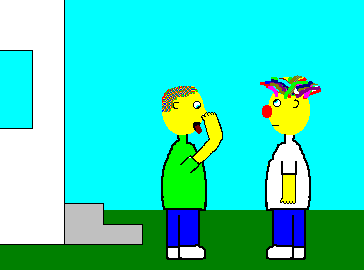
That guy from IRC with the story about his party gave me an idea for something to add to my website.  A few years ago, Nintendo released a game called Mario Paint.  It was not a game at all, it was more like rudimentary but functional drawing and animation software.  It came with a mouse, which was easier to use for drawing than the standard Super Nintendo control pad.  Three years ago, I used Mario Paint, two VCRs, and a microphone to make a short film about two strange teenage boys with a weird neighbor.  The film was influenced by the buddy comedies of the time period, like Wayne’s World and Beavis and Butthead.  I called my creation “Dog Crap and Vince.”  I made a few other Dog Crap and Vince short films over the next couple years, and the most recent one I made after I bought this computer, so the screenplay was still saved on this hard drive.

I opened my screenplay and read it.  Dog Crap’s cousin came to visit, and while throwing a football around in the yard, Vince threw it too hard, and it got run over by a truck.  The boys found a football at a garage sale to replace the one they lost, but it was so old and hard and brittle that it cracked open when it landed on the ground.  That was inspired by an inside joke; once, a strange neighbor back home gave my brother and me an old football that had belonged to her son when he was young, and it hit the ground and cracked open just like that.

I opened Microsoft Paint, the drawing software that came with Windows 3.1, and drew the opening scene, where Dog Crap opens the door and lets his cousin in.  I then drew the next scene, where the two of them watch television with Vince.  Both Dog Crap and Vince always had strange multicolored hair, and I never explained their odd appearance in any of the short films.  I also never explained why Dog Crap’s name is Dog Crap, and in their fictional universe, no one questions this.

I continued illustrating scenes from this Dog Crap and Vince story until around one in the morning.  The following day, after I finished a morning bike ride, I continued working on Dog Crap and Vince, illustrating the rest of the scenes from the story.

Next, I began typing the HTML code.  I typed the lines of dialogue and description for the story, in prose instead of the screenplay format I had written for the Mario Paint film.  It did not feel like an actual story, since the illustrations left most of the descriptions unnecessary; the remaining text was very heavy on dialogue.  But this was a new format for me, and I did not really have a template or precedent on which to base my work.  This story really was designed for animation, but in the absence of that kind of technology, this would have to do.

When I finished writing and debugging the HTML, I uploaded it, and all of my drawings, to the website.  I also updated the home page, trying to think of what to call my creation… was it a story, or a comic, or a script, or what?  I ended up calling it a story.  “Read my story: ‘Dog Crap and Vince, episode 1: ‘Football,’” I typed.  I made that line a hyperlink, so that someone could click on it to go to the story.  I read through my entire Dog Crap and Vince story again.  I was proud of my work.  Now I just needed someone to share it with.


Many of my friends who lived in this part of Jeromeville left for the summer, but some of them were still around.  Ramon and Jason were still in their apartment on Hampton Drive, and Caroline still lived upstairs from them.  Liz, Ramon’s girlfriend and Caroline’s roommate, had gone home for the summer.  By Saturday afternoon, the day after I finished Dog Crap and Vince, I was in a mood to socialize, so I walked over to Hampton Drive, about a quarter mile away.  Caroline saw me first; she was standing on the balcony, attaching some kind of wire mesh to the balustrade and railing.  “Hey, Greg!” she said.

“What are you working on?”

“I’m going to let Henry come out here.  I’m putting this up so he doesn’t accidentally fall.”

“That’ll be fun.  The cats we had growing up were always outdoor cats.  It’s weird to me to think that Henry never goes outside.”

“When we got Henry, we knew he had to be an indoor cat,” Caroline explained.  “The apartment wouldn’t allow it otherwise.”

“Makes sense.”

I heard the door on the downstairs apartment open.  “Hey, Greg,” Ramon said.  “I thought I heard your voice.”

“I just wanted to come say hi.”

“Stick around.  Liz is on her way up; she should be here soon.  She’ll want to see you.”

“Oh.  Cool.”

I went inside to watch TV with Ramon and Jason.  Ten minutes later, Caroline came down to tell us that the cat-proofing of the balcony was finished.  All of us went to the living room of the upstairs apartment and watched as Caroline opened the door to the balcony, picked up Henry and put him outside.  Henry looked around skittishly, then cautiously walked around, sniffing things.  Caroline tossed him his toy, a plastic ball with a small bell inside; Henry sniffed the ball and swatted it away, then chased his little furry black and white spotted body after it.

“It’s like he doesn’t quite know what to think of the outside,” Caroline said.

Just then, we heard Liz’s voice saying “Hey, guys!”  She walked into the apartment and put her bag down.  When she saw me, she looked surprised for a second, then smiled.  “Greg!  It’s good to see you!”

“How are you?”

“I’m good.”  Liz turned to see what everyone was looking at on the balcony.  “Henry’s outside!” she said.

“Yeah,” Caroline replied.  “I just wanted to try it.”

“It looks like he likes it.”

Liz moved her bag into the bedroom.  After she came back out to the living room, Ramon said, “Jason and I have been wanting to try that new Arch Deluxe burger at McDonald’s.  Greg?  You can come with us if you want.”

“Sure,” I said.  “I haven’t eaten yet.  And I haven’t tried that either.”

“It’s supposed to have more of an adult taste,” Jason explained.

“What does that mean?  How do hamburgers have adult tastes?” Liz asked.

“I don’t know,” Jason said.  “It’s being marketed as more sophisticated.”

Across the street from their apartment complex was the back of a shopping center facing Coventry Boulevard.  After making sure Henry was securely inside again, the five of us walked there.  The McDonald’s was in the middle of the strip mall part of the shopping center and had no drive-thru.  We each took turns ordering; I got an Arch Deluxe, eagerly anticipating what this adult cheeseburger would taste like.

“What have you been up to, Greg?” Liz asked as we waited for our order numbers to be called.  “You’re taking a class, right?”

“Yeah.  Computer Science 40, Intro to Software.  It’s going well.”

“Good!”

“Today I made something new for my website.  Just for fun, not part of the class.”

“Oh yeah?  What is it?”

I told them about Dog Crap and Vince, how I had created the characters with Mario Paint a few years ago, and about the illustrated story I had written.  “I’ll show you guys when we get back to the apartment, if you want.”

“Sure,” Ramon said.

Jason’s meal had arrived by then; he bit into the Arch Deluxe.  “This is pretty good,” he said.  “It’s different, I’m not sure exactly what is adult about it, but it’s good.”

“What does Dog Crap and Vince mean?” Caroline asked.  “What does dog crap have to do with the story?  Does Vince always step in dog crap?”

“Dog Crap is his friend’s name.  So the title refers to the two main characters, Dog Crap and Vince.”

“Why is his name Dog Crap?”

“I’ve never explained that.  It just is.”

“Okay,” Caroline said, as if not sure what to make of this.

The cashier called my number, and I went up to the counter to get my food.  I sat down and opened the cardboard Arch Deluxe container.  The burger had a different kind of bun, looking more like a sandwich roll, but round.  I opened it and removed the tomato slice.  “You don’t like tomatoes?” Liz asked.

“No.”

“May I have it?”

“Sure.”

I passed my tomato to Liz and took a bite of what remained of the burger.  I liked it.  Definitely different from most other McDonald’s products; it tasted like it was made from higher quality ingredients.  “This is good,” I said.  Growing up, I was a connoisseur of Chicken McNuggets; I did not usually eat hamburgers at McDonald’s, but I was willing to reconsider this position because of the Arch Deluxe.

We sat together at McDonald’s catching up for a while.  Liz told us all about her summer with her family, and those of us who were taking classes shared how our studies were going so far.  At one point, during a lull in the conversation, Ramon said, “Has anyone ever noticed that this song is the same four chords over and over again?”

“Huh?” Caroline asked.

“This song,” Ramon repeated.  Blues Traveler’s “Run-Around” was playing in the background of the restaurant.  “It’s the same four chords over again.”

I listened carefully to the guitar and bass playing behind the energetic harmonica solo.  “You’re right,” I said, pretending to sound like I knew what I was talking about.  I had three years of piano lessons in my past, and I had been singing in the choir at church for almost a year, but Ramon was a much more accomplished musician than I was.  “I always thought it was catchy, though.”

“Oh, yeah, it’s catchy,” Jason agreed.

 We walked back to the apartment after we finished eating.  “Greg?” Ramon asked.  “Did you still want to show us that Dog Crap thing?”

“Sure.”

Ramon turned on his computer as Jason found something to watch on TV.  He opened Netscape and asked, “What’s the address?”  I typed the address for my website, then clicked on the link for Dog Crap and Vince.  Ramon began reading silently as Liz and Caroline and I watched the screen.  I felt slightly awkward. Was I supposed to read it out loud to them?  How would Ramon know when everyone was done reading?  At the end of the first page, Ramon asked if everyone was done reading before he continued to the next page.  That would work.  The others laughed a few times, such as when Dog Crap and Vince saw the Unabomber at the garage sale.

“That’s pretty funny,” Ramon said when he finished.

“You did a good job with the website,” Liz added.  “Are you going to do more Dog Crap stories?”

“Eventually, yes.”

“I’ll keep watching for those.”

“Thanks!”

The four of us hung out watching television and just talking for another couple of hours.  I walked home after that and got out a sheet of paper.  Future Dog Crap and Vince Ideas, I wrote at the top, then I added, Dog Crap is playing guitar, but he only knows four chords, and Vince says he can still play that Blues Traveler song.  I used a variation of that line in another episode later that year, and I made it a habit to write down anything funny that I thought of or saw that could be used in future episodes.

Today was a good day.  I would be eating many more Arch Deluxes in the future; this would become my new go-to order at McDonald’s.  However, sadly, the product was considered a massive failure.  The Arch Deluxe never caught on as a popular item once the initial hype faded, and a few years later, it disappeared from McDonald’s menus.

Dog Crap and Vince, however, did not disappear from my life.  I continued making new episodes of the series for eleven years, with more animated short films after that.  I also did numerous other side projects involving Dog Crap and Vince.  Many of my friends have been involved in a Dog Crap and Vince project at some point.  These two characters spawned a fictional universe that became a major part of my life for a long time.  The world of Dog Crap and Vince even seemed to take on a life of its own at times.  The cast of main characters grew from two to at least six, with many other recurring characters in their world, and at times, their stories seemed to take on lives of their own.  I never would have believed, on that day three years ago when I drew those two silly-looking boys on Mario Paint, that this would become such a major part of my life.


Author’s note: Dog Crap and Vince is not real.  It is based on an actual project called “Cow Chip & Lance.”  I’ve known the guys behind those characters for many years, and I’ve done some work behind the scenes for them.  They were thinking about reposting their web series from the 90s, and I’m writing about the 90s, so we decided to join forces on that project.  Go check them out.


July 12, 1996. Thinking about the future. (#91)

Everyone has those experiences of seeing a familiar face in an unexpected place or situation, and usually, such a moment turns out to be awkward.  Kids see their teachers grocery shopping and freak out, because it never occurred to them that teachers eat like normal humans and do not live at school.  In 1996, Kevin Johnson was playing basketball for the NBA’s Phoenix Suns, and in 2007, I saw him ordering at Chipotle, but I was too afraid to say anything.

I had one of those moments one Friday afternoon in the summer of 1996, when I was taking Computer Science 40, Introduction to Software, at the University of Jeromeville.  It was five o’clock, and I was still wearing the same old pair of shorts that I used for pajamas.  I had no class on Fridays, so I had not showered today.  I spent the morning in an IRC chat talking to a girl on the other side of the country, then I had worked on homework for a while, then I read a few chapters of a book for fun, and now I was going to go for a bike ride.  I put on a pair of real shorts and walked my bike out to the parking lot.  I looked up and saw Joe White.  “Hey,” I said.

Wait a minute.  Joe White, the teacher’s assistant for my computer class, does not live at Las Casas Apartments.  Or does he?  I had never seen him around here before.  He appeared to have just gotten out of the pool, and he was holding hands with a girl in a black bikini whom I had seen around the complex.

“Hi, Greg,” Joe said.  “You live here?”

“Yeah.”

“My girlfriend lives here.  It seems like a pretty nice place.”

“It is.  I like it.”

“How are you?  You seem to be doing really well in class so far.”

“I’m good.  I tend to figure out computers pretty easily.”

“Are you a CS major?”

“No,” I said.  “I’m a math major.”

“Do you need CS 40 for the math major?”

“No, but I needed 30.  And 110 counts in place of math units toward the major.  I’ve always liked computers, I want to learn more about programming, and 40 is a prerequisite for 110.”

“That makes sense.  Hey, I’ve been meaning to ask you, you were in Math 145 last quarter with Dr. Thomas, right?”

“Yeah.  Were you in that class?”

“Yes.  I’ve been wondering if all the math professors at Jeromeville are as bad as Gabby Thomas, or if that was just her teaching style.”

This comment caught me completely off guard, since Gabby Thomas had been my favorite math professor so far, and I was not sure what it was that Joe found so abhorrent about her teaching style.  I liked her class.  Not wanting to debate this, I simply said, “Every professor is different.  I’ve had good and bad experiences.”

“That makes sense,” Joe said as I nodded.  He continued, “So what do you want to do with your math degree?”

“I’m not really sure,” I explained.  “Math is just what I’m good at.  I’ll probably just stay here and go to grad school.”

“A Ph.D. from Jeromeville doesn’t really mean much if you’re going to be a serious academic.  But if your math grades are anything like how you’re doing in CS so far, you could probably get into a really prestigious program.”

“Hmm,” I said, nodding.

“I should get going,” Joe said.  “Enjoy your ride, and I’ll see you in class.”

“Thanks!  Have a good weekend!”

I pedaled out toward Andrews Road and headed south toward campus, thinking about what Joe had said.  It had never crossed my mind how degrees from different universities with different levels of prestige might affect future employment opportunities.  As a kid, I just went to whatever school was in my neighborhood; I never had to consider the school’s prestige, reputation, or history.  Apparently, a career in academia was a bit more complicated.  It also rubbed me the wrong way that Joe seemed to have a very low opinion of the University of Jeromeville.  He thought my favorite professor was awful, and that an advanced degree from here was worthless.  If he thought so lowly of UJ, why was he getting his degree here?  For all I know, maybe he did not get accepted anywhere else.

I rode my bike past the North Residential Area and Thong Bikini Hill, which was full of sunbathers and swimmers today, to the oak grove at the west end of the Arboretum.  I continued along the path on the south bank of the creek for the entire length of the Arboretum, emerging downtown on First Street.  I turned right on Cornell Boulevard, crossing under the railroad tracks near Murder Burger and then over Highway 100.  Another trail followed the dry creek bed on this side of the highway; I worked my way to this trail and followed it east to where it ended.  The grasses between the trail and the dry creek bed had turned brown in the dry summer heat, but the trees lining the trail were full of green leaves.

At the end of the trail, I turned around and headed back to the west, until I got to the greenbelt that led to the park at the end of Baron Court, where I turned right, away from the creek.  In May, I had been playing disc golf in this Greenbelt as part of the Man of Steel competition, an annual event among the men of Jeromeville Christian Fellowship involving disc golf, an eating contest, and poker.  I was looking forward to next year, hoping that I would not finish close to last place for a second time in a row.

As I pedaled past trees and a small playground, I got an idea.  Although I lived alone at Las Casas, part of the reason I chose that apartment was because thirteen of my friends from freshman year lived within a short walk of me.  I occasionally walked to one of their apartments just to visit.  During sophomore year, I got involved with Jeromeville Christian Fellowship, and two households full of my new JCF friends lived on Baron Court.  What if I dropped in on them just to say hi the same way I did for my friends who lived near me?

I stopped my bike in front of the closer of the two houses and walked it up to the door, nervously.  During the school year, Haley, Kristina, Kelly, and Jeanette lived here, with two other girls whom I did not know as well.  I was not sure who would be here today, except that I knew that Haley would not, since she went home for the summer.

I took a deep breath and looked back out toward the street, contemplating getting back on my bike and going home.  This was a bad idea.  Maybe none of my friends would be here.  Maybe they had other roommates in the summer who did not know me; what would I say if one of them answered the door?  Which roommate was I looking for?  Would it be weird to say that I knew multiple girls who lived here and I just dropped by to say hi to whomever was home?  Why was I even here?  If I was looking for a chance to talk to Haley, she was not in Jeromeville, so that would not happen.  I knocked on the door before I could talk myself out of this.  The thirty seconds that I waited for a response felt like several minutes as I played out all the scenarios in my head.

Kelly answered, wearing a t-shirt and running shorts.  “Greg!” she said.  “Hi!  What’s up?”

“Nothing,” I explained.  “I was just out on a bike ride, out your way, and just wanted to say hi if anyone I knew was home.”

“Come on in!  I’m the only one here right now.  You want some water?”

“Sure.  And I’m sorry that I’m all sweaty.”

“It’s fine,” Kelly said, walking toward the kitchen.  I followed her.  “I just got back from a run a little while ago, and I haven’t showered yet.”  As Kelly got a glass out of the cupboard and filled it from a pitcher in the refrigerator, I noticed something frying in a pan on the stove.  “I’m making a hamburger,” Kelly explained, handing me the glass of water.

“I see,” I said, drinking about half the water in my first sip.  “How’s your summer going?”

“Pretty good.  Two classes during a summer session is a lot of work, though.  But I’m keeping up with it.”

“Yeah, that sounds like a lot of work.  I’m only taking one class, and that’s a lot of work by itself.”

“Which class?”

“Computer Science 40.  Intro to Software.”

“That does sound like a lot of work,” Kelly said, chuckling.  “What are you learning about?  Intro to software, like making your own?  I’m not really a computer person.”

“Yeah.  We’re programming in C, which is a structured programming language.  A lot of more entry-level programming classes use languages that are simpler for humans to understand, but a lot less powerful.  Like last quarter in CS 30, when we learned programming in Pascal.”

“I see.”

“I don’t like working in the computer lab in the basement of Kent Hall, though.  I work better from home, with music playing and stuff.  But I have to be connected to the computers in Kent, and I don’t want to tie up the phone line.  So I’ll dial in around 10 at night, and stay up late getting my work done, and it works out because I don’t have to be up early in the morning.”

“That makes sense.”

“And I’ve trained myself to sleep in a little.  I don’t usually sleep in very well.”

“I… have the opposite problem,” Kelly said, chuckling.  “I sleep through my early morning classes.”

“I’ve found that most people do have the opposite problem.”

Kelly flipped over the hamburger patty with a spatula.  “So what else have you been doing this summer?  Did you go home at all?”

“Yeah.  The week in between spring quarter and summer session.  My brother and I turned all of our silly inside jokes into a board game.”

“That sounds fun!  How old is your brother?”

“Fourteen.  He starts high school this year.”

“Oh!  I was picturing older.  Is it just the two of you?”

“Yeah.  What about you?”

“I have an older sister.  She’s in grad school in California.”

“Nice,” I said.  “That’s about it for my summer.  I’ve just been going to my class, and going for a lot of bike rides, and going to the Bible study on Thursdays at Lillian’s– Oh!  And I mailed off my payment for Urbana!  I’m going, for sure!”

“That’s exciting!  I’ve heard such great things about Urbana!  I really wish I could go.”

“Why can’t you?” I asked, hoping it was not too personal of a question.

“Did I tell you what I was doing next year?”

“I don’t think you did.”  I hoped that I had not disrespectfully forgotten some key piece of information that Kelly had told me before.  I first wondered if she could not afford the trip to Urbana, then I wondered if she was going on a mission trip, the kind of thing I would learn more about at Urbana, like what Taylor and Pete and Charlie were doing in Morocco or Xander was doing in India right now.  Neither one was correct.

“I’m going to Hungary,” Kelly said.  “To study abroad.”

“Oh!” I said.  “That’ll be exciting!”

“Yeah.  I always wanted to study abroad.  I wanted to be an exchange student in high school, but it never worked out.  This time, the opportunity did work out.”

“When do you leave?”

“After first summer session ends, I’m going to go home for a little over a week.  I leave in the middle of August.”

“Will you have email?  Or is there an address I can write you?”

“Yeah!  I don’t think I’ll have email, but I’m keeping an address book so I can write to people.  I’ll send you my address once I get there.  Lemme go get it.”  Kelly left the kitchen and came back a minute later with the address book; she turned to the page for the letter D and said, “Will you be at the same place next year?”

“No,” I said.  “I’ll give you my new address.”  I wrote in the address book, Greg Dennison, 2601 Maple Dr. #K-5, Jeromeville (after Sept. 1).

“Who did you say you were living with next year?”

Shawn Yang, Brian Burr, and Josh McGraw.”

“So this is Brian’s address too?  I’d been meaning to get his address.”

“Yes!  And I will definitely write you.”

“Great!”  Kelly turned off the stove and put her hamburger on a bun, which she had on a plate.

“I should probably let you eat that,” I said.  “I need to get home.”

“Yeah, I need to eat and then get in the shower.  But thanks for stopping by!”

“Yeah!  Good luck with the rest of your classes!”

“Thanks!  You too!”

I left Kelly’s house and rode down Baron Court.  I thought about stopping by the house down the street where a bunch of guys I knew lived, but at this point I was ready to get home and make something to eat, so I did not stop.  Kelly’s hamburger smelled good.

I turned right on Valdez and right again at Cornell Boulevard.  I saw tractors and backhoes on the other side of Cornell from me; I had read that a shopping center was being built here.  Shopping centers always brought controversy in Jeromeville.  The city was run by aging hippies who fought tooth and nail to keep the city feeling like the small town it was forty years ago, in complete denial of the population growth brought on by the large and growing university adjacent to the city.  The construction of a shopping center always renewed debate about what kind of stores belonged in a proper small town like Jeromeville.  I thought the city council should just mind their own business and let the free market decide, because this was America.

I turned left on Willard Avenue.  This was my first time on this stretch of road.  An overpass had just opened a few weeks earlier, connecting Willard Avenue with Power Line Road on the other side of Highway 100.  In typical Jeromeville fashion, the overpass was controversial; new roads would bring more traffic, which would bring more crime from other cities, according to the very shaky logic of the people who ran this city.  Currently, only two two-lane roads connected the part of Jeromeville south of 100 with the rest of the city, and horrible traffic jams plagued both of them, especially Cornell Boulevard heading into downtown.  This new overpass in between those other two was desperately needed, in the eyes of anyone who could think logically and unemotionally.

When the need for the overpass became apparent, the people planning it decided that it would be a uniquely Jeromevillian overpass, with a landscaped median full of planters with trees.  Trees on an overpass made no sense to me.  Trees grow, and trees have roots, which would crack the concrete and dangle over the freeway below.  The trees and planters also would add weight to the overpass.  As I crossed Highway 100, riding past the trees, I thought about how the local newspaper columnist Bill Dunnigan had said the same thing I did about them.  But someone thought this was a good idea, and as if not to be shown up, the city of Nueces, 15 miles west on Highway 100, built their own overpass with trees a few years later.

North of the freeway, the overpass crossed a railroad track and Second Street, then passed between two undeveloped grassy areas.  One had a pond fed by storm drains that was full for most of the year.  The city paid thousands of dollars to design a tunnel under this road so that wildlife could cross the road, a move which many pundits from other cities in the region made fun of.  A local artist built some miniature buildings called “Frogville” which he placed near one end of the tunnel.  What makes this situation even more messed up is that much of the land was paved over within a few years, and no frogs or other animals were ever seen using the tunnel.  I always said that Tunneling Frogs would make a good name for a band.  Had I done more research into the quirky left-wing hippie local politics in Jeromeville before I came to UJ for school, there is a good chance I would not have chosen UJ.  However, after making so many friends here and discovering how much I loved bike rides, Jeromeville was definitely starting to grow on me.

As I continued riding home, north on Power Line Road, west on Coventry Boulevard, and then right on G Street into the Coventry Greenbelt, I thought about that afternoon’s conversations.  Joe White had brought into question my plan to stay in school forever, with his comment about the importance of getting into a prestigious graduate program.  Kelly Graham clearly had a plan for her year in Hungary.

What was my plan?  Was I really planning on staying in school forever?  What would I do then?  I would become a mathematician, teaching college classes while doing mathematics research.  Was that what I wanted?  What were my other options?  I was pretty sure I did not want to teach middle or high school.  If I changed my major to computer science or something involving computers, I would be competing with others who were much more knowledgeable than me about computers from this decade.  I also enjoyed fiddling with computers, and I did not want something fun to turn into work.  By the time I got home, I found that I was more frustrated than I had been when I started on this ride.

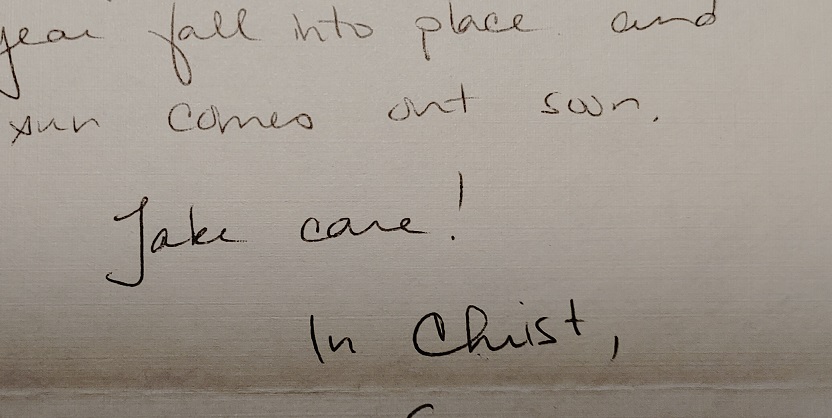
I stopped at the mailboxes on my way back to the apartment and took a deep breath.  I knew that I did not have to decide my future plans right now, but it felt more urgent than it had a few hours ago.  I opened the mailbox and saw a letter from Sarah Winters.  She was at home in Ralstonville for the summer.  I went home and read the letter before I got into the shower.  In my last letter to her, I had mentioned that the weather had been uncharacteristically cool.  I had also told her about my class, my week at home, and how I needed to coordinate with Shawn and Brian and Josh about moving into the new apartment and storing my things for a few days after I moved out of this apartment.  Sarah told me that she had been in a wedding for one of her high school friends, and that she had been going to the college group at her church.  She was going to Disneyland later this month, and she would be talking to her pastor about missionary opportunities over the next couple of years.  She closed her letter saying, “I hope your plans for next year fall into place and that the sun comes out soon.  Take care!”

The sun did come out; temperatures this week had been in the 90s.  And Sarah was referring to the moving plans falling into place, but after today, I felt like I had many other plans that needed to fall into place.  I still had time to figure out my future.  Or did I?  I had been at UJ for two years, and I had made virtually no progress in choosing a career.  I would graduate in another two or three years, and it would be better to come up with a plan soon, so that I could choose the right classes.

I seemed to remember the Math Club talking about career opportunities sometimes; maybe I should pay attention to those.  Or I may end up doing something entirely different.  In December, I would be attending the convention in Urbana, Illinois, to learn about Christian mission opportunities and ways I can serve God.  Maybe I would discover an entirely new career opportunity there.  The world was not an easy place, but I was learning, and I would figure out my future when I was ready.  Things seemed scary and confusing now, but my sun would come out soon.

July 2-5, 1996. I could go to jail for this. (#90)

When I was a student at the University of Jeromeville, I drove a 1989 Ford Bronco.  At the time, many people associated the Ford Bronco sport-utility vehicle model with retired football player and acquitted murder suspect O.J. Simpson, who led police on a nationally televised chase in a white Bronco two years ago.  Mine was red and tan, which conveniently enough were similar colors to my favorite football team, the Bay City Captains.  Technically my parents owned the car.  Dad bought it new when I was in seventh grade.  Between Dad driving to and from work, Mom picking me up from school, and all of my brother Mark’s baseball and basketball games and tournaments, we wore that car out quickly, putting a hundred thousand miles on it in less than five years.

Shortly before I left for Jeromeville, we were coming back from watching some of Mark’s friends in a baseball tournament in San Tomas, and the Bronco broke down.  My parents spent a fair amount of money to get it running again so they could send me off to school in the Bronco.  They got another car, and when they needed multiple cars, they often borrowed a car from my grandparents, who still had two cars and did not drive as often.

The Bronco was a big car.  It was great for when I had to move a lot of things, which pretty much had only happened once, when I moved out of the dorm at the end of freshman year.  It also had four-wheel drive, but I never drove off pavement, so this was not particularly useful to me either.  I would find advantages over the years to having a large vehicle, but those are stories for another time.

A car this size had two major disadvantages.  The Bronco only got around 13 miles per gallon, and it was difficult to park.  The first point was not something I thought about often.  The Bronco had a 30-gallon gas tank, and Mom and Dad gave me a credit card for Chevron gas stations on their account, so I did not have to pay for gas.  But I did often have trouble parking the Bronco in the parking spaces in Jeromeville, which seemed to be narrower than the parking spaces I grew up with.  One night, as I was coming home from the grocery store, this minor annoyance became something I needed to deal with immediately, as I tried to maneuver into a parking space at my apartment complex and felt a bump as I turned sharply to the right.

I had hit the car parked next to me.  What do I do?  My first thought was to finish parking, so I would not be in the way of anyone else trying to get by.  I carefully wiggled the Bronco into the parking space without further incident; I would have rather parked elsewhere, but the lot was full.  When I got out, I saw that the Bronco was fine, but the car next to me, a black Honda Civic, had a small crack in the taillight.  I vaguely remembered something from driver training class about having to leave my contact information and my car insurance information when I hit a parked car, but instead I ran in the house and called my parents.

“Hello?” Mom said.

“It’s me,” I replied, speaking quickly and panicky.  “I hit a parked car.  What do I do?”

“Where are you?”

“At home.  It was parked next to me.”

“How bad is the damage?”

“My car is fine.  The other car has a small crack in the taillight.”

“Don’t panic.  It’s not a big deal.  Do you know whose car it was?”

“No.”

“So just write down your name, and phone number, and insurance information, and put it on their windshield, under the wiper,” Mom said.  I heard Dad’s voice in the background, and Mom told Dad, “Greg hit a parked car.”

“Is my insurance rate going to go up?” I asked.

“Wait,” Mom said. “Dad is talking to me.”  I waited a minute, hearing muffled voices in the background.  “Greg wants to know if his insurance is going to go up,” I heard Mom ask Dad, followed by more muffled voices.  Finally, Mom said, more clearly, “Are you still there?”

“Yes,” I said.

“Dad says if you’re worried about getting insurance involved, if it’s just a tiny crack, it probably isn’t that expensive to fix.  You can offer to pay for it yourself, out of pocket.”

“That could work.”

“And if you’re worried about money, we can send you some to help.”

“I think I’ll be okay,” I said.

“Are you sure you’re okay?”

“Yes.  I should go now so I can leave a note on the car.”

“Good idea.  Just let us know if you need anything else.”

“I will.”

“Okay.  Bye.”

“Bye.”

I tore a sheet of paper out of a notebook and wrote: I accidentally bumped your car and hit the right taillight while I was parking.  I’m sorry!  If it’s not too expensive, I will pay for it without getting insurance involved.  If that doesn’t work, I can give you my insurance information.  Greg Dennison, apt. 124, 555-0159.  I went outside and walked down to where I had parked, so I could leave the note on my neighbor’s car.

It was not there.

The parking space to the left of me was empty.

I checked the car on the right, just to make sure I did not somehow get confused as to which car I hit.  The car on the right had no cracks in its taillights.

I was now officially guilty of the crime of hit and run.  I could go to jail for this.

Maybe no one would notice.

I waited about five minutes; the other car did not return.  I had not thought clearly enough to get the license plate number.  I went back in the house, picked up the telephone, and called Mom again.

“The car left before I could get back outside,” I said.

“Oh no,” Mom replied.  “I guess you just keep looking for the car around your apartment complex.  Do you remember what kind of car it was?”

“Black Honda Civic, but I don’t remember the license plate or anything like that.”

“Then just keep looking for a black Honda Civic with a cracked taillight, and when you find it, explain what happened.  That’s all you can do.”

“I guess.  I just don’t want to go to jail.  This is a hit and run now.”

“You won’t go to jail.”

“But I could.  I left the scene.”

“You really didn’t.  You went inside to get a pen and paper, and when you got back, the other car was gone.”

“I shouldn’t have spent five minutes on the phone with you,” I said.

“Five minutes is no big deal.  You’ll be fine.”

“I guess.”

“What are you doing the rest of the night?”

“Just working on homework.  I don’t usually work on it until late at night, because I need to dial in to a computer on campus to work from home, and I don’t want to tie up the phone line.”

“Should I let you go?”

“I guess.  I just hope I don’t go to jail.”

“You won’t go to jail!  Just keep looking for the car, and explain what happened.”

“I will.”

After I got off the phone with Mom, I listened to the sounds of the dialup modem connecting to a server from the Computer Science Department.  I worked on my assignment until around midnight.  Tomorrow was Wednesday, the day that I had to be on campus at 10:00 for the discussion, so I did not want to stay up too late.  Before I went to bed, I made one last walk through the parking lot, looking for a black Honda Civic with a cracked passenger side taillight.  I could not find it.  I looked at all the cars parked on the street nearby, as well as the two other parking lots for this large apartment complex, and I did not find the car there either.  I went to bed, hoping that I would not go to jail for this.


Wednesday was a fairly uneventful day.  After I got back from class in mid-afternoon, I checked all the parking lots again, still looking for the Honda with the cracked taillight; I did not find it.  We got our new weekly project for this week, and I worked on that during the night, starting at ten o’clock so I did not tie up the phone line during the day.

There was no school the following day, Thursday, because it was July 4, Independence Day in the United States.  All across the nation, in all fifty states, proud Americans celebrate our founding ideals of independence and freedom by attending barbecues and watching fireworks.

I did very little of that growing up, mostly because I lived in Plumdale.  I love my country, and I want to celebrate freedom, but Plumdale was too rural to have a big fireworks show.  The nearby cities of Gabilan and Santa Lucia did, but the cold ocean currents off of the West Coast often created a layer of fog in the evening, even in summer, obscuring the view of aerial fireworks shows.  Backyard home fireworks shows were also out of the question, since fireworks were illegal everywhere in Santa Lucia County.  Beginning in my preteen years, we began traveling north to Bidwell over the July holiday to see Dad’s relatives.  My great-grandmother lived in an old ranch house in the foothills on the edge of town, and from her house we could see two fireworks displays off in the distance, one at the fairgrounds and one downtown.  But until the first summer I spent in Jeromeville, I had never seen fireworks up close.

I spent the morning in my pajamas, reading, looking for girls to talk to on IRC chats, and working on the novel I had been writing off and on.  I also read the newspaper, a big part of my morning routine for many years.  Last year I subscribed to the major newspaper for this region, the Capital City Record, but I canceled my subscription last fall, when they missed my delivery three times in one month.  Since then, I had been reading the Jeromeville Bulletin, a much smaller newspaper with more of a focus on local news.  The Bulletin had a hilarious daily columnist named Bill Dunnigan who loved to make fun of all the little quirks of living in Jeromeville.  He said something about how Jeromeville always begins their local fireworks display with a speech by someone from the City Council, and how he wished that for once, they would just do away with the speech, and just say, “Let the fireworks begin!”  That would be nice.  The people who tend to win elected office in Jeromeville usually had the kind of political views that made me not want to hear them speak.

I found information about tonight’s fireworks display in the newspaper.  It was at Jeromeville Community Park at the corner of Coventry Boulevard and G Street, about three-quarters of a mile east of me.  The celebration would begin at six o’clock, with food booths and carnival games for children, and the fireworks themselves would begin at nine-thirty, after it was dark.  The article recommended walking or riding a bicycle to the park, since parking was limited and it would likely take a while to get out of the parking lot.  

I started walking east around eight o’clock.  Community Park was next to Jeromeville High School, and I saw the setup for launching fireworks on the school football field, along with a fire truck.  The park itself consisted of a large grassy expanse, with a playground, a few groups of picnic tables, and sports fields scattered throughout the park.  Oaks, sycamores, and pines were planted in small groups throughout the park, as well as a grove of redwoods.  The redwoods were the tallest trees in the park, although they did not grow as tall in this climate as they did in their native habitat on the northern California coast.  I found a place to sit where no one else had sat or placed a blanket to sit on.  It was far enough from the redwoods that my view of the fireworks would not be obstructed.

The park was already crowded, and I was glad I had chosen not to drive.  A band played in the distance; it was no one I recognized, but they sounded pretty good, so I listened until their show ended.  After that, I just sat and watched people for a long time as the sky grew darker.  Having come to Jeromeville as a student, like thousands of others, I spent most of my time in a sort of student bubble, living most of my life on campus and in a student-oriented apartment complex.  Although Jeromeville is known as a university town, children and families live in Jeromeville as well, many of whom have no connection to the university.  That side of Jeromeville, which I did not often come face to face with, was all around me now.  Children ran around the park playing with water guns and glow sticks, and young parents fed babies in strollers with bottles.  It was definitely a change of scenery.

At nine-thirty, I heard a woman’s voice on speakers.  It was hard to make out exactly what the voice was saying, but I heard her say something about the Jeromeville Bulletin newspaper, and then, “Let the fireworks begin!”  A cheer erupted from the crowd.  Apparently the people running this show had actually taken Bill Dunnigan’s suggestion to keep the speech short this year.

The lights in the park went dark, and immediately I heard rockets launching into the sky and loudly bursting in colorful displays, while recordings of marching bands performing America the Beautiful, The Stars and Stripes Forever, and other patriotic music played over the speakers.  After about ten minutes, I expected the show to be ending soon in some sort of grand finale, but the fireworks went on and on.  Fifteen minutes.  Twenty.  Would this show go on forever?  Even the fireworks I remembered watching from my great-grandmother’s house in Bidwell never seemed to last this long.  Finally, a few minutes before ten o’clock, I saw and heard many rockets launching at once; they lit up the sky as they all went off within seconds of each other.  Then the sky went dark, with only faint clouds of smoke blowing away from the park visible, and everyone cheered.  This was the best fireworks show I had ever seen.

When the lights in the park came back on, I immediately began walking back to the west toward Coventry Boulevard.  I had no blanket or children’s belongings to pack up, so I walked ahead of most of the people heading the same way.  It took less than fifteen minutes to get home.  Before I entered the apartment, I checked the parking lots again, still hoping to find the car with the cracked taillight, so I could make that right.  There was a black Honda Civic parked near my apartment, but both taillights were intact; also, this one had Oregon license plates, and if the car I hit had license plates from a different state, I probably would have noticed.

I walked across to the west side of the complex and checked that parking lot next.  I found another black Honda Civic there, and sure enough, it had a small crack in the passenger side taillight.  I memorized the license plate number, just in case the car was gone again by the time I got back to it.  I returned to my apartment, found the note I had written two days ago when I hit the car, and added a postscript about how the car had left while I was inside writing the note, and I had been searching for two days.  I then walked back to the car, which was still there, and left the note tucked under the windshield wiper.  Now all I could do was wait for the owner of the car to call.


I had no class on Fridays this summer, so I went for a bike ride in the early evening.  Early evenings in the summer were the best time for bike rides in Jeromeville, with trees full of green leaves and their shadows long, with the sun low enough that it was not quite as hot as it had been a few hours earlier.  I rode along the Greenbelts that connected directly to my apartment complex, ending in the same park where the fireworks had been the night before.  I continued east along Coventry Boulevard to the edge of the city, where a new housing development was being built.  I then worked my way back west on Fifth Street to downtown Jeromeville and the north end of campus, coming back home north along Andrews Road.

When I got home, the light on my answering machine was blinking.  I pressed the Play button.  “One. New. Message,” a robotic voice said.  The tape forwarded to where the message began, and I heard a woman’s voice.  “Hi.  My name is Dana Forbes, and you left a note on my car about the cracked taillight.  If you could call me back, so we could talk about that, my number is 555-0133.”

I was nervous.  I did not want Dana to be mad at me.  But I knew that I had to do this.  I called the number, and Dana picked up on the second ring.  “Hello?” she said.

“Hi.  My name is Greg Dennison, I left you the note about your cracked taillight–”

“Yes,” she said.  “Thanks for calling me back.”

“I’m so sorry,” I explained.  “I have a big car, and it just bumped a little, and I went inside and it took me a few minutes to write the note, and when I went back outside to put it on your car, you were gone.”

“Thanks for finding me, though,” she said.  “I noticed it yesterday, and I thought, I don’t remember that being there.  So did you want to just pay for it out of pocket?  I was going to get it fixed tomorrow.”

“Do you know how much it’ll cost?”

“He told me over the phone it probably would be around a hundred dollars.”

“That’ll be okay,” I said.  A hundred dollars was a little more than I was expecting to pay in my mind, but I really had no idea what I was dealing with.  I had never had to pay for a cracked taillight before.  “Again, I’m sorry that this happened.”

“Don’t worry about it!  Accidents happen.  I’m just glad you came back and let me know.”

“Yeah.  So do you want cash, or a check, or what?”

“Why don’t you come over with a check around this time tomorrow?  It should be done by then.  I’m in apartment 241.”

“That’ll work,” I said.  “Thanks for calling back.”

“No problem.  Have a great night!”

“I will.”

Everything else happened without incident.  Dana told me the next day that she had paid ninety-one dollars to get the taillight fixed, and I wrote her a check for exactly that amount.  I was relieved that Dana was not upset with me, and that I would not be going to jail.  I made a note to learn my lesson and be careful parking in the future.  With a car the size of a Ford Bronco, I had to be careful of this kind of thing.

As strange as this sounded, though, I kind of wished that my parents had not offered to pay for it.  I did not need them covering for my mistakes.  I already felt guilty that they were paying my rent, and gas.  They also paid all my university expenses, although I still had a scholarship for my grades that covered most of that.  I had my tutoring job, but that did not come anywhere close to covering everything I had to pay for.  Last night I had celebrated Independence Day at the park, but was I really independent if someone else was paying most of my bills?  I decided that once I was on my own with a full time job, I would no longer accept this allowance from my parents.  And when I did get my first full time job, I stopped using my parents’ Chevron credit card, and they stopped sending money to cover rent.  I was not independent yet, but I was working on a degree from the University of Jeromeville, and someday I would be.

June 25-27, 1996. The first week of summer session. (#89)

The architecture and landscaping around the University of Jeromeville are not the old brick buildings and towering, stately trees commonly associated with universities.  The towering trees are there, in the older parts of campus, but the buildings are a mix of architectural styles.  The traditional brick Wellington Hall, the wooden shingles of Old North and South Halls, the Spanish stucco and tile of Harper Hall, and the bizarre angled concrete of the Death Star Building are all visible just from the Quad.  Some criticize the campus for its lack of architectural unity, but I always found that this gave it character.

One of the sections of campus with the least glamorous architecture was far to the southwest of the Quad, just past the engineering buildings, east of the South Residential Area.  Two prefabricated buildings, resembling the portable classrooms on most elementary and secondary school campi in this state but larger, stood surrounded by several feet of bare dirt on each side, and more interesting buildings in view nearby.  One of these buildings was divided in half, with a sign calling it “Temporary Classrooms 1 & 2,” and the other had only one door, labeled “Temporary Classroom 3.”

I parked my bike and walked into Temporary Classroom 3.  A chalkboard ran along the side of the building to the left, and about eighty chairs with the little writing desks that fold out faced the chalkboard.  The room was about half full so far, and most of the empty seats filled up by the time the instructor arrived at noon.  I assumed that this man was the instructor, at least, because he carried a binder and stack of papers to the front of the room.  He was slender, with wavy light brown hair, wearing a dress shirt and slacks, and he appeared fairly young, probably in his early thirties.  A darker-haired man of about that age, dressed more casually, had been sitting in the front of the room the whole time.  The instructor handed the other man a stack of papers, which they began passing out to the class.

“Welcome to Computer Science 40, Introduction to Software,” the instructor said.  “My name is Tom Kroger.  This,” he said, gesturing to the darker-haired man passing out papers, “is Joe White.  He will be the TA for this class, and he will lead the discussion section on Wednesday mornings.”  The syllabus was among the papers Joe White passed out, and neither of their names had the title “Dr.” in front.  I assumed that Joe White, like most teaching assistants, was a graduate student studying computer science, and I wondered, because of his youth and lack of title, if Tom Kroger was a graduate student as well.  In my department, mathematics, graduate students sometimes taught first-year classes as the actual instructor, not just the teaching assistant; perhaps computer science did the same thing, particularly during the summer session.  (I would learn later that I was correct.)

Tom spent the first part of class explaining our assignments, the grading policy, office hours, computer lab hours, and other procedural items.  We would be using the programming language C, and the textbook for the class was called C How To Program, the only textbook I ever had with a pun for a title.  An optional supplementary book taught the basics of Unix operating systems; I bought this book too, since I had little familiarity with Unix.  For the rest of the 110-minute class, Tom lectured about high-level structured programming languages and the C standard library.  While some elements are common to most programming languages, C seemed fundamentally different than the Commodore 64 BASIC programming that I taught myself at age nine, or the Pascal language that I learned last quarter in my Introduction to Programming class.

Summer session classes teach ten weeks of material in six weeks, so the class met more often during the week than classes do during the regular school year.  The class met from 12:10 to 2:00 every Tuesday, Wednesday, and Thursday afternoon, with a discussion section Wednesday morning from 10:00 to 11:50, right before the lecture.  We would have weekly projects that would be discussed at that time.  This was the only class I was taking this summer, and I had no job, so I had plenty of time to study and get work done.

After class, I went to the Memorial Union and got a slice of pepperoni pizza.  I had not packed a lunch, I just figured that I would eat when I got home, but being back on campus for the first time in almost two weeks made me want to sit back and take in the atmosphere.  I took my lunch to a table in the courtyard by the fountain that was now kept perpetually dry.  I read the Daily Colt campus newspaper as I ate.  The name was a bit misleading, since during the summer, the newspaper only published twice a week, in a smaller tabloid format only about half as long as the regular edition. 

The campus was much quieter today than I was used to, since the majority of the student population was not in class for the summer.  Those fun times last year of running into friends around campus between classes, and all the interesting conversations that happened around those encounters, probably would not happen as often this summer.  The last time I sat at this table was when Haley Channing was sitting here, and I asked if I could join her.  For a girl-crazy, socially awkward guy like me, getting to have lunch with Haley was like winning the lottery.  Of course, I embarrassed myself in front of her a few minutes later; Claire Seaver from church choir walked by, and I tried to introduce Haley and Claire, not realizing that they already knew each other.  I would have no random encounters with Haley this summer, since she was home working a summer job, 400 miles away.

 The Daily Colt still included a crossword puzzle, which I did after I was done eating.  Even though the campus was emptier than usual, I was not completely alone.  I still had choir practice at church on Wednesdays, and I was in a Bible study that started this Thursday, so I would see some of my friends then.


The discussion Wednesday morning was also in Temp 3.  It was required, and the class was not split into multiple small discussion groups, so all of the students were there.  Joe White introduced our first project.  It seemed fairly straightforward, a project designed mostly just to acquaint students with the system and the basics of coding in C.

At two o’clock, after the lecture with Tom Kroger, I went to the computer lab in the basement of Kent Hall.  It was spread out across five rooms, and being an afternoon in summer when only a few computer science classes were offered, all of them were mostly empty.  When I had come here during Intro to Programming last quarter, there were usually many more people down here.  These computers ran X Window, a graphical interface for Unix-based computers that bore a superficial resemblance to the Microsoft Windows 3.1 that I was familiar with.  I opened a text editor in a new window, where I typed my code as a text file, which I would later compile into an executable.

I stayed in the lab for about an hour working on my project, and by that time I felt comfortable with how this system worked, as well as with C in general.  I still had a lot of work to do on the project, but I had a week to do it.  I was in no hurry; I just wanted to make sure I was familiar with the computer system before it was too late.


Since many UJ students leave to spend the summer at home or get summer jobs or internships elsewhere, the Newman Center only offers two Sunday Masses during the summer instead of three.  I would learn later that many other churches in Jeromeville also decrease the number of services during the summer, for the same reason.

When I got to choir practice on Wednesday night, some familiar faces were missing, and others had taken their places.  I knew that the Coronado sisters had both gone home to Desert Ridge for the summer, and a few others, including Phil Gallo and Melanie Giordano, were absent as well.  I recognized a few people from events that the church had held, and I assumed that these new people were singers from the early morning Mass, who were combined with us now.

“Greg!” Claire said when I walked in.  “You’re here!  Are you gonna be here all summer?”

“Mostly,” I replied.  “I wasn’t here last week because I went home to see my family.  But I’m back for the summer.  At least most of it.”

“How was that?”

“It went well.  My brother and I made a silly board game out of all of our inside jokes.”

“That sounds fun!”

“It was!”

I walked over to the music stand with my copy of this week’s music.  A girl I did not know stood next to me.  She was short, with short chin-length brown hair and brown eyes.  “Hi,” I said.  “I don’t think I know you.”

“I’m Ellen.”

“I’m Greg,” I replied.  “Nice to meet you.”

“You too.”

“Are you from the early service?” I asked, assuming that the answer would be yes.

“No,” Ellen said.  “My family goes to Mass here.  I’m going to school in San Diego, and I’m home for the summer.”

“Oh, I see,” I said.

“Do you know Kevin Stark?  He’s my dad.”

“I think I know who he is.  He’s a professor of pomology, or something like that?”

“Yes!  It’s funny, that’s what everyone seems to remember about him.”

“I remember him talking about his research once.”

“Yeah, Dad always tells people he studies fruits and nuts.  Then he adds, ‘The kind that grow on trees.’”

“That’s funny,” I said, laughing.

“Yeah, but it’s less great when you hear him say it all the time.  Dumb jokes get old.”

“True.  That makes sense.  So what’s your major?”

“Marine biology.  You?”

“Math.”

“Wow.  That was never my favorite class.”

“I get that reaction a lot,” I said.

At this point, I realized that the rest of the room had become quiet and was staring at us.  “I was just saying, it’s time to get started,” Claire explained.  We mostly did familiar songs that week, so we got through choir practice relatively quickly.  Ellen had a nice voice.  I was looking forward to singing on Sunday.  While I still held out hope that something would work out with Haley eventually, I could not help but wonder if Ellen had a boyfriend.  


Thursday felt like a Friday to me, since I knew that it was my last class for the week.  With only one class this summer, I was going to have a four-day weekend every week.  I liked this schedule.  After class was over, I rode my bike into downtown Jeromeville and went to Tower Records.  After browsing the entire store, I bought the new Dave Matthews Band CD, Crash.  I listened to it as soon as I got home.

That night, after dinner, I drove to Pine Grove Apartments, about a mile to the south.  Jeromeville Christian Fellowship did not have their large group meetings on Fridays during the summer, but there were two Bible studies meeting this summer, one here near campus and one on the other side of Jeromeville.  I found the apartment I was looking for and knocked on the door.  “Come in,” someone said from inside.

“Greg!” Lillian greeted as I opened the door.  Lillian was a year older than me, and she had co-led my Bible study during the school year.  Her co-leader this summer with a guy her year named Chris.  

“Hey, Greg,” Chris said.  “What’s up?”

“Not much.  Just taking a class and hanging out.”

“Which class?” Lillian asked.

“CS 40.  Intro to Software.”

“I’ve heard that’s really hard,” Chris said.  “My roommate is a CS major.  And you’re taking it in the summer, packed into six weeks?  Good luck.”

“I like it so far,” I said.

“Do you need computer science for the math major?” Lillian asked.

“CS 30 is required; I took that last quarter.  110 is optional, it counts in place of math units, and 40 is a prerequisite for 110, so I figured I would take 40 in the summer, when it’s easier to get into.  And programming is something I was always interested in.”

About five minutes after I arrived, we started with worship music as Chris played guitar and we all sang.  When it came time to begin the study, Lillian explained that we would be studying the First Epistle of John this summer.  I knew most of the people in this Bible study, after having spent most of the last school year going to JCF.  Tabitha Sasaki read the first half of the chapter out loud, and Jason Costello read the second half.  A verse that Tabitha read stuck out in my mind: “We proclaim to you the eternal life, which was with the Father and has appeared to us.”

We spent the next forty minutes or so discussing what John meant in writing these verses.  I kept thinking about that verse about proclaiming eternal life, which I was not good at.  I preferred to mind my own business when it came to telling people about my faith, this came more naturally to me, but I often worried that this was not enough.  I had friends who were good at inviting their friends to JCF; some people, including myself, had come to faith by being invited to JCF.  I had friends who were proclaiming eternal life this summer in Morocco, India, and other nations where Chrsitianity was not a dominant part of the culture.

The parent organization of JCF, Intervarsity, put on a convention every three years in Urbana, Illinois, for young adults to learn about mission trips and service opportunities.  Many of my friends were going, and I was considering going as well, although the thought of spending a few hundred dollars to register for this, and a few hundred more to fly to Illinois, was overwhelming.  An early bird price offered a significant discount to anyone who signed up before the end of June, which was only a few days away.

After we finished studying the chapter from 1 John, Chris asked, “Are there any prayer requests?”  A few of the others shared concerns about sick relatives and overwhelming school workloads.

I spoke up after a few minutes.  “I still haven’t decided whether or not I’m going to Urbana,” I said, “and I want to decide before the price goes up.  That’s in a few days.”

“I think it’ll be a really good experience for you,” Lillian said, “but I know, it’s a lot of money if you’re not really committed.  We’ll pray for you.”

After everyone shared their prayer requests, we all went in a circle, praying for the person next to us.  “God,” Tabitha said, “I pray for Greg.  I pray that you will give him wisdom to know whether or not Urbana is right for him.  I pray that Greg will know your will, and that you will speak to him all the great things you plan on doing through him.  I pray that he will find a way to make the finances work out, if this is your will.”

“Lord, I pray for Jason,” I said after Tabitha was done.  “I pray for his busy schedule, that you will help him stay focused on classes.  I pray that he will manage his time well, and find a balance between spending time in the Word and spending time on studies.”

After we finished prayer requests, and the study ended, Tabitha asked, “What are you up to tonight?”

“Just going to work on my project for class,” I said.  “I’m going to see if I can figure out how to connect to the CS computer lab from my computer at home, so I don’t have to go into the lab.”

“Let me know as soon as you’ve decided on Urbana.  I still want to get a few people to go in together on a flight.  I told you about that, right?”

“Yeah.  I will let you know.”

“Perfect!”

After I got home, I turned on the computer, listened to the beeps and whirs of the dialup modem connecting, and connected to the computers in the basement of Kent Hall.  I opened a second window and connected to my usual IRC chat channel, so I could find people to send messages to while I was working.  I put on the new Dave Matthews Band CD for the second time that day.

By the end of the night, I had decided that I preferred this setup over physically going to the basement of Kent Hall.  Writing code from home gave me the opportunity to listen to music and have a chat room open at the same time.  For certain types of studying, like those involving large amounts of reading, I do not do well while listening to music, but I enjoyed listening to music during other types of studying, like math homework or computer science projects.

The obvious drawback of doing computer science work from home, of course, is that I could not use the telephone while I was connected to the Internet.  Anyone who tried calling me would get a busy signal.  Although I did not get many calls, I did not want to tie up the phone line; I always held out hope that maybe I would get a phone call from a cute girl, or that someone would invite me to something awesome.  But since I did not have to get up early most days, I could wait until after ten o’clock, when I was unlikely to get phone calls, and work on coding late into the night.  I managed to train myself to sleep in until around ten in the morning, since my class did not begin until noon, although I had to make sure to get to bed earlier on Tuesdays so I could get up in time for the Wednesday morning discussion.  Once my body got used to staying up late and waking up late, that schedule worked very well for me.  I did not set foot in the basement of Kent Hall again for the rest of the summer.

When I finally went to bed that first night, at 1:46 AM, I closed my eyes and prayed again that God would show me the right decision about going to Urbana.  By that time, though, I felt like I already knew the answer.  I had found Jesus, and I needed to know what the next step in my faith journey would be.  I also had many friends who were traveling overseas to spread the Gospel, and I did not know how to support them, or even the nature of their work in the first place, in some cases.  I mailed my registration form the following morning.  I now had six months to work out the details, but I already had a head start since Tabitha was putting a flight together.  It was a wonderful first week of class, and as I drifted off to sleep, I felt optimistic for the rest of the summer.

June 18-21, 1996. The time my brother and I turned a bunch of silly inside jokes into a board game. (#88)

It had been two years since I graduated from high school, and I had only heard from two high school friends in the last couple months: Melissa Holmes and Rachel Copeland.  Neither of them was in town during the week that I came home, after the end of the school year at the University of Jeromeville and before the start of my summer class.  Plumdale was not exactly the world’s most exciting place; neither was Gabilan or Santa Lucia or anywhere else in Santa Lucia County.  Santa Lucia was on the beach, but it was usually windy and not very warm, not what I call beach weather.  Gabilan had a low-level minor league baseball team; in the long tradition of unusual team names in Minor League Baseball, the team was called the Peppers.  I went to one Peppers game with my family that week.  The Peppers lost.

Usually, when I came home on school breaks, the only friends I saw were my brother Mark’s friends, who were all 14 and 15 years old.  There was Cody Kaneko, a teammate and opponent of Mark in baseball and basketball whose parents had known mine for decades.  Another one was Matt Bosworth, Boz for short, a unique combination of silly and intellectual who also had no sense of smell, so we could fart in front of him all we wanted.  Mark and his friends and I had a lot of inside jokes.  Many of them came at the expense of Mark’s other friends, like Ryan Lathrop, who always seemed a bit out of it, or goofy Eric Kingston.

Eric Kingston came over one day during the time I was home.  I was in Mark’s room playing Donkey Kong Country on the Super Nintendo, alone, while Mark and Eric played basketball in the backyard.  After my game ended, I went outside to watch them.

“For three!” Mark shouted, shooting the ball some distance from the court. The ball cleanly sailed through the hoop.  Eric took the ball to the back of the half-length court, then he ran around the court, holding the ball instead of dribbling and flapping his arms like wings, making a vaguely bird-like noise that sounded like “Ba-caa!  Ba-caa!”

“What’s that?” Mark shouted.  “Traveling!”

“No, it’s not traveling,” Eric explained.  “It’s the Flying Bacaa.  That means I don’t have to dribble.  Ba-caa!  Ba-caa!” Eric shot the ball from just a few feet away; it missed.  All three of us started laughing hysterically.

“Ba-caa!  Ba-caa!” I crowed, running around the yard and flapping my arms in imitation of Eric.  Eric and Mark started laughing harder.

After Eric and Mark got tired of basketball, all three of us went back inside to Mark’s room, trying to decide what else to do.  I saw a Monopoly game through the open closet door, and suggested, “Let’s play Killer Monopoly.”

“Okay,” Mark said.

“Killer Monopoly?” Eric asked.

“Yes,” I explained.  “It’s like Monopoly, but with a few extra rules.  We use the house rule about getting money on Free Parking.  And also, there’s no limit to how many houses and hotels you can build, and you can build more houses after you build a hotel.”

“Can’t you always do that?”

“Not according to the actual rules.”

“Well, that’s how I’ve always played.”

“But the most important rule change is, when you land directly on Go, instead of the two hundred dollars, you get a bomb.  And if you land on someone’s property and you don’t want to pay rent, you use the bomb to blow up their houses and hotels.  And if you use two bombs, the whole property goes back to the bank.”

“That sounds cool,” Eric said.

We began playing, aggressively buying property.  After a few times around the board, Mark had all three of the light purple properties.  He landed on Free Parking on that round and used the money to put two houses on each property.  Eric landed on Go on his next turn, just as Mom opened the door to check on us.  Julio, a large orange and white striped cat, one of four cats who lived here, walked into the room when the door opened.

“I got a bomb!” Eric said.

“A bomb?” Mom asked.  “In Monopoly?”

Killer Monopoly,” I corrected.  “I tried teaching it to you a few days ago, but you weren’t interested.  You just said you hated Monopoly.”

“I do!” Mom said.

“No, no, Julio,” Mark said, pushing Julio away to make sure he did not walk across the board and knock over pieces.

“You come with me,” Mom told Julio, picking him up.  She patted him on the head, saying, “You feel better now, don’t you.”  Turning to Eric, Mom explained, “He had worms in his butt.  But the doctor gave him medicine, and now he’s all better.”  Eric got a horrified look on his face.  He looked at Mark, then back at Mom.  “Oh!” Mom said, laughing.  “You thought I was talking about Mark!  No, I meant Julio.  The cat.”

“Oh!” Eric said, laughing.  I laughed too.

“I don’t have worms in my butt!” Mark shouted.

After Mom left with Julio, I took my turn and landed on Mark’s St. Charles Place, with two houses.  I begrudgingly handed over the rent, leaving me with very little money left.  “I wish I had a bomb,” I said.  “Maybe we need something so you can escape paying rent, but without blowing up the property.  I know!  We should make a Community Chest card that you can keep, like the Get Out Of Jail Free card, and when you play it, you just run away and reappear somewhere else. Like, it takes you the space farthest away from where you are.  It can be the Flying Bacaa card.”

“Ba-caa!  Ba-caa!” Eric squawked.

“We can use the ‘You have won second prize in a beauty contest’ card for that.  I always thought that card was silly anyway.”

Eric went home late in the afternoon.  Mark went out to the living room and put in a VHS tape of shows he had been recording.  First on the tape was a recent episode of The Fresh Prince of Bel-Air, a popular sitcom starring Will Smith as a city kid who moved in with wealthy relatives to keep him out of trouble.  Will’s cousin Hilary had gotten a job hosting a television talk show, and the family was talking about William Shatner being a guest on the show.

“Have you seen this one, Greg?” Mom asked me.

“No,” I replied.

“It’s hilarious!  We have to watch it!  You know the show ended this season, right?”

“I don’t know if I knew that.”

“Mark?  Do you have the last episode on this tape?”

“I think so,” Mark answered, sounding annoyed.  “I’ll look for it later.”

I continued watching as Carlton embarrassed himself trying to impress William Shatner, accidentally breaking his tooth with a pool stick and taking him to the dentist. William Shatner got doped up on laughing gas just in time for the interview on Hilary’s show.  Mom and Mark and I laughed hysterically through the entire episode.  Mark pressed fast-forward to look for the finale of The Fresh Prince of Bel-Air, but stopped when an episode of Beavis and Butthead came on.  “This one!” he said.  “Plant Man!”

“Yes!” I shouted. The show Beavis and Butthead alternated between a silly story involving the two teenage boys of less than stellar intellect and scenes of the boys watching music videos.  In this episode, they were watching a very strange video called “Plant Man,” by Gary Young.  One part of the song featured Gary Young banging on the drums, and Beavis commented that he could play drums like that.  It was not the first time seeing this episode for any of us.

“Beavis and Butthead sure do watch the strangest music videos,” Mom said.

“I know!” I replied.

Mark found the other episode of The Fresh Prince of Bel-Air on the tape.  While he fast-forwarded to skip commercials, I said, “I like that idea of adding a Flying Bacaa card to Killer Monopoly.”

“Ba-caa!  Ba-caa!” Mark said.

“We also need to get Plant Man in that game somehow.”

“Maybe Plant Man should fight the Monopoly guy.”

“That would be funny,” I said.  “Or maybe we should leave Killer Monopoly alone and make a new game with the Flying Bacaa and Plant Man.”

“And Erzix,” Mark added, using an old nickname for Eric Kingston from a few years ago.  Eric was playing a video game that asked for your name, and he started entering Eric but finished with nonsense letters.  Erzix was pronounced “air-zicks,” with the first syllable pronounced like the first syllable of Eric.

“Yes!” I said.  “The Adventures of Erzix.  You have to go around the neighborhood fighting Plant Man and a bunch of other weirdos.  And you can get items to help you win a fight.”

“If you land on the same space as another player, you have to fight the other player.”

“But first, you have to ask them, ‘Pardon me, sir, but do you have any Grey Poupon?’” I suggested, quoting a TV commercial.

“Yes!”

“Let’s go work on this!”

We went back to Mark’s room with a pen and paper.  I began drawing four glorified stick figures resembling Erzix wearing a basketball jersey and colored them different colors.  “Don’t forget, he has an earring now,” Mark said.  I drew an oversized hoop earring on each of the four Erzices.  (Since I was one to use irregular plurals facetiously, I had decided years ago that the plural of Erzix was “Erzices,” analogous to the plurals of “matrix” and “vertex” being “matrices” and “vertices.”)

“Who else should you have to fight besides Plant Man?” I asked as I drew Plant Man.

“Putnam,” Mark said.

“Who’s Putnam?”

“You don’t know Putnam?  Let me bring you up to Putnam.”

“Huh?” I asked.  Mark told me about some funny-looking annoying kid at his school named Putnam, then proceeded to draw a caricature of a face with a bad haircut and exaggerated features. I cut out the Putnam picture and glued it to the front of a playing card, from a deck that was missing cards anyway. Those cards would become the cards for the Erzix game.

Mark had a stuffed figure of Pepe the Pepper, the mascot of the Gabilan Peppers baseball team, on a shelf.  Pepe was an anthropomorphic jalapeño with a mustache and baseball cap.  As I stared at that shelf, I asked, “What about Pepe? Should he be one of the enemies?”

“No!” Mark said.  “Pepe is awesome!  He should be on your side instead!”

“What about, you can go to the stadium and get Pepe, and then he follows you and helps you in the next fight?”

“Yeah!  Let’s do that!”


The next day, I typed the rules for The Adventures of Erzix on the family computer.  When I went to print the rules, I noticed the printer was not working, so I asked Mom about that.

“We just got a new printer,” she said.  “And we haven’t set it up yet.  We were waiting for you to come home so you could help.”

I rolled my eyes.  The directions for setting up a printer were not difficult.  You plug it in, you put the CD in the computer, and you follow the prompts it gives you.  I did exactly that.  About halfway through the installation process, I said, “It wants you to name the printer.  What do you want to name it?”

“Carlton!” Mom said, after the character from The Fresh Prince of Bel-Air.

“Really?” I asked.  “You’re gonna name your printer ‘Carlton?’”

“Sure!  Why not?”

I typed “Carlton” in the box and waited for the printer to finish installing.  When it was done, I printed the rules to The Adventures of Erzix; it worked.  “Printer works!” I called out.

“Good!” Mom replied.”


Later that week, Cody and Boz both came over on the same day.  While waiting for a turn on the Super Nintendo, I said, “We should play The Adventures of Erzix.  All four of us.”

“Yeah!” Mark said.

“We should play what?” Boz asked.

“The Adventures of Erzix.  Mark and I made a board game.”

“You made a board game about Erzix?” Cody asked.  “I gotta see this.”

I unfolded the game board and set up the pieces as I was explaining the rules to Cody and Boz.  “I have the rules right here,” I said, holding up the typed rule sheet, “so you know I’m not making anything up.”

We began the game, taking our turns and drawing Item cards when we landed on certain spaces.  Boz was the first to land on a Fight space.  He drew an Enemy card.  “Putnam,” he said, laughing at the drawing.  “The items that say ‘roll 1 to win fight,’ I can play that now and I also win by rolling a 1, is that how that works?”

“Yes,” I said.  “With no item, you have to roll higher than whatever the card says.”

“Then I’m going to play this Giant Otter Pop, and hit Putnam with it.”  Boz rolled the die; it was a 1.  “Got him!”

Cody took his turn next.  He landed on an Item space and drew a card.  “Go to Ryan’s Fart Station,” he read aloud.  He laughed, then asked, “What the heck is Ryan’s Fart Station?”

“One time we were playing Legos with Ryan Lathrop,” I explained.  “He found a piece that said ‘STATION,’ it’s supposed to be for a train station, and he goes, ‘I’m going to build a fart station!’  I have no idea what it means.”  I pointed to Ryan’s Fart Station on the board, and as Cody moved his piece there, I added, “You have to shuffle your items and discard the top one.”

“What?  Why?”

“Because Ryan’s Fart Station stinks so bad, it makes you drop something!”

“Like this?” Mark said.  He farted loudly, and the rest of us laughed.

“Eww!” I screamed as the smell of Mark’s fart hit my nose.

“Boz!” Mark exclaimed.  “You’re lucky you can’t smell that one!”

Just then the door opened.  “What’s going on in here?” Mom asked.

“Mark farted, that’s what’s going on,” I said.

“Whew!  I can smell it!” Mom exclaimed, and the four of us all started laughing again.  “Are you actually playing that Erzix game that you’ve been working on?”

“Yes!” I said, proud of my creation.

“I want to see how this works.”

“Okay.  Whose turn was it?”

“Mine,” Mark said.  Mark rolled the die, moved, and landed on Flying Bacaa.  “Ba-caa!  Ba-caa!” he shouted, flapping his arms, as he moved his Erzix token across the board.

“Wha– what?” Boz asked.  “What even is a Flying Bacaa?”

“Some weird Erzix thing,” I said.  “My turn.”  I landed on a Fight space and drew an Enemy card.  “Ogre,” I said, as I drew a card with a drawing of myself on it, complete with Jeromeville T-shirt.

“Ogre, like the nickname that Mark’s baseball team used to call you when you worked in the snack bar?” Mom asked.  “You’re in this game?”

“Yeah.  It was Mark’s idea.  But my Erzix doesn’t have to fight Ogre, because I have this,” I said, playing an Item card from my hand.  “I’m going to use the White Bronco to drive away!”

“Yes!” Cody said, laughing.

“White Bronco?” Boz asked.  “Like O.J. Simpson’s car?”

“Yes!” I shouted.  “My turn is done!  Your turn, Boz.”

Boz drew the Item card that says to challenge another player to a game of one-on-one.  He took Mark’s piece and moved them both to the Basketball Court space. Mark rolled higher, so Boz had to give Mark his last two Item cards.

Cody took his turn next.  He landed on a Fight square and drew an Enemy card.  “Plant Man!” he said, laughing at the drawing resembling Gary Young in his furry green suit. Cody pulled an Item card out of his hand, saying, “I’m going to use this Picture of a Butt, to get an extra chance to win.”

“What?” Boz said, reading the card to make sure he heard right.

“You guys are silly,” Mom said.  


A couple weeks after I moved back to Jeromeville for my summer class, I heard from Mom that Eric Kingston had come over and played The Adventures of Erzix with Mark.  He got a good laugh out of the whole thing, although he said that my drawing of him did not look like him.

We dragged the game out a few more times when I came home on school breaks.  After that, it spent twenty-four years in a closet at my parents’ house, where it remains today.  The game was not a regular activity for our family for long, but it had an important legacy in my life.  It served as a sort of first draft for another silly board game I would write a couple of years later.  The later game had a very similar style of play to The Adventures of Erzix, but with the game rules reworked and improved a little.  Over the years, I taught that later game to many other groups of friends, and I was still playing it regularly for most of my adulthood.  One of my friends who now lives in another state just recently, a few days before I wrote this, dragged out her copy and taught it to some people she knows now.  That other game is another story for another time.

This story has had one more lasting legacy in my life.  In the years since I helped Mom set up Carlton the printer, I have bought three more printers, and every one was named after a Fresh Prince of Bel-Air character.  I keep print copies of all of my writing, so if you will excuse me, I need to go print this on my printer, Aunt Viv.

(April 2021. Interlude, part 4, and Year 2 recap.)

If you’re new here, this is not a typical post, but this is the perfect post for you.  Don’t Let The Days Go By is an episodic continuing story about a university student figuring out life.  I am currently on hiatus after finishing writing about Year 2.  Sometime later this spring I will start writing and posting about Year 3.

This week I will be recapping and summarizing Year 2.  Last week, I did the same for Year 1.  Many of my current readers have not been with the story since the beginning, so this is an opportunity to catch up.  I will also include links to some, but not all, of the episodes, so you can read an abridged version of the story more detailed than this recap.  As always, you can start from the first episode (here) and keep clicking Next if you want to read the entire story, 88 episodes so far.  If this is your first time here, and you do not want to read all 88 episodes, you may want to read the recap of Year 1 first.


I went home to Plumdale for the summer and worked in a small bookstore.  I got the job through the connection that one of the two other employees was a family friend.  Mom volunteered me for the job without asking me, and while I hate when she does that, this time I did not mind because I needed something to do, and getting paid would be nice.  I thought at first that working in a bookstore would be fun, but the store was very slow, and not exactly my clientele.

June 22, 1995. The first day on the job.

I had lost touch with most of my high school friends, although I saw a few of them.  I watched a roller hockey game with Rachel, and I saw Catherine and Renee and some of Catherine’s friends from Austria in a choir and orchestra performance that she put together.  I kept in touch with a number of Jeromeville friends, mostly through writing letters, although a few of them had access to email during the summer.  My cousins Rick and Miranda came to visit for a week, and I went with them, my mother, and my brother Mark to Jeromeville for a day, to show everyone around.  I got to see Taylor and another guy from my freshman dorm on that day.

July 18, 1995. The day we went to Jeromeville with Rick and Miranda.

I turned 19 in August.  The lease for my apartment began September 1, and I moved back to Jeromeville the first weekend of September.  Classes did not start until the end of September, but I preferred being bored in Jeromeville to being bored in Plumdale.  I spent that September going on lots of bike rides and talking to lots of girls on Internet Relay Chat.  As the school year approached, I was encouraged as I started seeing familiar faces around campus and town.  Megan, the resident advisor from a nearby building whom I had gotten to know (and like) the previous year, was now an RA in a building in the North Area, and she invited me to have lunch with her at the dining commons.

September 26, 1995.  My lunch date with Megan.

I had plenty of new experiences that fall.  I got a job tutoring calculus for the tutoring center on campus.  Also, Danielle, my friend from last year who also went to Mass at the Newman Center, finally talked me into singing in the choir at church. Another student in the choir, Heather, lived near me, so we usually carpooled to choir practice and to Mass.

October 11, 1995. A busy day.

Liz, another friend from last year, had invited me a few times to Jeromeville Christian Fellowship.  I was hesitant , since I was Catholic and I knew that other Christians did things differently and sometimes looked down on Catholics.  I was not sure that JCF would be the first place for me.  But I finally decided to take her up on her invitation that fall; since I was living alone, I knew that I needed to do all I could to stay close with my friends.  I quickly decided that JCF was a wonderful place for me.  In addition to already having several friends who attended there, I started making new friends, and in addition to learning more about the Bible, I also started socializing with JCF people.

November 17, 1995. What’s a but stop?

I started a new creative project that fall: a novel, about an 18-year-old who is not ready for high school to be over.  He goes away to live with relatives and pretends to be younger so he can go through high school again and get a second chance at having a social life.  I got the idea because I felt that way sometimes.  As the winter went on, my classes continued, I worked on the novel, and the holidays came.  I spent Thanksgiving with my family visiting the relatives in Bidwell.  I spent Christmas back home in Plumdale with my family, where Mom volunteered me for something yet again without asking me.  We made a last minute trip to Disneyland for the New Year, and on that trip we decided on a whim to drive by the house of an infamous celebrity.

December 30, 1995 – January 1, 1996. A family vacation that did not involve boring relatives.

I had still never had a girlfriend, and things never seemed to work out for me.  It seemed like every girl I met always seemed to have a boyfriend.  I was disappointed when Megan, the older girl who was an RA, mentioned at one point that she was dating someone.  I found out something later that made me realize that Megan and I never would have worked out anyway.

January 19-20, 1996. A dangerous glance.

While many positive things had happened so far that year, I still got discouraged and had bad days sometimes.  One of those bad days happened on a Friday, the night that JCF met.  As everyone trickled out of the room, I sat alone by myself.  Two guys, Eddie and Xander, came over to talk to me and invited me to hang out with them afterward, along with Haley, Kristina, and Kelly, three girls who lived down the street from them. I made new friends that night, some of whom I am still friends with today.

January 26, 1996. Pieces falling into place.

The winter quarter was not easy academically.  My classes all had their midterms on the same day.  Then, a few days later, some jerk decided to steal my clothes out of the laundry.  Just when despair was starting to get to me, I saw one of the JCF staff on campus; she told me exactly what it means to follow Jesus, how he died for our sins to bring us eternal life with God. I made a decision that day to follow Jesus.

February 15-16, 1996. And hope does not disappoint us.

With this new outlook on life, I started attending Bible study.  I was learning more about my faith, really paying attention to God’s Word for the first time.  My friend Melissa from high school told me in an email that she went bowling and got a score of 178, her best ever. This was exactly the same as my best bowling score ever, from the fall when I took bowling class. Melissa and I agreed to meet over spring break to see who was truly the better bowler, and that one game was legendary.

March 28, 1996. At the bowling alley and coffee shop during spring break.

In April, the University of Jeromeville got a new ID card system.  We all had to take new pictures, and mine was the worst ID card picture I have ever taken in my life.  The following week, I got invited along on a road trip to Bay City with a mix of old friends, including Sarah and Caroline, and new friends, including Eddie, Xander, and Haley.  We ate at the Hard Rock Cafe, walked uphill to an amazing view, and then drove down the coast to Moonlight Cove and slept illegally on the beach.

April 12-13, 1996. The road trip to Bay City and Moonlight Cove.

Finding a place to live in Jeromeville is a very stressful endeavor.  I heard Pete and Charlie say that they needed a third roommate for next year, but Mike Knepper came along and took that spot just as I about ready to commit.  I asked for prayer about it at Bible study a couple weeks later. Shawn, the senior who co-led the study, almost immediately mentioned that he and his current roommate Brian were staying in Jeromeville another year with no place to live yet.  God answered the first part of my prayer pretty quickly, giving me roommates for next year.  I had trouble finding a house to rent, since we waited so long, but I found a nice apartment on the northern edge of Jeromeville, about two miles from the campus core.

May 1996. Looking for a place to live.

I went to the Spring Picnic again, and I saw the band Lawsuit play.  I also worked the Math Club table for a while, which took away from my time to wander around and have fun, so I learned that day never to volunteer during the Spring Picnic.  I saw the Olympic torch pass through Jeromeville on its way to Atlanta.  I saw Sarah and a few other students from JCF get baptized.  And Haley had become my newest love interest, so of course I had plenty of awkward moments in front of her, as well as in front of other girls.

May 11-16, 1996. A montage of awkward moments.

I was still doing very well in classes.  Being a math major, I was now taking two math classes every quarter, and  started taking upper division math classes in the middle of that year.  Dr. Gabby Thomas was my favorite math professor so far; she spoke clear English and felt like a normal human being more than many of my other professors.  As the year ended, I participated in the Man of Steel competition, a decade-old tradition among the men of JCF involving disc golf, a hamburger eating contest, and a game of poker.  I did not do too well.  Fortunately, my finals went better than the Man of Steel competition, and I ended the year on a positive note, at a huge graduation party hosted by my new friends who were graduating, Brian and Shawn.

June 15, 1996. The graduation party at the Valdez Street house.

Here is the playlist of songs I used in year 2. As always, please leave comments or suggestions or questions for me. I love hearing from all of you. I’m not sure what, if anything, I’ll be doing next week; I will continue the story into Year 3 soon, but in real life, things are going to be a little crazy over the next month or two, so I might need some more time off.

June 15, 1996. The graduation party at the Valdez Street house. (#87)

Back in the 1990s, all of the hottest names in alternative rock played the Lollapalooza festival.  The festival toured major cities around the United States every summer, bringing live music along with other performances and attractions.  Critics called Lollapalooza an event that changed the history of music forever.

I never attended a Lollapalooza show.  I did not go to big concerts back then, and I felt a little scared to do so, knowing the kind of people that an event like Lollapalooza attracted.  In my life, the legacy of Lollapalooza was all of the advertising campaigns, small local events, and the like with names ending in “-palooza.”  This was similar to the excessive use of the suffix “-gate” to name political scandals, after the burglary at the Watergate Building in Washington, D.C. in 1972, which led to President Richard Nixon’s resignation.  If something had a name ending in “-palooza,” everyone knew that it was going to be life-changing… or at least the person organizing and naming the event believed that it would be life-changing.

A little over a week ago, I had been at the final meeting of Jeromeville Christian Fellowship for this school year, talking to people afterward about the upcoming finals week.  Brian Burr approached me, handing out small postcard-sized flyers.  He was tall and athletic, a high jumper on the University of Jeromeville’s track team, with reddish-brown hair.  He was graduating this year, and next year he would  be staying in Jeromeville to work with JCF part-time and apply to medical school.  Brian and I were going to share an apartment next year, along with Shawn, my current Bible study leader and one of Brian’s current housemates.

“Grad-a-palooza,” Brian said in an overly dramatic and exaggerated tone as he handed me his flyer.  I took the flyer and read it.


GRADAPALOOZA!
A celebration of the graduation of the gentlemen of 1640 Valdez Street
Mr. Brian Burr
Mr. Shawn Yang
Mr. Michael Kozlovsky
Mr. Daniel Conway

Saturday, June 15, 1996
6pm until whenever
1640 Valdez St., Jeromeville


“Graduation party?” I asked.  “At your house?”

“Yes.  Saturday, the 15th.  Right after finals are done.”

“Sure,” I said.  “I’ll be there.”

In hindsight, it was not entirely necessary for me to repeat back that it was a graduation party; this was obvious from the flyer.  I suppose I asked because I was surprised; I had never been invited to a college graduation party. I did not know any seniors last year.

Yesterday, Friday, was the last scheduled day for finals, but my last final had been on Thursday morning.  I had spent the last two and a half days doing a fat load of nothing.  I went for bike rides, I read, I worked on my novel, and I wasted a lot of time on the Internet with Usenet groups and IRC chats.  It was wonderful, and so far there had not been another incident like the one a few days ago.

When I moved to Jeromeville to start school, someone gave me a camera as a going-away present.  The camera then spent twenty-one months in a drawer, unused.  Yesterday I remembered that I had a camera, and I bought film and batteries, so I was ready to preserve some memories from Brian and Shawn’s party tonight.

Valdez Street was in south Jeromeville, on the other side of Highway 100 from me.  I drove east on Coventry Boulevard and turned right on G Street toward downtown.  As I approached downtown, I drove past progressively older houses and apartment complexes; after crossing Fifth Street, G Street became a commercial corridor.  It was Saturday night, and I had to drive slowly, watching for pedestrians and bicycles.  At least three households of JCF students were neighbors on Valdez Street and Baron Court, and as I got to know these people more, I often wished I could be part of that community.  Most of these people who were not graduating would be dispersing to other parts of Jeromeville next year, though, so a community like that may not exist next year.  I at least had the new apartment with Brian and Shawn to look forward to, even if we would not be neighbors with a large group of friends.

The student population of Jeromeville was gradually emptying as students finished finals, but I still had to park farther away from Brian and Shawn’s house than usual.  I could hear muffled music and conversation as I approached the house; apparently this was a big party.  I walked in and looked around; music was playing, and people were talking loudly.  Hopefully I would be able to hear when people talked to me.

“Greg!” Brian called out, waving, as he saw me from across the room.  “Come on in!”

I had been in this house four times before, and I had never seen it this full.  People were sitting on couches, in chairs, on the floor, and on the stairs.  A streamer that said “CONGRATULATIONS CLASS OF 1996” hung from the wall.

“How’d your finals go?” Brian asked.

“I think I did well.  What about you?”

“They weren’t great, but I passed.”

“Congratulations!  Your ceremony was this morning?”

“Yeah.  Mom and Dad and my sister came for the day.  We went out to dinner, then they left about an hour ago.”

“Nice!”

“Thanks!  Enjoy the party!”

Someone I did not recognize got up and walked toward the bathroom; I sat in his vacated seat.  I knew about half the people here from JCF, and I recognized some other JCF people whom I did not know well.  I assumed that the guys who lived here probably had other friends, so not everyone here would be from JCF.  I pulled out my camera and took a few candid shots of people sitting around talking.

Kristina, a sophomore who lived around the corner on Baron Court, walked past me.  “Greg!” she said.  “What’s up?”

“Not much.  How were finals?”

“Hard!  But they’re over now!  How were yours?”

“I think I did fine,” I said. “Is–” I caught myself before finishing my question, Is Haley here?  Six years ago, in eighth grade, Paul Dickinson had figured out that I liked Rachelle Benedetti, and within a few days the whole school knew.  Ever since then, any time I had any sort of romantic interest or crush, I treated it like a closely guarded secret which no one must ever find out.  “Are any of your roommates here?” I asked instead.  That way, my question would get answered without Kristina suspecting that I liked Haley.

“Kelly and Jeanette are here somewhere.  Haley went home on Thursday after her last final.”

 “Oh, ok.”  I was a little disappointed that I would not see Haley for the next three months, but also relieved that, with Haley not here, I would have no opportunities to embarrass myself in front of her.  “What are you up to this summer?” I asked.

“Taking classes.  You?”

“Same.  Well, one class first session.  Probably just hanging out here second session.  I’m going to my parents’ house next week.”

“Nice.  I’ll probably see you around campus.”

“Yeah.”

I walked around, making small talk and asking people their plans for the summer.  Most of the people here were not going to be in Jeromeville.  That did not bode well for my hope of having a social life this summer.  I knew that JCF was running one small group Bible study this summer, so that was something.  And I would still be singing at church; I knew some people from church who would be around this summer.

I got up to use the bathroom.  A decoration on the bathroom wall above the toilet said “We aim to please, you aim too please.”  At first, my mind parsed that as “we aim to please, you aim to please” with a word misspelled.  I did not understand why the phrase needed to be repeated.  I did not get the joke until I flushed the toilet; the second part was supposed to say “you aim too, please,” as in “please don’t pee on the floor.”  I laughed out loud at my sudden realization.  Hopefully no one found it strange that someone was laughing in the bathroom.

I returned to the living room, realizing that I had not talked to Shawn Yang yet, although I probably knew him the best of all the guys who lived at this house.  I saw Shawn on the couch with a middle-aged Asian couple.  I approached him, and he said, “Hey, Greg.  Have you met my parents yet?”

“No,” I said.  “I’m Greg.”

“I’m John,” Mr. Yang said, shaking my hand.  “And this is Judy.”

“Nice to meet you.”

“Greg is going to be my roommate next year,” Shawn explained.  “And he’s a math major too.”

“Oh you are?” Mr. Yang asked.  “You gonna be a teacher too?”

“I don’t know what I’m gonna do,” I said.  “I don’t really see myself as a teacher.”

“You’re not graduating this year?”

“No.  I’m a sophomore.”

“Oh, ok.”

“You guys are from Ashwood?  Is that right?”

“Yeah.  What about you?  Where are you from?”

“Plumdale.”  Without thinking, I added, “Near Gabilan and Santa Lucia.”  Most people have no idea where Plumdale is.

“It’s nice out there!”

“Yeah.  I’ll be in Jeromeville most of the summer, but I’m going home next week.”

After a lull in the conversation, Mr. Yang said, “It was nice meeting you!”

“You too!”

I was ready for another break from socializing, so I walked outside.  It was a little before eight o’clock, and it was still light out; in Jeromeville, the sun does not set until close to nine this time of year.  Two guys were throwing a Frisbee back and forth in the street, moving out of the way whenever a car approached.  Eddie, Xander, Lars, and a guy I had met a couple times named Moises sat on a couch, which had been placed on the lawn for some reason. 

“We’re done with another school year,” Eddie said.  “Two down, two to go.”

“I know,” I replied.  “I think I did pretty well on finals.  How were yours?”

“It was a lot of work, but I passed.”

“Dude, mine were really tough,” Lars said.

“What are you doing this summer?” Xander asked me.

“I’m staying here.  I have one class first session.  When do you leave for India?”

“Two weeks.  I’m a little nervous, but mostly excited!  God is going to move!”

“I can’t wait to hear about it,” I said.

“Greg?” Eddie asked.  “Have you decided yet if you’re going to Urbana?”

I had not decided, and now that Eddie was asking, I felt like I had dropped the ball.  Intervarsity, the parent organization of Jeromeville Christian Fellowship, puts on a convention every three years, in Urbana, Illinois, for young adults to learn about missions and service opportunities around the world.  The convention was the last week of the year, after Christmas.   “I haven’t decided,” I said.  “But I’d like to if I can make it work.  I don’t know if I’m ready to go on a mission trip myself, but now that I have a lot of friends doing stuff like that, I think it would help me understand what they’re doing.  Xander’s trip to India, and Melinda’s trip to Russia, and Taylor and Pete and Charlie going to Morocco with Jeromeville Covenant Church.”

“Then what are you still thinking about?  If it’s money, you can apply for a scholarship through JCF.  Talk to Dave and Janet.”

“It’s more just the fact that it’s overwhelming.  I don’t know how to book a flight or a hotel room or anything like that.  And it is a lot of money, too.”

“I know a lot of people have been wanting to travel in groups and share hotel rooms,” Eddie said.  “If I hear of someone who might be able to include you, I’ll have them contact you.”

“Thanks.  That would be awesome.”

“Heads up!” shouted Alex McCann, a housemate of some of the guys on the couch, as a Frisbee sailed toward us.  Lars stood up and caught the Frisbee in time; then, walking away from the couch, he shouted at Alex and threw the Frisbee back at him.  Eddie and Xander stood up, and Eddie said to me, “We’re gonna go throw the Frisbee.  Wanna come?”

“I might later,” I said.  “Thanks.”

“No problem.”

Moises stayed on the couch with me.  “I think you should go to Urbana,” he said.  “God is going to do great things through you.”

“Thanks,” I said, curious how he knew about God’s plan for my life when I pretty much just knew this guy to say hi to.

“Have you ever taken a spiritual gift assessment?” Moises asked.

“I don’t think so.”

“They handed one out at my church a few weeks ago.  You answer questions about what skills you have and what you’re good at, and it tells you, like, if God has equipped you to preach or worship or pray or do administrative work.  You can ask your pastor if he has one.  What church do you go to?”

“Newman Center.”

“What’s that?”

“It’s the student-led Catholic church.”

“My family is Catholic,” Moises said.  “My family came here from Mexico; everyone is Catholic there.  But then when I became a Christian, I realized just how much Catholics have wrong.  Like, Jesus died on the cross for your sins already.  You don’t have to confess to a pope.”  I just nodded, not wanting to argue.  Moises‘ knowledge of the inner workings of the Catohlic Church must have had some shortcomings if he believed that the average Catholic confessed to His Holiness Pope John Paul II on a regular basis.  Also, although I did not think about it at age 19, I have also come to learn over the years that being a busybody like Moises is not the best way to share one’s faith with others.  After studying the Bible more this year, though, I had come to agree with his point that salvation came from the death and resurrection of Jesus Christ, not through following the rituals of Catholicism alone.

By this time, it was getting dark, so I went back inside, making more small talk and helping myself to snacks on the kitchen counter.  Later that night, in the living room, Eddie, Kristina, Brian, and a few others were doing some kind of silly dance.  I saw Tabitha, one of the first people I knew from JCF because she was in the dorm next to mine last year, sitting on the couch with an empty seat next to her.  “May I sit here?” I asked Tabitha.

“Sure,” she said.  “Actually, I was looking for you.  Eddie told me a few minutes ago that if you go to Urbana, you’d be interested in going in together with someone on a flight and hotel room.”

“Definitely.”

“I was going to put something together later this summer.  I’ll keep you posted.”

“I’m not going for sure yet, but I know the price goes up July 1, so I want to decide for sure by then.  I’ll let you know, and you keep me posted on your plans.”

“Great!  Sounds good!”

I stayed at the party until after midnight.  By then, much of the crowd had gone home, the music had stopped, and I was getting tired.  I said my final goodnights and congratulations to Brian and Shawn, as well as to their other graduating housemates, Mike Kozlovsky and Dan Conway.  These four and all the other seniors here tonight were done with college, at least done with their bachelor’s degrees.  And now I was halfway there, if I finished on schedule.  It was hard to believe that it had already been almost two years since Mom and Dad helped me unpack in my tiny dorm room in Building C.

As I drove home through the dark but warm Jeromeville night, I kept thinking about how my life had changed so much, not only in the time since I came to Jeromeville, but just in this school year.  I had a great time at this party, and unlike my few other experiences with college parties, people here were not getting drunk.  At the beginning of this school year, I did not even know that any of these people existed, except for Tabitha, and she was not in my close circle of friends yet at the time.  So much had changed for the better.

I lived alone in a small studio apartment this year because I was unable to find roommates among people I knew.  Early in the year, I worried that living alone would be excessively boring and lonely, but indirectly, living alone ended up being the best thing for me.  It prompted me to make more of an effort to stay connected with my friends from freshman year, which led to me finally accepting Liz Williams’ invitation to come to Jeromeville Christian Fellowship.  At JCF, I made so many new friends, including the people at this party, and my future roommates for junior year.  And, more importantly, I learned what it really meant to follow Jesus, and how only his death on the cross brought eternal life, and hope, and inner peace.

I went straight to bed when I got home; I was tired.  I would have time to pack a suitcase in the morning, and after church I would make the two and a half hour drive to my parents’ house in Plumdale.  But unlike a year ago, the drive to my parents’ house would not mean the start of three months away from my friends.  I was only staying there for a week this time, and I would go for another week in August after my summer class ended.  For the rest of the summer, I would be here in Jeromeville.  Plumdale was home, but Jeromeville was also home now.

As I drifted off to sleep, still thinking about how much life had changed during my sophomore year at UJ, I wondered what changes were in store for me in the next school year.  Maybe I would find other new things to get involved with, as I had gotten involved with JCF this year.  Maybe I would end up going to that Urbana convention and deciding to become a missionary.  The possibilities were endless.  At the time, I had no idea that the next school year would bring challenges to my faith and questions about my future.  I would have to make difficult decisions.  I would find myself getting involved in two new activities, one of which was not at all anything I expected to do until it happened, and the other of which I was only beginning to think about at that point.  But I knew that, no matter what, with God on my side everything would work out just fine.

September 18, 1995. New frontiers and new area codes. (#51)

Sleeping in was always a foreign concept to me.  I was a light sleeper, and I was used to waking up early for school.  Even when I wanted to sleep in, I woke up early.  But after two weeks in the new apartment, having no class or job to wake up for, and regularly staying up late reading, looking for girls to talk to on IRC chat channels, or just playing around on the computer, my body was gradually getting used to sleeping later.  This morning, I did not wake up until 9:30; I could not remember the last time I had slept in that late.

The morning was uneventful.  I spent a couple hours on IRC.  I had nothing to read, since I had recently finished part 5 of Stephen King’s The Green Mile and I had yet to make it to the bookstore to buy part 6.  I had been playing around with teaching myself HTML, the code used to make websites, although I had no way to share the files anywhere on the Internet for others to see.  University of Jeromeville student accounts did not have this feature.  A guy I knew from IRC said he could give me an account on his server, but he had not done this yet.

Around five o’clock, I went for a bike ride.  This had become part of my routine over the last couple weeks.  It was very hot during the daytime, and it did not begin to cool until around five at the earliest.  It was a dry heat, and the sun was low enough by five that it actually felt nice being outside.  I had explored much of Jeromeville on my bike over the last two weeks.  I had ridden extensively through the greenbelts of North and West Jeromeville.  I had seen all of campus, including the outlying agricultural areas and research buildings.  I had explored a new neighborhood still under construction at the northeast edge of town, and I had even explored some of the rural areas north of the city limits.  But one last frontier of Jeromeville remained mostly unexplored to me, and this would be my destination this afternoon.

I began my ride on very familiar routes.  I took Andrews Road all the way south into campus, past the Recreation Pavilion and Thong Bikini Hill, following it east through a 90 degree turn to the water tower.  From there, I took the narrow path into the Arboretum, continuing northeast to downtown Jeromeville.  I turned right on First Street.  At the next traffic light, where E Street became Cornell Boulevard, I turned on Cornell.

Cornell Boulevard headed diagonally southeast under a railroad track, through a very narrow underpass.  This part of the road was built in 1917, part of the first paved highway to connect Capital City with Bay City.  This road was no longer a main highway, having been bypassed by a freeway in the 1960s, but it was still the only connection between downtown and that freeway, and it had never been widened, resulting in horrific traffic jams at certain times of the day.  A pedestrian and bicycle path ran parallel to the street through its own small tunnel under the railroad track, allowing me and my bike to bypass the traffic jam.  I had walked through this smaller tunnel three months earlier, when a large group of people from my dorm had eaten at Murder Burger on the last night of the school year.

On the other end of the tunnel, pedaling uphill, I rode past Murder Burger, a hotel, an Italian restaurant, and, on the opposite side of the street, a gas station.  I continued against gravity as Cornell Boulevard crossed the freeway on an overpass, then I stopped pedaling for a while and coasted downhill into South Jeromeville.  The area known as South Jeromeville was actually southeast of downtown, but the name stuck because it was the only part of the city south of Highway 100.

I continued east on Cornell Boulevard, past some large office buildings, sprawling apartment complexes, and vacant lots yet to be developed.  When the road curved north back toward Highway 100, I turned south on a street called Valdez Street, which then curved east.  This was a residential neighborhood, with houses mostly on culs-de-sac, and it was still under construction, full of vacant lots and houses in various stages of completion.  At the end of one of the culs-de-sac, I saw what appeared to be a connection to a bike path, reminiscent of culs-de-sac in North Jeromeville that connect to the greenbelts.  The short connecting path led through an opening in a fence.  Could there be another greenbelt here?  I turned that way to investigate.

Behind the fence, I found a much longer path, running east-west along a dry creek bed.  On the other side of the creek was open farmland.  I knew where I was now.  In the late 19th century, after multiple floods in Jeromeville, Arroyo Verde Creek was diverted into a parallel channel two miles to the south.  Later, the part of the old channel running through campus was dammed at both ends to make a long narrow lake, and the Arboretum on campus was planted around this lake.  But downstream from campus, the dry creek bed, called North Fork Arroyo Verde Creek on maps, remained dry, except to collect storm drain runoff during the wet season.  This is what I saw in front of me.  A park bench was on my right.  Trees grew between the path and the creek, oaks and wild walnut trees and others that I could not identify.  The ground was covered in grasses and weeds that had turned brown over the hot summer.

I turned left, heading east.  The creek was on my right, and to the left was a fence separating me from the construction site, a fence which would eventually be the back fence of people’s houses.  A couple hundred feet beyond this, another greenbelt split off of this one to head north.  I made a note to come back and explore that way later.

2019 south jville greenbelt
(Photograph taken June 2019.  The trees behind the fence at the upper left were much smaller in 1995 when the neighborhood was new.)

Short connecting paths to three more streets branched off to the left.  This neighborhood was complete, and the view to my left looked much like the greenbelts near my apartment: a thin strip of vegetation next to the path, and beyond that, fences separating the greenbelt from backyards, interrupted every few hundred feet by a path connecting to a residential street.  After this, the greenbelt path came to an end.  To the left, this street was a narrow residential street that continued some distance to the north, and to the right, the street crossed the creek bed, becoming a private dirt road leading to the farms beyond.

I turned around the way I came, back along the creek bed, and turned north to follow the other greenbelt that intersected this one.  I passed a playground, a field that looked big enough for soccer, and tennis courts.  A large apartment complex was behind the tennis courts, probably the same apartments I had seen on the corner of Cornell and Valdez.  An empty field lay across the path from the tennis courts.  Continuing north, I felt the path incline downward as it led into a tunnel under a street, and beyond that, back on ground level, I saw trees and fenced backyards on either side.

I followed the path about another half mile to Cornell Boulevard, running right next to Highway 100.  I wanted to continue exploring.  I had not seen much of this side of Jeromeville, and I had not explored the other direction of the creek.  But I also knew I had to get home.  I had been gone for well over half an hour, and I was still quite some distance from home, and I was getting hungry.

I turned west on Cornell toward home.  The road ran adjacent to the freeway for the first few hundred feet, with only a small barbed wire fence and a line of leafy, shady walnut trees between them.  I squinted a little, riding close to the direction of the setting sun, inhaling the scent of dry vegetation.  Something about this made me feel peaceful.  The weather was pleasantly warm with the sun shining at a low angle.  I was back in Jeromeville where I belonged, and this town still had a lot of unexplored territory for me.

I crossed back over the freeway and through the tunnel into downtown.  Instead of going back the way I came, I turned right on First and left on G Street, past the movie theater, the train station, a hardware store, and a few blocks of restaurants and bars, into a very old residential neighborhood.  I eventually turned left on 15th Street and right onto the path leading to the North Jeromeville greenbelts.  I crossed Coventry on the bike overpass and turned left on the part of the greenbelt that headed west, past tall leafy trees that cast shadows over parts of the path, eventually taking me right to the parking lot by my apartment.

I had been on my bike for a little over an hour, and I was drenched in sweat, but it was a good feeling.  After showering and eating a microwaved frozen dinner, I turned on IRC and went to my usual chat room to look for anyone I recognized, or possibly meet someone new.  I saw that Mindy Jo was in the room.  

gjd76: hi :)
MindyJoA: hey you
gjd76: how was your day?
MindyJoA: it was monday, nothing exciting.  i had class.  have you started classes yet?
gjd76: no.  thursday the 28th.
MindyJoA: i just don’t understand your school’s schedule.  i mean, you explained it to me, but it’s weird that you start so late
gjd76: we go later than you too, until the middle of june.  i kind of like it though, having september off has been really nice, it’s perfect weather here
MindyJoA: that makes sense. it’s really hot and humid here today

Mindy Jo was a fifth-year undergraduate at West Georgia College.  I had never been to Georgia, or anywhere in the eastern half of the United States, and when people from there described the weather as “hot and humid,” I had no concept of what that felt like.  I grew up with cool humid Pacific coast weather in Santa Lucia County, and now I was familiar with the hot dry summers here in the Valley, but hot humidity was a completely foreign concept to me.  I did not know how to react.  The next thing I typed was not about weather at all; it was a spontaneous thought that had popped into my head a few minutes earlier.

gjd76: hey, can i call you?
MindyJoA: huh? you mean like on the phone?
gjd76: yeah, i just feel like doing something different tonight
MindyJoA: sure.  770-555-0130
gjd76: ok.  give me a minute

After the incident earlier this month with Allison DarkSparkles, I was definitely not ready to meet another girl from the Internet in person.  But talking on the phone felt much safer than meeting in person.  I was not putting myself physically in unknown surroundings, and I had nothing to lose but the cost of a long-distance phone call.  It would be fun to finally hear the voice of someone I had been chatting and emailing with for several months.

I picked up the phone and dialed the number, pressing buttons quickly so I did not talk myself out of doing this.  It was fairly late at night in Georgia, but Mindy Jo was expecting my call, so I was not worried about waking her.

“Hello?” a voice said through the telephone.  Even with that one word I could tell that she spoke with a different accent from mine.  This was not surprising, since she was from Georgia, but when reading emails from her I never imagined her speaking like that.

“Mindy Jo?” I asked.

“Yeah.  Is this Greg?”

“Yes it is.”

“It’s good to hear from you.  It’s interesting to hear your voice.  It’s not quite how I imagined it.”

“Same with you,” I said.  “I didn’t think about the accent.”

“That’s funny.”

“This is going to sound weird, but did your area code just change recently?”

“It did.  About a month ago.  How did you know?”

“I’ve always had this weird fascination with area codes.  I used to want to memorize every area code someday.”

“Interesting.  I could see you doing that.”

“Yeah.  So I noticed once that all area codes have a middle digit of either 0 or 1.  That’s how the phone can tell that you’re dialing a different area code.”

“Really.”

“Yes.  But there aren’t any area codes left.  More people, more phones and stuff.  So apparently the technology is here now that area codes don’t have to have 0 or 1 in the middle digit.  I always look at the area code map in the phone book every year, and just this year I started seeing some new area codes that don’t have 0 or 1 in the middle.  Like your 770.  I think this is the first time I’ve ever dialed an area code without 0 or 1 in the middle.”

“I never would’ve thought about that.  It’s interesting the way your mind works.”

“Yeah.  I know.  And that’s probably why I can’t find a girlfriend.”

“Don’t be silly,” Mindy Jo said reassuringly.  “You’ll find someone.  I don’t understand why you’re still single.  You seem like a really great guy.”

“Well right now it’s because a lot of students haven’t moved back here yet.  But I just don’t know how to ask a girl out.”

“You just ask.  If there’s a girl you like, just talk to her.  And say something like, hey, you want to go grab coffee after class, or something.”

“I don’t like coffee.”

“You can get hot chocolate.  Or something else.  Or go get ice cream or eat lunch instead.”

“I guess.  It just seems weird.”

“What’s weird about it?”

“She probably won’t like me.  Or,” I said, trailing off.  I had sudden flashbacks of lunch time in 8th grade, when I would sit vaguely near Rachelle Benedetti and look in her direction, but never actually say anything.  Paul Dickinson noticed me and asked if I liked Rachelle, I told him that I did, and by the end of the week the whole school knew.  Even some teachers knew.  I was embarrassed.  “Someone might find out I asked her out, and that’s embarrassing,” I continued.

“So what?  This isn’t junior high.  You’re an adult.  No one cares, and everyone gets turned down sometimes.  But you’ll never know what’ll happen until you try.”

“I guess,” I said.  “What about you?  Any guys in your life?”

“I’ve been on a few dates lately.  But nothing serious.  I need to concentrate on school this semester, so I can graduate at the end of the year.”  I wondered what she meant by a few dates but nothing serious.  Was she just hanging out with these guys?  Were they kissing?  Were they doing other stuff together?  These ordinary words about dating made no sense to me.

I stayed on the phone with Mindy Jo for another half hour.  I told her about my bike ride today, the time I met Allison DarkSparkles, and my classes for the upcoming quarter.  She told me about her classes, a terrible professor, and an awkward moment from last week when she ran into an ex-boyfriend.  After that, she told me she had to go to bed.  “But hey, I’m glad you called,” she said.  “I’ll talk to you soon, okay?”

“Yes.  Sleep well.”

“Good night, Greg.”

“Bye!”

Mindy Jo was the third girl from IRC whom I had spoken with on the telephone, and once she answered I did not feel nervous.  That was mostly because she was expecting my call, though.  Calling a girl out of nowhere and asking her to get coffee still terrified me.  Maybe it would be less scary if I liked coffee.  Maybe I needed to teach myself to like coffee, so that I would be able to ask girls out.

But Mindy Jo was right that I would never know what would happen unless I tried.  And I was trying new things.  I was exploring.  I was finding new parts of Jeromeville I had never seen before.  I tried meeting Allison DarkSparkles in person, and it did not go well.  I tried calling Mindy Jo on the phone, and it did go well.  And maybe someday, I would meet a girl and figure out a way to ask her out.  A new school year was about to start, I would be meeting new people in new classes.  Maybe when the right girl comes along at the right time, there will not be anything to figure out, and everything will just fall into place naturally.  Maybe she will open the metaphorical door, and all I will have to do is step through it.

Something kind of like what happened the following week, in fact; at least it felt that way at the time.  But I will save that story for later.

August 10-23, 1995.  Voices of Austria and birthday surprises. (#48)

My brain tends to do weird things when I am in a familiar place and I see a familiar face that has no connection to that  place.  That happened one Thursday morning when a short girl with long red hair walked into the store.

“Hey,” I said, in a familiar tone, because I knew her.  Of course I knew her; it was Renee Robertson, and she had been my prom date a little over a year ago.  My brain caught up then and became confused, because I did not expect to see Renee in Books & More.  Somehow my brain took those thoughts of confusion and turned them into the spoken words, “I know you.”

Renee appeared to be as surprised as I was when she turned and looked at me.  “Greg!” she said.  “I forgot you worked here.”

“How are you?”

“Actually, I’m here for Catherine.  I’m putting these flyers up around town.  Do you think I’d be able to put one up here?”  Renee put a flyer on the counter.  I read it.


VOICES OF AUSTRIA
Choir & Orchestra Performance

Wednesday, August 23, 1995, 7:00pm
Good Shepherd Church, Gabilan


“So this is a choir made up of people Catherine knew when she was in Austria?”

“Yeah.  She put together this trip where we’re going to do a tour of performances around here.  Gabilan, Mount Lorenzo, San Tomas, and Bay City, I think.  And we’re going to sing the national anthem at a Titans game.”

“That’s so cool!” I said.

“Yeah.  Just contact Catherine for tickets.”

“For sure!  I will!”

“So where can I put the flyer?  Do you need to ask your supervisor?”

“She isn’t here right now, but I’ll ask her later this afternoon.”

“Great!”

“How is your summer going?” I asked.

“It’s pretty good.  I’m mostly just hanging out with family and Anthony,” Renee answered.  “I’m glad he was able to come home.  It was hard having him so far away last year.”

“I’m sure it was.”

“How’s your summer?”

“Nothing too exciting here.  Just working here.  I’ve been going to a lot of San Tomas Mountain Lions roller hockey games.  And I took a day trip to Jeromeville with my family and my cousins.”

“That sounds fun.  I haven’t been back to Valle Luna all summer.  Hey, I need to get going and put up the rest of these flyers.  But it was good seeing you!”

“You too!  I’ll definitely be at your show.  Say hi to Anthony for me.”

“I will!  Thanks!”

Jane arrived about an hour later, and she approved of me putting the Voices of Austria flyer in the window.  She wanted to know more about what exactly they would be singing.  I did not know anything beyond what was on the flyer, and I told her so.

When my shift ended that day, I did not go straight home.  Instead, I went to the Lucky grocery store across the parking lot from Books & More.  Lucky stores disappeared a few years later in a merger with Albertsons, and they reappeared in the early 21st century when Albertsons sold all of their holdings in this part of the country, including the Lucky name, to another company.  I walked straight to the greeting card aisle and looked for birthday cards.  Greeting card companies made special cards for 18th and 21st birthdays, because of the legal milestones involved, and special cards for people turning 30, 40, and 50.  But to my knowledge there were no cards for turning 20, as the person I was shopping for was doing.  My own birthday was coming up next week also, and there were definitely no special cards for turning 19.

After a few minutes, I chose a card that had a cartoon drawing of an elephant, saying, “Of course I remembered your birthday!”  On the inside, the card said, “Who are you?”  I chuckled loudly for a second, in the middle of the store, when I read that.

After I got back to the car, I thought for a few minutes, then started writing on the inside.


Megan

Happy birthday!  How are your classes going?  I hope you’re doing well.  Things really aren’t very exciting for me.  One of my friends from high school came into the store today; that was a nice surprise.  I can’t wait to get back to Jeromeville and see everyone again.  I hope you have a great birthday!  What are you doing for it?  My birthday is coming up on the 15th, but I don’t have anything planned, probably just cake and presents with my family.  See you soon!

Greg


I had carefully prepared for this moment.  I left the house today knowing that I would probably have to mail Megan’s card today in order for it to get to Jeromeville by August 12, her actual birthday.  I had a stamp and a scrap of paper on which I had written Megan’s address in the glove compartment.  I put the stamp on the envelope and copied the address onto the envelope: Megan McCauley, 2525 E. 5th St. #202, Jeromeville, followed by the state abbreviation and ZIP code.  I knew that the mail at the nearest Post Office did not get picked up until five in the afternoon, so I drove there to mail Megan’s card, which would most likely get it to Jeromeville in two days.  

I drove home, still nervous about what I had done.  Sending a friend a birthday card should not have been a big deal, and Megan and I had been periodically in touch by email for most of the summer.  But this was not just any friend.  Megan was a year older than me, the first older friend I made at UJ other than my dorm’s resident advisors.  She was so nice.  And she was cute.  I felt kind of dumb.  I probably didn’t have a chance with her.  She probably saw me as a silly little kid.


Ten years earlier, my childish lack of self-control led to a new family tradition in the Dennison household.  I had asked for an obscure computer game for my birthday, the first birthday after our family got our first computer.  I woke up at 1:30 in the morning, asking if it was time to open presents; Mom told me to go back to sleep.  I woke again at 3:30, asking if it was time to open presents; Mom told me to go back to sleep.  I woke again at 5:00, asking if it was time to open presents, and Mom handed me a box, saying, “Here’s your stupid game!  Now let me sleep!”  Since then, we have always opened mine and Mark’s birthday presents on the night before, so I would not be too excited to sleep on the night before receiving presents.  To this day, I visit my parents every Christmas, and we still open Christmas presents on the night of December 24.

My 19th birthday was August 15, five days after the day Renee came into the store.  Although I felt that I had probably outgrown the insomnia-inducing excitement on the night before receiving birthday presents, Mom still insisted on giving my presents on the 14th after dinner.  Many of this year’s gifts were practical things for the new apartment.

“Thank you,” I said after opening a cookie sheet.  As I began opening a package the size of a compact disc case, Mom said, “This is more of a fun gift.”

“It looks like music,” I replied.  I thought I knew what it was, because I had only mentioned one CD that I wanted, and I was right.  It was the album Cracked Rear View by Hootie & the Blowfish.

“And I thought you would like this,” Mom said, handing me what appeared to be a wrapped paperback book.  I had spent enough time around books that summer that I recognized the shape and size.  But as I began unwrapping it, it felt like it was not entirely solid, more like it was several thin paperback books.  “Oh!” I said as I had removed enough wrapping paper to see the name Stephen King on the side of each thin paperback.  “The Green Mile.”

“Part 6 isn’t out yet.  So you’ll have to watch for it at Books & More.  Or at the campus store in Jeromeville.”

“I can do that.”  I had read that Stephen King had been working on publishing a novel in monthly installments, but I knew nothing about the story.  I read the descriptions on the backs of the first two books, something about a murder and prisoners awaiting execution and something mysterious happening at the prison.  Of course there was something mysterious happening; it was Stephen King.

green mile

The best birthday surprise came two days later when I got home from work.  After Mom said hi to me, she said, “That girl you know who is in Jeromeville this summer, is her name Megan McCauley?”

I felt a jolt of excitement.  “Yes,” I said, trying not to draw attention to my thoughts.

“You got something from her. It looks like a birthday card.  I left it on the table.”

“I see it.  Thanks.”  I picked up Megan’s card from the table and took it to my bedroom.  Looking at the envelope, I realized that I had never seen Megan’s handwriting before.  It did not look like what I would have expected; the lowercase letters were much smaller than the capital letters, with a lot of space between them.  After so many years of being in school and seeing people’s handwritten work, it seemed odd that I could know someone for a year and never see her handwriting.

I opened the envelope.  Inside was a card with a picture of a birthday cake with candles, and “HAPPY BIRTHDAY” in large colorful letters above it.  The printed text on the inside said, “Celebrate your special day!”  Megan had added a note in her own handwriting.


Happy birthday!  Thanks for the card!  I hope you’re enjoying your summer!  I’ll see you in the fall.

-Megan


It wasn’t a very long note, but it was better than nothing, and I was getting emails periodically from Megan so I already knew the basics of what was going on in her life.  Still, though, it was nice that she thought of me and took the time to send a card.


Mom and Dad and I arrived at Good Shepherd Church slightly better dressed than usual.  I was wearing a shirt with a collar and no writing on it.  I saw an older couple dressed nicely and realized that I might be under-dressed for an event like this, but looking around I also spotted others dressed similarly to me, so I was probably okay.

 I was unsure what to expect.  I looked through the program and saw names of pieces of music that I did not know, many of which were in German or Latin.  A few of the composers’ names were familiar, like Mozart, and that made me feel a little smarter.  This was no big deal; I should not be this nervous.  I was watching my friends in a performance; I belonged here just as much as anyone else.  No one was going to judge me for not knowing classical music.  I continued looking through the program and recognized the name of a song: Edelweiss, from The Sound of Music.  I had seen that movie many times.  It was one of Mom’s favorites, although watching it with her meant having to hear her sing along to everything.

Mom nudged me, with her program open.  I looked up.  She pointed to the last three words of the title “Gott nahe zu sein, ist mein Glück,” and whispered, “It’s my gluck,” pronouncing the last word as if it rhymed with “pluck.”

“Don’t make me laugh,” I said, trying to stifle giggles at this silly randomness.

A few minutes later, the performers walked onto the stage, the choir standing on risers placed in front of the altar, and the orchestra seated in front of them.  Catherine walked to the front of the stage.  “Welcome to Voices of Austria,” she said.  “My name is Catherine Yaras.  I grew up here, but I spent my senior year studying in Austria.  I performed with some of these musicians here during that year.  Now they have come out here to perform and do some sightseeing.  This is the first of six performances we will be doing, including the national anthem at a Bay City Titans baseball game.  So please sit back, relax, and enjoy the show.”

As they began singing and playing, I started to feel out of place again.  I did not know what to expect at a classical music performance.  I guessed it was probably frowned upon to sing along or wave lighters or shout “FREE BIRD!” in between songs.  Everyone else seemed to be sitting still and clapping at the end of each song, so I did the same.  I wondered if any customers from the bookstore were in attendance tonight.  This was their world.  Probably not, though.

As much as I did not know classical music or understand the lyrics, I really did enjoy the performance.  All of them sounded beautiful, and for as much fun as rock and pop music could be, classical music had complexities far beyond that of most rock and pop music that gave it a pleasing sound.

When they got to the Glück song, I noticed that that word was not pronounced like Mom said, rhyming with “pluck,” but with a vowel that does not exist in English, close to rhyming with “Luke” but not exactly.  I leaned over to Mom and whispered, “It’s ‘Glück, not gluck,” attempting to replicate that sound.

“I hear that,” she whispered back.

At the end of the performance, I waited in my seat, watching for Catherine and Renee so I could go talk to them.  When I saw them come out from the room behind the altar, I said to Mom and Dad, “I’m going to go say hi to Catherine and Renee.”

“Okay,” Mom replied.  “We’ll wait over here.”

I approached Catherine and Renee; they were with a few of the other performers.  “Greg!” Catherine said as she saw me approach.  She walked up and gave me a hug.  “Meet my friends.  This is Helga; she was my sister when I stayed in Austria.  Helga, this is Greg.  He was one of the people who wrote me letters that year.”

“Oh, yes,” Helga said.  “It’s nice to meet you.”

“You too,” I replied.

“And this is David, Matthias, Lisi, and Katharina,” Catherine continued as she introduced me to the rest of the group.

“Hi,” I said as they waved and greeted me in return.

“I’m so glad you could make it!  Thank you very much!”

“I enjoyed it.  You guys are really good.”

“Thanks,” Renee replied.  “I felt like I messed up my part on one song.”

“I didn’t notice,” I told her.  “I don’t know what it’s supposed to sound like, so if one part is a little bit wrong, I won’t know.”

“That’s what I said!” Catherine exclaimed.  “So have you ever thought about performing in a choir?”

I was not expecting that question.  “Me?” I asked.  “I’m too self-conscious up on stage.  You know that.”

“I think you should try it!  Find a group to sing with in Jeromeville.”

“I don’t know.  Maybe.”

“It’ll be good for you.”

“So you guys get to sing at a Titans game?  That’s really cool.”

“I know!  A baseball game seems like such an American thing to do.”

“I haven’t been to a game in two years.  I’m still kind of upset at baseball for being on strike last year.  Matt Williams was going to break the home run record.  But I’m sure you guys will have fun.”

“I need to go say hi to some other people, but it was great seeing you!  When do you go back to Jeromeville?”

“End of next week.  September 2.”

“And is that when classes start?  I thought you guys started later?”

“We do.  But my apartment lease starts September 1, and I’m kind of ready to be back up there.”

“That makes sense.  I don’t know if I’ll get to see you again before then, though, since I’ll be busy with these guys for the next week.”

“Yeah,” I replied.  “If not, I’ll be home for Christmas.”

“Call me before you leave, okay?”

“I will.”

“Bye, Greg.  Thanks again for coming.”  Catherine hugged me.

“Bye,” Renee added.

“See you guys later.  Enjoy the rest of your performances.”

I walked back to the car with Mom and Dad.  “That was really good,” Mom said.  “They’re all really musically talented.”

“I know,” I said.

“Yes,” Dad agreed.

“I know I say this all the time, and I don’t want to bug you, but I always wish you would have stuck with music.  You were always good at playing piano and singing.”

“I guess,” I said.

Mom started talking about something else as Dad pulled out of the parking lot, which was good because I was tired of this topic.  I took piano lessons when I was a kid.  I quit when I was 10.  I was too concerned with my image, and playing piano did not seem cool to me.  But also, more importantly, I got tired of Mom making a big deal of my piano playing and making me perform every time we had company or relatives come over.  I was too self-conscious to perform music in front of people.  I love music, but as for performing, I was content to sing along in the car while driving alone.

But Mom and Catherine had basically told me the same thing tonight, that I should get into music again.  I could not even remember if Catherine had ever heard me sing.  And three years earlier, in tenth grade, I had attended our school production of The Sound of Music (Catherine played the Mother Abbess), and one of my teachers, Mrs. Norton, asked me why I wasn’t up there singing and performing.  I knew Mrs. Norton had never heard me sing.  It was strange.  Did Catherine and Mrs. Norton see something in me that I did not see in myself?  Was being part of a choir singing in front of a group something that I could do?

As I sat in the car headed north on Highway 11 on the way home from the Voices of Austria concert, I had no idea that that question would be definitively answered less than two months later.

voices of austria
A big thank you to Catherine for finding this t-shirt from the tour at her parents’ house.